6.7 Study subjects and stages
As we have said before, the school education is divided into 36 school terms distributed between 3 stages according to student ages such that each stage is regulated by the relevant Shari’ah rules. With respect to study subjects, each stage has specific subjects together with specific rules related to failure and progress (transferring from one course to the next). Study subjects in each stage are divided into two: Basic subjects and Skills and Activities Subjects.

In the 1st school stage, two teachers begin teaching students from the first term. The first teaches them Islamic culture and Arabic language, the second teaches them sciences and mathematics. Both share in teaching skills and activities. The teacher should remain with his students in this stage for at least three consecutive school terms.
In the skills subject, the teacher gives the child activities to develop his ability to link and think e.g. building and dismantling of things. Care must be taken to relate these activities and skills to the term’s basic adopted subjects.
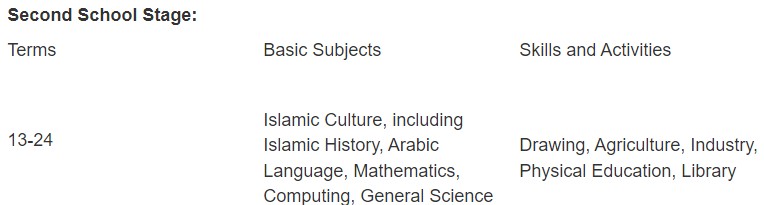
The “General Sciences” subject in this stage includes principles of chemistry, biology, physics and geography.
Third School Stage:
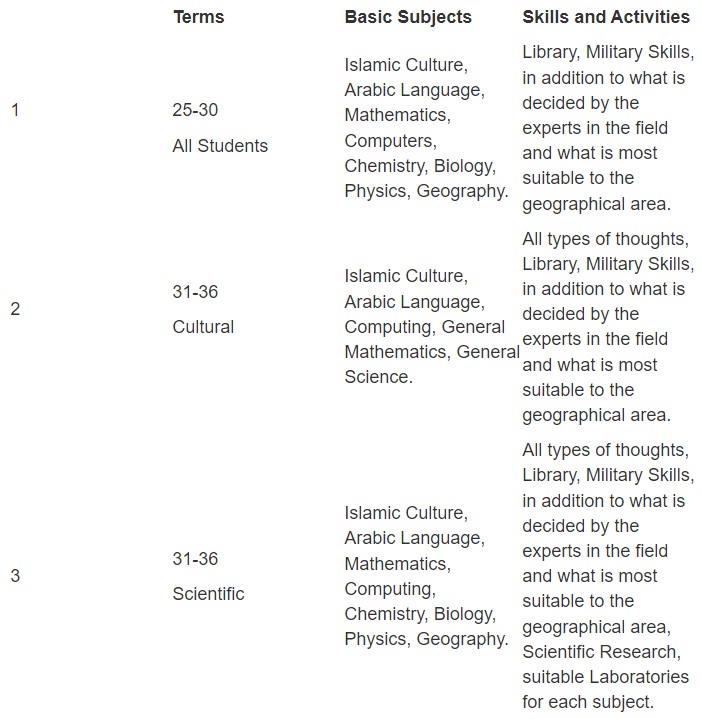
This stage covers the terms 25 to 36. In this stage, all students participate in the same study subjects in terms 25 to 30 only. Thereafter, in terms 31 to 36 students join the optional branches (furoo’) they prefer. These options are:
- Cultural Option - Scientific Option - Industrial or Technical Option (computing, mechanics, electrical, communications, cartography etc.)
- Agricultural Option - Commerce Option - Domestic Option (for females)
The following chart shows the subjects studied in each of these options:
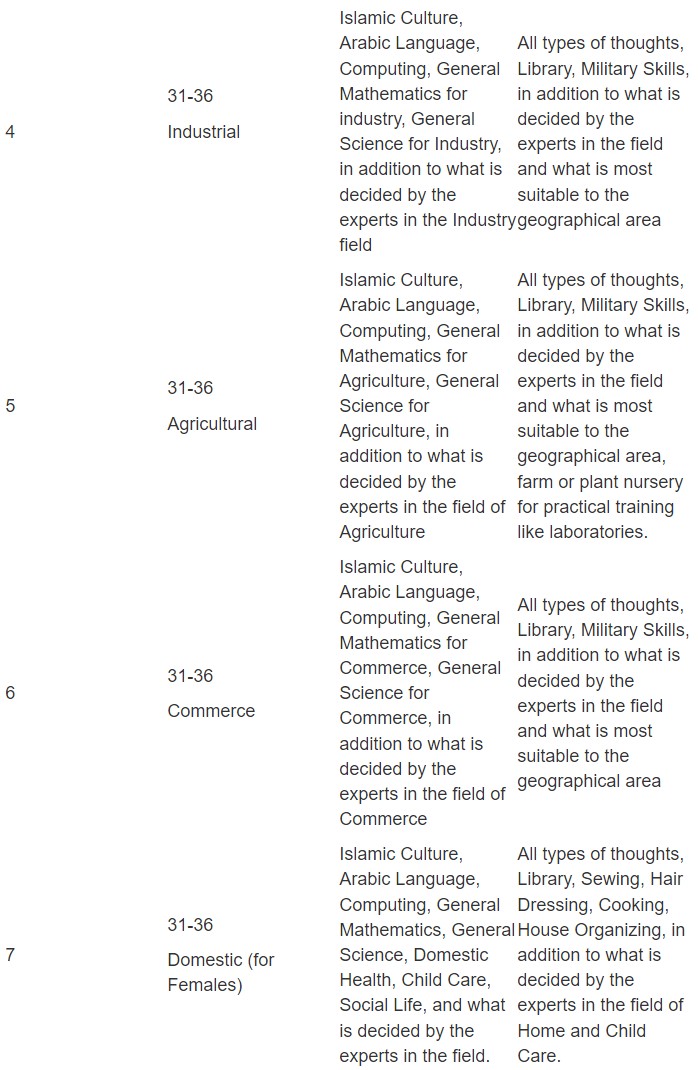
In the cultural option of the third school stage, the student takes extended topics in both Islamic Culture and Arabic Language. Experts determine the requirements in the subjects of Fiqh, Usul, Tafseer, '‘Ulum Al-Hadith, History and other Islamic culture options. Likewise, they adopt specific courses (manaahij) in the Arabic language options required for this stage such as Eloquence (Balagha), Literature texts etc.
In non-scientific options, the student takes Mathematics and Sciences in a concise form with focus paid only to the topics required for their option. Thus the Commerce option student takes Mathematics topics related to Commerce e.g. Accounting, Zakat and Inheritance Accounts, Profits and Loss Accounts together with Bookkeeping and Cashbook Accounts; likewise he/she takes topics in Statistics. Whereas the Industrial option student takes topics specific to Industry such as Geometrical Drawing, Shapes, Area and Volume Calculation etc.
The General Sciences student of the non-scientific option takes topics focusing upon studies of the Human Body, Diseases, Public Safety as well as scientific topics related to man and his environment. In the agricultural option, topics related to agriculture and nutrition are added such as methods of Plant Agriculture, their diseases and treatment, types of soil, fertilisers, insecticides etc.
The Industrial option student takes subjects related to the science of materials and their attributes such as Density and Mass, together with the principles of Mechanical Dynamics and Public Safety.
Experts adopt what the student requires in each school stage and each option of the third school stage.