Quran Course
All BooksDownloads
All BooksDownloadsSystem Of Islam
Also visitSystem Of Islam
Built with love by StudioToronto.ca
Quran Course
All BooksDownloads
All BooksDownloadsSystem Of Islam
0%
Understanding Usul Al-Fiqh2 min readViewed 2 times

4.3 Basic Terms in Hadith


• Sanad: ( ع ٕذ ) A chain of reporters leading back to the Prophet (saw).

• Tabaqah: (غرمس ) A class of reporters in the same generation, i.e. Sahabah, Tabi‟een.

• Marfu‟: ( شِفٛع ) A Hadith whose Sanad leads to the Prophet (saw).

• Mawquf: (ِٛلٛف ) A Hadith whose Sanad ends with a Sahabi.

• Mursal: (شِعً ) A Hadith leading to the Prophet (saw) but missing the name of the Sahabi who reported it.

• Qudsi: (لذعٟ ) A Hadith whose Sanad leads to Prophet (saw) and the Prophet (saw) is reporting it from Allah (swt).

The report of Hadith Qudsi can begin in one of two ways:

a) The Prophet (saw) says reporting from Allah (swt).

b) Allah (swt) has said as reported by His Messenger (saw).

Types of Hadith:

Different types of Ahadith exist due to the method of transmission, number of reporters in each class, and the authenticity of the Hadith.
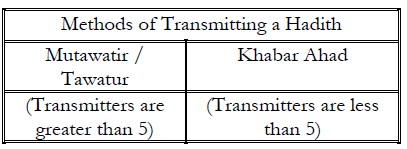
Mutawatir / Tawatur: a Daleel transmitted by an indefinite number of people. Due to the large number of people reporting the Daleel and their diversity of residence, reliability, and conviction, it is inconceivable that this Daleel could be fabricated.

The minimum number of transmitters that are required to classify a Daleel as Mutawatir is generally five. However, some scholars may have more stringent criteria. The character of the reporters narrating Mutawatir Ahadith has to be noble.

Ahad: (آقحد ) Riwayah Ahad is a number less than the Mutawatir.
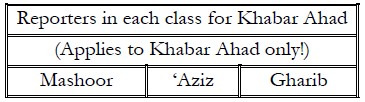
Mashoor: A Hadith reported by at least three individuals in every class (Sahabah, Tabi‟een, etc.).

„Aziz: A Hadith reported by at least two individuals in every class.

Gharib: A Hadith reported by only one individual in one or more classes.
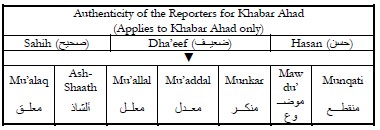
Sahih:

A Hadith narrated by an „Adl (not known for misconduct) and Daabit (maintains accuracy of the report) person from another person of similar qualities until the end of the report. The report should also exclude any Shudhudh (disagreement with other credible reporters).

Hasan:

It has two definitions:

a) A Hadith, which meets the requirements of Sahih to a lesser degree.

b) A Hadith, which is acceptable by the majority of the Fuqaha.

Dha‟eef:

A weak Hadith which does not meet the requirement of either the Sahih or the Hasan Hadith, it can be one of the following:

Mu‟alaq: A Hadith which is missing one or more reporters either at the beginning of the Isnad, in the middle or in the end.

Mu‟addal: Hadith which is missing two or more consecutive reporters.

Munqati: A Hadith which has interruption in the class.

Ash-Shaath: A Hadith in which one credible reporter reports something that disagrees with other credible reporters.

Mu‟allal: A Hadith whose Sanad seems to be fine, but due to some reasons discovered by scholars, it is discredited.

Munkar: A Hadith in which non-credible reporters convey a message, which is in disagreement with what, was reported by credible reporters.

Mawd‟u: A fabricated Hadith.

← Previous chapterNext chapter →
Chapters (80)
  1. 1Introduction to this edition
  2. 2Introduction
  3. 31. Basic Terms In Islamic Jurisprudence
  4. 41.1 Fiqh
  5. 51.2 Usul Al-fiqh
  6. 61.3 Shari‟ah
  7. 71.4 Hukm Shara‟i
  8. 81.5 Types Of Hukm Shara‟i
  9. 91.6 The Application Of Shar‟iah
  10. 102. Daleel
  11. 112.1 Structure of Daleel
  12. 123. Qur‟an
  13. 133.1 Revelation of the Qur‟an
  14. 143.2 Arrangement of the Qur‟an
  15. 153.3 Compilation of the Qur‟an
  16. 163.4 Open & Hidden meaning?
  17. 173.5 The Muhkamaat (clearcut) and Mutashaabihaat (ambiguous)
  18. 183.6 Asbaab An-nuzool (circumstances Of Revelation)
  19. 193.7 Abrogation (Naskh)
  20. 204. Sunnah
  21. 214.1 The Sunnah Is A Definitive Source
  22. 224.2 Types of Sunnah
  23. 234.3 Basic Terms in Hadith
  24. 244.4 Reconciling a perceived conflict between two or more Ahadith
  25. 254.5 The Application of the Sunnah
  26. 265. Ijma‟ as-Sahabah
  27. 275.1 The meaning of Ijma‟
  28. 285.2 Examples of Ijma‟ as-Sahabah
  29. 295.3 Daleel indicating the Authority of Ijma‟ as-Sahabah
  30. 305.4 Who is a Sahabi?
  31. 316. Qiyas
  32. 326.1 The meaning of Qiyas
  33. 336.2 Daleel indicating the Authority of Qiyas
  34. 346.3 The Process of Qiyas
  35. 356.4 The Arguments of those who reject Qiyas
  36. 366.5 „Illah from the Text or the Mind?
  37. 376.6 The areas of Ahkam Shari‟ah which do not contain „Illah
  38. 386.7 Types of Ahkam Shariah where an „Illah can be found
  39. 396.8 Customs and traditions cannot be an „Illah
  40. 406.9 Difference between Manaat al-Hukm (reality of the rule) and „Illah
  41. 417. Sources of Hukm Shar‟i not agreed upon by all the Ulema
  42. 427.1 Ijma‟ al Ummah
  43. 437.2 Ijma‟ al Mujtahideen
  44. 447.3 Ijma‟ Ahlel Bayt
  45. 457.4 Ijma‟ Ahlel Medinah
  46. 467.5 Istihsan
  47. 477.6 Masalih Al Mursalah
  48. 487.7 Laws revealed before Islam (Shar‟a man qablana)
  49. 498. Ijtihad
  50. 508.1 Evidences for Ijtihad from the Sunnah
  51. 518.2 Evidences For Ijtihad From Ijma As-sahabah
  52. 528.3 Qualifications for performing Ijtihad
  53. 538.4 Types of Mujtahid
  54. 548.5 Reasons for differences of opinion among the Mujtahideen
  55. 559. A Brief Overview of Some Schools of Thought
  56. 569.1 Era of the Prophet (Saw)
  57. 579.2 Era of the Sahabah (ra)
  58. 589.3 Era of the Tabi‟een
  59. 599.4 Madhab of Imam Abu Hanifah
  60. 609.5 Madhab of Imam Malik
  61. 619.6 Madhab of Imam Shafi‟i
  62. 629.7 Madhab of Imam Ahmad Ibn Hanbal
  63. 639.8 Madhab of Ibn Hazm
  64. 649.9 Introduction to Madhab of Imam Zayd and Imam Jafar
  65. 6510. Do We Need a New School or Madhab?
  66. 6610.1 Reason for Differences of Opinion among the Mujtahideen
  67. 6711. Taqleed
  68. 6811.1 Daleel for performing Taqleed
  69. 6911.2 Muslims must ask for Daleel
  70. 7011.3 Taqleed is forbidden in the „Aqeedah (Belief)
  71. 7111.4 Muqalid shifting from one Opinion to Another
  72. 7212. Topics Related To Islamic Jurisprudence
  73. 7312.1 Wahy (Revelation)
  74. 7412.2 Role of „Aql
  75. 7512.3 Does the Shariah Apply on Non-Muslims?
  76. 7612.4 Was Prophet Muhammed (saw) A Mujtahid?
  77. 7712.5 Can Fiqh Be Changed?
  78. 7812.6 Need for a Minority Fiqh?
  79. 79Conclusion
  80. 80Bibliography