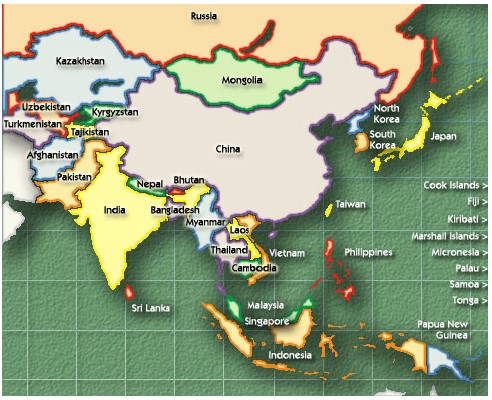
In China’s 5000 year history it has never been a superpower and has never influenced the global balance of power. Even when it adopted Communism it never carried this beyond its borders and never influenced any of the regions of the world. Much of China's 5000 year history is composed of internal wars and struggles in order to unify the homeland. China’s foreign policy is centred on domestic economic development and procuring all the necessary raw materials to achieve such aims. China has challenged America’s containment policy by attempting to weaken the nations the US is attempting to use to contain China. This is through using trade and developing bilateral ties to loosen US relations with the likes of Australia, India, Japan and South Korea.
Due to this reality China has focussed on its region and as of yet has shown little ambition beyond the region. China’s string of pearls policy is its first venture beyond the region. The policy was described by the US government as follows: “The “String of Pearls” describes the manifestation of China’s rising geopolitical influence through efforts to increase access to ports and airfields, develop special diplomatic relationships, and modernize military forces that extend from the South China Sea through the Strait of Malacca, across the Indian Ocean, and on to the Persian Gulf.”10 The sea lines run through the strategic choke points of Strait of Mandab, Strait of Malacca, Strait of Hormuz and Strait of Lombok as well as other strategic naval interests along Pakistan, Sri Lanka, Maldives and Somalia. All of these are key strategic routes for oil and gas and will inevitably lead to a clash with the US.
China currently has shown little global ambition in constructing an alternative global system. It has in fact amalgamated into America’s global system of trade - WTO, security – United Nations and finance – IMF and the World Bank. China appears to be working to achieve its interests from the existing system rather than attempting to replace it. With such a narrow view China will politically never be able to challenge the US. If China has any plans to become the world superpower then it will not just need to challenge the US, but solve a number of domestic issues which would otherwise cause a massive fracture domestically, these include:
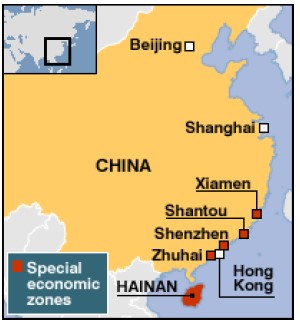
- China’s development is rooted in Deng Xiaoping’s attempts at creating special economic zones (SEZ) which allowed foreign investment and technology and became a new source of wealth. China today is an export oriented economy and dependent on foreign countries to continue importing from it. Therefore whatever the size of China’s currency reserves, no matter how cheap its labour force or its technological developments, China relies on foreign nations to import from it and physically ship them – A naval blockade would cripple China. The world imports from China at the cost of closing down their own factories, as long as no other nation produces the worlds goods cheaper than China, China will remain the world’s workshop. China today is the world’s industrial workshop; it remains totally dependent on the world to continue buying from it rather than anyone else, this is a very fragile model of development.
- Being the world’s Industrial factory has lead to economic development and created immense wealth. However on its own this does not turn a nation into a world power. Whilst China has become the world’s factory, this is all at the lower end of the technology ladder. The Atlantic monthly writer James Fallows spent a year in China, watching the nation’s industrial machine up close. He compared China’s current manufacturing capability to the U shaped smile on a happy face , he illustrated the development of a product, from its initial conception to its eventual sale. At the top left of the curve there is the initial idea and industrial design, the products details and how it will eventually look and work. Lower down the on the curve is the detailed plan by an engineer. At the bottom of the curve is the manufacturing, assembly and shipping. Then rising up on the right of the curve is the distribution, marketing, retail, sale, service contracts, parts and accessories. Fallows observed that in almost all the manufacturing industry in China, China takes care of the bottom of the curve and the US the top. “The simple way to put this – that the real money is in the brand name, plus retail.”11 The ends of the U is where the money is and the US dominates this area globally. China is fast going down the road Japan ended in. Throughout the 1980’S Japan was meant to overtake the US economy and replace it as the world’s superpower, similar to China it became the worlds industrial factory, in the end the Asian financial crisis of 1997 proved the fallacy of what an export led policy actually leads to.
China’s rapid economic development has been anything but equal. The Special Economic Zone’s (SEZ) were all constructed on China’s Eastern coast and everything that comes of the production line is placed on ships as cargo and exported to the world. The coastal region as a result is interlinked with the global economy; it has seen most of China’s rapid development and enriched a new breed of merchants, all at the expense of the rest of China. Most of China today remains largely agrarian, has little infrastructure and lives in poverty. This has created China’s massive internal cohesion problem.