USA In A Post American World
13 federal states of North America formed United States of America in 1776 after defeating Britain in the American war of independence. Through manifest destiny the USA expanded until nearly 50 states became part of the union. The American civil war of 1865 sealed the destiny of the nation and its economic system. The armament needs of the civil war laid the groundwork for the modern US industrial economy. War needs had enormously stimulated manufacturing, speeding an economic process based on the exploitation of iron, steam, and electric power, as well as the forward march of science and invention. Since the middle of the 1880’s the USA has been the world’s largest economy every year.
The US turned from a nation of immigrants in the North American continent to a nation today that produces more wealth then the next four nations combined. Militarily the US dominates the world and controls the world’s oceans. Politically the US is involved in most international issues and disputes. US companies dominate most sectors of the global economy and US brands and symbols are some of the most recognised across the globe.
America emerged a world power as WW2 drew to a close. US participation in the Pacific zone of the conflict and its ability to produce on mass industrial machinery and military equipment for the allies was decisive in bringing the war to its conclusion when Britain had been completely consumed due to the German war effort. The US occupied Japan with half a million of its troops and shared the occupation of Germany with Russia and Britain.
War historically has been central to America’s development. George Friedman outlined this in his book: The Next 100 Years: “Virtually every other industrialised power in the world experienced devastating warfare in the 20th century. The United States waged war, but America itself never experienced it. Military power and geographical reality created an economic reality. Other countries have lost time recovering from wars. The United States has not. It has actually grown because of them.”2
It was the United States that constructed the post war world. Having used the most technologically advanced invention at the time – nuclear weapons, to bring to an end in one stroke to WW2, America was well placed to dictate the terms of the post war world, only the Soviet Union presented any obstacle. Whilst the Yalta conference in 1945 distributed the spoils amongst the victors the Bretton Woods conference created the International Monetary Fund, the World Bank and the General Agreement on taxes and Tariffs (GATT), it also made the Dollar the world’s reserve currency – all this institutionalised US influence, which Europe accepted as it was devastated by the war. The Brookings institute confirmed in a report: "The United States has viewed all multilateral organisations including the World Bank, as instruments of foreign policy to be used in support of specific US aims and objectives…US views regarding how the world economy should be organised, how resources should be allocated and how investment decisions should be reached were enshrined in the Charter and the operational policies of the bank."3
As the post –WW2 architecture was being constructed a new war was beginning – the cold war. The US and the USSR competed with each other, the US rather then deconstructing both Japan and Germany decided to turn them into successful Capitalist nations as a counter weight to the expansion of Communism. Whilst Europe received aid through the Marshall plan for reconstruction, Japan and Germany for decades received access to US technology which significantly aided their rapid economic development.4
The Cold War resulted in numerous military developments which the US led in its arms and space race with the Soviet Union. The US created the Western bloc which consisted of most of the liberal democracies around the world as a counter weight to the Eastern bloc. This allowed the US to disseminate its culture around the world. Hollywood became central to the American way of life infiltrating the minds of the global audience. The US consumer became idolised for the American dream that could be pursued and American philosophers and thinkers led the way on political and philosophical ideas.
Post – Americanism
At the end of the 20th century the US was the unrivalled world power, having defeated Communism, established NATO as the world’s default security organisation and dominated the world economy, it was considered very likely that the world would be writing and printing about US prowess for decades to come.
The US in the 21st century however is a very different global power to the one of the 20th century.
Today America is bleeding from two open wounds in Iraq and Afghanistan that show no signs of abating. Both wars have now lasted longer than WW2. The US army, the most technologically advanced in history has been unable to defeat a band of fighters using weapons developed in the 1960’s. As a result it has to rely on a variety of surrogates to avoid embarrassment. The Iraq and Afghan wars and the fact that the US has been unable to extricate itself has been compared to the Boer war of 1899, which is considered the beginning of the end of the British empire. The details of the war bear a similar resemblance to the US in Iraq and Afghanistan.
Boer War
After successfully concluding the war of Omdurman in Sudan where the British army was outnumbered two to one. Britain just like the US presented their reasons for the war, the Empire argued the rights of the English speaking people, who were treated as second class citizens had to be protected. In reality the Boers – farmers, resided over diamond fields and with the discovery of Gold in 1886, many foreigners hurried to what is today South Africa to participate in its Gold rush. In 1899 the Boer area of South Africa was producing 25% of the world’s gold.
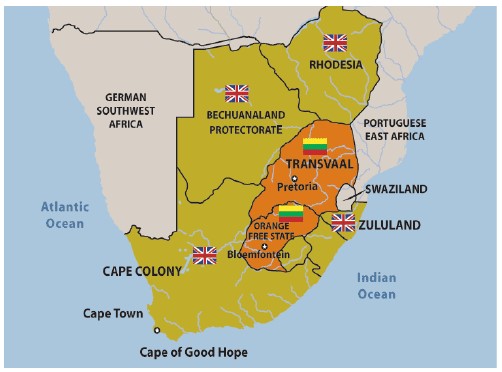
The Empire faced around 45,000 farmers the Transvaal and the Orange Free State who knew how to defend their land, they had the support of most of the indigenous population and utilised guerrilla tactics which was impossible to contain when the British Empire had such a large army on the ground. As a result the Empire resorted to brutal tactics that included burning down whole villages, creating concentration camps for the population and resorting to summery executions.
The Boers held out until 1902 when they eventually surrendered. Whilst Britain actually won the war as they defeated the enemy in reality they had lost. By the wars end Britain had 450,000 troops on the ground fighting a mere militia of 45,000. Britain lost 45,000 troops and had massively overspent in the war effort and has stretched its military to breaking point. However its brutal tactics undermined the British cause forever at home and abroad. Whilst all the powers of the day exposed British tactics, domestically Britain’s role in the world was questioned when you kill the masses in order to give them freedom.
Fast forward to today and the similarities are striking, the US lied about weapons of mass destruction, and quick victory gave way to long occupations, which has seen corruption and incompetence at the highest level. The cost to the US has been massive and continues. Guantanamo bay has undermined America’s chief export for over a quarter of a century – human rights. Similarly the US military is viewed as overstretched and America’s position is seen as untenable.
Aside from America’s wars, the US is facing numerous challenges in different regions of the world which only a decade ago it completely dominated. The world is moving away from the US as the uni-polar power who enjoys uncontested hegemony to a multi-polar world where other nations are challenging US prowess. The US is finding that it now has to share the world’s oil with other powers whose appetite shows no sign of slowing down anytime soon. China, India, Japan and the European Union are all competing for the world’s oil, which the US has virtually controlled for decades. Whilst the US economy is the world’s largest economy its share of the global economy is shrinking as nations such as China, India, Brazil, Japan, Mexico, Turkey and Russia continue their rapid growth.
American symbols are also being rapidly replaced. Today the tallest building is in Dubai, not America, the world’s richest person is no longer an American but a Mexican. The world’s largest traded company is in China and the world’s largest plane was constructed by Russia and Ukraine. London is the world’s largest financial centre and the worlds largest Sovereign Wealth Fund (SWF) is in the UAE, not New York. Beijing has the world’s largest mall, whilst the US only has one mall in the word’s top ten. The world’s biggest movie industry is longer Hollywood, but is now Bollywood in India. Similarly the world’s largest ferris wheel is in Singapore, whilst the world’s largest Casino is in Macao. Only 10 years ago the US was at the top of all of these lists.