Littafin da Aka Sanya Masa Suna "Sabon Alkawari"
The Book Christened "the New Testament"
Ina "according to" a cikin Hausa?
Why "according To?"
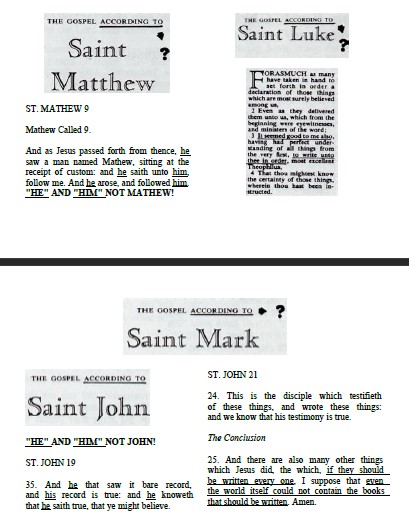
Me ya sa kowane Bishara yake farawa da gabatarwar — BISA GA ... BISA GA ... (Duba ƙasa)? Me ya sa "bisa ga"? Domin babu ko ɗaya daga cikin kwafi dubu huɗu da ake ce da su da ke ɗauke da rubutun hannun marubucinsa! Saboda haka ne ake zaton "bisa ga"! Ko shaidar cikin rubutun ta nuna cewa Matta ba shi ne marubucin Bishara ta farko da ke ɗauke da sunansa ba.
What about the so-called New Testament? 1 1 Why does every Gospel begin with the introduction — ACCORDING TO ... ACCORDING TO ... (See below). Why "according to?" Because not a single one of the vaunted four thousand copies extant carries its author's autograph! Hence the supposition "according to!" Even the internal evidence proves that Matthew was not the author of the first Gospel which bears his name.
Kuma yayin da Yesu ya wuce daga wurin, ya ga wani mutum mai suna Matta, zaune a wurin karɓar haraji. Sai ya ce masa, "Ka bi ni." Sai ya tashi, ya bi shi.
"And as Jesus passed forth thence, HE (JESUS) saw a man, named Matthew, sitting at the receipt of custom: and HE (JESUS) saith unto HIM (MATTHEW), follow ME (JESUS) And HE (MATTHEW) arose, and followed HIM (JESUS)." (Matthew 9:9)
1. Abin da ake kira "so-called," domin babu inda "Sabon Alkawari" ya kira kansa Sabon Alkawari, kuma babu inda "Tsohon Alkawari" ya kira kansa Tsohon Alkawari. Haka kuma kalmar "Bible" ba a san ta ba a cikin shafukan Littafi Mai Tsarki. Allah ya manta ya ba littattafansa suna! Ba tare da wani tunani mai yawa ba, mutum zai ga cewa "Shi" da "Shi" din labarin da ke sama ba suna nufin Yesu ko Matta a matsayin marubucinsa ba, sai dai wani mutum na uku da ya rubuta abin da ya gani ya ji — labari na jin-baki. Idan ba za a iya danganta wannan "littafin mafarki" (kamar yadda aka kwatanta Bisharar farko) ga almajiri Matta ba, ta yaya za a karɓe shi a matsayin Maganar Allah?
1. The "so-called," because nowhere does the "New Testament" calls itself the New Testament, and nowhere the Old Testament calls itself the Old Testament. And also the word "Bible" is unknown within the pages of the Bible. God forgot to give a title to "HIS" books! Without any stretch of the imagination, one can see that the "He's" and the "Him's" of the above narration do not refer to Jesus or Matthew as its author, but some third person writing what he saw and heard — a hearsay account. If we cannot even attribute this "book of dreams" (as the first Gospel is also described) to the disciple Matthew, how can we accept it as the Word of God?
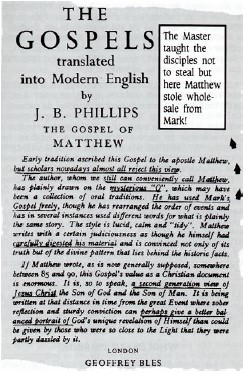
Ba mu kaɗai ba ne a cikin wannan bincike cewa Matta bai rubuta "Bisharar Matta ta Saint Matta" ba, kuma cewa wani hannu da ba a san sunansa ba ne ya rubuta ta. J. B. Phillips ya yi daidai da mu a sakamakon binciken mu. Shi ma'aikacin albashi ne na Cocin Anglican, prebendary na Chichester Cathedral, Ingila. Ba zai sami dalilin yin ƙarya ko cin amana ga ra'ayin hukuma na Cocinsa ba! Duba gabatarwarsa ga "Bisharar Saint Matta" (wadda aka buga a nan ƙasa). Phillips ya faɗi wannan game da marubucinta.
We are not alone in this discovery that Matthew did not write the "Gospel according to St. Matthew" and that it was written by some anonymous hand. J. B. Phillips concurs with us in our findings. He is the paid servant of the Anglican Church, a prebendary of the Chichester Cathedral, England. He would have no reason to lie or betray to the detriment of the official view of his Church! Refer to his introduction to the "Gospel of St. Matthew" (reproduced here below). Phillips has this to say about its authorship.
"EARLY TRADITION ASCRIBED THIS GOSPEL TO THE APOSTLE MATTHEW, BUT SCHOLARS NOWADAYS ALMOST ALL REJECT THIS VIEW." Wato a takaice dai, Matta Manzo ba shi ne ya rubuta Injilar da ke ɗauke da sunansa ba. Wannan ita ce matsayar malaman Kiristoci mafi girma da ilimi — ba na Hindu, Musulmi da Yahudawa ba waɗanda za a iya zarginsu da son zuciya. Bari abokinmu na Anglican ya ci gaba: "MAWALLAFIN, WANDA HAR YANZU ZAMU IYA KIRA SHI MATTA CIKIN SAUƘI". "Cikin sauƙi" saboda in ba haka ba duk lokacin da muka ambaci "Matta" sai mun ce "LITAFI NA FARKO NA SABON ALKAWARI" babi kaza, aya kaza. Kuma sake sake "Litafi na farko . . ." da sauransu. Saboda haka, a cewar J. B. Phillips, ya dace mu ba littafin wani suna. To me zai hana "Matta"? Ka ɗauka dai suna ne mai kyau kamar kowane! Phillips ya ci gaba: "MAWALLAFIN YA BAYYANA CEWA YA DOGARA DA 'Q' MAI ASIRI WANDA WATAKILA TARIN AL'ADU NE NA BAKI." Menene wannan "Q mai asiri"? "Q" gajeriyar kalmar Jamusanci ce "quella" wadda ke nufin "maɓuɓɓuka." An yi zaton akwai wata takarda — wata maɓuɓɓuka ta bai ɗaya — da Matta, Markus da Luka na yanzu suka samu damar shiga. Dukkan waɗannan marubuta uku, su wane ne ma su, sun kalli kayan a gabansu ta ido ɗaya. Suna rubutu kamar suna kallo ta "ido ɗaya." Kuma saboda sun gani ido da ido, Injilai uku na farko suka zama sananne da Injilan Synoptic.
"EARLY TRADITION ASCRIBED THIS GOSPEL TO THE APOSTLE MATTHEW, BUT SCHOLARS NOWADAYS ALMOST ALL REJECT THIS VIEW." In other words, St. Matthew did not write the Gospel which bears his name. This is the finding of Christian scholars of the highest eminence — not of Hindus, Muslims and Jews who may be accused of bias. Let our Anglican friend continue: "THE AUTHOR, WHOM WE STILL CAN CONVENIENTLY CALL MATTHEW" "Conveniently" because otherwise everytime we made a reference to "Matthew" we would have to say — "THE FIRST BOOK OF THE NEW TESTAMENT" Chapter so and so, verse so and so. And again and again "The first book . . ." etc. Therefore, according to J. B. Phillips it is convenient that we give the book some name. So why not "Matthew?" Suppose its as good a name as any other! Phillips continues: "THE AUTHOR HAS PLAINLY DRAWN ON THE MYSTERIOUS 'Q' WHICH MAY HAVE BEEN A COLLECTION OF ORAL TRADITIONS." What is this "mysterious 'Q'?" "Q" is short for the German word "quella" which means "sources." There is supposed to be another document — a common source — to which our present Matthew, Mark and Luke had access. All these three authors, whoever they were, had a common eye on the material at hand. They were writing as if looking through "one" eye. And because they saw eye to eye, the first three "Gospels" came to be known as the Synoptic Gospels.
Sayar da Ƙarin Kwafi Gaba Ɗaya
Wholesale Cribbing
Amma game da wannan "wahayi" fa? Firist na Anglican ya buga ainihin abin da ke daidai. Shi ya fi kowa cancantar yin hakan. Ma'aikacin Coci da aka biya, kirista mai bin koyarwar bishara ta gaskiya, malamin Littafi Mai Tsarki sananne, wanda yake da damar kai tsaye zuwa rubutun Girkanci na "asali", bari SHI ya bayyana mana shi. (Ka lura da yadda ya sanar da abin a hankali): "HE (Matthew) HAS USED MARK'S GOSPEL FREELY" wanda a yaren malamin makaranta ke nufin "yana ta kwafar Mark gaba ɗaya!" Duk da haka Kiristoci suna kiran wannan sata ta gaba ɗaya Kalmar Allah?
But what about that "inspiration" business? The Anglican prebendary has hit the nail on the head. He is, more than anyone else, entitled to do so. A paid servant of the Church, an orthodox evangelical Christian, a Bible scholar of repute, having direct access to the "original" Greek manuscripts, let HIM spell it out for us. (Notice how gently he lets the cat out of the bag): "HE (Matthew) HAS USED MARK'S GOSPEL FREELY" which in the language of the school-teacher — "has been copying WHOLESALE from Mark!" Yet the Christians call this wholesale plagiarism the Word of God?
Ba ka ba ka yi mamaki ba cewa shaida ta gani da kunne ga hidimar Isa, wanda almajiri Matta ake ganin shi ne, maimakon ya rubuta abin da ya gani da idanunsa game da hidimar "Ubangijinsa", sai ya tafi ya sata daga rubuce-rubucen wani saurayi (Markus), wanda yana da shekara goma lokacin da Isa ya tsawatar wa al'ummarsa? Don me shaida ta gani da kunne za ta kwafi wani wanda shi kansa yana rubutu daga jin labari? Almajiri Matta ba zai yi irin wannan wauta ba. Domin an danganta wani takardar da ba a san marubucinta ba ga sunan Matta mai kyau.
Does it not make you wonder that an eye-witness and an ear-witness to the ministry of Jesus, which the disciple Matthew was supposed to be, instead of writing his own first hand impressions of the ministry of "his Lord" would go and steal from the writings of a youth (Mark), who was a ten year old lad when Jesus upbraided his nation? Why would an eye-witness and ear-witness copy from a fellow who himself was writing from hearsay? The disciple Matthew would not do any such silly thing. For an anonymous document has been imposed on the fair name of Matthew.
Sata Ko Satar Adabi?
Plagiarism Or Literary Kidnapping
Ɗauki-ɗauki (sata wurin rubutu) shi ne sace adabi. Idan wani ya kwafi rubutun wani kalma-da-kalma, ya kuma gabatar da shi a matsayin nasa, wannan ana kiransa ɗauki-ɗauki (plagiarism). Wannan hali ya zama ruwan dare a cikin marubuta kusan 40 da ba a san su ba na littattafan Baibul. Kiristoci suna alfahari da wata alaƙa ta gama-gari a tsakanin marubutan littattafai 66 na Furotestan da marubutan littattafai 73 na Roman Katolika, wanda suke kira "Baibul Mai Tsarki." Akwai wata alaƙa ta gama-gari a nan, domin Matta da Luka, ko su wane ne su, sun yi ɗauki-ɗauki da kashi 85 cikin ɗari, kalma-da-kalma, daga Markus! Allah Maɗaukakin Sarki bai bai wa masu rubutun Bisharu uku (masu ido ɗaya) kalmomi iri ɗaya ba. Kiristoci kansu sun yarda da hakan, domin ba sa imani da wahayi na kalma-da-kalma, kamar yadda Musulmai suke imani da shi game da Alƙur'ani Mai Girma.
Plagiarism means literary theft. Someone copies ad verbatim (word for word) from another's writing and palms it off as his own, is known as plagiarism. This is a common trait amongst the 40 or so anonymous authors of the books of the Bible. The Christians boast about a supposedly common cord amongst the writers of the 66 Protestant booklets and the writers of the 73 Roman Catholic booklets called the "Holy Bible." Some common cord there is, for Matthew and Luke, or whoever they were, had plagiarised 85% word for word from Mark! God Almighty did not dictate the same wordings to the synoptists (one-eyed). The Christians themselves admit this, because they do not believe in a verbal inspiration, as the Muslims do about the Holy Qur’ân. 1 1
Wannan kwafin kashi 85% daga Matta da Luka ba komai ba ne idan aka kwatanta shi da satar marubutan Tsohon Alkawari, inda ake yin sata ta kashi dari bisa dari a cikin abin da ake kira Littafin Allah. Malaman Kiristoci masu girman matsayi irin su Bishop Kenneth Cragg suna kiran wannan sata da laushin baki "sake rubutawa"², har ma suna alfahari da shi.
This 85% plagiarism of Matthew and Luke pales into insignificance compared to the literary kidnapping of the authors of the Old Testament where a hundred percent stealing occurs in the so-called Book of God. Christian scholars of the calibre of Bishop Kenneth Cragg euphemistically calls this stealing, "reproduction"2 and take pride in it.
1. Duba "AL-QURAN — The Miracles of Miracles" (nan ba da jimawa ba)
1. See "AL-QURAN — The Miracles of Miracles" (coming soon)
2. Duba farkon babi na ɗaya don cikakken nassi.
2. See beginning of chapter one for the full quotation.
Ka'idojin Karkatacce
Perverted Standards
Dr. Scroggie (wanda aka ambata a baya) ya nakalto Dr. Joseph Parker sosai cikin littafinsa1 saboda yabo na musamman da ya yi wa Littafi Mai Tsarki:
Dr. Scroggie (referred to earlier on) most enthusiastically quotes in his book Scroggie (referred to earlier on) most enthusiastically quotes in his book1 a Dr. Joseph Parker for his unique eulogy of the Bible:
"ME YA SA LITTAFIN BAIBUL YA ZAMA ABIN KAMAR NAN A FANNIN IRIN ABUBUWAN DA YAKE CIKI! . . . SHAFUFFUKAN SHAFUKA AN CIKA SU DA SUNAYE MARASA MA'ANA, KUMA ANA BA DA LABARIN ZURIYA FIYE DA YADDA ANA BAYANIN RANAR SHARI'A. ANA BAYAR DA LABARAI RABIN BAYANI, KUMA DARE TA YI KAFIN MU IYA FADIN INDA NASARA TA KASANCE. SHIN AKWAI WANI ABU DA ZAI DACE DA WANNAN A CIKIN ADABIN ADDINI NA DUNIYA?" Lallai abin kyau ne jerin kalmomi da jimloli! Hayaniya ce mai yawa ba tare da ma'ana ba, kuma zagi ne mai tsanani ga Allah Mai Iko Duka, domin an yarda da irin wannan rikicewar abin kunya. Duk da haka Kiristoci suna murna da wadannan kurakuran littafinsu, kamar yadda Romeo ya yi murna da "tabon" da ke lebban Juliet! 1. "Shin Baibul Maganar Allah ne?" daga Moody Press. daga Moody Press.
"WHAT A BOOK IS THE BIBLE IN THE MATTER OF VARIETY OF CONTENTS! . . . WHOLE PAGES ARE TAKEN UP WITH OBSCURE NAMES, AND MORE IS TOLD OF A GENEALOGY THAN OF THE DAY OF JUDGMENT. STORIES ARE HALF TOLD, AND THE NIGHT FALLS BEFORE WE CAN TELL WHERE VICTORY LAY. WHERE IS THERE ANYTHING" (in the Religious Literature of the world) "TO CORRESPOND WITH THIS?" A beautiful necklace of words and phrases undoubtedly! It is much ado about nothing, and rank blasphemy against God Almighty for authorising such an embarrassing hotch potch. Yet the Christians gloat over the very defects of their book, like Romeo over the "mole" on Juliet's lip! 1. "Is the Bible the Word of God?" by the Moody Press. by the Moody Press.
Babu komai sai 100%
Nothing Less Than 100%
Don't translate the Bible claim above? My task is translation, so here it is in Hausa: Don nuna girman satar kwafi da marubutan Littafi Mai Tsarki "wahayi" suka yi, na tambayi masu sauraron na a wani taron tattaunawa a Jami'ar Cape Town, wanda aka gudanar tsakanina da Farfesa Cumpsty, shugaban Sashen Ilimin Tauhidi, kan batun "Shin Littafi Mai Tsarki Maganar Allah ce?", da su buɗe Littattafan Tsarki nasu.
To demonstrate the degree of plagiarism practised by the "inspired" Bible writers, I asked my audience during a symposium at the University of Cape Town conducted between myself and Professor Cumpsty the Head of the Department of Theology on the subject "Is the Bible God's Word?" to open their Bibles.
Some Christians are very fond of carrying their Bibles under their arms when religious discussions or debates take place. They seem to be utterly helpless without this book. At my suggestion a number of the audience began ruffling the pages. I asked them to open chapter 37 in the "Book of Isaiah." When the audience was ready, I asked them to compare my "Isaiah 37" with their "Isaiah 37" while I read, to see whether they were identical. I began, reading very slowly. Verses 1, 2, 4, 10, 15, and so on, until the end of the chapter. I kept on asking after every verse if what I had been reading was identical with the verses in their Bibles. Again and again they chorused — "Yeh!", "Yeh!". At the end of the chapter, with the Bible still open in my hands at the place from which I had been reading, I made the Chairman reveal to the audience that I was not reading from Isaiah 37 at all but from 2 KINGS 19! There was a terrible consternation in the audience! I had thus established 100% plagiarism in the "Holy Bible." (See below)
Some Christians are very fond of carrying their Bibles under their arms when religious discussions or debates take place. They seem to be utterly helpless without this book. At my suggestion a number of the audience began ruffling the pages. I asked them to open chapter 37 in the "Book of Isaiah." When the audience was ready, I asked them to compare my "Isaiah 37" with their "Isaiah 37" while I read, to see whether they were identical. I began, readingly slowly. Verses 1, 2, 4,10, 15, and so on, until the end of the chapter. I kept on asking after every verse if what I had been reading, was identical with the verses in their Bibles. Again and again they chorused — "Yeh!", "Yeh!". At the end of the chapter with the Bible still open in my hands at the place from which I had been reading, I made the Chairman to reveal to the audience that I was not reading from Isaiah 37 at all but from 2 KINGS 19! There was a terrible consternation in the audience! I had thus established 100% plagiarism in the "Holy Bible." (See below)
Wato, Ishaya 37 da 2 Sarakuna 19 iri ɗaya ne kalma da kalma. Duk da haka, an danganta su ga marubuta biyu daban-daban, masu nisan shekaru ɗaruruwa, waɗanda Kiristoci suka ce Allah ne ya yi musu wahayi.
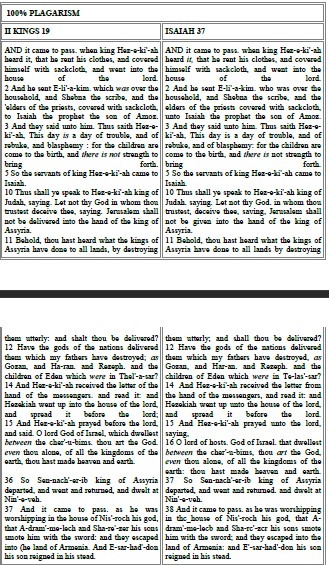
Waɗannan ayoyin an zaɓo su ne daga Authorised Version, amma za ku same su iri ɗaya a kowane Version.
These verses are culled from the Authorised Version, but you will find the same in every Version.
Babu Wahayin Lafziya
No Verbal Inspiration
(Don't forget to consult the "Collins'" R.S.V. with its annotations for a complete list of all the books of the Bible and their authors.) What do Christian scholars say about the "Book of Isaiah"? They say: "MAINLY CREDITED TO ISAIAH. PARTS MAY HAVE BEEN WRITTEN BY OTHERS." In view of the confessions of Bible scholars, we will not take poor Isaiah to task. Can we then pin this plagiarism on the door of God? What blasphemy! Professor Cumptsy confirmed at question time, at the end of the aforementioned symposium, that the "Christians do not believe in a verbal inspiration of the Bible." So God Almighty had not absent-mindedly dictated the same tale twice! Human hands, all too human, had played havoc with this so-called Word of God, the Bible. Yet Bible-thumpers will insist that "every word, comma and full stop of the Bible is God's Word!"
(For a complete list of all the books of the Bible and their authors, avail yourself of the "Collins'" R.S.V. 'with' its annotations). What have Christian scholars to say about the "Book of Isaiah?" They say: "MAINLY CREDITED TO ISAIAH. PARTS MAY HAVE BEEN WRITTEN BY OTHERS" In view of the confessions of Bible scholars, we will not take poor Isaiah to task. Can we then nail this plagiarism on the door of God? What blasphemy! Professor Cumptsy confirmed at question time, at the end of the aforementioned symposium that the "Christians do not believe in a verbal inspiration of the Bible" So God Almighty had not absent-mindedly dictated the same tale twice! Human hands, all too human, had played havoc with this so-called Word of God — the Bible. Yet, Bible-thumpers will insist that "every word, comma and full stop of the Bible is God's Word!"