3. Wane Ne Kuma Me Muke Gani?
3. Who And What Do We See?
Ƙarfin Hoto
The Power Of An Image
Yadda muke ganin kanmu da yadda muke tunanin wasu suna ganinmu yana da tasiri a kan asalin kanmu da kuma dangantakar tsakanin 'kai' da 'wasu'. Wannan yana bayyana a zahiri a cikin wani hoto mai ban sha'awa mai suna 'The Fear Is Still Me' (duba ƙasa). Hoton yana nuna siffar dabba ta wani fursuna da ake azabtarwa wanda ya sanya abin rufe kai da ke ɓoye asalin kamanninsa kamar na beyar.18
How we see ourselves and how we imagine ourselves being seen has a bearing on our self-identity and on the relationship between ‘self’ and ‘other’. This is reflected visually here in an evocative image entitled ‘The Fear Is Still Me’ (see below). The image suggests a bestial persona of a tortured prisoner donning a hood that conceals his bear-like identity.18
«ومع أنه "لا يستطيع أن يرى"، فإنه يُنظر إليه بوضوح على أنه محور المشهد، كما لو أن حراس السجن يقدّمونه ويحيطونه بالتبجيل. وفي الصورة يظهر ما يشبه الهالة. نتساءل: هل الهالة المرسومة حول رأسه هي شعاع مصباح يدوي من خلفه، أم ضوء كاشف يسلَّط عليه من الأمام، أم أن الفنان يتحدّاك لتتأمل الثنائيات المتضادة التي تتجاور فيها رموز الحياة الإنسانية وغير الإنسانية؟ فتماسك الحراس خلفه في هيئة أشبه بالقطيع يتعارض مع عزلة السجين، وتشكيل الحراس الجماعي أشبه بالذئاب يتناقض بشكل لافت مع السجين الوحيد الذي يشبه الدب. والسجين الجريح الشبيه بالدب هو الذي طُورد وصيد، والحراس هم من يقدّمونه ويعلنون حضوره.»
Though “he cannot see” he is very much to be seen as a centre-piece as if heralded by the prison guards. In the image, there appears a halo. We wonder whether the halo etched around him is the beam of a torch from behind him, a floodlight shining onto him or whether the artist challenges us to consider binary oppositions wherein symbols of humanised and dehumanised life become juxtaposed. The togetherness of the guards behind him is set against the isolation of the prisoner though the pack-like formation of the guards and the lone bear-like prisoner is strikingly ironic. It is the wounded bear-like prisoner who has been hunted and the prison guards herald him.
Akwai abubuwa da yawa da za a gani. Zanen ya nuna wani mutum mai girma fiye da na al'ada, duk da cewa ƙafafunsa da suka fito waje watakila suna nuna gaɓoɓin da bugu ya kumbura, kuma a cikin haka fursunan ya bayyana kamar mara daidaiton hankali. Amma tunda ƙafafunsa ba su da raunuka, ko kuwa za su iya nuna, maimakon haka ko lokaci guda, kasancewarsa mai tattaka ƙasa? Ba ma iya ganin hannayensa ba, kuma muna iya tunanin irin raunukan da za su iya ɗauka.
There is much to be seen. The cartoon suggests a larger-than-life individual though his protruding feet perhaps reflect limbs swollen by beating, and in this the prisoner appears imbalanced. Since however his feet bear no injuries might they instead or simultaneously suggest his stamped presence? We cannot see his hands however and imagine what injuries they might bear.
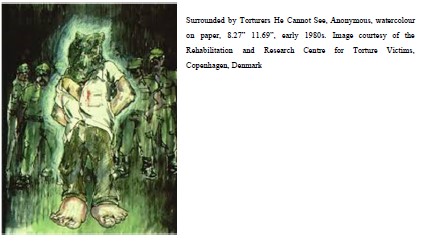
Tufafin fursunan da suka lalace, tare da maɓallan riga da zik ɗin wando a buɗe, sun ƙara bambanta shi da tufafin masu tsari da kyau na jami'an gidan yari, waɗanda suka nuna wayewa. Kasancewar fursunan yana sanye da hular kai yana nuna rashin sanin kansa. Duk da haka, maimakon tsoro, damuwa da azabar da ake zato yana da shi, hular kamar ta beyar tana nuna tsayin daka da ƙarfi.
The scruffy clothes of the prisoner with shirt buttons and trouser zip undone are a further contrast to the ‘civilised’ and neat attire of the prison guards. The fact that the prisoner is hooded reveals a lack of self-identity. Though, in place of his assumed fear, worry and pain, the bear-like hood projects defiance and strength.
Babu shakka, Musulmai suna fuskantar wani ci gaba na rahotannin jarida da ke wulakanta addininsu ko sauran Musulmai. Wannan ci gaba da ake nuna su a matsayin "wasu daban" yana ƙara fargaba, kuma yana tasiri ga yadda muke ganin kanmu a matsayin al'umma da aka fi bayyana ta da tashin hankali. Alamomin zalunci da koma baya, da hotunan mata sanye da hijabi ko burqa da aka zana cikin labarai na tsoro da abin da ba a sani ba, abu ne da ake yawan gani. Butler ta lura cewa "hanyoyin da muke fahimtar rayuwar wasu, ko kuma mu kasa fahimtarta a matsayin wadda aka rasa ko aka cutar da ita (wadda za a iya rasawa ko cutarwa), an riga an jiƙa su da siyasa. Su kansu ayyuka ne na iko. Ba sa yanke shawarar yanayin bayyanuwa su kaɗai, amma manufarsu ita ce iyakance yankin bayyanuwar kanta."19
Undoubtedly, Muslims face a constant barrage of press reports that vilify their faith or other Muslims. This constant othering heightens anxieties and comes to shape the way we see ourselves as a people largely defined through violence. Motifs of barbarity, backwardness, images of women in hijab or burqa framed around narratives of fear and the unknown are commonplace. Butler notes that ‘the frames through which we apprehend or, indeed, fail to apprehend the lives of others as lost or injured (lose-able or injurable) are politically saturated. They are themselves operations of power. They do not unilaterally decide the conditions of appearance, but their aim is nevertheless to delimit the sphere of appearance itself.’19
Tudor (2011) ya kawo misali mai zuwa don nuna yadda halaye da hangen nesa game da wasu ke da tasiri sosai kan ra'ayoyin tausayawa ko fahimtar juna. Ko da yake ya yi gargadi game da yin hasashe gaba ɗaya, ya rubuta cewa:
Tudor (2011) strikes the following example to reflect how attitudes and perceptions of others have a strong bearing on sympathetic or empathic outlooks. Though cautioning against generalisations, he writes:
"Reel Bad Arabs" wani littafi ne na Jack Shaheen. Sunan wani shiri ne na fim game da yadda Hollywood ke nuna Larabawa. Wait, the instruction says reply with translation only. Corrected: Reel Bad Arabs
Reel Bad Arabs
Bincike da Lendenman (1983) ya yi ya bayyana yadda aka rika nuna Larabawa ta hanyar munana a cikin zane-zanen siyasa a jaridun Amurka kamar The Washington Post, The Washington Star, The Miami News, The Baltimore Sun da sauransu. Nazarin Palmer (1995) kan zane-zanen siyasa a The Washington Post bayan yaƙe-yaƙen Isra'ila na 1956, 1957 da 1973, da kuma Intifada ta Falasdinawa. Ko kafin yakin Gulf na farko, an ga irin wannan dabi'a ta nuna Larabawa cikin munana da rage musu mutunci, musamman Larabawan Falasdinu. Irin wadannan hotunan munana sau da yawa ana amfani da su wajen goyon bayan yakin Amurka, ko kuma, a nazarin Palmer (1995), wajen goyon bayan yakin Isra'ila kan Falasdinawa.26 Nazarin Nasir (1979) kan yadda aka nuna Larabawa a fina-finan Amurka tsakanin 1894 da 1960
Lendenman’s (1983) research has revealed successive negative portrayals of Arabs in political cartoons in American newspapers such as The Washington Post, The Washington Star, The Miami News, The Baltimore Sun and others. Palmer’s (1995) analysis of political cartoons in The Washington Post following Israel’s wars of 1956, 1957 and 1973, the Palestinian Intifida. Even prior to the first Gulf War, there was reflected the same tendency of negative and dehumanising portrayals of Arabs, and oftentimes specifically Palestinian Arabs. Such negative images are often used to promote American wars, or in the case of Palmer’s (1995) analysis, to promote Israel’s campaigns against Palestinians.26 Nasir’s (1979) study of the portrayal of Arabs in American movies between 1894 and 1960
An ya bayyana hoton da ya fi yawa na Larabawa a matsayin mutanen baya, miyagu kuma marasa tausayi.27 A cikin nazari mai zurfi da Shaheen ya yi na fiye da fina-finan Hollywood 900 da aka fitar tsakanin 1896 da 2001, an ga a fili wani yanayi mai rinjaye na yadda kafafen yada labarai ke nuna Larabawa a matsayin miyagu da aka cire musu mutuntaka.28
revealed a predominant image of Arabs as backwards, evil and inhumane.27 In Shaheen’s comprehensive study of over 900 Hollywood movies released between 1896 and 2001, a dominant trend of media presentations of Arabs as the dehumanised villain is evident.28
Haka kuma, Kamalipour (2000) ya tantance yadda ake nuna Larabawa cikin mummunan yanayi a rediyo, talabijin da fina-finai, yana mai bayyana yadda ake nuna Larabawa a matsayin masu saurin aikata ta'addanci kan Amurkawa.29 Haka kuma ayyukan Ayish (1994) da Qazzaz (1975) sun nuna yadda irin waɗannan hotunan tatsuniya game da Larabawa, na cewa suna da mugunta, tashin hankali, rashin wayewa da barazana ta asali, suka yi fice a littafan koyon ilimin zamantakewa na makarantun firamare, da na sakandare na farko da na sakandare, abin da ya ci gaba da yaɗa munanan ra'ayoyi game da Larabawa.
18 Kahleen McCullough-Zander da Sharyn Larson, ‘The Fear Is Still Me’ - http://www.nursingcenter.com/upload/static/230543/fear.pdf.
18 Kahleen McCullough-Zander and Sharyn Larson, ‘The Fear Is Still Me’ - http://www.nursingcenter.com/upload/static/230543/fear.pdf.
19 Judith Butler (2010) ‘Performative Agency’ in Journal of Cultural Economy, 3:2, p. 1.
19 Judith Butler (2010) ‘Performative Agency’ in Journal of Cultural Economy, 3:2, p. 1.
20 K. Tudor (2011). Understanding Empathy. Transactional Analysis Journal, 41(1), 39–57. Garber: 2004, p. 83.
20 K. Tudor (2011). Understanding Empathy. Transactional Analysis Journal, 41(1), 39–57. Garber: 2004, p. 83.
21 R. Srikanth, Constructing the Enemy: Empathy/Antipathy in U.S. Literature and Law (Philadelphia, Temple University Press: 2012), shafi. 158.
21 R. Srikanth, Constructing the Enemy: Empathy/Antipathy in U.S. Literature and Law (Philadelphia, Temple University Press: 2012), p. 158.
22 Kayla Williams, Love My Rifle More Than You (W.W. Norton, 2006), p. 249.
22 Kayla Williams, Love My Rifle More Than You (W.W. Norton, 2006), p. 249.
23 Herbert Kelman, "Violence Without Moral Restraint: Reflections on the Dehumanization of Victims and Victimizers", Journal of Social Issues, Vol. 29, No. 4, (1973), shafi. 48.
23 Herbert Kelman, “Violence Without Moral Restraint: Reflections on the Dehumanization of Victims and Victimizers”, Journal of Social Issues, Vol. 29, No.4, (1973), p. 48.
24 Jodi Halpern da Harvey M. Weinstein, Rehumanizing the Other: Empathy and Reconciliation, Human Rights Quarterly, Vol. 26, No. 3 (Aug., 2004), pp. 568-9.
24 Jodi Halpern and Harvey M. Weinstein, Rehumanizing the Other: Empathy and Reconciliation, Human Rights Quarterly, Vol. 26, No. 3 (Aug., 2004), pp. 568-9.
25 Jodi Halpern, From Detached Concern to Empathy: Humanizing Medical Practice 1 7-18 (2001), pp. 130-133;143.