5. Kipande cha Nyama
5. A Lump Of Flesh
kisha Tukaifanya ile mbegu kuwa donge la nyama
and then We made that form into a lump of flesh
Hatua inayofuata ya ukuaji wa binadamu iliyofafanuliwa katika Qur'ani ni mudghah. Neno hili lina maana ya kutafuna, kutafuna kwa meno, kutafunwa, na kipande kidogo cha nyama.61 62 Pia linaelezea kiinitete baada ya kupita hatua nyingine na kuwa nyama.63 Maana nyingine ni kitu ambacho meno yamekitafuna na kuacha alama zinazoonekana juu yake; na alama zinazobadilika wakati wa kutafuna kutokana na kitendo cha kurudiwa.64 Hatua ya mudghah inafafanuliwa zaidi, mahali pengine katika Qur'ani:
The next stage of human development defined in the Qur’an is mudghah. This term means to chew, mastication, chewing, to be chewed, and a small piece of meat.61 62 It also describes the embryo after it passes to another stage and becomes flesh.63 Other meanings include something that teeth have chewed and left visible marks on; and marks that change in the process of chewing due to the repetitive act.64 The mudghah stage is elaborated on further, elsewhere in the Qur'an:
kisha kutoka kwenye donge la nyama (mudghah), lenye umbo na lisilo na umbo. 65
then from a fleshy lump (mudghah), formed and unformed. 65
Neno la Kiarabu linalotumika hapa kwa 'liliundwa' ni *mukhallqah*, ambalo pia linaweza kumaanisha 'lilichongwa' au 'lilifinyangwa'.66
The Arabic word used here for ‘formed’ is mukhallqah which can also mean ‘shaped’ or ‘moulded’.66
UFAFANUZI WA KISAYANSI
SCIENTIFIC INTERPRETATION
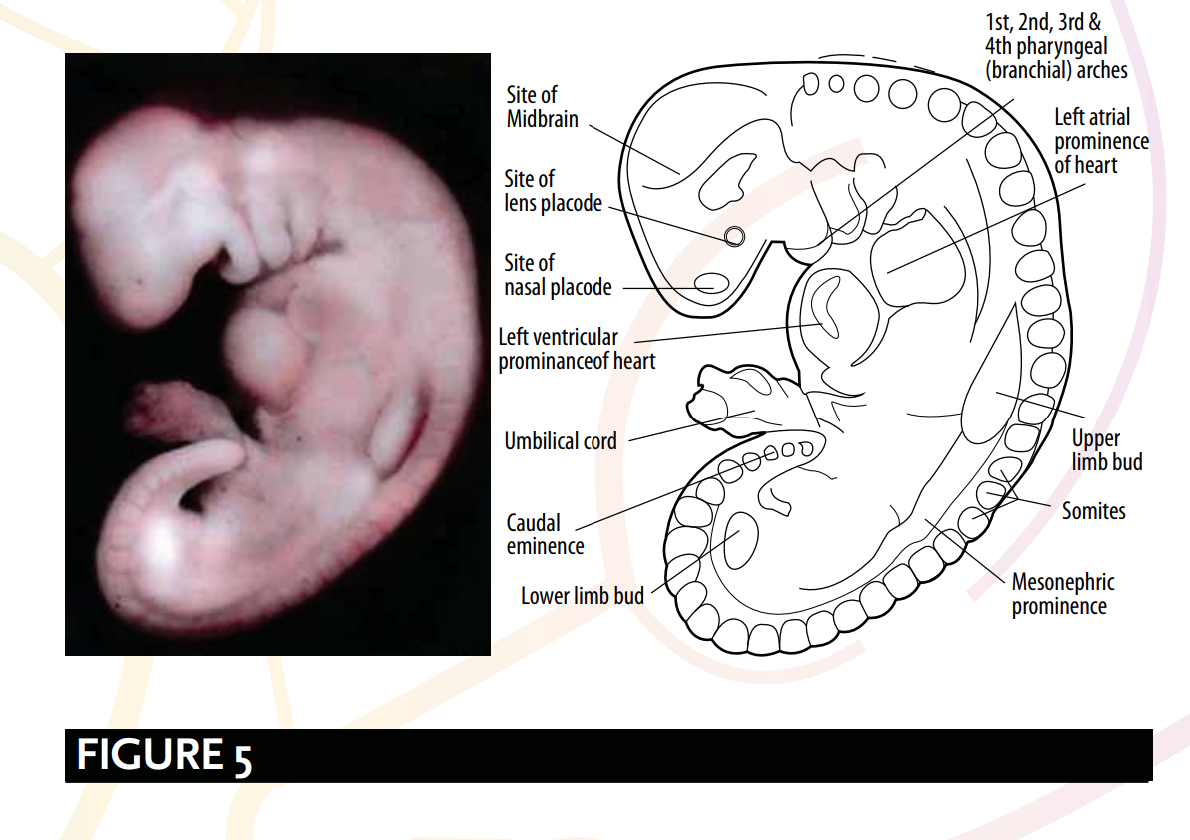
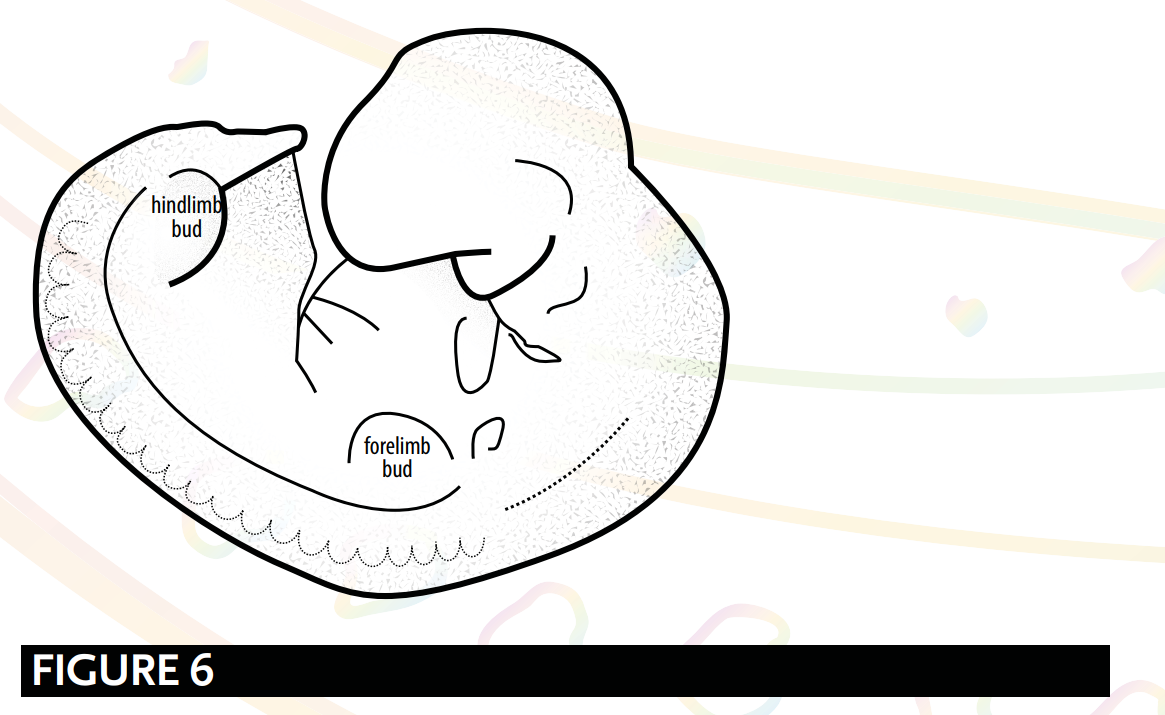
Kwa kuchukua mbinu ya kileksia katika kufasiri neno hili, hatua hii inahusu wiki ya nne, wakati somiti, ambazo zinafanana na alama za meno, zinaanza kukua. Mwonekano wa kiinitete katika hatua hii, kutokana na ukuaji wa somiti, unalingana na maana mbili: 'kutafunwa' na 'kitu ambacho meno yametafuna na kuacha alama zinazoonekana'. Kuhusu ukuaji wa somiti, Barry Mitchell na Ram Sharma wanaandika:
Taking a lexical approach to the interpretation of the word, this stage deals with the 4th week, when somites, which resemble tooth-marks [see Figures 5 and 6], begin to develop. The appearance of the embryo at this stage, due to somite development, corresponds with the meanings: ‘to be chewed’ and ‘something that teeth have chewed and left visible marks on’. Concerning somite development, Barry Mitchell and Ram Sharma write:
Katika wiki ya nne, seli za mesenkaimu zilizopo upande wa kati wa somites huhamia kuelekea notokodi ili kuunda skleroto mu (scelerotomes) [mesenkaimu ni tishu-unganishi za kiinitete zilizopangwa kwa mpangilio uliolegea ndani ya kiinitete].67
In the fourth week, the medially placed mesenchymal cells of the somites migrate towards the notochord to form scelerotomes [mesenchyme is the loosely arranged embryonic connective tissue in the embryo].67
Neno mudghah lina maana nyingine pia, ambayo ni pamoja na kitu kinachofanana na kipande kidogo cha nyama. Hii pia ni maelezo sahihi ya mwonekano wa kiinitete katika hatua hii. Cha kuvutia ni kwamba maelezo ya Qur'ani ya mudghah kuwa "iliyoumbwa na isiyoumbwa" yanaweza kurejelea kipindi cha organogenesis, ambacho viungo vyote vikuu vimeanza kukua lakini bado havijakamilika kikamilifu.68 Kipindi hiki pia hutokea karibu wiki ya 4.
Another meaning for the word mudghah includes something looking like a morsel of flesh. This too is an accurate description of the embryo's appearance at this stage. Interestingly, the qur’anic explanation of mudghah as being “formed and unformed”, can refer to the organogenetic period, during which all the main organs have begun to develop, but are not yet fully formed.68 This period also occurs at around the 4th week
DUTU ILIYOTAFUNWA
A CHEWED SUBSTANCE
Hoja inayotolewa na wakosoaji kuhusu hatua ya mudghah ni kwamba kipande cha nyama kilichotafunwa au donge la nyama halifanani na kiinitete katika hatua yoyote iliyoelezwa na elimu ya kisasa ya kiinitete. Katika kujibu hoja hii, ni lazima kufafanua maana ya 'kipande cha nyama kilichotafunwa'. Hii inajumuisha si tu kutafuna kwa muda mrefu, bali pia kitu kilichotafunwa mara moja tu. Hii inadumisha maana ya neno mudghah kwa kuwa alama za kuumwa zinafanana na kipande cha nyama kilichotafunwa mara moja. Hili linasisitizwa na maana yake nyingine: 'kitu ambacho meno yamekitafuna na kuacha alama zinazoonekana juu yake'.
An argument raised by critics concerning the mudghah stage is that a chewed piece of meat or a lump of flesh does not resemble the embryo at any stage described by modern embryology. In responding to this, it is necessary to clarify what constitutes a ‘chewed piece of flesh’. It includes, not just mastication, but also something being chewed just the once. This maintains the meaning of the word mudghah as the bite marks do resemble a piece of meat chewed once. This is highlighted by its other meaning: ‘something that teeth have chewed and left visible marks on’.
MUHTASARI
SUMMARY
Hatua ya `mudghah
The `mudghah stage:
Ukuzaliwa kwa somites kunampa kiinitete muonekano wa dutu iliyotafunwa. Kile kinachofanana na kipande cha nyama ni maelezo sahihi ya muonekano wa kiinitete katika hatua hii.
The development of somites giving the embryo the appearance of a chewed substance. What looks like a morsel of flesh - an accurate description of embryo's appearance at this stage.
Pia inaelezea kipindi cha organojenesisi (ukuaji wa viungo, ambavyo bado havijakamilika kikamilifu).
It also describes the organogenetic period (the development of organs, not yet fully formed).
Kama kawaida, kumekuwa na majaribio ya kulinganisha neno la Kiqur'ani *mudghah* na kazi ya Galen ili kuthibitisha dai kwamba Mtume Muhammad ﷺ alinakili maandishi ya Kigiriki kuhusu ukuaji wa binadamu. Hata hivyo, kwa kuchambua maandishi ya Galen na kuyalinganisha na maana mbalimbali na pana za neno *mudghah*, tofauti iliyo wazi hujitokeza. Galen anasema:
As ever, there have been attempts to compare the qur’anic term mudghah with Galen’s work to substantiate the view that the Prophet Muhammad ﷺ plagiarised from Greek writings on human development. However, upon analysing Galen’s writings, bringing it in contrast to the various and extensive meanings of the word mudghah, a pointed difference is made distinct. Galen states:
Kipindi cha tatu kinafuata hapa, ambapo, kama ilivyosemwa, inawezekana kuona kwa uwazi sehemu tatu zinazotawala na aina ya mchoro, kivuli, kwa namna fulani, cha sehemu nyingine zote. Utaona muundo wa sehemu tatu zinazotawala kwa uwazi zaidi, ule wa sehemu za tumbo kwa hafifu zaidi, na zaidi sana bado, ule wa viungo. Baadaye hutengeneza 'matawi madogo', kama Hippocrates alivyoeleza, akionyesha kwa neno hilo kufanana kwao na matawi ya miti.69
The third period follows on this, when, as was said, it is possible to see the three ruling parts clearly and a kind of outline, a silhouette, as it were, of all the other parts. You will see the conformation of the three ruling parts more clearly, that of the parts of the stomach more dimly, and much more still, that of the limbs. Later on they form ‘twigs’, as Hippocrates expressed it, indicating by the term their similarity to branches.69
Kama ilivyochunguzwa, Qur’ani inataja *mudghah* kama dutu inayofanana na kitu kilichotafunwa na kipande kidogo cha nyama. Kwa upande mwingine, Galen anajadili "mpangilio" wa "sehemu tatu zinazotawala", "vivuli" na "matawi", ambavyo kuna uwezekano mkubwa vinarejelea uundaji wa mifupa ya viungo. Anaeleza sehemu hizi tatu zinazotawala kuwa zinaonekana zaidi kuliko tumbo na viungo. Hata hivyo, Qur’ani haitaji jambo hili hata kidogo, na kutajwa kwake kwa uundaji wa mifupa ya viungo kunakuja katika hatua inayofuata. Kwa hiyo, si jambo linalowezekana wala la vitendo kudai kwamba Mtume Muhammad ﷺ alinakili kazi za Galen, kwa kuwa Qur’ani haijumuishi hata moja ya maelezo aliyotoa Galen katika hatua hii.
As explored, the Qur’an mentions mudghah as a chewed-like substance and a small piece of flesh. In contrast, Galen discusses the “conformation” of “the three ruling parts”, “silhouettes” and “twigs”, which is most likely in reference to limb bone formation. He details these three ruling parts as being more visible than the stomach and the limbs. However, the Qur’an makes no mention of this, and its mention of the limb bone formation comes at the next stage. It is both implausible and impractical, therefore, to suggest the Prophet Muhammad ﷺ copied the works of Galen as the Qur’an does not include any of the descriptions provided by Galen at this stage