Kitabu Kiitwacho "Agano Jipya"
The Book Christened "the New Testament"
Kwa nini "according To?"
Why "according To?"
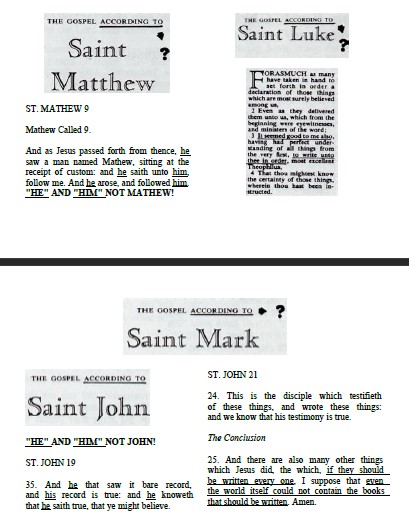
Vipi kuhusu kinachoitwa Agano Jipya? 1 1 Kwa nini kila Injili huanza na utangulizi — KWA MUJIBU WA ... KWA MUJIBU WA ... (Angalia hapa chini)? Kwa nini "kwa mujibu wa"? Kwa sababu hata nakala moja kati ya nakala hizo elfu nne zinazosifiwa haibebi sahihi ya mwandishi wake mwenyewe! Hivyo ndiyo dhana ya "kwa mujibu wa"! Hata ushahidi wa ndani unathibitisha kwamba Mathayo hakuwa mwandishi wa Injili ya kwanza inayobeba jina lake.
What about the so-called New Testament? 1 1 Why does every Gospel begin with the introduction — ACCORDING TO ... ACCORDING TO ... (See below). Why "according to?" Because not a single one of the vaunted four thousand copies extant carries its author's autograph! Hence the supposition "according to!" Even the internal evidence proves that Matthew was not the author of the first Gospel which bears his name.
Na Yesu alipopita kutoka hapo, aliona mtu aitwaye Mathayo, ameketi kwenye kituo cha ushuru; naye akamwambia, Nifuate. Naye akainuka, akamfuata.
"And as Jesus passed forth thence, HE (JESUS) saw a man, named Matthew, sitting at the receipt of custom: and HE (JESUS) saith unto HIM (MATTHEW), follow ME (JESUS) And HE (MATTHEW) arose, and followed HIM (JESUS)." (Matthew 9:9)
1. Hiyo "inayoitwa" Agano Jipya, kwa sababu hakuna mahali popote ambapo "Agano Jipya" linajiita Agano Jipya, na hakuna mahali popote ambapo "Agano la Kale" linajiita Agano la Kale. Pia neno "Biblia" halipatikani ndani ya kurasa za Biblia. Mungu alisahau kuvipa vitabu vyake "VYAKE" jina! Bila kutumia mawazo mengi sana, mtu anaweza kuona kwamba "Yeye" na "Yake" katika simulizi hapo juu hazimrejelei Yesu wala Mathayo kama mwandishi wake, bali mtu wa tatu anayeandika kile alichokiona na kusikia, yaani simulizi la kusikia-sikia. Ikiwa hatuwezi hata kumhusisha huu "kitabu cha ndoto" (kama Injili ya kwanza pia inavyoelezwa) na mwanafunzi Mathayo, tutawezaje kuukubali kuwa Neno la Mungu?
1. The "so-called," because nowhere does the "New Testament" calls itself the New Testament, and nowhere the Old Testament calls itself the Old Testament. And also the word "Bible" is unknown within the pages of the Bible. God forgot to give a title to "HIS" books! Without any stretch of the imagination, one can see that the "He's" and the "Him's" of the above narration do not refer to Jesus or Matthew as its author, but some third person writing what he saw and heard — a hearsay account. If we cannot even attribute this "book of dreams" (as the first Gospel is also described) to the disciple Matthew, how can we accept it as the Word of God?
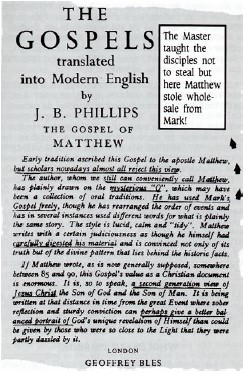
Hatuko peke yetu katika ugunduzi huu kwamba Mathayo hakuandika "Injili kwa mujibu wa Mtakatifu Mathayo" na kwamba iliandikwa na mkono usiojulikana. J. B. Phillips anakubaliana nasi katika matokeo yetu. Yeye ni mtumishi aliyelipwa wa Kanisa la Anglikana, prebendari wa Kanisa Kuu la Chichester, Uingereza. Hangekuwa na sababu yoyote ya kusema uongo au kusaliti kwa madhara ya msimamo rasmi wa Kanisa lake! Tazama utangulizi wake wa "Injili ya Mtakatifu Mathayo" (imeonyeshwa hapa chini). Phillips anasema yafuatayo kuhusu uandishi wake.
We are not alone in this discovery that Matthew did not write the "Gospel according to St. Matthew" and that it was written by some anonymous hand. J. B. Phillips concurs with us in our findings. He is the paid servant of the Anglican Church, a prebendary of the Chichester Cathedral, England. He would have no reason to lie or betray to the detriment of the official view of his Church! Refer to his introduction to the "Gospel of St. Matthew" (reproduced here below). Phillips has this to say about its authorship.
"KWA MUDA MREFU MAPOKEO WA KALE ULIHUSISHA INJILI HII NA MTUME MATHAYO, LAKINI WANAZUONI WA SIKU HIZI KARIBU WOTE WANAKATAA MTAZAMO HUU." Kwa maneno mengine, Mtakatifu Mathayo hakuandika Injili inayobeba jina lake. Hii ndiyo hitimisho la wanazuoni wa Kikristo wenye hadhi ya juu kabisa — si Wahindu, Waislamu wala Wayahudi ambao wanaweza kushutumiwa kwa upendeleo. Acheni rafiki yetu Mwanglikana aendelee: "MWANDISHI, AMBAYE BADO TUNAWEZA KUMWITA MATHAYO KWA URAHISI." "Kwa urahisi" kwa sababu vinginevyo kila tunapotaja "Mathayo" ingetubidi kusema — "KITABU CHA KWANZA CHA AGANO JIPYA" sura ya kadhaa, mstari wa kadhaa. Na tena na tena "Kitabu cha kwanza . . ." n.k. Kwa hiyo, kulingana na J. B. Phillips, ni rahisi kukipa kitabu jina fulani. Basi kwa nini tusiseme "Mathayo"? Chukulia kwamba ni jina zuri kama jingine lolote! Phillips anaendelea: "MWANDISHI AMETUMIA WAZI CHANZO CHA AJABU 'Q' AMBACHO HUENDA KILIKUWA MKUSANYIKO WA MAPOKEO YA KINYWA." "Mysterious 'Q'" hii ni nini? "Q" ni kifupi cha neno la Kijerumani "quelle" linalomaanisha "chanzo." Inadhaniwa kwamba kuna hati nyingine — chanzo cha pamoja — ambacho Mathayo, Marko na Luka wa sasa walikuwa nacho. Waandishi hao watatu, ye yote walivyokuwa, walikuwa na macho ya pamoja juu ya nyenzo zilizokuwepo. Walikuwa wakiandika kana kwamba wanatazama kwa "jicho moja." Na kwa sababu waliona kwa namna moja, Injili tatu za kwanza zikaja kujulikana kama Injili za Kisinoptiki.
"EARLY TRADITION ASCRIBED THIS GOSPEL TO THE APOSTLE MATTHEW, BUT SCHOLARS NOWADAYS ALMOST ALL REJECT THIS VIEW." In other words, St. Matthew did not write the Gospel which bears his name. This is the finding of Christian scholars of the highest eminence — not of Hindus, Muslims and Jews who may be accused of bias. Let our Anglican friend continue: "THE AUTHOR, WHOM WE STILL CAN CONVENIENTLY CALL MATTHEW" "Conveniently" because otherwise everytime we made a reference to "Matthew" we would have to say — "THE FIRST BOOK OF THE NEW TESTAMENT" Chapter so and so, verse so and so. And again and again "The first book . . ." etc. Therefore, according to J. B. Phillips it is convenient that we give the book some name. So why not "Matthew?" Suppose its as good a name as any other! Phillips continues: "THE AUTHOR HAS PLAINLY DRAWN ON THE MYSTERIOUS 'Q' WHICH MAY HAVE BEEN A COLLECTION OF ORAL TRADITIONS." What is this "mysterious 'Q'?" "Q" is short for the German word "quella" which means "sources." There is supposed to be another document — a common source — to which our present Matthew, Mark and Luke had access. All these three authors, whoever they were, had a common eye on the material at hand. They were writing as if looking through "one" eye. And because they saw eye to eye, the first three "Gospels" came to be known as the Synoptic Gospels.
Ukopaji wa jumla
Wholesale Cribbing
Lakini vipi kuhusu hii "ufunuo" (inspiration)? Mhudumu wa Kanisa la Anglikana amelipigilia msumari kichwani. Yeye, kuliko mtu mwingine yeyote, ana haki ya kufanya hivyo. Ni mtumishi aliyelipwa wa Kanisa, Mkristo wa kiinjili mwenye msimamo thabiti, mwanazuoni wa Biblia mwenye sifa, mwenye upatikanaji wa moja kwa moja wa hati "asili" za Kigiriki. Acha yeye mwenyewe atufafanulie: (Tazama jinsi anavyolifichua jambo hilo kwa upole): "YEYE (Mathayo) AMETUMIA INJILI YA MARKO KWA UHURU," ambayo kwa lugha ya mwalimu wa shule ina maana "amekuwa akinakili KWA JUMLA kutoka kwa Marko!" Je, bado Wakristo wanaiita wizi huu wa jumla wa kazi ya mwingine Neno la Mungu?
But what about that "inspiration" business? The Anglican prebendary has hit the nail on the head. He is, more than anyone else, entitled to do so. A paid servant of the Church, an orthodox evangelical Christian, a Bible scholar of repute, having direct access to the "original" Greek manuscripts, let HIM spell it out for us. (Notice how gently he lets the cat out of the bag): "HE (Matthew) HAS USED MARK'S GOSPEL FREELY" which in the language of the school-teacher — "has been copying WHOLESALE from Mark!" Yet the Christians call this wholesale plagiarism the Word of God?
Je, haikukufanya ushangae kwamba shahidi wa macho na masikio wa huduma ya Yesu, ambaye alidaiwa kuwa mwanafunzi Mathayo, badala ya kuandika kumbukumbu zake mwenyewe za moja kwa moja kuhusu huduma ya "Bwana wake", angeenda kuiba kutoka maandishi ya kijana (Marko), ambaye alikuwa mvulana wa miaka kumi wakati Yesu alipowakemea watu wa taifa lake? Kwa nini shahidi wa macho na masikio angenakili kutoka kwa mtu ambaye mwenyewe alikuwa akiandika kwa kusikia tu kutoka kwa wengine? Mwanafunzi Mathayo asingefanya jambo la kijinga kama hilo. Kwa maana hati isiyojulikana mwandishi wake imewekwa juu ya jina jema la Mathayo.
Does it not make you wonder that an eye-witness and an ear-witness to the ministry of Jesus, which the disciple Matthew was supposed to be, instead of writing his own first hand impressions of the ministry of "his Lord" would go and steal from the writings of a youth (Mark), who was a ten year old lad when Jesus upbraided his nation? Why would an eye-witness and ear-witness copy from a fellow who himself was writing from hearsay? The disciple Matthew would not do any such silly thing. For an anonymous document has been imposed on the fair name of Matthew.
Wizi wa Kiakili au Utekaji Nyara wa Kifasihi
Plagiarism Or Literary Kidnapping
Wizi wa kifasihi ni nini? Wizi wa kifasihi maana yake ni mtu kunakili neno kwa neno (ad verbatim) kutoka katika maandishi ya mwingine na kuyawasilisha kama yake mwenyewe, na hili linajulikana kama wizi wa kifasihi (plagiarism). Hii ni tabia ya kawaida miongoni mwa waandishi wasiojulikana, takriban 40, wa vitabu vya Biblia. Wakristo wanajivunia kile wanachodai kuwa ni uhusiano wa kawaida miongoni mwa waandishi wa vitabu 66 vya Kiprotestanti na waandishi wa vitabu 73 vya Kikatoliki vinavyoitwa "Biblia Takatifu." Kuna uhusiano fulani wa kawaida, kwa maana Mathayo na Luka, au yeyote yule walikuwa, walinakili 85% neno kwa neno kutoka kwa Marko! Mungu Mwenyezi hakuwaagiza watu wa Injili tatu za kwanza (synoptists, yaani wenye macho moja) maneno yale yale. Wakristo wenyewe wanakiri hili, kwa sababu hawaamini katika uvuvio wa maneno (verbal inspiration), kama Waislamu wanavyoamini kuhusu Qur’ani Tukufu. 1 1
Plagiarism means literary theft. Someone copies ad verbatim (word for word) from another's writing and palms it off as his own, is known as plagiarism. This is a common trait amongst the 40 or so anonymous authors of the books of the Bible. The Christians boast about a supposedly common cord amongst the writers of the 66 Protestant booklets and the writers of the 73 Roman Catholic booklets called the "Holy Bible." Some common cord there is, for Matthew and Luke, or whoever they were, had plagiarised 85% word for word from Mark! God Almighty did not dictate the same wordings to the synoptists (one-eyed). The Christians themselves admit this, because they do not believe in a verbal inspiration, as the Muslims do about the Holy Qur’ân. 1 1
Wizi huu wa 85% kutoka kwa Mathayo na Luka unapungua sana ukilinganishwa na utekaji nyara wa kifasihi wa waandishi wa Agano la Kale, ambapo wizi wa asilimia mia moja unatokea katika kile kinachoitwa Kitabu cha Mungu. Wanazuoni wa Kikristo wa hadhi ya Askofu Kenneth Cragg wanaliita wizi huu kwa upole "uzalishaji upya", na wanajivunia jambo hilo.
This 85% plagiarism of Matthew and Luke pales into insignificance compared to the literary kidnapping of the authors of the Old Testament where a hundred percent stealing occurs in the so-called Book of God. Christian scholars of the calibre of Bishop Kenneth Cragg euphemistically calls this stealing, "reproduction"2 and take pride in it.
1. Tazama "AL-QURAN — The Miracles of Miracles" (inakuja hivi karibuni)
1. See "AL-QURAN — The Miracles of Miracles" (coming soon)
2. Angalia mwanzo wa sura ya kwanza kwa nukuu kamili.
2. See beginning of chapter one for the full quotation.
Viwango Vilivyopotoka
Perverted Standards
Dkt. Scroggie (aliyetajwa hapo awali) anamnukuu kwa shauku kubwa katika kitabu chake Dkt. Joseph Parker kwa sifa yake ya kipekee ya Biblia:
Dr. Scroggie (referred to earlier on) most enthusiastically quotes in his book Scroggie (referred to earlier on) most enthusiastically quotes in his book1 a Dr. Joseph Parker for his unique eulogy of the Bible:
"KITABU GANI CHA BIBLIA KWA UPANA WA YALIYOMO! . . . KURASA NZIMA ZIMEJAZWA NA MAJINA YASIYOJULIKANA, NA IMESIMULIWA ZAIDI KUHUSU NASABA KULIKO SIKU YA HUKUMU. HADITHI ZINASIMULIWA NUSU TU, NA USIKU UNAINGIA KABLA HATUJAJUA USHINDI ULIPO. JE, KUNA CHOCHOTE" (katika Fasihi ya Kidini ya dunia) "KINACHOLINGANA NA HILI?" Ni shanga nzuri ya maneno na misemo bila shaka! Ni kelele nyingi bila maana, na ni kufuru kubwa dhidi ya Mungu Mwenyezi kuruhusu mkusanyiko wa kuaibisha namna hii. Hata hivyo, Wakristo wanajivunia kasoro hizo hizo za kitabu chao, kama Romeo alivyokuwa akijivunia "alama" kwenye mdomo wa Juliet! 1. "Je, Biblia ni Neno la Mungu?" na Moody Press. na Moody Press.
"WHAT A BOOK IS THE BIBLE IN THE MATTER OF VARIETY OF CONTENTS! . . . WHOLE PAGES ARE TAKEN UP WITH OBSCURE NAMES, AND MORE IS TOLD OF A GENEALOGY THAN OF THE DAY OF JUDGMENT. STORIES ARE HALF TOLD, AND THE NIGHT FALLS BEFORE WE CAN TELL WHERE VICTORY LAY. WHERE IS THERE ANYTHING" (in the Religious Literature of the world) "TO CORRESPOND WITH THIS?" A beautiful necklace of words and phrases undoubtedly! It is much ado about nothing, and rank blasphemy against God Almighty for authorising such an embarrassing hotch potch. Yet the Christians gloat over the very defects of their book, like Romeo over the "mole" on Juliet's lip! 1. "Is the Bible the Word of God?" by the Moody Press. by the Moody Press.
Hakuna Kidogo Kuliko 100%
Nothing Less Than 100%
Ili kuonyesha kiwango cha wizi wa maandishi unaofanywa na waandishi "waliovuviwa" wa Biblia, niliwaomba hadhira yangu, wakati wa mdahalo katika Chuo Kikuu cha Cape Town kati yangu na Profesa Cumpsty, Mkuu wa Idara ya Theolojia, kuhusu mada "Je, Biblia ni Neno la Mungu?", wafungue Biblia zao.
To demonstrate the degree of plagiarism practised by the "inspired" Bible writers, I asked my audience during a symposium at the University of Cape Town conducted between myself and Professor Cumpsty the Head of the Department of Theology on the subject "Is the Bible God's Word?" to open their Bibles.
Some Christians are very fond of carrying their Bibles under their arms when religious discussions or debates take place. They seem to be utterly helpless without this book. At my suggestion a number of the audience began ruffling the pages. I asked them to open chapter 37 in the "Book of Isaiah." When the audience was ready, I asked them to compare my "Isaiah 37" with their "Isaiah 37" while I read, to see whether they were identical. I began, reading very slowly. Verses 1, 2, 4, 10, 15, and so on, until the end of the chapter. I kept on asking after every verse whether what I had been reading was identical with the verses in their Bibles. Again and again they chorused — "Yeh!", "Yeh!". At the end of the chapter, with the Bible still open in my hands at the place from which I had been reading, I made the Chairman reveal to the audience that I was not reading from Isaiah 37 at all but from 2 KINGS 19! There was a terrible consternation in the audience! I had thus established 100% plagiarism in the "Holy Bible." (See below)
Some Christians are very fond of carrying their Bibles under their arms when religious discussions or debates take place. They seem to be utterly helpless without this book. At my suggestion a number of the audience began ruffling the pages. I asked them to open chapter 37 in the "Book of Isaiah." When the audience was ready, I asked them to compare my "Isaiah 37" with their "Isaiah 37" while I read, to see whether they were identical. I began, readingly slowly. Verses 1, 2, 4,10, 15, and so on, until the end of the chapter. I kept on asking after every verse if what I had been reading, was identical with the verses in their Bibles. Again and again they chorused — "Yeh!", "Yeh!". At the end of the chapter with the Bible still open in my hands at the place from which I had been reading, I made the Chairman to reveal to the audience that I was not reading from Isaiah 37 at all but from 2 KINGS 19! There was a terrible consternation in the audience! I had thus established 100% plagiarism in the "Holy Bible." (See below)
Kwa maneno mengine, Isaya 37 na 2 Wafalme 19 zinafanana neno kwa neno. Hata hivyo, zimehusishwa na waandishi wawili tofauti, waliokuwa na miaka mia kadhaa kati yao, ambao Wakristo wanadai kuwa waliongozwa na Mungu.
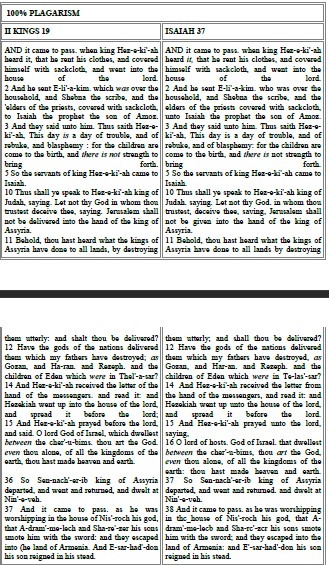
Aya hizi zimechukuliwa kutoka Authorised Version, lakini utazipata vilevile katika kila Version.
These verses are culled from the Authorised Version, but you will find the same in every Version.
Hakuna Uvuvio wa Maneno
No Verbal Inspiration
(Kwa orodha kamili ya vitabu vyote vya Biblia na waandishi wao, tumia "Collins'" R.S.V. pamoja na maelezo yake.) Wasomi wa Kikristo wanasema nini kuhusu "Kitabu cha Isaya?" Wanasema: "KINASIFIWA ZAIDI KWA ISAYA. BAADHI YA SEHEMU HUENDA ZILIANDIKWA NA WENGINE." Kwa kuzingatia kukiri kwa wasomi wa Biblia, hatutamlaumu Isaya maskini. Je, tunaweza basi kumtwika Mungu wizi huu wa maandishi? Kufuru iliyoje! Profesa Cumptsy alithibitisha wakati wa maswali, mwishoni mwa mkutano huo nilioutaja, kwamba "Wakristo hawaamini katika uvuvio wa neno kwa neno wa Biblia." Kwa hiyo Mungu Mwenyezi hakuwa amesahau na kuagiza hadithi ile ile mara mbili! Mikono ya kibinadamu, ya kibinadamu kupita kiasi, ilikuwa imeharibu Neno hili linalodaiwa kuwa Neno la Mungu — Biblia. Hata hivyo, wanaohubiri Biblia kwa msisitizo watasisitiza kwamba "kila neno, koma na nukta ya Biblia ni Neno la Mungu!"
(For a complete list of all the books of the Bible and their authors, avail yourself of the "Collins'" R.S.V. 'with' its annotations). What have Christian scholars to say about the "Book of Isaiah?" They say: "MAINLY CREDITED TO ISAIAH. PARTS MAY HAVE BEEN WRITTEN BY OTHERS" In view of the confessions of Bible scholars, we will not take poor Isaiah to task. Can we then nail this plagiarism on the door of God? What blasphemy! Professor Cumptsy confirmed at question time, at the end of the aforementioned symposium that the "Christians do not believe in a verbal inspiration of the Bible" So God Almighty had not absent-mindedly dictated the same tale twice! Human hands, all too human, had played havoc with this so-called Word of God — the Bible. Yet, Bible-thumpers will insist that "every word, comma and full stop of the Bible is God's Word!"