3. Tunamwona Nani Na Nini?
3. Who And What Do We See?
Nguvu ya Picha
The Power Of An Image
Jinsi tunavyojiona sisi wenyewe na jinsi tunavyofikiri tunavyoonekana na wengine vina uhusiano na utambulisho wetu binafsi na na uhusiano kati ya 'nafsi' na 'mwingine'. Hili linaonekana kwa picha ya kuvutia yenye kichwa 'The Fear Is Still Me' (tazama hapa chini). Picha hiyo inaonyesha utu wa kinyama wa mfungwa aliyeteswa, aliyevaa kofia inayoficha utambulisho wake kama dubu.18
How we see ourselves and how we imagine ourselves being seen has a bearing on our self-identity and on the relationship between ‘self’ and ‘other’. This is reflected visually here in an evocative image entitled ‘The Fear Is Still Me’ (see below). The image suggests a bestial persona of a tortured prisoner donning a hood that conceals his bear-like identity.18
"Ingawa 'hawezi kuona', yeye bado anaonekana kwa kiasi kikubwa kama kitovu, kama vile walinzi wa gereza wanavyomtangaza. Katika picha, kuna mduara wa mwanga kichwani mwake. Tunajiuliza kama mduara huo uliochorwa kuzunguka yeye ni mwanga wa tochi kutoka nyuma yake, mwanga wa taa kubwa (floodlight) unaomwangazia, au kama msanii anatualika kufikiri juu ya upinzani wa kimantiki (binary oppositions), ambapo alama za maisha ya kibinadamu na yale yasiyo ya kibinadamu zinawekwa pamoja. Umoja wa walinzi walio nyuma yake unalinganishwa na upweke wa mfungwa, na mpangilio wa walinzi kama kundi la mbwa mwitu unalinganishwa na mfungwa mmoja anayefanana na dubu, jambo ambalo lina kejeli ya wazi. Ni mfungwa huyu aliyejeruhiwa, anayefanana na dubu, ambaye amewindwa, na ndiye walinzi wa gereza wanaomtangaza."
Though “he cannot see” he is very much to be seen as a centre-piece as if heralded by the prison guards. In the image, there appears a halo. We wonder whether the halo etched around him is the beam of a torch from behind him, a floodlight shining onto him or whether the artist challenges us to consider binary oppositions wherein symbols of humanised and dehumanised life become juxtaposed. The togetherness of the guards behind him is set against the isolation of the prisoner though the pack-like formation of the guards and the lone bear-like prisoner is strikingly ironic. It is the wounded bear-like prisoner who has been hunted and the prison guards herald him.
Mengi yanaweza kuonekana. Katuni inapendekeza mtu mwenye umbo kubwa kuliko la kawaida, ingawa miguu yake inayotokeza labda inaashiria viungo vilivyovimba kwa kupigwa, na kwa sababu hiyo mfungwa anaonekana kukosa usawa. Hata hivyo, kwa kuwa miguu yake haina majeraha yoyote, je, inaweza badala yake au pia kuashiria uwepo wake uliokanyagwa kwa nguvu? Hatuwezi kuona mikono yake, lakini tunaweza kufikiria ni majeraha gani inaweza kuwa nayo.
There is much to be seen. The cartoon suggests a larger-than-life individual though his protruding feet perhaps reflect limbs swollen by beating, and in this the prisoner appears imbalanced. Since however his feet bear no injuries might they instead or simultaneously suggest his stamped presence? We cannot see his hands however and imagine what injuries they might bear.
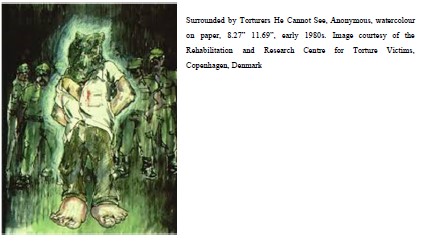
Mavazi chakavu ya mfungwa, akiwa amefungua vifungo vya shati na zipu ya suruali, ni tofauti nyingine na mavazi nadhifu na "yaliyostaarabika" ya walinzi wa gereza. Ukweli kwamba mfungwa amefunika kichwa chake kwa kofia unaonyesha ukosefu wa utambulisho binafsi. Hata hivyo, badala ya hofu, wasiwasi na maumivu anayodhaniwa kuwa nayo, kofia hiyo inayofanana na ya dubu inaonyesha ujasiri na nguvu.
The scruffy clothes of the prisoner with shirt buttons and trouser zip undone are a further contrast to the ‘civilised’ and neat attire of the prison guards. The fact that the prisoner is hooded reveals a lack of self-identity. Though, in place of his assumed fear, worry and pain, the bear-like hood projects defiance and strength.
Bila shaka, Waislamu wanakabiliwa na mvua ya mara kwa mara ya taarifa za vyombo vya habari zinazodharau imani yao au Waislamu wengine. Ubaguzi huu wa mara kwa mara unaongeza wasiwasi na hatimaye unaunda jinsi sisi wenyewe tunavyojiona kama watu wanaofafanuliwa zaidi kupitia vurugu. Mada za ukatili, nyuma ya maendeleo, na picha za wanawake wamevaa hijabu au burqa zilizowekwa ndani ya simulizi za hofu na yasiyojulikana ni jambo la kawaida. Butler anaeleza kwamba ‘mifumo ambayo kwayo tunatambua au, kwa kweli, tunashindwa kutambua maisha ya wengine kama yaliyopotea au kujeruhiwa (yanayoweza kupotea au kujeruhiwa) imejaa siasa. Ni shughuli za madaraka zenyewe. Hazaamui kwa upande mmoja hali za kuonekana, lakini lengo lao ni hata hivyo kuweka mipaka ya eneo la kuonekana lenyewe.’19
Undoubtedly, Muslims face a constant barrage of press reports that vilify their faith or other Muslims. This constant othering heightens anxieties and comes to shape the way we see ourselves as a people largely defined through violence. Motifs of barbarity, backwardness, images of women in hijab or burqa framed around narratives of fear and the unknown are commonplace. Butler notes that ‘the frames through which we apprehend or, indeed, fail to apprehend the lives of others as lost or injured (lose-able or injurable) are politically saturated. They are themselves operations of power. They do not unilaterally decide the conditions of appearance, but their aim is nevertheless to delimit the sphere of appearance itself.’19
Tudor (2011) anatoa mfano ufuatao kuonyesha jinsi mitazamo na mitizamo ya watu wengine inavyoathiri kwa kiasi kikubwa mtazamo wa huruma au wa kuhisi hisia za wengine. Ingawa anatahadharisha dhidi ya kujumlisha, anaandika:
Tudor (2011) strikes the following example to reflect how attitudes and perceptions of others have a strong bearing on sympathetic or empathic outlooks. Though cautioning against generalisations, he writes:
Reel Bad Arabs
Reel Bad Arabs
Utafiti wa Lendenman (1983) umebaini mfululizo wa picha hasi za Waarabu katika katuni za kisiasa za magazeti ya Marekani kama vile The Washington Post, The Washington Star, The Miami News, The Baltimore Sun na mengineyo. Uchambuzi wa Palmer (1995) wa katuni za kisiasa katika The Washington Post baada ya vita vya Israel vya mwaka 1956, 1957 na 1973, na Intifada ya Wapalestina, ulionyesha mwelekeo uleule. Hata kabla ya Vita vya Ghuba vya kwanza, kulikuwa na mwelekeo uleule wa kuwaonyesha Waarabu kwa namna hasi na ya kuwavua utu, mara nyingi Waarabu wa Kipalestina hasa. Picha hasi za namna hii mara nyingi hutumiwa kukuza vita vya Marekani, au, katika uchambuzi wa Palmer (1995), kukuza kampeni za Israel dhidi ya Wapalestina.26 Utafiti wa Nasir (1979) kuhusu taswira ya Waarabu katika filamu za Marekani kati ya mwaka 1894 na 1960
Lendenman’s (1983) research has revealed successive negative portrayals of Arabs in political cartoons in American newspapers such as The Washington Post, The Washington Star, The Miami News, The Baltimore Sun and others. Palmer’s (1995) analysis of political cartoons in The Washington Post following Israel’s wars of 1956, 1957 and 1973, the Palestinian Intifida. Even prior to the first Gulf War, there was reflected the same tendency of negative and dehumanising portrayals of Arabs, and oftentimes specifically Palestinian Arabs. Such negative images are often used to promote American wars, or in the case of Palmer’s (1995) analysis, to promote Israel’s campaigns against Palestinians.26 Nasir’s (1979) study of the portrayal of Arabs in American movies between 1894 and 1960
…ilifichua picha kuu ya Waarabu kuwa nyuma kimaendeleo, waovu na wasio na utu.27 Katika utafiti mpana wa Shaheen wa zaidi ya filamu 900 za Hollywood zilizotolewa kati ya mwaka 1896 na 2001, mwelekeo mkuu wa jinsi vyombo vya habari vilivyowasilisha Waarabu kama wahalifu waliovuliwa utu wao unaonekana wazi.28
revealed a predominant image of Arabs as backwards, evil and inhumane.27 In Shaheen’s comprehensive study of over 900 Hollywood movies released between 1896 and 2001, a dominant trend of media presentations of Arabs as the dehumanised villain is evident.28
Vivyo hivyo, Kamalipour (2000) alichunguza taswira hasi ya Waarabu katika redio, televisheni na filamu, akaonyesha jinsi Waarabu wanavyoonyeshwa kuwa na mwelekeo wa kufanya vitendo vya ugaidi dhidi ya Wamarekani.29 Kazi nyingine za Ayish (1994) na Qazzaz (1975) zilionyesha jinsi picha hizi za kubuni za Waarabu kama watu waovu kwa asili, wenye vurugu, wasio na utamaduni na wenye kutisha zinavyojitokeza sana katika vitabu vya elimu ya jamii vya shule za msingi, sekondari ya chini na sekondari ya juu, na hivyo kuendeleza dhana potofu hasi kuhusu Waarabu.
18 Kahleen McCullough-Zander na Sharyn Larson, ‘The Fear Is Still Me’ - http://www.nursingcenter.com/upload/static/230543/fear.pdf.
18 Kahleen McCullough-Zander and Sharyn Larson, ‘The Fear Is Still Me’ - http://www.nursingcenter.com/upload/static/230543/fear.pdf.
19 Judith Butler (2010) ‘Performative Agency’ in Journal of Cultural Economy, 3:2, p. 1.
19 Judith Butler (2010) ‘Performative Agency’ in Journal of Cultural Economy, 3:2, p. 1.
20 K. Tudor (2011). Understanding Empathy. Transactional Analysis Journal, 41(1), 39–57. Garber: 2004, p. 83.
20 K. Tudor (2011). Understanding Empathy. Transactional Analysis Journal, 41(1), 39–57. Garber: 2004, p. 83.
21 R. Srikanth, Constructing the Enemy: Empathy/Antipathy in U.S. Literature and Law (Philadelphia, Temple University Press: 2012), uk. 158.
21 R. Srikanth, Constructing the Enemy: Empathy/Antipathy in U.S. Literature and Law (Philadelphia, Temple University Press: 2012), p. 158.
22 Kayla Williams, Love My Rifle More Than You (W.W. Norton, 2006), uk. 249.
22 Kayla Williams, Love My Rifle More Than You (W.W. Norton, 2006), p. 249.
23 Herbert Kelman, “Violence Without Moral Restraint: Reflections on the Dehumanization of Victims and Victimizers”, Journal of Social Issues, Vol. 29, No.4, (1973), p. 48.
23 Herbert Kelman, “Violence Without Moral Restraint: Reflections on the Dehumanization of Victims and Victimizers”, Journal of Social Issues, Vol. 29, No.4, (1973), p. 48.
24 Jodi Halpern na Harvey M. Weinstein, Rehumanizing the Other: Empathy and Reconciliation, Human Rights Quarterly, Vol. 26, No. 3 (Aug., 2004), pp. 568-9.
24 Jodi Halpern and Harvey M. Weinstein, Rehumanizing the Other: Empathy and Reconciliation, Human Rights Quarterly, Vol. 26, No. 3 (Aug., 2004), pp. 568-9.
25 Jodi Halpern, From Detached Concern to Empathy: Humanizing Medical Practice 1 7-18 (2001), pp. 130-133;143.