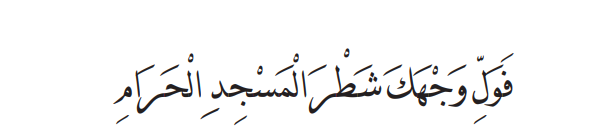
Dans ce verset, Allah (SWT) mentionne le premier ordre, qui consistait à se diriger vers Jérusalem, comme étant Son propre ordre. Cela impressionne le lecteur par le fait qu'Allah (SWT) lui-même était à l'origine de l'ordre de se diriger vers Masjid al-Aqsa. Mais lorsque nous lisons le Coran, nous ne trouvons aucun verset de ce genre dans lequel Allah (SWT) ordonne aux musulmans de prier vers Jérusalem.
In this aya, Allah سبحانه وتعالى.mentions the first order, which was to face towards Jerusalem, as His own order. This impresses upon the reader the fact that Allah سبحانه وتعالى. himself was behind the order to face Masjid al-Aqüó. But when we read the Qur’an we do not find any such aya in which Allah سبحانه وتعالى. ordered the Muslims to pray towards Jerusalem.
Le fait est que cet ordre provient du Bienheureux Prophète ﷺ et non d'un verset du Coran. Le verset ne dit pas : « Le Bienheureux Prophète ﷺ a instauré l'ordre... », mais il dit plutôt : « Nous avons désigné la direction de la prière (Qiblah)... ». Cela nous amène à comprendre que l'ordre du Bienheureux Prophète ﷺ n'est pas différent de l'ordre d'Allah (SWT).
The fact is that this order came from the Blessed Prophet صلى الله عليه وسلم and not from any aya of the Qur’an. The aya does not say, “The Blessed Prophet صلى الله عليه وسلم enacted the order…” rather it says, “We appointed the qibla….” This brings us to the understanding that the order of the Blessed Prophet صلى الله عليه وسلم is no different from the order of Allah سبحانه وتعالى..
La preuve est si évidente qu'elle ne nécessite aucune clarification supplémentaire. Cette déclaration claire du Qur’an concernant l'ordre donné par le Prophète ﷺ démontre une croyance fondamentale concernant l'aúódõth du Prophète ﷺ : qu'il s'agit d'une forme de révélation. Et c'est ce que l'on appelle la révélation non dite ou non récitée.
The proof is so self-evident it does not require any further clarification. This clear statement from the Qur’an regarding the order given by the Blessed Prophet صلى الله عليه وسلم demonstrates a fundamental belief about the aúódõth of the Blessed Prophet صلى الله عليه وسلم: that they are a form of revelation. And this is what is known as the unspoken or unrecited revelation.
L'ayah mentionnée ci-dessus révèle également d'autres points importants :
The aya mentioned above also reveals some other important points:
1. Un type spécial de révélation fut envoyé au Bienheureux Prophète ﷺ qui ne faisait pas partie du Qur’an.
1. A special type of revelation was sent to the Blessed Prophet صلى الله عليه وسلم which was not a part of the Qur’an.
2. Ces révélations provenaient d'Allah (SWT).
2. These revelations were from Allah سبحانه وتعالى.
3. De même, les règles découlant des révélations non formulées étaient également les règles d'Allah (SWT).
3. Similarly, the rulings that derived from the unspoken revelations were also the rulings of Allah سبحانه وتعالى.
Tous les compagnons (Sahabah) رضي الله عنه étaient tenus de se conformer aux ordres de la révélation non formulée de la même manière qu'ils se conformaient à la révélation formulée [le Coran]. Certains ordres furent révélés pour éprouver la foi des musulmans, particulièrement ceux qui furent révélés par la révélation non formulée, afin de voir s'ils obéissaient aux ordres. De nombreux autres exemples pourraient être cités, mais ils n'ont pas été mentionnés par souci de brièveté.
All the Sahaba رضي الله عنه were obligated to fulfill the orders of the unspoken revelations in the same manner as they were the spoken revelation [Qur’an]. Some orders were revealed to test the õmón of the Muslims, particularly those orders that were revealed through the unspoken revelation, to see whether they obeyed the orders. Many other examples could be cited, but they have not been mentioned for the sake of brevity.
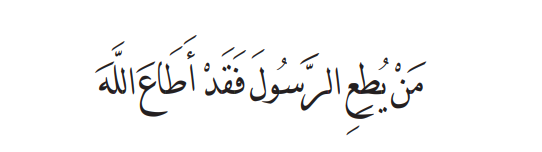
Alors que cette preuve susmentionnée souligne l'importance des hadiths et leur validité en tant qu'autorité en Islam, elle établit également que la préservation du Qur’an inclut la préservation des hadiths. Le Qur’an lui-même est l'essence de la pensée islamique et constitue la parole finale en la matière. Le Qur’an déclare :
While this aforementioned proof highlights the importance of the aúódõth and their validity as an authority in Islam, it also establishes that the preservation of the Qur’an includes preservation of the úódõth. The Qur’an itself is the essence of Islamic thought and is the final word in this matter. The Qur’an states: