3.2 第二章 牲畜的天课
3.2 Chapter Two Zakah On Livestock
动物界有许多物种。人类只利用了其中的少数几种。阿拉伯人称之为"al an'am"(牲畜)。骆驼、牛、水牛、绵羊和山羊,都属于真主赐予仆人的恩典之列。它们的益处在祂的圣书中多处提到。 在《al Nahl》章(有时也称为《al An'am》即牲畜章)中,真主说:"牲畜,祂为你们创造了它们,你们从中获得温暖和许多益处,并以它们的肉为食。你们傍晚把它们赶回家时,早晨把它们牵去放牧时,心中都感到荣耀与美丽。它们为你们负载沉重的货物,到达你们若非极其疲惫便无法抵达的地方。你们的主实在是至慈的,极仁慈的。"[1]又说:"牲畜之中,有你们的一个教训。我们从它们腹中的粪便和血液之间,为你们提取纯净、美味、饮者喜爱的乳汁。"[2]又说:"祂用牲畜的皮为你们造了帐篷供你们居住,你们在旅途中和停留时都觉得轻便方便;又用它们的羊毛、绒毛和毛发,为你们制作家具和各种用品,供你们享用一段时间。"[3] 在《Yasin》章中,真主说:"难道他们没有看见,我亲手创造的万物中,我为他们创造了牲畜,它们归他们支配。我使它们为他们所用:其中有的供他们骑乘,有的供他们食用;他们还从中获得其他益处,并得到乳汁饮用。他们难道还不感恩吗?"[4] 真主为人类创造了这些牲畜,使它们听从人类,供人骑乘,并利用它们的皮和毛。真主要求人们感恩,这并不令人惊讶。
The animal kingdom has many species. Mankind has made use of only a few of them. This is what is known by Arabs as al an'am. Camels, cows, buffalo, sheep, and goats, are all part of what God bestowed on His servants. Their benefits are mentioned in several places in His Holy Book. In sura al Nahl - sometimes called sura al An'am (livestock) - God says "and cattle He has created for you, from which ye derive warmth, and numerous benefits, and of their meat ye eat. And ye have a sense of pride and beauty in them as ye drive them home in the evening, and as ye lead them forth to pasture in the morning, And they carry your heavy loads to lands that ye could not otherwise reach except with souls distressed, for your Lord is indeed most kind, moat merciful,"1 Also "and buried in cattle will ye find an instructive sign, from what is within their body between excretions and blood, we produce for your drink, milk, pure and agreeable to those who drink it,"2 "and made for you, out of the skins of animals, tents for dwellings, which ye find so light and handy when in travel and when ye stop, and out of their wool, and their soft fibers, and their hair, furniture and articles for all convenience to serve you for a time"3. In sura Yasin, "See they not that we have created for them among the things which our hands have fashioned, cattle which are under their domination. And that we have subjected them to their use: of them some do carry them and some they eat, and they have other profits from them besides, and they get milk to drink. Will they not then be grateful?".4 God fashioned this livestock for mankind, and He subjects then to humans to ride and to make use of their skin and hair. It is not surprising that God asks people to be thankful.
《古兰经》和纯正的圣训所号召的最明显、最切实的感恩方式,便是缴纳天课的义务。天课的基数和税率都已确定,每年都会派遣收取者前往牲畜的所有者处,并对拒绝缴纳者提出警告。牲畜,尤其是骆驼,在先知ﷺ时代是阿拉伯人最有用的财产。因此,圣训非常明确地规定了牲畜的基数和税率。如今在许多国家,尤其是穆斯林国家,牲畜仍然是最重要的国家资产和收入来源之一。
The most obvious and practical thankfulness urged by the Holy Qur'an and the purified tradition of the Prophet (p) is the obligation of zakah. Its nisab and rates are determined, collectors are sent every year to owners of cattle, and warning to those who refuse its payment is put forth. Livestock, especially camels, were the most useful asset for the Arabs at the time of the Prophet (p). Consequently, Sunnah determined their nisab and rates very clearly. In many countries today especially Muslim countries, livestock still represent one of the most important national assets and source of income.
以下各节旨在全面阐述牲畜的天课(zakah)。
The following sections attempt to provide full account of zakah on livestock.
第一节 牲畜天课的一般条件
SECTION ONE GENERAL CONDITIONS FOR ZAKAH ON LIVESTOCK
天课并非对所有数量和种类的牲畜都征收。牲畜要应纳天课,必须满足若干条件,下面逐一列举:
Zakah is not imposed on livestock of all quantity and kind. There are certain conditions that should be fulfilled for the zakatability of livestock which are ennumerated here:
1. 应缴天课的最低限额(Nisab)
1. The minimum for zakatability (Nisab)
第一个条件是尼萨布(nisab),因为天课只向富人征收,而并非每个牲畜的主人都是富人。因此必须有一个界限,超过此界限的人才被视为富人,这个界限就是尼萨布。据穆斯林数百年来的一致共识,骆驼的尼萨布是五峰。不足五峰骆驼的,不需缴纳天课;羊的尼萨布是四十只,同样是一致的共识。尼萨布的确定依据是先知ﷺ的圣训、他的实际做法,以及他的继承者们的实践。至于牛的尼萨布,则根据所采纳的教法学派不同而有所差异,从五头、三十二头到五十头不等。
The first condition is nisab, since zakah is only on the rich, and not every owner of livestock is rich. There always should be a limit above which persons are considered rich. This limit is nisab. It is five camels by unanimous agreement of Muslims for centuries. There is no obligated zakah for anything below five camel, nisab for sheep is forty sheep, also unanimous. Nisab is determined by sayings of the Prophet (p), by his actual practice and by the application of his successors. Nisab for cows varies from five to thirty-two to fifty, depending upon the school of jurisprudence one adopts.
2. 一年的流逝(年度)
2. The passage of a Year (Annual)
这一圣训真实可靠,传自先知(愿主福安之)及其继承者。他们过去每年派遣收取天课的人一次,清点牲畜的数目。在前一章中已经说明,非劳动所得的财产须经过一个完整的阴历年,这一条件是获得一致公认的。在此还可补充,主张劳动所得也须满一年的多数学者,并不要求在一年中繁殖所生的牲畜幼崽满一年,而认为幼崽的计算年限应与其母畜相同。
This is reported authentically from the Prophet (p) and his successors. They used to send zakah collectors once every year to take the count on livestock. It was shown in the previous chapter that the condition of the passage of one full lunar year for non-earned assets is accepted unanimously. One can add here that the majority who assert this condition on earned income do not require it on the offspring of livestock that result from reproduction during the year, and accept the zakatable year for offspring to be that of their mothers.
3. 它们应当自然放牧。
3. They should be pastured naturally
放牧牲畜是指在一年中大部分时间里,在天然且无需花费的牧场上放养,以用于繁殖、挤奶和增重的牲畜。与天然放牧相对的是购买饲料。
Pastured livestock are those that are grazed on natural and cost-free pasture land during the major part of the year for the purpose of breeding, milking, and putting on weight.5 The opposite of natural grazing is buying feed.
条件是:牲畜大部分时间靠自然放牧维持生计,即可满足该条件。
The condition is satisfied if livestock is pastured naturally most of the year.
应当为了增殖、繁育和挤奶而放牧;因此,如果是为了个人骑乘或食用而放牧,这些牲畜就不需缴纳天课,因为这样的安排使牲畜脱离了增殖资产的范畴,而归入个人使用的类别,而个人使用的牲畜是不需缴纳天课的,这一点将在下一小节中说明。
Pasturing should be made for the purpose of growth, reproduction, and milking; thus if it is made for the purpose of personal riding or eating, these animals are not zakatable, since such allocation removes animals from being growth assets and put them in the category of personal use which is not zakatable as shall be shown in the next subsection.
这一条件的理由在于:天课是课于盈余之物,即人们易于缴纳的部分,这依据经文"你们当取其盈余",以及经文"他们问你们应施舍什么,你说:盈余",也就是说,课于那些不耗费很多、且能迅速增长的财产。只有放牧而食、不需额外成本的牲畜才能满足这一要求,因为人工饲养的牲畜成本高昂,会使人们难以将其作为天课施舍出去。
The reason for this condition is that zakah is obligated on the surplus, what is easy for persons to pay, in accordance to the verse, "take the surplus"6 and the verse "when they ask you what to spend, say the surplus"7, that is, on what does not cost much and grows rapidly. This can only be fulfilled if the animals pastured cost-free, since artificially fed animals have high cost, which makes it hard for people to give then away as zakah.
这一条件源自艾哈迈德、奈萨仪和艾布·达乌德所传的圣训:巴哈兹·本·哈基姆从其父,再从其祖父传述,他说:我听见神的使者(愿主福安之)说:"在自然放牧(无需成本)的骆驼中,每四十头应缴纳一头作为天课……"等等。这段圣训被一些著名学者评定为可靠。 这里的形容词"自然放牧(无需成本)"表明,人工喂养的骆驼不需缴纳天课;否则添加这样一个形容词就毫无意义,而先知(愿主福安之)是不会无故发言的。从这段圣训可以明显看出,被描述为自然放牧、无需成本的骆驼,与非自然放牧的骆驼是不同的。
This condition is derived from what is reported by Ahmad, al Nasa'i, and Abu Daud from Bahz bin Hakim from his father from his grandfather, who said: I heard the Messenger of God (p) saying about naturally ( cost-free ) postured camels, for each forty, there is one as zakah ... etc. "This saying is graded correct by a group of leading scholars. The adjective "naturally, cost-free pastured" here implies that artificially fed camels are not subject to zakah; otherwise adding such an adjective becomes meaningless, and the Prophet (p) does not speak in vain. It is obvious from this saying that camels characterised, as naturally, cost-free pastured are unlike those that are not.
艾哈迈德·哈塔比(Al Khattabi)评注道:"当某事物可能具有两种特征之一,而某条沙里亚律例适用于其中一种特征时,那么根据隐含之义,相反的律例便适用于另一种特征。"8
4. 应纳天课的牲畜不应是役用牲畜
4. Zakatable livestock should not be working animals
这是牲畜应纳天课的第四个条件。它的意思是,这些牲畜不应被用于耕作、搬运水或货物、骑乘等。此条件只适用于骆驼和牛。 艾布·欧拜德(Abu Ubaid)转述自阿里('Ali):"役用牛不需缴纳天课(sadaqah)。" 另有传述,贾比尔·本·阿卜杜拉(Jabir bin 'Abd Allah)说:"从事耕作的牲畜不需缴纳天课。" 艾布·达乌德(Abu Daud)在其《圣训集》(Sunan)中转述自祖海尔(Zuhair):"艾布·伊斯哈格(Abu Ishaq)转述自阿辛·本·达穆拉('Asem bin Damurah)和哈里斯(al Harith),二人转述自阿里(祖海尔说:'我认为是转述自先知ﷺ'):他说:'把十分之一的四分之一拿来给我,即每四十迪拉姆纳一迪拉姆……'他接着说:'役用牲畜则无须缴纳任何天课。'"此传述也由伊本·艾比·舍拜(Ibn Abi Shaibah)归于先知ﷺ,并由阿卜杜·拉兹克('Abd Al Razzaq)在其《穆萨奈夫》(Musannaf)中,经由萨尔瑞(al Thawri)和马马尔(Mamar)仅归于阿里。12
This is the fourth and last condition for zakatability of livestock. It means that they should not be used for cultivation, carrying water or loads or riding, etc. This condition only applies to camels and cows. Abu Ubaid reports from 'Ali, that " There is no sadaqah on working cows."There is also a report that Jabir bin 'Abd Allah said "Animals working in cultivation are not zakatable."11 Abu Daud, in his Sunan, reports from Zuhair "We are told by Abu Ishaq from 'Asem bin Damurah and al Harith from 'Ali, (Zuhair said "I think from the Prophet") that he said, "Bring me one-fourth of a tenth, i.e. on each forty dirhams one dirham..." and he continued, "and there is nothing due on working animals." This is reported also by Ibn Abi Shaibah linked to the Prophet, and by 'Abd Al Razzaq, in his Musannaf, via al Thawri and Mamar as from 'Ali only.12
类似的传述也见于易卜拉欣、穆贾黑德、祖赫里、欧麦尔·本·阿卜杜勒·阿齐兹以及其他一些再传弟子。13 这也是艾卜·哈尼法、赛日(Al-Thawri)、沙斐仪以及宰丁派的观点。就牛而言,这也是莱斯(al Layth)的主张。
Similar reports exist as coming from Ibrahim, Mujahid, al Zuhri, Umar bin 'Abd al Aziz, and some other Followers.13 It is also the view of Abu Hanifah, al Thawri, al Shafi'i, and the Zaidis. It is the opinion of al Layth as far as cows are concerned.
两个方面支持这些传述和这一观点。第一,凡是为个人使用和服务而备置的财产不需缴纳天课,同理,为耕作或个人运输而饲养的牲畜也不应缴纳天课。显然,这类牲畜并不属于用于增值的投资资产。14 第二,阿布·欧拜德转述祖海里的说法:用于载人的牛和骆驼不需缴纳天课,用于耕作的牛同样不需缴纳。15 所有这些都类似于农业工具。赛义德·本·阿卜杜·阿齐兹·塔努赫说:"用于耕作的牛不需缴纳天课,因为对所产的谷物已经征收天课,而这其中包含了牛的劳作。"16 如果对农业生产中使用的牲畜也征收天课,那么农业就要被双重征收:一次针对生产资料,再一次针对产出,正如阿布·欧拜德所正确指出的那样。马立克在这一裁决上与多数学者意见相左,依他之见,无论牛和骆驼是否役使,是否在自然牧场放牧,都负有天课义务。当有人向赛绥里转述马立克的观点时,他回答说:"我没想到会有人这样说。"17 公允地说,还应补充一点:一些马立克学派的法学家倾向于多数学者的观点。
Two things support these narrations and this point of view. The first is the principle that assets designated for personal use and service are not zakatable, and by the same token livestock designated for cultivation, or personal transportation should not be zakatable. It is apparent that such animals are not part of the assets invested for growth.14 Secondly, the report of Abu 'Ubaid from al Zuhri, that cows and camels used for carrying riders are not zakatable, and neither are cows used for cultivation.15 All these are like tools for agriculture, Sa'id bin Abd al Aziz al Tanukhi says "Cows used in cultivation are not zakatable, because the grain produced is being zakated, and it involves the work of cows.16 If animals used in the process of farming were to be zakated, zakah would then be double on agriculture, taken once on the means of production and again on the produce, as rightly stated by Abu 'Ubaid. Malik disagrees with the majority on this ruling, and according to him zakah is obligated on cows and camels, working or not, naturally pastured or not. When the view of Malik was mentioned to al Thawri he replied "I did not think that anyone would say that".17 In fairness, one should add that some Malikite jurists lean toward the view of the majority.
第二节 骆驼的天课
SECTION TWO ZAKAH ON CAMELS
穆斯林的一致共识,以及先知的若干可靠圣训和圣门弟子的记载,都表明骆驼的尼沙布及其对应的征收标准如下:
The unanimous agreement of Muslims, as well as several correct sayings of the Messenger of God (p) and reports from his Companions indicate nisab of camels and the rates of nisab on them are as follows:
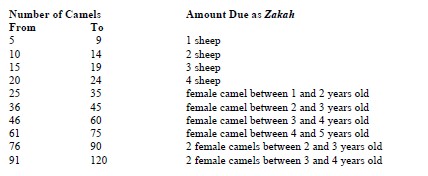
在这一计算方法上,学者们达成了共识(ijma),唯一的例外是'Ali的一则传述:每二十五头骆驼缴纳五只羊,二十六头骆驼则缴纳一头一至两岁的母骆驼。19 伊本·al-Mundhir说:此处的一致意见并未被打破,因为从'Ali传来的这则传述并不可靠。而Anas关于这些数目和数量的说法是正确的,学者们一致认同其内容。20 对于超过一百二十头骆驼的情况,多数学者的看法是:每增加五十头骆驼,额外的天课为一头三至四岁的母骆驼;而每增加四十头骆驼,额外的天课为一头两至三岁的母骆驼。21 下表列出了这些规定:
There is ijma on this schedule,l9 except for a report from 'Ali that on 25 camels there is five sheep and on 26 camels there is one female camel between one and two years old.20 Ibn al Mundhir says. The unanimity is net broken, because what is reported from 'Ali is not authentic. The saying of Anas on these quantities and amounts is correct and there is a unanimous agreement on its content.21 For more than 120 camels the majority's view is that for each additional 50 camels the additional amount of zakah is a female camel between three and four years old while on each additional 40 camels the additional amount of zakah is a female camel between two and three years old.22 This is shown in the following table :
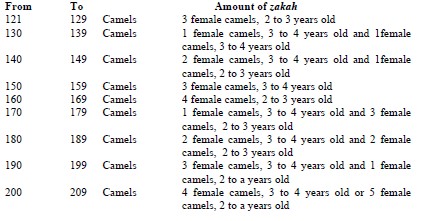
从表中可以看出,对于较大的数目,骆驼数量增加不足十头时,天课的数额不受影响。一旦增加到十头,则依照上述同一规则,天课的应付数额便提高一个等级。从这两张表可以明显看出,若所拥有的骆驼少于五头,则无天课。骆驼达到五头时,应付的数额为一只羊。 《Al Mabsut》的作者引述一位学者的话说:"这意味着要考虑牲畜的价值。一至两岁的骆驼当时的价格为四十迪拉姆,一只羊为五迪拉姆,因此五头骆驼等于二百迪拉姆,也等于四十只羊。这表明骆驼、羊和白银钱币达到应纳天课的最低标准是相同的。" Ibn al Humam在《al Fath》中、Ibn Nujaim在《al Bahr》中回应道,有一条圣训这样说:"若有人应当以某一年龄段的骆驼作为天课,但他并未拥有该年龄段的骆驼,则他可以用羊来替代,按平均每只十迪拉姆折算;若他也没有羊,……"这是一段明确的经文,与al Sarakhsi的解释相矛盾。24所引用的这条圣训,由《al Bahr》转引自Anas。
It is seen from the table that for big numbers, an increase of less than ten camels does not affect the amount of zakah. Once it is increased by ten, then you go one step higher in the amount of zakah due according to the same rule mentioned above. It is obvious from these two tables that if the number of camels owned is less than five then there is no zakah. Once they reach five , the amount due is one sheep. The author of al Mabsut quotes a scholar as saying, "this means that the value of the livestock is considered. Camels between one and two years old used to be priced at forty dirhams and a sheep at five dirhams, so five camels equal 200 dirhams also equal 40 sheep. This implies that the minimum for zakatability of camels, sheep, and silver money is the same. Ibn al Humam in al Fath and Ibn Nujaim in al Bahr reply, there is a saying that states "Whoever is obliged to give as zakah a camel of a certain age group, but does not own any in that age, can pay in substitution on the average of 10 dirhams for a sheep, if he does not have a sheep. This is an explicit text that contradicts the explanation of al Sarakhsi.24 The saying referred to is reported by al Bahr from Anas.
伊斯兰教法规定,若应纳天课的骆驼数量少于二十五头,则以羊作为天课缴纳,不过通常天课是从同类应纳天课的财产中支付的。
Shari'ah obligates sheep as zakah on camels if the number of zakatable camels is lees than 25, though usually zakah is paid out of the same kind of the zakated assets.
原因显然是应缴的数额不足一头骆驼,但与此同时,伊斯兰教法认为五头骆驼足以界定一个人是否属于富有者。25
The reason is obviously that the amount due is less than one camel, but at the same time Shari'ah considers five camels to sufficiently define who is rich.25
上述两张表格中的数字和数量,都来源于上帝的使者(愿主福安之)的行为。奈瓦维在《麦吉慕尔》中说,牲畜天课的数量和金额来源于安祖(愿主喜悦之)和伊本·欧麦尔(愿主喜悦之)所传述的两段圣训。26
Numbers and amounts in the above two tables come from the actions of the Messenger of God (p). Al Nawawi in al Majmu' says that the quantities and amounts of zakah on livestock come from the two saying narrated by Anas and Ibn 'Umar.26
阿奈斯传述:诚实者阿布·伯克尔在派遣他前往巴林时,写下了这封信。
Anas narrated that Abu Bakr, the Truthful wrote this message when he sent him to Bahrain:
以至仁至慈的真主之名。这是使者(愿主福安之)所规定的穆斯林应尽的天课义务,此乃真主对他的命令。 Wait—per the rules, "Messenger of God (P)" should be rendered with ﷺ once after the mention of the Prophet, instead of an abbreviated honorific. Correct output: 以至仁至慈的真主之名。这是真主的使者ﷺ所规定的穆斯林应尽的天课义务,此乃真主启示给他的命令。
In the name of God, most merciful, most gracious. This is the obligation of sadaqah imposed on Muslims by the Messenger of God (P), as ordained to him by God.
凡按照这些规定被要求缴纳的人,应当缴纳;凡被要求缴纳超出规定之数的人,应当拒绝。每二十四头骆驼或更少的情况下,天课以羊缴纳。每五头骆驼,需缴纳一只羊。骆驼达到二十五头直至三十五头时,需缴纳一头一至两岁的母骆驼。从三十六头到四十五头,需缴纳一头两至三岁的母骆驼。
Whoever is asked to pay it according to these rules must give it, and whoever is asked to pay more should refuse. On each 24 camels or less, zakah is due in sheep. On each five camels, one sheep is required. Once they reach 25 and up to 35 one female camel, one to two years old, is required. From 36 to 45, there is one she-camel two to three years old.
如果骆驼数量达到46至60头,应缴纳一头三至四岁、可以配种的母驼。如果达到61至75头,应缴纳一头四至五岁的母驼。如果达到76
If they reach 46 to 60, there is one she-camel three to four years old due, one that can be bred. If they reach 61 to 75, one she-camel four to five years old is due. If they reach 76
从九十只到一百二十只,应缴两只两岁至三岁的母驼。若达到九十一只至一百二十只,应缴两只三岁至四岁的母驼。若超过一百二十只,则每四十只……
to 90, there is two she-camels two to three years old due. If they reach 91 to 120, there are two she-camels, three to four years old due. If they are more than 120, for each 40
每二十五头骆驼中有一头两至三岁的母骆驼;每五十头中有一头三至四岁的母骆驼。拥有四头骆驼以内的人,除非自愿,否则不需缴纳天课;但若骆驼达到五头,则需以一只羊作为天课缴纳。在羊的天课中,若羊是天然放牧、不需花费饲料的,且数量在四十至一百二十只之间,则应缴纳一只羊。超过一百二十只至两百只,则应缴纳两只羊。
there is one she-camel two to three years old, and for each 50 there is one she-camel three to four years old. A person who owns [up to] four camels is not zakatable unless he volunteers, but if they reach five camels, one sheep is due on them as zakah. In the sadaqah on sheep, if they are naturally, cost-free pastured, and number between 40 and 120 sheep, there is one sheep due. For more than 120 and up to 200, there are two sheep.
对于超过200只但不足300只的情况,应缴纳三只羊。超过300只的,每100只羊缴纳一只羊作为天课,不足100只的部分也计算在内。若一个人所拥有的羊不足40只,
For more than 200 up to 300 there are three sheep. For more than 300, the amount of zakah is one sheep for each 100 or a fraction therein. If a person owns less than 40
关于一百二十只骆驼之后的费率差异
Variance on the Rates after 120 Camels
我前面指出,学者们对一百二十只骆驼以上的天房费(天课)有不同看法。马立克、沙斐仪、艾哈迈德及多数学者认为:每超过五十只,应缴一头三至四岁的雌驼;每超过四十只,应缴一头两至三岁的雌驼。这与艾奈斯和伊本·欧麦尔转述的艾布·伯克尔和欧麦尔的文告相符。同样的内容也见于伊本·哈兹姆以及齐雅德·本·拉比德致哈达拉茂特人的文书,还有先知ﷺ的圣训:"若超过一百二十只,则每四十只缴一头两至三岁的雌驼,每五十只缴一头三至四岁的雌驼。"该圣训的部分版本由传述人简化为"每五十只缴一头雌驼……",未提及每增加四十只的标准,但各版本相互补充。
I pointed out earlier that there are varying views among jurists on zakah on above 120 camels. Malik, Shafi'i, Ahmad, and the majority consider the rate to be one female camel, three to four years old for each additional 50, and one female camel, two to three years old, for each additional 40,39 as mentioned in the message of Abu Bakr and 'Umar narrated successively by Anas and Ibn 'Umar. The same also appears in the messages of Ibn Hazm and Ziad bin Labid to the people of Hadramut,40 in the words of the Prophet (p) "If they exceed 120, then for each 40 one female camel two to three years old, and for each 50 one female camel three to four years old". Some versions of the last saying are summarized by that narrator, as "In each 50 one female camel ..." without mentioning the rate for each additional 40, but the different versions complete each other.
阿布·哈尼法的观点
Abu Hanifah's view
纳赫伊(Al Nakha'i)、萨乌里(Al Thawri)和艾布·哈尼法41认为:"对于超过120峰的部分,我们从头开始计算费率,即额外每5峰骆驼缴纳一只羊,直至24峰;额外25峰骆驼时,应缴天课为一头一至两岁的雌骆驼,以此类推。"下表列出了依照此观点应缴纳的数额:
Al Nakha'i, Al Thawri, and Abu Hanifah41 say that "for what is above 120, we start the rates from the beginning, i,e., for an additional five to 24 camels, the rate is one sheep for each 5 camels, and for an additional 25 camels zakah due is one female camel, one to two years old, etc."The following table shows the amount due according to this opinion:
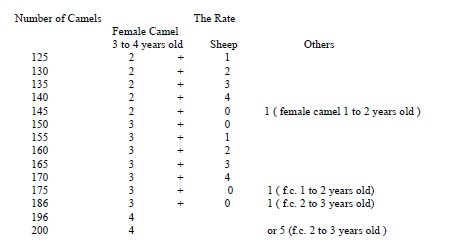
超过200头骆驼后,费率重新开始循环:每增加五头骆驼,缴纳一只羊;每当额外应纳天课的骆驼达到五十头时,应缴纳的天课为一头三至四岁的母骆驼。
After 200 the rate repeats itself, one sheep for each additional five camels, and each time the additional zakatable camels reach fifty, the amount of zakah due on it is one female camel three to four years old.
哈乃斐学派认为,艾卜·达五德(Abu Daud)所载的圣训属于"穆尔赛勒"(mursal,即传述链中未提及提供消息的圣门弟子之名的圣训)。伊斯哈格在其《穆斯奈德》(Musnad)中,以及泰哈维在其《米什克勒》(Mushkel)中,均从哈马德·本·萨拉马(Hmmad bin Salamah)处传述。他说:"我对盖斯·本·萨阿德说,请为我取来穆罕默德·本·哈兹姆的文书。于是他给了我一封信,并说这是他从艾卜·伯克尔·本·穆罕默德·本·哈兹姆那里取得的,后者说,先知穆罕默德ﷺ曾将此信写给我的祖父。我读了它,发现其中有关于天课骆驼的比例……"他接着叙述该段文字,直至:"骆驼超过一百二十头后,每三十头应交一头三至四岁的雌驼。对于增加的部分,从头开始计算比例;而不足二十五头的骆驼增量,天课则以羊计,每五只交一只羊。"此段记载见于宰拉伊(al Zaila'i)的《奈斯布·赖伊》(Nasb Al Rayah)。阿绥姆·本·达穆拉('Asem bin Damurah)从阿里处也传述了相似的版本,此传述同样与先知ﷺ相连,并止于阿里。据传伊本·麦斯欧德也说过类似的话。伊本·鲁世德(Ibn Rushd)记载,哈乃斐学派认为,此类事项只能依据先知ﷺ的明确指示来决定,因为它不是可以通过类比推导出来的内容。44
The Hanafites argue that Abu Daud reports as mursal [saying in whose chain the name of the reporting Companion is not mentioned], Ishaq in his Musnad and al Tahawi in his Mushkel from Hmmad bin Salamah, who said, "I told Qais bin Sa'd to get me the message of Mohammad bin Hazm, so he gave me a letter which he said he took from Abu Bakr bin Mohammad bin Hazm, who said that the Prophet (p), wrote it to my grandfather. I read it and found in it the rates of zakah on camels... " and he narrated the saying until, "Once they exceed 120 make due on each 30 one female camel three to four years old. For the increments, restart the rates from the beginning, and for what is less than 25 camel increments, the amount of zakah is due in sheep, one sheep for each five." This is reported in Nasb Al Rayah by al Zaila'i.42 A similar version is narrated by 'Asem bin Damurah from Ali, linked to the Prophet as well as ending at 'Ali,43 and Ibn Mas'ud is reported to have said similar things. The Hanafites are said by Ibn Rushd to have argued that such a thing cannot be decided but by instructions from the Prophet, because it is not anything that can be deducted by analogy.44
大多数学者不认同哈乃斐派的论据,并认为他们的结论有欠缺。拜哈基(Al Baihaqi)指出,关于此事,传自伊本·麦斯欧德(Ibn Mas'ud)的说法并不可靠。45 与先知(ﷺ)相连的阿里('Ali)那段话的版本同样不正确,而归于阿里的那段话的版本,学者们也意见不一。其中一个版本与艾布·伯克尔(Abu Bakr)和欧麦尔('Umar)的书信内容相符,另一个版本则有所不同。在这种情况下,通行的原则是:优先采信与其他正确且无争议的圣训相符的版本。这一点为哈兹米(al Hazimi)所指出。46 此外,同一段话(出自阿辛('Asem))的版本中还包含一句话,因其薄弱,所有学者都一致弃置不用,即:每二十五头骆驼的天课应为五只羊,而非一头一至两岁的母骆驼。另一方面,可以对那些不同的版本作出解释,使其与其他正确的圣训相互一致。
The majority of scholars disapprove of the arguments of the Hanafites and see weakness in their findings. Al Baihaqi shows that whatever is reported from Ibn Mas'ud in this matter is not correct.45 The version of the saying of 'Ali which is linked to the Prophet (p) is also incorrect, and there are also differing opinions on the version that is attributed to 'Ali. In one version it is reported in a consistent manner with the letters of Abu Bakr and 'Umar, while in another version it is reported differently. The usual applicable rule in such a case is that we give more weight to the version that is consistent with other correct sayings which are not disputed. This was noted by al Hazimi.46 Moreover, the same version of the saying (from 'Asem) contains a sentence all scholars agree to disregard because of its weakness. That is the statement that for each 25 camels the zakah due is five sheep instead of a one to two years old she-camel. On the other hand, it is possible to interpret those differing versions in a way that make then consistent with the other correct sayings.
艾勒·塔巴里的观点
The view of Al Tabari
艾布·贾法尔·al·塔巴里提出了第三种调和性的观点,认为两种意见都可以接受,由天课征收机构选择采用哪一种观点。52 在我看来,这种做法更为可取,因为只要有一丝可能使先知(p)的所有传述得以调和,就不应认为某段圣训的内容已被取代而失效。若我们牢记,确定天课骆驼的年龄和数量,其目的在于便利天课的计算、缴纳与征收,并简化程序,使天课征收机构能够行使一定的裁量权,那么塔巴里所提出的这种调和无疑是可以接受的。
Abu Ja'far al Tabari expresses a third, reconciling view, stating that both opinions are acceptable, and it is up to the zakah collection agency to select which view to apply.52 In my opinion this is a better approach, since one should not consider the content of a saying superseded and annulled if there is the slightest chance of a reconciliation of all the reports from the Prophet (p). The reconciliation proposed by al Tabari is undoubtedly acceptable if we keep in mind that the determination of ages and quantity of camels due as zakah is meant to facilitate zakah calculation, payment, and collection, and to simplify the procedures so that the zakah collecting agency can exercise some discretion.
"零钱"的"天课"之间细微的字母差异
The slight differences in the letters of zakah
在来自安拉的使者(愿主福安之)及其贤明的继任者们所传的天课相关圣训的不同版本中,人们会发现一些细微的差异。例如,不同年龄骆驼之间的价值差额,是十迪拉姆(或两只羊),还是二十迪拉姆(或两只羊)?如何解释阿里的书信与艾布·伯克尔和欧麦尔的书信之间的差异?众所周知,归于先知(愿主福安之)的阿里那段记载并不可靠,但也众所周知,认为那是阿里本人之言的版本是正确的。阿里怎么会与先知(愿主福安之)的书信相左呢?他既然生活在艾布·伯克尔和欧麦尔的时代,怎么会不了解他们的书信及其执行情况呢?他是否认为自己掌握的信息优先于另一封书信所载的内容?
Looking at the different versions of messages about zakah reported from the Messenger of God (p), and his Wise Successors, one would find some minor differences. An example is whether the difference in value between different age camels is ten dirhams (or two sheep) or twenty dirhams (or two sheep)53. How can the difference between the letter of 'Ali and those of Abu Bakr and 'Umar be explained? It is known that the report of 'Ali is incorrect as linked to the Prophet (p), but it is also known that the version stating that it is a saying of 'Ali himself is correct. How could 'Ali differ with the letter of the Prophet (p)? How could he, who lived the era of Abu Bakr and 'Umar not be aware of their letters and application? Did he believe that he had information which superseded that contained in the other letter?
在我看来,这些问题的答案都是否定的,我认为对这些细微差异应当另作解释。我相信,其中一些等值规定,例如羊与白银的价值换算,是先知(ﷺ)以国家元首的身份所定的。当时羊的价格大约是一只羊等于十个迪尔汗。众所周知,价格会随时间变化,因此当先知(ﷺ)把两只羊定为二十个迪尔汗时,他引用的是当时的市价。到了阿里哈里发时期,羊价已经不同,他所引用的价格是两只羊十个迪尔汗。这并不违背先知的话语,而是运用先知所采用的原则,使之适应阿里所处的时代。在我看来,这种解释比任何否定那些互相歧异的经文的做法都更为妥当,例如雅哈雅·本·马因的做法,他断言关于天课的数额和比例,没有任何可靠的记载。伊本·哈兹姆对此类说法作了严厉的批驳,质问像伊本·马因这样的人,怎能在毫无丝毫证据支持的情况下说出这样的话。东方学家沙赫特则把这一说法发挥到极致,借以试图否定所有关于天课的正确圣训。
In my opinion all these questions are answered negatively and it seems to me that another interpretation of those minor differences is due. I believe that some of these equalities, like the value of sheep in silver, are given by the Prophet (p), in his capacity as the head of the state. Their prices at his time were such that a sheep equaled approximately ten dirhams. It is known that prices vary from time to time, and when the Prophet (p), gave the ratio as twenty dirhams for two sheep he was quoting his period's current prices. At the time of 'Ali's caliphate, prices of sheep were different, and his quotation of those prices were ten dirharms for two sheep. This is not a violation of the Prophet's saying, but rather an application of the rule used by the Prophet (p), to what suits the time of 'Ali. This interpretation is, in my opinion, better than any attempt to disregard any of the differing texts, like what Yahya bin Ma'in did in claiming that nothing correct is reported on the determination of rates and quantities of zakah.55 Ibn Hazm came down very hard on such a claim and asked how a person like Ibn Ma'in could state such a thing without even the slightest supporting evidence.56 An Orientalist like Schacht abuses to the utmost that claim in his attempt to reject all the correct sayings on zakah.
第三节 牛的天课
SECTION THREE ZAKAH ON COWS
牛是人类用于耕田、获取肉食和牛奶的动物,也是真主赐予祂的仆人的另一项恩惠。这一物种的用处曾经如此之大,以至于一些民族,例如古埃及人和当代的印度教徒,甚至崇拜这种动物。
Cows, used by mankind for land cultivation, meat and milk, are another bounty of God on His servants. The usefulness of this species was so great at times that some peoples, such as the ancient Egyptians and contemporary Hindus worshiped this animal.
所有穆斯林法学家都将水牛归入牛类,伊本·蒙迪尔(Ibn al Mundhir)对此有所记载。
Buffalo is counted with the cows by all Muslim jurists, as stated by Ibn al Mundhir.
天课在牛只上的义务,由圣行(Sunnah)和公议(Ijma)确立。布哈里在他那部可靠的圣训集中,传述了艾布·匝尔的话:"我来到先知(愿主福安之)跟前,他说:'我以那掌握我灵魂的主起誓',或者说:'我以那除他之外别无应受崇拜者的主起誓。凡是拥有骆驼、牛或羊,却不缴纳其应尽之权利的人,在复活日,这些牲畜会以最大最强壮的形态来践踏他,用蹄子踩他,用角顶他。当最后一只完成对他的践踏后,第一只又会被带回来,直到众人之间的审判结束。'"布哈里伊玛目说:"此圣训也由巴基尔从艾布·萨利赫,从艾布·胡莱赖,从先知(愿主福安之)传述。"圣训中所说的"应尽之权利",指的是在其他一切事务之前的天课。天课是财产上的应尽之权利,这一定义是艾布·伯克尔在与拒绝缴纳天课者作战时所确定的,欧麦尔以及其他所有圣门弟子都认可这一定义(由布哈里和穆斯林所传述)。穆斯林所传的版本中,用"天课"一词代替了"应尽之权利"。此外,历代穆斯林一致确认,牛只须缴纳天课,没有任何一位学者持有异议。不过,关于牛只天课的最低限额(尼萨卜)和缴纳比例,学者之间存在分歧。
Zakah on cows is obligated by Sunnah and Ijma. Bukhari, in his correct collection, reports from Abu Dharr "I came to the Prophet (p)58 and he said 'I swear by He who holds my soul in His hand,' or 'I swear by the one beside whom there is no God. No man who has camels, cows or sheep and does not pay their right due but on the Day of Judgement will be trampled by them at their largest and heaviest. They will be stepping on him with their hooves and ramming him with their horns, and when the last one is done with him the first is brought back until judgement has been given to all people." Imam al Bukhari said "It is also narrated by Bakir from Abu Saleh from Abu Hurairah from the Prophet (p). The "right due" mentioned in the saying means zakah before any other thing. Zakah is the right due on wealth as defined by Abu Bakr at the time of fighting those who rejected zakah, this definition was approved by 'Umar and all other Companions, (reported by al Bukhari and Muslim). In the version reported by Muslim the word "zakah" is used in place of the word "right due", moreover, Muslims through all generations have unanimously confirmed that zakah is obligated on cows. Not a single scholar disagrees.59 There are however, differences in determining nisab and zakah rates on cows.
牛的天课起征点(尼萨布)与税率
Nisab and rates of zakah on cows
关于牛的天课的数额和税率,并没有确切的圣训像骆驼那样加以规定。这可能是因为牛在汉志地区(麦加和麦地那周围)较为罕见;也可能是因为牛在体型和价值上与骆驼相近,因此先知ﷺ没有基于二者显而易见的相似性而对其税率另作规定。然而,关于这一问题没有确切的圣训,使得法学家们在天课的数额和税率的确定上产生了不同的见解。
There is no correct saying that provides us with the nisab and rates of zakah on cows as we have seen on camels. This may be because cows were rare in the area of Hijaz (around Makkah and Madinah); it may be also because cows are close in size and value to camels, so the Prophet did not determine their rates on the assumption of their obvious similarity. But the fact that there is no correct saying on the issue left the jurists with varying views on the determination of nisab and rates.
流行的观点:Nisab(纳ǐsab,即应缴天课的最低限额)是30头牛。
The popular opinion: Nisab is 30 cows
公认的立场,也是四大教法学派所坚持的观点,是尼萨卜为三十(只数)。
The reputed position upheld by the four schools of jurisprudence is that nisab is 30
牛只方面:少于三十头牛则没有应缴的天课。三十头牛应缴一头一岁的牛;四十至五十九头牛应缴一头两岁的牛。六十头牛应缴两头一岁的牛;七十头牛应缴一头一岁和一头两岁的牛;八十
cows, and there is no obligated zakah on less than 30 cows. For 30 cows, a one-year old cow is due, and for 40 to 59 cows there is one cow, two years old, due. For 60 cows, two one-year-old cows are due; for 70 cows, a one-year-old and a two-year-old; for 80
牛:每30头牛收一头一岁的牛;每40头牛收一头两岁的牛。 每60头牛,收两头两岁的牛; 每90头牛,收三头一岁的牛; 每100头牛,收一头两岁的牛和两头一岁的牛; 每110头牛,收两头两岁的牛和一头一岁的牛; 每120头牛,收三头两岁的牛或四头一岁的牛。
cows, two two-year olds; for 90 cows, three one- year-olds; for 100 cows, one two-year old and two one-year-olds; for 110, two cows two year olds and one cow one year old, and for 120 cows, three two-year olds or four one-year olds.
这一观点所依据的,是艾哈迈德所载的圣训,以及《提尔米泽圣训集》《奈萨仪圣训集》《艾卜·达五德圣训集》和《伊本·马哲圣训集》四部著作所载的圣训,传述链为:麦斯鲁格从穆阿兹·本·哲伯勒传述,他说:"上主的使者ﷺ派我去也门。他吩咐我,每三十头牛征收一头一岁的牛犊,每四十头牛征收一头两岁的牛犊。"这段圣训被提尔米泽评为"良好"(hasan),被伊本·哈班和哈基姆评为"可靠"(sahih),伊本·阿卜杜勒·巴尔评论说:"其传述链是正确、连续且真实的",伊本·巴塔勒也有类似的论断。但伊本·哈哲尔在《芭里》中说:"对于这段圣训是否正确的任何裁定,我们都需要审慎考察,因为麦斯鲁格并未见过穆阿兹。"提尔米泽认为它是良好的,是因为有其他圣训可以印证它,例如《穆宛塔》中从陶斯传述穆阿兹的那段;但陶斯同样没有见过穆阿兹。61
This opinion relies on the saying reported by Ahmad and the four books of Sunan al Tirmidhi, al Nasa'i, Abu Daud and Ibn Majah from Masruq from Mu'adh bin Jabal who said "The Messenger of God, (p) sent me to Yemen. He instructed me to collect on each 30 cows, a one year-old cow, and on each 40 cows one two-year-old"60. This saying is graded as good by al Tirmidhi and as correct by Ibn Habban and al Hakim, Ibn 'Abd al Barr comments "Its chain is correct, continuous and authentic" and similar statement is made by Ibn Battal. Ibn Hajar said in al Fath "We need to scrutinise any ruling about the correctness of this saying, because Masruq [The follower] did not meet Mu'adh." al Tirmidhi considers it good because there are other sayings that testify with it, such as the one in al Muwatta, from Taus from Mu'adh, but Taus did not meet Mu'adh either.61
Abu Daud 有一段与此相似的、传自 'Ali 的记载。62 Ibn al Qattan 评论 Masruq 从 Mu'adh 传来的这段记载时说:"这很可能是真实的,依照大多数学者的观点,应当视为连续相接的传述。"63 Ibn Hazm 起初因为 Masruq 未曾与 Mu'adh 相见,而认为这段记载不可靠;但他后来改正了自己的看法,并说:"我发现 Masruq 只是提到了 Mu'adh 在也门关于牛的天课的做法。毫无疑问,他生活在 Mu'adh 的时代,亲眼见证了 Mu'adh 的任职,并熟知他那些广为人知的做法。因此,他对 Mu'adh 的引述是可以接受的,因为他引用的是许多亲眼见证这一做法的人的说法,而这一做法反映的是真主的使者ﷺ的指示,所以我们必须接受这段记载。"64
Abu Daud has a similar saying from 'Ali.62 Ibn al Qattan comments on the narration of Masruq from Mu'adh, "It is probable; it should be considered connected in accordance with the majority's view.63 Ibn Hazm first considered this saying weak on the ground that Masruq did not meet Mu'adh, but he later corrected himself and said. "I found that Masruq merely mentioned the practice of Mu'adh in Yemen regarding zakah on cows; there is no doubt that he lived in Mu'adh's era, witnessed his governorship, and recognized his well-known practices. Consequently his quotation of Mu'adh is accepted, because he is quoting many people that witnessed the same practice, a practice that reflected the instructions of the Messenger of God (p), so we must accept that report"64.
关于阿勒·塔巴里(al-Tabari)认为尼萨卜为50的观点
The view of al Tabari that nisab is 50
伊本·贾利尔·泰伯里认为,天课的起征数额(nisab)必须是五十头牛,并且一致公认的是,每五十头牛应缴纳一头牛作为天课。低于五十头的情况存在争议,且没有明确的经文支持。 伊本·哈兹姆在《穆哈里》中基于与泰伯里相同的理由支持这一观点。他评论道:"凡是有争议、且没有经文规定其为义务的事情,不得强加于人,因为这意味着在没有确切地由真主或其使者(ﷺ)的可靠经文证明其为义务的情况下,没收穆斯林的一部分财产。"他还通过自己的传述系谱引用了阿慕尔·本·迪纳尔的话:"伊本·祖拜尔的收税官以及伊本·奥夫的收税官,过去每五十头牛收取一头,每一百头牛收取两头,超过的部分,比例仍是每五十头收取一头。"这些收税官是在麦地那众多圣门弟子面前履行职责的,而这一做法并未受到任何人的反对。
Ibn Jarir al Tabari argues that nisab must be 50 cows, that if is undoubtedly unanimous that for each 50 cows there is an obligatory zakah of one cow. Anything below 50 is controversial and not supported by a clear text.69 Ibn Hazm in al Muhalla supports this opinion on the same grounds as al Tabari. He comments "Anything that is controversial and on which there is no text making it obligatory must not be imposed on people, because it means confiscating a part of a Muslim's wealth without being certain about its requirement by virtue of a correct text from God or His messenger (p).70 He went on to quote, through his own chain, from 'Amr bin Dinar, "The commissioners of Ibn al Zubair as well as Ibn 'Auf used to collect one cow from each 50 cows,71 2 cow from each 100 and for more than that, the rate was one cow out of each 50.72 These commissioners were performing their duties in the presence of many, many Companions in Madinah, and this performance was not objected to.
但是,可以从两个方面反驳这一观点。
But one may disprove this opinion on two grounds:
A. 从文本的角度来看。'Amr bin Hazm 关于天课的长篇圣训中说:"每三十头牛取一头一岁的牛,每四十头牛取一头牛"。这段圣训被一些杰出学者评定为"好"(Hasan)的等级,而且伊本·泰米叶(al Tabari)曾引用它来反驳 Taqiy al Din bin Daqiq al 'Id 在其著作 Al Imam 中的观点。73
A. From the point of view of the text. The long saying of 'Amr bin Hazm on zakah says "and from each 30 cows, take one cow one-year-old, and from each 40 cows, one cow". This saying is graded good by a handful of leading scholars and it was used by al Tabari against the view of Taqiy al Din bin Daqiq al 'Id in his book Al Imam.73
此外,关于穆阿兹的一段话,即天课应当从每三十(头牛)中收取……
Additionally, the saying of Mu'adh according to which zakah should be collected on 30
并且四十头牛被一群杰出的学者认定为正确的。正是依据这段话,伊本·哈兹姆纠正了自己的观点,回归到了多数学者的看法。74
and 40 cows is graded correct by a group of the leading scholars. It is by virtue of this saying that Ibn Hazm corrected himself and reverted to the view of the majority.74
B. 从理性的角度来看。最公正、最有智慧的伊斯兰教法(Shari'ah)不太可能只对5峰骆驼或40只羊规定天课,却把牛的应纳天课起点定为50头。牛也许不像骆驼那样庞大,但它们无疑比羊更大、更有用,也更有价值。
B. From the point of view of the rationale. It is very unlikely that Shari'ah, which is most just and wise, would obligate zakah on only 5 camels or 40 sheep and leave the minimum for zakatability on cows to be 50. Cows may not be as huge as camels, but they certainly are bigger, more useful, and more valuable than sheep.
伊本·穆赛耶卜与祖赫里的观点
The opinion of Ibn al Musayyeb and Al Zuhri
两位著名学者赛义德·本·穆萨figure伊卜·本·穆萨耶卜(Said bin al Musayyeb)和穆罕默德·本·谢哈卜·祖赫里(Muhammad bin Shehab al Zuhri),以及阿布·库拉巴(Abu Qulabah)等人,都认为牛的尼萨布与骆驼的尼萨布相同,牛的天课税率也与骆驼的相同,只作一处小的变动,即不考虑骆驼的年龄。类似的观点也见于一个版本的欧麦尔·本·哈塔卜关于天课的信件中,该信件的内容来自贾比尔·本·阿卜杜拉等人,他们在先知ﷺ在世时曾缴纳天课。阿布·乌拜德引述穆罕默德·本·阿卜杜·拉赫曼的说法,称欧麦尔·本·哈塔卜所写的天课指示中包括:"从牛身上所取的,与从骆驼身上所取的相同。"阿布·乌拜德接着写道:"有人被问及牛的天课,回答是与骆驼的天课相同。"
Two leading scholars, Said bin al Musayyeb and Muhammad bin Shehab al Zuhri, along with Abu Qulabah and others view nisab on cows to be the same as nisab on camels, and the zakah rate of camels to be the same for cows with only a minor change, that is, disregarding the ages of camels. A similar opinion is reported as a version of the letter of 'Umar bin Al Khattab on zakah, from Jabir bin 'Abd Allah and others who paid zakah at the time of the Prophet (p). Abu 'Ubaid reported from Mohammad bin 'Abd al Rahman that the instructions 'Umar bin al Khattab wrote on zakah included "from cows one should take the same as from camels." Abu 'Ubaid continues "Others were asked about zakah on cows and the answer was it is the same on camels".
伊本·哈兹姆以自己的传述链,从祖赫里和戈塔德那里转述,二人都是从哲比尔·本·阿卜杜拉那里得知,他说:"每五头牛应纳一只羊,十头应纳两只羊,十五头应纳三只羊,二十头应纳四只羊。"祖赫里说:"牛的天课与驼的天课相同,只是年龄不同。也就是说,如果牛的数量在二十五至七十五之间……"
Ibn Hazm reports with his own chain from al Zuhri and Qatadah, both from Jabir bin 'Abd Allah his saying that "in each five cows there is one sheep due, in ten two sheep, in 15, three sheep, and in 20, four sheep due." Al Zuhri says "zakah on cows is like zakah on camels except for the ages. That is, if the number of cows were between 25 and 75
每头牛应纳的天课是一头牛;数量在76至120头之间,应纳两头牛。超过120头后,每增加40头牛,再增加一头牛。我们得到的说法是:“每30头牛中应纳一头一岁的牛,每40头牛中应纳一头牛”,这只是为也门人简化并减轻税率的说法,后来已被弃用。 76 据传,伊克黑迈·本·瓦利德('Ikrimah bin Walid)也曾说:“后来我被委派负责伊克('Ikk)地区的天课,我遇到了一些老人,他们在上主的使者ﷺ在世时就曾缴纳天课。他们的意见不一:有些人说,牛的天课应当像骆驼的天课那样征收;有些人说,每30头牛应取一头一岁的牛;还有一些人说,每40头牛应取一头两岁的牛。” 76 伊本·哈兹姆通过自己的传述链,转述了伊本·穆赛耶卜(Ibn al Musayyib)、阿布·古拉巴(Abu Qulabah)以及另一位学者的观点,与祖赫里(al Zuhri)的观点相近。他还转述了欧麦尔·本·阿卜杜·拉赫曼·本·海尔达('Umar bin 'Abd al Rahman bin Khildah al Ansari)的话:“牛的天课与骆驼的天课相同,只是年龄有所不同。”77
the amount of zakah due on it is one cow, between 76 and 120 two cows. Above 120, for an additional 40 cows there is one additional cow. We were told that the statement 'in each 30 cow there is one cow due one year old, and in each 40 cows there is due one cow ' was only a simplification and reduction in the rates for the people of Yemen which was disregarded later."76 It is also reported from 'Ikrimah bin Walid his saying: later I was commissioned on the zakah of 'Ikk and I met some old people who paid zakah at the time of the Messenger of God (p). They disagreed: some of them said make zakah on cows like zakah on camels, and some said from each 30 cows you take one cow, one year old, while yet some others said from each 40 cows you should take one two-year-old cow."76 Ibn Hazm reports through his own chain from Ibn al Musayyib, Abu Qulabah, and another scholar a view similar to that of al Zuhri. He also report from 'Umar bin 'Abd al Rahman bin Khildah al Ansari, "Zakah on cows is the same as zakah on camels except for the ages.77
支持这一观点的证据
Evidence supporting this view
A. 这一观点得到了阿布·乌拜德以其自身传述链所引的一则记载的支持,该记载出自穆罕默德·本·阿卜杜勒·拉赫曼:"在先知ﷺ关于天课的信中,以及欧麦尔·本·赫塔卜的信中,都写明:牛的天课应当与骆驼的天课相同。"78
A. This opinion is supported by a report of Abu Ubaid with his own chain from Muhammad bin 'Abd al Rahman, "It is in the Prophet's letter on zakah and in the letter of 'Umar bin al Khattab that from cows, one should take the same as from camels."78
此外,这一观点还得到了'Abd al Razzaq从Ma'mar处所传的支持,他说:"Sammak bin al Fadl交给我一封先知ﷺ写给Malik bin Kuflanis Al Mus'abiyn的信,我在信中读到:'牛所应缴纳的,与骆驼所应缴纳的相同。'"79
Also, this view is supported by what is reported by 'Abd al Razzaq from Ma'mar, who said, " Sammak bin al Fadl gave me a letter from the Prophet, to Malik bin Kuflanis Al Mus'abiyn, in which I read, 'and on cows is due the same as on camels.'"79
B. 这一点得到了祖赫里所转述的证实:他说这是来自真主的使者(ﷺ)的最后一个传述;并且最初每三十头牛取一头一岁的牛,是对也门人的一种恩惠。此传述是马尔苏勒(mursal)的,但它得到了前述圣训以及若干圣门弟子言论的支持。
B. This is confirmed by what is mentioned by al Zuhri that it was the latest report from the Messenger of God (p), and that taking a one-year-old cow of each 30 cows was, at the beginning, a matter of favor for the peoples of Yemen. This report is mursal, but it is supported by the previous saying and by statements from some Companions.
伊本·哈兹姆评论道:"如果说任何人的穆尔萨勒(mursal)圣训可以被接受,那么从祖赫里那里接受它就更加理应,因为他精通圣行(Suunah),并且遇见了许多圣门弟子。"80
Ibn Hazm comments "If a mursal saying would be accepted from anyone, it deserves to be accepted from al Zuhri because he was well versed in Suunah and met a number of the Companions".80
C. 这一观点也得到了第三节开头所提及的那段圣训所隐含的一般性原则的支持:"凡拥有牛而不缴纳其应尽的天课者,在复活日,他将被放倒,任由牛践踏。"有人认为,这是一段具有普遍性的经文,适用于任何数量的牛,除非有经文或公议(Ijma')另行作出限制。还有人认为,关于"每三十头牛应缴纳一头一岁的牛,每四十头牛应缴纳一头两岁的牛"的那段圣训,也支持这一观点,因为它并未免除少于三十头牛的天课,它只是说明天课的比率。
C. This view is also supported by the general rule implied in the saying mentioned at the beginning of Section 3 "And for anyone who owns cows and who does not pay their right due, he would be laid down for the cows to trample on the Day of Resurerction" It is argued that this is a general text that includes cows of any number except for restrictions brought in by a text or any Ijma'. It is further argued that the saying stating that there is one cow, one year old, due, on each 30, and a two-year-old due on each 40 also supports this opinion because it does not waive zakah from cows below 30. It is only a statement of the rate of zakah.
第四种观点
A fourth opinion
Ibn Rushd在没有提供该观点作者的名字,也没有给出其论据的情况下,又提出了另一种观点:每十头牛应缴纳一只羊,直到达到三十头牛,此时应缴纳一头一岁的牛。84 我发现,伊本·艾比·沙伊巴在他的《al Musannaf》中将这一观点归于沙赫尔·本·豪沙卜。后者说:"天课应为每十头牛缴纳一只羊,每二十头牛缴纳两只羊,三十头牛缴纳一头一岁的牛。"
Ibn Rushd gives yet another opinion without providing the name of its author nor its argument: On each ten cows there is one sheep due, until they reach 30 cows, on which there is a one-year-old cow due.84 I find that Ibn Abi Shaibah attributes this view to Shahr bin Haushab in his al Musannaf. The latter says "zakah should be one sheep due on each ten cows, two sheep on each twenty cows, and one cow, one year old, on 30
"cows."85 这意味着牛的卡卜(nisab)是十头,而前面提到的观点则是五头。伊本·艾比·沙伊巴并未提供任何支持性的证据。有人可能会想到,这一论点可以由一段圣训来支持:该段圣训规定,对生命损失的赔偿为100头骆驼或200头牛。这段话据称是欧麦尔所说,也被追溯到先知(愿主福安之)所言。86 这表明一头骆驼等于两头牛。如果骆驼的卡卜是五头,那么牛的卡卜必定是十头;而如果每五头骆驼应缴纳的天课是一只羊,那么每十头牛就应缴纳一只羊。
cows."85 This means that nisab of cows is ten as compared to five in the previously mentioned opinion. No evidence of support is given by Ibn Abi Shaibah. It may come to mind that this argument can be supported by the saying that estimates the compensation for the loss of life at 100 camels or 200 cows. This is reported as said by 'Umar, as well as linked to the Prophet (p).86 This implies that one camel equals two cows. If nisab for camels is five, that of cows must be ten, and if for each five camels the amount of zakah due is one sheep, there should be one sheep due for each ten cows.
分析与权衡
Analysis and weighing
在列出所有这些观点之后,在我看来,关于每三十头和每四十头牛应缴的比率,多数学者的观点更有分量,其依据是穆阿兹和阿慕尔·本·哈兹姆的圣训。然而,值得注意的是,这两段圣训并未说明三十头以下的情况,无论是否征收,而只是确定了天课的比率,而非其起征数额(尼萨卜),除非是通过对比才可推知。有趣的是,伊本·哈兹姆的圣训接着说:"每四十第纳尔(黄金)应缴一第纳尔。"多数法学家一致认为黄金的尼萨卜是二十第纳尔而非四十第纳尔,这表明该段圣训是为了确定天课的比率,而不一定是其尼萨卜,因为黄金的比率是百分之二点五,即四十分之一。
After listing all these opinions,87 it seems to ms the view of the majority about the rate on each 30 and 40 cows is the one that carries more weight, on the basis of the saying of Mu'adh and Amr bin Hazm. However, it is notable that these two sayings do not give information about what is below 30 cows, whether negative or positive, but only determine the rate of zakah rather than its nisab, except by contrast. Interestingly enough, the saying of Ibn Hazm goes on to state, "And on each 40 dinars (of gold) there is due one dinar". The majority of jurists agree that nisab on gold is 20 dinar and not 40, which indicates that this saying was given to determine the rate of zakah and not necessarily its nisab, since the rate on gold is two-and-half percent or one-fortieth.
可以将这一观点与伊本·穆赛耶卜、祖赫里及其追随者的观点结合起来,认为牛的天课起征点为五头,尤其是因为在欧麦尔关于天课的一封信的某个版本中,它被定为五头,这是来自圣门弟子贾比尔·本·阿卜杜拉的传述,有时还被归于先知ﷺ的信中。艾布·欧拜德评论说,这一观点并不为人所知,但前文已经表明,它实际上为若干圣门弟子和再传弟子所知。此外,可以主张,以骆驼类比牛是一种有力的类比,而伊本·哈兹姆的反对意见可以置之不理,因为他的反对基于他个人认为一切类比都无效的观点。大多数学者都同意这一原则:正确的类比是沙里亚中推理的依据之一。
It is possible to combine this opinion with that of Ibn al Musayyib, al Zuhri and their group of followers in putting nisab on cows at five, especially since it is put at five in a version of 'Umar's letter on zakah, as a report from Jabir bin 'Abd Allah, a Companion, and is sometimes attributed to the letter of the Prophet (p). Abu 'Ubaid comments that this opinion was not known by people, but it was shown earlier that it was in fact known to a number of Companions and Followers. Additionally, one can argue that the analogy of cows and camels is a strong one and the objection of Ibn Hazm can be disregarded as based on his personal view that all analogy is invalid. The majority of scholars are in accord on the principle that the correct analogy is a source of deduction in Shari'ah.
真主至知。但在我看来,使者(愿主福安之)有意对天课中的某些事项不作明确规定,并未予以界定,以使其执行能够随着情势的变化而灵活调整。这些细节由伊斯兰国家及其天课机构不时制定。牛可能比骆驼更昂贵、更有用。在这种情况下,可以将尼萨卜定为五头,并适用每五头牛征收一只羊的标准;当牛的数量达到三十头、四十头时,则可以适用穆阿兹所传的那段训示。随着养牛成为规模庞大且有利可图的产业,这一观点可能会变得更加切实可行、更加明确。在某些国家或某些时期,牛的价值可能低于骆驼,以至于五头牛并不构成足以征收天课的可观财富,在这种情况下,尼萨卜可以定为三十头。这种灵活性源于祖海里的说法:以三十头牛为尼萨卜,仅仅是为了让也门人的情况更为便利。依据祖海里所言,设定三十头尼萨卜的书信与设定五头的书信在时间上的先后顺序,并不必然意味着后者废止了前者,而可以理解为先知(愿主福安之)以国家元首的身份(而不仅仅是以使者的身份),在两种不同情况下作出的不同处置。因此,在不同的情况下,他甚至可能持有另一种观点。89
God knows best, but it seems to me that the Messenger of God (p), intentionally left certain issues in zakah undefined and undetermined in order to make its application flexible with changing circumstances. It is left to the Islamic state and its zakah institution to draw up those details from time to time. Cows may become more expensive and useful than camels. In this case nisab may be set at five, and the rate of one sheep for each five cows could be applied, and when they number 30's and 40's, the saying from Mu'adh could be applied. This opinion may become more practical and clear when cow raising becomes big and profitable business. In some countries or times, cows may carry lesser value than camels, to the extent that five of them would not be such substantial wealth as to stand as a minimum zakatable, in which case nisab could be put at 30. This flexibility has its root in the comment of al Zuhri that 30 cows as nisab was made only to make things easier for the people of Yemen. Given what al Zuhri said, the sequence in time between letters setting the nisab at 30 and at five does not necessarily imply that the latter annuls the former, but can be interpreted as different applications in two different circumstances by the Prophet (p), in his capacity as head of state and not just as a Messenger. Consequently, for different circumstances he may have even another opinion.89
第四节 羊的天课
SECTION FOUR ZAKAH ON SHEEP
羊的天课是依据圣训和一致公议(Ijma')而被规定为义务的。在圣训方面,安as(Anas)在前文提到的艾布·伯克尔(Abu Bakr)的指示信中记述说:"至于羊的天课,即自然放牧的羊,每四十只应缴纳一只,直至一百二十只。"
Zakah on sheep is obligating by virtue of Sunnah and Ijma'. In Sunnah, Anas narrates in the letter of instruction of Abu Bakr mentioned earlier that "As for sadaqah on sheep, naturally cost-free pastured, out of each 40 there is one sheep due, up to 120.
如果数量增加,那么200只以内应缴两只羊;数量每增加一只,到300只时应缴三只羊。超过300只后,每增加100只缴一只羊。如果天然放牧、无需支付费用的羊少于40只,哪怕只少一只,除非主人自愿施舍,否则不负有义务的天课。作为天课,不应收取老弱病残的羊或公羊,除非主人自愿奉献。类似的说法也见于伊本·欧麦尔的圣训以及其他几段记载中。
If the number increased, then two sheep are due up to 200, and if the number increases by one up to 300, there are three sheep due. If it is above 300,90 then one sheep is taken for each additional 100. If naturally, cost-free pastured sheep are less than 40, even by only one, there is no obligatory sadaqah on it unless the owner wishes to volunteer, As zakah one should not accept the old, the damaged, or the ram except when volunteered by the owners." Similar statements appear in the saying from Ibn 'Umar and in several others.
法学家一致认为天课在绵羊上是有义务的。同时,人们也一致认为"ghanam"一词既包括绵羊,也包括山羊,二者可以合并计算为同一类财产。91
Jurists unanimously agree that zakah is obligatory on sheep. There is also unanimous opinion that the word "ghanam" includes both sheep and goats in such a way that they are combined together as one item.91
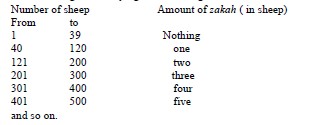
根据这段话,可以画出如下表格:
According to this saying the following table can be drawn:
我们将在第6节讨论应当作为天课缴纳的牲畜,包括其体型、年龄和性别的描述。
We will discuss in section 6 the description of what animal should be taken as zakah as for its size, age and sex.
关于羊的费率的讨论
Discussion of the rate on sheep
值得注意的是,伊斯兰教法(Shari'ah)随着羊的数量增加而降低了税率。从前面的时间表可以看出,当数量超过120只后,税率稳定在百分之一,这与商业资产、货币及其他资产通常的百分之二点五形成对比。这种降低的理由是什么?一些当代研究者92试图对此作出解释,认为伊斯兰教法通过这种降低来鼓励畜牧业发展,因为对40
It is notable that Shari'ah reduced the rate on sheep as their number increases. From the previous schedule it is observed that as the number grows above 120 the rate stabilizes at one percent in contrast with the usual two-and-half percent on business assets, money and other assests. What is the rationale for this reduction? Some contemporary researchers92 attempt to explain this reduction with the argument that Shari'ah intends to encourage animal breeding by this reduction, since the rate on 40
羊的天课率是百分之二点五,超过二百只后,会递减为每一百只一只的比例。但人们不禁要问:如果上述解释是正确的,为什么同样的原则没有应用到其他牲畜的天课上?骆驼和牛在数量较大时,天课率都稳定在百分之二点五左右,这与天课的一般比率相符。如果上述解释成立,那么它也应当适用于其他牲畜。
sheep is two-and-half percent and it regresses at 200, going clean to one percent. But one wonders, if this explanation is correct, why the same is not applied on zakah on other kinds of livestock. The rate on both camel and cows stabilizes around two-and half percent on big numbers, which is consistent with the general rate of zakah. If the above-mentioned interpretation is correct, it should apply to other animals as well.
在我看来——真主至知——一旦羊的数量增加,羊的总资产中就会包含许多幼羔,因为大多数羊一年不止生育一次。这些幼羔计入羊的数量,但不被接受作为天课的支付,这将在下面两节中说明。在我看来,公正要求由于这一原因而对税率作出一定的减免。如果在羊群包含许多幼羔的情况下,仍然按每四十只取一只的税率计算,那么实际税率就会高得多。至于最初的四十只,税率为百分之二点五,因为预计幼羔不会计入最初的四十只之中,这将在第五节中解释。
The way I see it --God knows best-- is that once the number of sheep grows, the total assests of sheep shall contain many baby lambs because most sheep give birth more than once a year, These babies are counted in the number of sheep but not accepted as payment of zakah, as shall be shown in the following two sections. It seems to me that the justice requires certain reduction in the rate for this reason. If the rate is kept at one out of each 40 while the herd contains many babies, the actual rate becomes much higher. As for the first 40, the rate is two-and-half percent because it is expected that babies would not be counted in the first 40, as will be explained in Section five.
这表明,zakah的税率实际上基本是恒定的,既非累进,亦非累退,这一点将在本书最后一部分详细讨论。在对《Risalah》的注释中,已故马立克学派学者Zarruq写道:"绵羊在40至200只之间的zakah税率递减——羊群数量增加后,其成本随之上升,而积累财富的欲望也随之增强,因此现金资产的税率低至十分之一的四分之一,而其他资产的税率则提高到十分之一。"93 我无法认同这一论点,因为财富增加时,其成本反而下降。这或许正是牧主喜欢大规模合群放牧的原因,以分摊圈舍和牧羊的成本。如今这被称为大规模经济。如果Zarruq的解释是正确的,那么它也应适用于所有牲畜,但我们看到,驼和牛的大量数量并未相应降低税率。
This shows that the rate of zakah is in fact about constant, not progressive or regressive, which will be discussed at length in the last part of this book. In the commentary on al Risalah, the late Malikkite Sheikh Zarruq writes on the declining rate of zakah on sheep between 40 and 200" once the numbers of sheep grows their cost increases, and the desire for accumulation increases too, therefore, the rate on cash assets is as low as one fourth of ten percent, while it goes up to ten percent on other assets."93 I could not appreciate this argument because when wealth increases its costs decline. This is perhaps why owners of cattle like to pasture together on a large scale, to diffuse the cost of shelter and shepherding. This is known now as the economy of large scale. If the explanation given by Zarruq is correct it should have applied to all cattles but we see the rate not reduced for large quantities of camel and cows.
第五节 幼小的牲畜需要缴纳天课吗?
SECTION FIVE ARE BABY ANIMALS ZAKATABLE ?
艾哈迈德、艾布·达五德和奈萨仪从苏艾德·本·安拉比传述:“安拉的使者(ﷺ)的征收员来到我们这里。我们坐在他身边,我听见他说:‘按照我的指示,不应从哺乳的牲畜中征收。’”94 这表明幼畜不计入天课,这也是一批著名学者的观点。但此段圣训的传述链存在争议。另一方面,马立克在《穆宛塔》中传述,欧麦尔曾吩咐他的征收员苏菲扬·本·阿卜杜拉·萨左斐说:“要计算其中的幼畜,即使是牧人用手抱着的,但不要以之缴纳天课。”95 这一传述也见于沙斐仪和艾布·欧拜德。96 欧麦尔的这段传述与前一段相矛盾,表明幼畜计入牲畜的基数(尼萨布),因而也需要缴纳天课。一些法学家采纳此观点,甚至认为如果应纳天课的牲畜全是幼畜,其中一只即可作为天课缴纳。97 不过,也有人认为应要求畜主从外面购买一只成年牲畜来缴纳天课。98
Ahmad, Abu Daud, and al Nasa'i report from Suaid Bin Ghaflah that "the zakah commissioner of the Messenger of god (p), came to us. We sat close to him and I heard him saying 'In my instructions it is pleased that I should not take from nursing animals'.94 This indicates that baby livestock are not zakatable, and this is the opinion of a group of leading scholars. But the chain of this saying is contested. On the other hand, Malik in al Muwatta reports that 'Umar told his commissioner, Sufian bin 'Abd Allah al Thaqafi, to "Count the babies in them, even those carried by the shephered in his hands, but do not accept them in payment."95 This is also reported by al Shafi'i and 'Abu Ubaid.96 This report of 'Umar contradicts the previous report and indicates that baby animals are counted in nisab and consequently zakatable. This is what a group of jurists adopt, to the extent that if all the zakatable animals were babies, one of them would be acceptable as payment,"97 though others say the owner should be asked to buy an older animal from outside to fulfil the payment of the zakah.98
有些学者试图调和欧麦尔的传述与苏艾德的说法:他们认为,若应缴天课的牲畜全部是幼畜,则不对幼畜征收天课,苏艾德的说法即适用于此种情况;而若幼畜与其母畜在一起,则将幼畜计入。然而,也有一些法学家认为,只有当成年牲畜已达到应纳天课的最低限额(nisab)时,幼畜才计入应缴天课的牲畜总数。这是艾布·哈尼法、沙斐仪、伊本·哈兹姆等人的观点。99 在我看来,这一观点最接近伊斯兰的公正原则,似乎也优于其他观点。若让一个拥有四头老骆驼的人免缴天课,而向一个拥有五头幼骆驼或四只幼羊的人征收,这违背了公正原则,因为后者的财富少于前者。一旦仅凭成年牲畜即可满足最低限额,那么在确定应缴天课的总数时,便可以计入幼畜。对于数量较大的牲畜,费率结构本身是灵活的,它按数量划分层级,并在每一层级的低端和高端适用同一费率。因此,五头骆驼按一只羊的费率计征天课,与九头骆驼的情况相同。
Some scholars attempt to reconcile the report of 'Umar with the saying of Suaid by not obligating zakah on baby animals if they comprise the entire zakatable, saying that is where the saying of Suaid applies, while counting baby animals if they are with their mothers. However, some jurists consider that baby animals are counted in the total number of the zakatable herd only if older animals make up the nisab required for zakatability. This is the view of Abu Hanifah, al Shafi'i, Ibn Hazm and others.99 It is, in my opinion, the closest to Islamic justice and it seems to outweigh other views. It violates the principle of justice to exempt from zakah a person who owns, for example, four old camels and collect it from a person who owns five baby camels or four baby lambs, since the latter is less rich than the former. Once nisab is fulfilled by counting adult animals alone, then baby animals can be counted in determining the total number subject to zakah. For larger quantities, the rate structure itself is flexible because it takes stratas of quantities and applies the same rate on the lower and the higher ends of each layer. Thus five camels are zakatable at the rate of one sheep, the same as nine camels.
第六节 用作天课的牲畜的条件
SECTION SIX CONDITIONS OF ANIMALS GIVEN AS ZAKAH
应缴纳为天课的牲畜需具备若干条件,其中包括:
A few conditions are required of the animals that can be paid as zakah, which include:
1. 无缺陷、无损伤。牲畜应无疾病、无骨折、非年老,也没有天生或意外造成的缺陷或损伤。《古兰经》说:"你们不要专拣污秽的财物而施舍,其实你们自己是不肯接受的,除非你们闭着眼睛接受。"{你们所施舍的,不要拣选污秽之物,你们自己也不会接受,除非你们闭着眼睛接受。}并且先知ﷺ说:"不应给予年老或有缺陷的牲畜,收取者也不应接受公羊,除非交纳者自愿奉献。"这是来自阿奈斯的圣训的一部分。以有损伤的牲畜作为天课交纳,对贫困者和其他应得者不公平,它偏向于牲畜的主人,这是不当的。
1. Free of defects and damage. The animal should be free of illness, bone fracture, old age, or birth and accidental defects or damages. The Qur'an says "and do not aim at getting anything which is bad, in order that out of it ye may spend "100 and the Prophet (p) states "and one should not give an old or defective animal, nor should a collector accept a ram unless the payer wishes to volunteer it". This is part of the saying from Anas. Accepting damaged animals as zakah payment is not fair to the poor and other deserving recipients; it is a bias in favor of the owner, which is improper.
关于瑕疵或损害的定义,多数学者认为其含义与买卖合同中所用的定义相同;但也有人认为,凡是不可用于献牲的牲畜,都不能用于缴纳天课。需要提及一个特殊情况:如果所有应缴天课的牲畜都带有同样的瑕疵或损害,例如共同的疾病,那么有瑕疵或受损的牲畜也可以用来缴纳天课。这是因为天课的规定是从应纳税人所拥有的财产中缴付,而不强迫他或她为了缴纳天课而专门从外面购买一头好的牲畜。02
As for the definition of defect or damages, the majority are of the view that it is the same definition used in sales contracts, though some say that anything not accepted for sacrifice is not accepted as zakah.l0l One should mentions unique case where a defected or damaged animal is accepted as zakah, which is if all the animals being zakated have the same defect or damage, such as a common disease. This is because the ordinance of zakah asks payment from what the zakatable person owns without forcing him or her to purchase from outside a good animal only for the payment of zakah.l02
牲畜的天课 101
Zakah on Livestock 101
2. 指定动物的性别:用作天课的牲畜必须是该种类的雌性。这一规定仅适用于骆驼,但阿奈斯的圣训中提到的情况除外,在那些情况下,可以用年龄更大的雄性代替应缴的雌性。
2. Specification of the animal's sex, The animal given as zakah must be a female of the species. This applies only to camels, except in the cases mentioned in the saying from Anas, whereby a male of a higher age group is accepted instead of the due female.
哈乃斐派认为,可以依据对雄性牲畜价值的估算来支付(天课)。103
Hanafites accept the payment of male animals on the basis of estimating their value,103
因为根据他们的观点,应付之物的价值可以代替实物来支付,这一点,如果神意允许,我们将在第五部分中讨论。
because according to them, the value of the due item can be paid instead of it as shall be discussed, God willing, in Part Five.
4. 平均值 收取天课的人不应拿最好或最差的牲畜,而应取应付牲畜的平均水平。伊本·阿拔斯传述,先知(p)对穆阿兹说:"不要拿人们财产中最好的,要畏惧受压迫者的祈祷,因为它与真主之间没有帷幕。"伊本·艾比·沙伊巴报道,先知(p)在作为天课收集来的骆驼中看到一头上好的母驼,他对收取者大怒,说:"这是什么?"收取者回答:"我用它换了两头质量较差的骆驼。"先知说:"那就可以了。"115
4. The average The zakah collector should not take the best or the worst in quality, but the average of the animals owed. Ibn 'Abbas narrates that the Prophet (p) said to Mu'adh, "Avoid the best of people's wealth, and be fearful of the prayer of the oppressed, for there is no curtain between it and God." Ibn Abi Shaibah reports that the Prophet (p) saw among the camels collected as sadaqah, an excellent she-camel. He was furious at the collector and said, "What is this?" The collector answered "I exchanged it for two lesser quality camels". The Prophet said, "Then it is all right."115
这正是因为天课建立在对纳课人与受课人双方公平的基础之上,取最好的或最差的都会偏袒其中一方。然而,很明显,牲畜主人可以依据价值来选择最好的或最差的。 艾布·达乌德通过自己的传述链,从先知ﷺ那里传述:"有三件事,谁做到了,谁就能尝到信仰的甘甜:独一崇拜真主,确信除真主外别无应受崇拜者;每年心甘情愿地交纳财产的天课……不要给老弱病残或产奶很少的瑕疵牲畜,而要从你财产的中等之物中给予。真主不要求你们给予其中最好的,也不命令你们给予其中最差的。"在收取天课时,征收者不得拿走哺乳幼崽的牲畜、怀孕的牲畜、羊群中的公羊,也不得拿走用于供给纳课人家庭食用的牲畜。马利克在《穆宛塔》中从阿伊莎那里传述:欧麦尔·本·黑塔卜经过用作天课的羊群,看到一只乳房很大的羊,便问:"这是什么羊?"有人回答:"是取来的天课。"他说:"它的主人不是心甘情愿交出的,所以不要强迫人们把东西拿回去,也不要拿穆斯林财产中最好的部分。"118
This is essentially because zakah is based on fairness to the two parties, payers and recipients, and taking the best or the worst means favoring one of them. However, it is obvious that the worst or the best can be taken on the basis of value at the option of the livestock owner. Abu Daud reports, through his own chain, from the Prophet (p) "There are three things, which whoever fulfills them will taste the sweetness of faith: to worship God alone, realizing that there is no deity but God, to give zakah on your wealth with your soul pleased at paying it year after year... and to give not the old, or the ill or the baby, or the defective animal that give little milk, but to give from the average of your wealth. God does not ask you to give the best of it, nor does He ordain you to give the worst of it."116 As zakah payment, the collector must not take the animal that nurses babies, nor pregnant animals, nor the ram out of sheep, nor the animal that is meant to provide meat for the household of the zakah payer.117 Malik reports in al Muwatta from 'Aishah that 'Umar bin al Khattab passed by the sheep taken as sadaqah, and saw one with big udders and asked, "What is this sheep? "He was answered, "One taken as sadaqah." He replied, "Its owners did not give it pleasantly, so do not force people to turn back, and do not take the best of the wealth of Muslims."118
作为这一条件的应用,幼小的牲畜不被接受作为天课。当欧麦尔·本·哈塔卜委派苏夫扬·本·阿卜杜拉·萨加斐去收取天课时,他开始计算小羊,有人问他:"你在计算这些小羊,而你却不接受它们作为缴纳之物吗?"他回来告诉欧麦尔这件事后,欧麦尔说:"是的,计算小羊,即使是那些小到需要牧人抱着的小羊,但不要接受它们作为缴纳之物,也不要拿取家中用于食用的、哺乳的母羊、怀孕的母羊,也不要拿公羊。只拿满一岁的绵羊或山羊。" 艾哈迈德、艾布·达乌德和奈萨仪从一个名叫西尔的人那里转述,他是安拉的使者(愿主福安之)所派遣的两位收取天课者之一。他们说:"安拉的使者(愿主福安之)禁止我们拿取怀孕的牲畜。"又从苏阿伊德·本·加法莱转述:"安拉的使者(愿主福安之)所派的一位天课收取者来到我们这里,我听见他说:'在交给我的明确指示中写明,我不应计算幼小的牲畜。'……当有人想给他一头怀孕的母骆驼时,他拒绝接受。"
第七节 混合与合伙对牲畜天课的影响
SECTION SEVEN THE EFFECT OF MIXING AND PARTNERSHIP ON ZAKAH ON LIVESTOCK
牲畜主人为了节省开支,常常把各自的牲畜合在一起。那么,在确定净额(nisab)和天课比率时,所有聚集在一起的牲畜应当视为一个整体,还是应当分别按每个主人单独计算?
It is common for livestock owners, to put together their cattles in order to save on overhead expenses. Should all gathered livestock be treated as one unit in determining the nisab and rate of zakah? or should they be considered for each owner alone?
要处理这个问题,首先应当注意,集体放牧主要有两种形式。一种是各自保有所有权,只在某些开支上分摊;另一种是牲畜由合伙人共同拥有。在后一种形式中,每个所有者的份额不以数量确定,而只按总数的比例确定;而在前一种形式中,每个人自己的牲畜是有区分的。这两种合伙投资的方式对天课的应纳性,未必产生相同的影响。
To deal with this question one should note that there are two leading forms of collective breeding. One involves keeping the ownership separate and sharing in certain expenses, and the other is when the cattle is owned commonly among the partners. In the latter form, the share of each owner is not determined in number but only as a proportion of the total, whereas in the former each person's own animals are distinguished. These two forms of investing together need not have the same effect on zakatability.
伊本·鲁世德在《宗师的开端与智者的指导》中,按以下方式概括了法学家的观点:
Ibn Rushd in Bidayat al Mujtahid, summarizes the views of jurists according to the following:
大多数法学家认为,牲畜的混合会影响天课的应纳性,但阿布·哈尼法及其门徒除外,他们认为牲畜的混合对尼萨布或适用的税率没有影响。马立克、沙斐仪以及大多数法学家一致认为,将牲畜混在一起放养的养殖者群体,应被视为同一个所有者。然而,这些法学家在两个方面存在分歧:尼萨布的确定,以及有效混合的定义。
Most jurists view mixing animals as affecting the zakatability except for Abu Hanifah and his disciples, who believe that mixing together of animals does not have any effect on nisab or on the applicable rate. Malik, al Shafi'i, and most jurists agree that the group of breeders who mix their cattles together are treated as if they were one owner. Those jurists however differ in two areas: the determination of nisab and the definition of effective mixing together.
需要指出的是,这些不同观点的原因在于对先知ﷺ的一句圣训有不同的理解。在关于施舍(sadaqah)的书信中,先知ﷺ
It should be noted that the reason for these different opinions is the different interpretation of the saying of the Prophet (p). In the letter on sadaqah the Prophet (p)
他说:"分开的不可合并计算,合在一起的不可分开计算,以免逃避天课;属于两人的财产,应按各自所占的比例进行结算。"那些认为合并饲养不影响天课的人,将这段话解释为:收取天课的人不应将同一个人所拥有的牲畜加以拆分,从而增加天课的数额。
said, "What is separate should not be counted together, and what is together may not be counted separately in order to avoid sadaqah, and as far what belongs to two persons, they must settle their account in proportion to their ownership". Those who say that mixing together does not affect the zakah interpret this to mean that the zakah collector should not divide herds owned by one person in such a way that would increase zakah.
第八节 马匹的天课
SECTION EIGHT ZAKAH ON HORSES
用于个人交通和作战的马匹免除天课。
Horses used for personal transportation and fighting are exempt from zakah.
穆斯林一致认为,为个人骑乘、搬运个人负载以及为主道而战之目的而拥有的马匹,无论是自然放牧还是圈养,均免征天课,因为这些马匹是供个人和家庭使用的,并非超出个人需要的增值资产。126 另一方面,除了扎希里学派之外,所有穆斯林都一致认为,马商持有的作为经营存货的马匹,无论是自然放牧还是人工喂养,均须缴纳天课,理由是为经营存货而设的马匹属于商品,与其他商业资产一样。127 同样一致认为,由主人大部分时间喂养、且并非为上述任何用途而拥有的马匹,免征天课,因为根据大多数学者的看法,牲畜应征天课的条件之一是自然放牧。128
It is agreed upon among Muslims that horses owned for the purpose of personal riding, carrying personal loads, and fighting for the sake of God are exempt whether they are naturally pastured or fed in ranches, because they are for personal and household use and are not growing assets in excess of personal needs.126 On the other hand, all Muslims except Zahirites have agreed that horses used as business inventory owned by horses' merchants, are zakatable whether they are naturally pastured or manually fed on the grounds that horses designed for business inventory are commodities, like other business asset.127 It is also agreed upon that horses that are fed by owners most of the year, which are not owned for any of the previously mentioned purposes, are exempt from zakah, because natural free pasturing is a condition for zakatability of animals, according to the majority of scholars.128
放牧饲养用于繁殖的马匹的天课义务
Zakatability of naturally pastured horses designated for breeding
关于在草场上自然放养、用于繁殖和增殖的无偿马匹是否应纳天课,学者有两种看法。艾卜·哈尼法认为它们应纳天课,前提是所拥有的马匹不全是雄性,因为全是雄性时便无法繁殖。129 大多数法学家认为这些马匹免纳天课,这一观点由伊本·阿尔-孟祖尔转述自阿里、伊本·阿姆尔·阿尔-沙比、阿塔、侯赛因·阿卜迪、欧麦尔·本·阿卜杜勒·阿齐兹、塞吾利、艾卜·尤素福、穆罕默德(即艾卜·哈尼法的两位弟子)、艾卜·陶尔、艾卜·海赛迈和艾卜·伯克尔·本·沙伊巴。另有人将此观点归于欧麦尔、马立克、奥扎Iy、莱思和达乌德。130
There are two opinions on the zakatability of naturally cost-free pastured horses that are designated for breeding and growth. Abu Hanifah believe they are zakatable, provided that not all horses owned are males since in this case they cannot breed.129 The majority of jurists consider these horses exempt from zakah, and this is narrated by Ibn al Mundhir from 'Ali, Ibn 'Amr al Sha'bi, 'Ata, al Husain al Abdi, 'Uamar bin 'Abd al Aziz, al Thawri, Abu Yusuf, Muhammad (the two disciples of Abu Hanifah) Abu Thawr, Abu Khaithamah, and Abu Bakr bin Shaibah. Others attribute this opinion to 'Umar, Malik, al Awza'i, al Laith and Daud.130
马匹不需缴纳天课的证据——大多数学者的观点
Evidence of the majority for the non-zakatability of horses
1. 《两部真实可信的圣训集》及其他圣训集中均记载,艾布·胡莱赖(愿安拉喜悦他)传述:先知ﷺ说:"穆斯林的奴隶和骡子上,不需缴纳天课。"131 这一免除适用于所有马匹,无论是否在草场放牧,无论雌雄,因为该圣训的措辞是普遍性的。
1. It is reported in the two correct books and in others from Abu Hurairah that the Prophet (p) said " There is no sadaqah obligated on Muslims on their slaves and mares."131 This exemption includes all horses, naturally pastured or not, female or male because it is general.
2. 艾哈迈德、艾布·达五德和提尔米兹在引述中传自阿里,阿里传自先知(愿主福安之)ﷺ的圣训
2. The report of Ahmad, Abu Daud, and al Tirmidhi from Ali from the Prophet (p)
“我已为你们免除了马和奴隶的天课。应当缴纳银币的天课,每四十枚缴纳一枚迪拉姆。”132
"I waived for you sadaqah on horses and slaves. Pay sadaqah on silver money, one dirham for each 40."132
3. 先知(愿主赐他平安)的做法中并不包括对马征收天课,而骆驼、牛和羊则是征收天课的。使者负责阐明《古兰经》中所规定的义务的细节,而他的言行表明马匹不需缴纳天课。
3. The actions of the Prophet (p) did not include collecting zakah on horses, even though it was collected on camels, cows and sheep. The Messenger is the one who gives the details of the obligation outlined in the Qur'an, and his word and deed indicate that horses are not zakatable.
4. 他们还主张,应纳天课的牲畜与马显然大不相同,马不能通过类比而被视为应纳天课,因为两者在用途和拥有目的上存在根本差异。养马是为了用于战斗、建立这一宗教以及抵御敌人,因此人们应当被鼓励去获取并为此目的而饲养马匹。真主说:"你们当竭尽所能,为他们预备力量,和马匹。"[133] 战马属于作战装备,如同武器及其他作战工具一样,只要不作为商品用于贸易,就不应纳天课。134
4. They also argue that livestock that are zakatable are obviously very different from horses and that horses cannot be made zakatable by analogy because of the basic differences in use and in the purpose of owning these different kinds of animals. Horses are obtained for use in fighting, in establishing this religion, and in defense against enemies, so people should be encouraged to obtain them and keep them for such purposes. God says "Against them make ready your strength to the utmost of your power, including seeds of war.133 Horses of war are fighting equipment, like weapons and like other fighting tools are not zakatable as long as they are not used as a commodity for trade.134
阿布·哈尼法的观点及其所依据的证据
Abu Hanifah's opinion and its supporting evidence
阿布·哈尼法认为放牧的马匹需要缴纳天课,他提出了以下论据:
Abu Hanifah, who believes that naturally pastured horses are zakatable, provides the following arguments:
首先,布哈里在他的《圣训实录》中从艾卜·胡莱赖(Abu Hurairah)处转述,先知ﷺ说:"马匹对人而言,有的是得赏的因由,有的是谋生的资本,有的则是犯罪的根源。以马为得赏因由的,是为了主道而养马,骑它去作战,或把它借给别人去作战,这样的马就是得赏的因由。以马为谋生资本的,是为了自己出行而养马,不依赖他人,也不忘记主在马身上的权利,以及人们可以借马背搭乘的权利,这样的马就是谋生的资本。至于养马是为了炫耀和对抗伊斯兰教徒,这样的马就是犯罪的根源。"[135]这段圣训表明,马匹上有主的权利,即天课以及允许他人借其背搭乘。[136]另有一些法学家认为,马匹上的权利所指的是在战斗中使用马匹。137
Firstly, al Bukhari reports in his correct collection from Abu Hurairah that the Prophet (p) said "Steeds are for a person a source of reward, for another they are a source of sustenance, and for yet another they are a source of sin. He for whom they are a source of reward is the man who owns horses for the purpose of fighting for the sake of God, to ride it in battle or to give it to someone else to ride in battle. That is why they are a source of reward. For one who keeps horses for personal transportation so he does not need others, and does not forget God's right on the horses or the right of people to be given lifts on their backs, they are source of sustenance. And for the person who keeps steeds as a matter of pride and to fight against the people of Islam, they are a source of sin."135 This saying indicates that there is a right of God on horses, zakah and giving lifts on their backs.136 Other jurists argue that what is meant by the right on horses is the use of horses in fighting.137
其次,据贾比尔传述,先知(ﷺ)说:"每匹以自然放牧方式饲养的母马,应缴纳一第纳尔或十迪拉姆。"此段圣训由达拉库特尼和拜哈基传述,二人都将其评定为弱(да'īf)圣训。因此,大多数法学家认为,它不能与"穆斯林的马匹和奴隶不计征天课"这一确凿的圣训相抗衡。 第三,以骆驼为类比:二者都是能够繁殖增长、可供利用的牲畜,并且二者都满足应纳天课的条件,即自然放牧、无需主人花费饲料。所谓马与其他牲畜之间的区别,不过是牲畜各类之间的区别,因为每种动物都有其独特的特性。骆驼与绵羊之间也有许多差别,但二者都应纳天课。艾卜·哈尼法持此论点,其依据是:天课义务的原因是可以被理性推论的事项,而不仅仅是一种纯粹的功修。这一原因就是增长或具有增长的潜力;一旦其他财产中也存在增长,天课的应纳性就应当推及该财产。
Secondly, it is reported from Jabir from the Prophet (p), "On each naturally pastured mare there is due one diner or ten dirhams." It is reported by al Daraqutni and al Baihaqi, and they grade it weak. For this reason, the majority of jurists argue that it can not stand against the correct saying of zakah waiving off horses." There is no zakah on the slaves and mares of Muslims." Thirdly, by analogy to camels, both are growing and useful animals, and in both the condition for zakatability, natural cost-free pasturing, is fulfilled. The claimed differences between horses and other livestock are no more than those among the other kinds of livestock, since each animal has its unique characteristics. There are many differences between camels and sheep yet both are zakatable. Abu Hanifah holds to this argument on the basis that the reason for the obligation of zakah is a matter that can be rationalized and not a matter of worship only. This reason is growth or growth potential and once growth exists in another asset zakatability must be extended to it.
马匹的天课明白与税率 Actually, let me give a clean translation: 马匹的天课之尼萨卜与税率
Nisab and rates of zakah on horses
阿布·哈尼法没有为马匹规定尼萨布。《杜尔·穆赫塔尔》的作者写道:"众所周知,阿布·哈尼法没有为马匹估定尼萨布;我们没有他关于此事的任何传述。"146 伊本·阿比丁在其注释中引用卡哈斯塔尼的话说:"有人以三匹为尼萨布,有人以五匹为尼萨布。"147 看来,定为五匹更为正确,因为它与骆驼的情况相似。五这个数字在尼萨布中经常使用:尼萨布为五头骆驼、五乌基叶(银两,等于200迪尔汉姆),以及五瓦斯格的谷物。
Abu Hanifah does not determine a nisab for horses. The author of al Durr al Mukhtar writes "It is best known that Abu Hanifah does not estimate nisab for horses; we have no report from him about that."146 Ibn 'Abidin in his commentary quotes al Qahastani as saying "Some indicate nisab at three and others indicate it at five."147 It seems that the estimation of five is mare correct because of its similarity to that of camels. The number five is often used in nisab . nisab is five camels, five 'uqiyyah of silver [equals 200 dirhams] and 5 wasq of grain.
根据伊本·阿比丁引述艾布·哈尼法的说法,对阿拉伯马的所有者,可以选择每匹缴纳一第纳尔,或者估算马匹的价值后缴纳其中的五十分之一。
The rate is explained by Ibn Abidin from Abu Hanifah: Owners of Arabian horses are given the choice of paying one dinar on each or evaluating their horses and paying 5
每两百迪尔汗(dirham)的价值应缴纳五迪尔汗的一半,即两迪尔汗半。至于非阿拉伯马,则只计算其价值。148
dirhams for each 200 dirhams of value - the rate is just two-and-half. For non-arabian horses, only the value is considered.148
分析
Analysis
在讨论了两方的论据之后,在我看来,先知(ﷺ)并没有明确地否定马匹上的天课,但也没有明确地使其成为义务。艾卜·胡莱赖(Abu Hurairah)所传的那句话:"穆斯林的奴隶和母马上没有天课",所指的仅仅是用于个人代步和作战坐骑的马匹。这一解释得到了宰德·本·萨比特(Zaid bin Thabit)和伊本·阿拔斯('Abbas)的解释的支持,这些解释都正确地传述自他。这句话中的"他的奴隶和他的母马"这几个字本身似乎也表明了这一含义。此外,除了open zahirite(追随字面派)之外,法学家一致公认,当马匹和奴隶作为商业货物时,天课是有义务的。 艾卜·胡莱赖倾向于固守经文的字面意义,在众圣门弟子中以记忆精确著称,但他并不像宰德和伊本·阿拔斯那样以分析和阐发见长。阿里的那句话:"我为你们免除了马匹和奴隶的天课",达尔古特尼(al Daraqutni)注明,当它止于阿里、而不与先知相连时,是正确的。众所周知,达尔古特尼是这方面的专家。然而,"为你们免除"这几个字暗示,这些财产原则上是应当纳税的,只是先知(ﷺ)因某种原因而免除了其天课。这一原因可能是对作战坐骑的迫切需要,也可能是马匹在阿拉伯并不是重要的财产。
After discussing the two arguments, it seems to me that the Messenger (p) did not negate the existence of zakah on horses in a clear way, but neither did he obligate it clearly. The saying from Abu Hurairah, "There is no sadaqah on a Muslim's slave and mare" does not touch on anything other than the horse used for personal transportation and as a mount for war. This explanation is supported by the interpretation from Zaid bin Thabit and 'Abbas, correctly reported to him. The very words "His slave and his mare" in the saying seem to indicate this meaning. Also, that it is unanimous by Ijma' among jurists -- except Zahirites-- that zakah is obligatory on horses and slaves when they are part of business inventory. Abu Hurairah was inclined to hold to the letters of texts, and was known among the Companions for his precise memory, and did not have a reputation of analyzing and elaborating like Zaid and Ibn 'Abbas. The saying from 'Ali, "I have waived for you the sadaqah on horses and slaves" is noted by al Daraqutni as correct when it ends at 'Ali and is not linked to the Prophet. It is well known that al Daraqutni is the expert on such matters. However the words "waived for you" imply that these assets should be in principle zakatable but the Prophet (p) waived the zakah are them for certain reason.l49 This could be the desperate need for steeds of war or the fact that horses were not a substantial item of wealth in Arabia.
《Fiqh al-Zakah》(第一卷),Yusuf al-Qardawi 博士,108
Figq al Zakah (Vol. I), Dr. Yusuf al Qardawi 108
总之,没有明确文本规定马匹须缴纳天课,并不一定意味着马匹不需要缴纳天课。先知(愿主赐福他并使他平安)并无记载说他规定过黄金须缴纳天课。当时通行的货币大多是白银,而黄金的裁定是通过类比推导出来的,因为两种金属在用途上有明显的相似之处。我认为欧麦尔与叶拉·本·乌麦叶的故事具有极其重要的分量。欧麦尔所采取的行动表明,类比和伊杰提哈德在天课中占有重要地位。先知(愿主赐福他并使他平安)从某些类别的财产中征收天课,并不意味着在他之后的穆斯林不能从与之相似的其他类别中征收。事实上,每一项有实质性增长的财产都应当须缴纳天课。
Anyhow, the lack of a text clearly obligating the zakah on horses does not necessarily mean that they are not zakatable. The Prophet (p) is not reported to have said anything about obligating zakah on gold. It is apparent that most coins used at his time were silver and the ruling on gold is derived by analogy because of the apparent similarity in use of the two metals. The story of 'Umar with Yala bin Umayah has, in my opinion, extremely important weight. The action taken by 'Umar indicates that analogy and ijtihad have an important position in zakah. The fact that the Prophet (p) took zakah from certain kinds of assets does not mean that Muslims after him may not take it from other kinds that are similar. In fact every substantial growing asset must be zakatable.
题外话:先知作为真主的使者所下的命令,与他作为世俗国家元首所下的命令之间的区别。
Digression: The distinction between orders of the Prophet as a messenger of God orders as a temporal head of state.
在前面的讨论之后,我们有必要用几段文字来论述这一重要问题。对于先知(愿主福安之)所说的每一句话,都应当考察其所处的背景和所涉及的主题,看它与世俗事务、政治、经济、军事或行政管理有关,还是与伊斯兰生活方式的原则有关。有时,可能存在另一段经文,表明某一原则具有特定的世俗适用性;或者,类似的事件曾以不同的方式处理,这表明这种处理方式可能属于世俗层面,而非宗教层面。
The previous discussion leads us to devote a few paragraphs to deal with this important point. One should always look at the circumstances that surround a statement made by the Prophet (p) and the subject matter of the saying to see whether it relates to temporal, political, economic, military, or administrative affairs, or to the principles of the Islamic way of life. There may exist sometimes another text that indicates the enduring principle of a special temporal application, or similar events may have been differently treated, which indicates this treatment may be temporal rather than religious.
举例而言,卡拉非在其《判断之精微》(al Ihkam)中引述了“杀死一名敌军士兵者,其遗留的个人财物归他所有”这一说法。马立克认为,这是先知ﷺ以国家元首身份作出的裁决,并非普遍适用的通则。若伊斯兰国的领导人在战争开始时宣布此类规定,则应当执行;否则,战利品依照《古兰经》第八章(《战利品章》)的经文进行分配这一一般原则依然有效。马立克提出以下论据来支持这一观点:
An example is give by al Qarafi in his al Ihkam about the saying "One who kills an enemy soldier shall have his personal property". Malik says this is a decision by the Prophet (p) as a head of state and is not a general rule. If the leaders of the Islamic state declare such a regulation at the beginning of a war, then it should apply, but otherwise, the general principle that war booty is distributed according to the text of the Qur'an in sura eight (al Anfal) remains applicable. Malik gives the following arguments to support this view:
1. 《古兰经》中关于战利品分配的经文(《安法勒》章)与这段圣训相矛盾。
1. The verse about the distribution of war booties in sura (al Anfal) contradicts this saying.
2. 这样的规定可能会干扰并转移战士的意图,使其不再是为了真主而战,反而变成了对敌人财产的贪求。
2. Such a regulation may interfere with, and divert the intentions of the fighters from being for the sake of God to being the desire for the enemy's property.
3. 先知(愿主赐福于他并使他平安)说这句话的原因,是为了鼓励参战者在某一场特定的战役中奋战。51
3. The reason why this saying was given by the Prophet (p) was to encourage the fighters in a particular battle.l51
已故的沙伊赫·达赫拉维在《安拉的确证》(Hujjah Allah al Balighah)中提到,从先知(p)那里传下的圣训可分为两类。第一类是他以使者身份阐明安拉启示的圣训,依据经文:"使者给你们的,你们当接受;使者禁止你们的,你们当戒除。"这一类包括所有关于幽玄之事的言论。第二类是他以人类身份和国家元首身份所说的话,正如他自己所言:"我只是一个人。若我以宗教的名义为你们制定了什么,你们就应当遵行;若我以个人意见告诉你们什么,那我只是一个人。"属于这一类的,包括他关于医学的言论,因为这些言论基于其时代的经验和习俗,并不构成对安拉的服从或崇拜。同样属于这一类的,还有他偶然、意外所做的事,而非出于本意和决心。达赫拉维继续说,属于这一类的还有那些反映暂时性关切、并不适用于本民族所有世代的言论,例如他在组织军队和选择标识方面所下的命令。许多包含此类规定的圣训都被归入此类,例如他的言论:"杀死敌方士兵者,可获得其财物。"以及:"使已死之地复苏者,该地归其所有。"根据马利基学派的观点,杀死敌人的士兵确实应得其财物,除非穆斯林领袖在战前或战时禁止这样做;根据哈乃斐学派的观点,复苏荒地须事先获得伊斯兰政府的许可。
第九节 其他自然放牧的家畜
SECTION NINE OTHER NATURALLY PASTURED DOMESTIC ANIMALS
本节讨论的是为获利而放牧的、无需成本即可自然觅食的家畜的一般情况。我们能否将天课的规定推广到所有此类牲畜呢?换言之,天课应当仅限于前面提到的四种牲畜,还是应当包括所有家畜?当今一些杰出的伊斯兰学教授,包括穆罕默德·阿布·扎赫拉、阿卜杜勒·瓦哈卜·赫拉夫和阿卜杜勒·拉赫曼·哈桑,从欧麦尔的做法中推导出可以对天课运用类比推理。
This section deals with the general case of naturally cost-free pastured domestic animals maintained for profit. Can we generalize the case of zakah on all such animals or not? In other words should zakah be restricted to the four previously mentioned species or should it include all domestic animals? Some of today's leading professors of Islamic studies, including Muhammad Abu Zahra, 'Abd al 'Wahab Khallaf, and 'Abd al Rahman Hasan, deduct from the practice of 'Umar that one can apply analogy on zakah.
欧麦尔·本·哈塔卜以类比为依据,认为马匹日益成为有价值的财产,因此对马匹征收天课。阿布·哈尼法是运用类比的大师,他也支持这一主张。而不对马匹征收天课的人,并非因为否定类比,而是因为他们认为牲畜可供食用这一特性是其应纳天课的重要理由。既然马不可食用,他们便不把应纳天课的规定扩展到马匹身上。《al Mughni》的作者写道:"马匹与牲畜的类比是不正确的,因为后者是能够增值的财富,可用于挤奶、食肉,并可用作献祭牲畜。"大多数学者并不认为单凭增值性就是应纳天课的理由。
'Umar bin al Khattab obligated zakah on horses by analogy, on the grounds that horses were becoming valuable assets. This is upheld by Abu Hanifah, the master in the application of analogy. Those who do not obligate zakah on horses do not do so in denial of analogy, but because they consider the edible character of livestock an important reason for their zakatability. Since horses are not edible, they refuse to extend zakatability to horses. The author of al Mughni writes "The analogy of horses and livestock is incorrect, because the latter are growing wealth that is used for milking and meat and can be used for sacrifice." The majority of scholars does not consider the character of growth alone the reason for zakatability.
这三位教授补充道:如果有智慧的继承者欧麦尔认为增长是应纳天课的必要条件,并且阿布·哈尼法也遵循此说,那么我们便可将其适用范围扩展到其他牲畜,并宣布:所有正在增长且自然放牧、无需花费的牲畜,只要达到应纳天课的最低限额(尼萨布),即二十第纳尔,便应以2.5%的比率缴纳天课。尼萨布以黄金来衡量,因为欧麦尔接受了以估价来确定天课的原则,而当今的价值是以黄金来估算的。158
These three professors add: If the Wise Successor 'Umar considered growth the essential requirement for zakatability, and was followed Abu Hanifah, then we can extend their application to other animals and declare that all animals that are growing and naturally, cost-free pastured are zakatable, if they reach the minimum for zakatability (nisab), which equals twenty dinars, at the rate of 2.5%. Nisab is estimated in relation to gold, because 'Umar accepted the principle of evaluating horses to determine zakah, and value is currently estimated in gold.158
这一点得到以下事实的支持:使者(愿主福安之)被问及驴的天课时,并没有明确否定天课的义务,而是说:"除了这节全面而精确的经文外,真主并没有就此事降示给我任何东西:'行了一个蚁重之善的人,必定看见它;行了一个蚁重之恶的人,必定看见它。'"159 2.5%的比率得到巴哈兹·本·哈基姆引述其父、其祖父的圣训支持,先知(愿主福安之)说:"放牧的骆驼中,每四十头应缴纳一头两至三岁的骆驼。"这是超过一百三十头骆驼和超过四十头牛的一般比率。
This is supported by the fact that the Messenger (p) when asked about zakah on donkeys did not negate the obligation of zakah in a clear statement but said "God did not send upon me anything on this matter except this comprehensive and precise verse 'Then shall anyone who has done an atom's weight of good see it, and anyone who has done an atom's weight of evil see it'.159 The ratio of 2.5% is supported by the saying from Bahz bin Hakim from his father from his grandfather that the Prophet (p) said "Out of all naturally pastured camels, on each forty there is due one camel, two-three years old". This is a general rate for camels exceeding 130 and for cows exceeding 40.
第十节 源自前几节的一般原则
SECTION TEN GENERAL PRINCIPLES DERIVED FROM THE PREVIOUS SECTIONS
本章前面各节的讨论之所以较为冗长,是因为伊斯兰教法本身对牲畜天课规定了许多原则和裁定,而这些内容在天课的其他方面未必如此详尽;同时,对这一问题的深入分析揭示了一些重要原则,这些原则对于理解天课的本质大有裨益。其中包括以下几项原则:
The discussion in the previous sections of this chapter has been lengthy because Shari'ah itself dictates many principles and rulings about zakah on livestock that may not be as detailed in other areas of zakah, and because the lengthy analysis of this issue uncovers important principles that will be of great benefit in understanding the essence of zakah in general. Among these principles are the following:
1. 天课(Zakah)虽然是一种崇拜,但它同时也是伊斯兰国家监管的一项公共制度。委派和派遣天课征收官是伊斯兰国家的职责。
1. Zakah, although a worship, is also a public institution supervised by the Islamic state. Appointing and sending zakah commissioners is the duty of the Islamic state.
2. 天课的规定在穷人的诉求与富人的利益之间取得平衡:少量财富免征天课,天课的缴纳也只以中等质量的财产为准。
2. Zakah regulations balance the concerns of the poor on one hand and the interests of the rich on the other hand, so that small quantities of wealth are exempted from zakah and average quality assets only are accepted as zakah payment.
3. 资产的高额维护成本会减少其应缴的天课,甚至免除该资产的天课。因此,大多数著名法学家认为,人工喂养的牲畜免缴天课,理由是其养护成本与为主人带来的收益相当。
3. The expensive upkeep of an asset reduces zakah or waives it on that asset. For that reason, the majority of leading jurists consider manually fed animals exempt from zakah on the ground that they cost as much as they profit the owner.
4. 根据大多数学者的观点,将用于营利的增长性资产转为个人使用,即可免除天课。这适用于用于灌溉、耕作和驮运个人行李的牛和骆驼。
4. A transformation of a growing asset from its use for profit to personal use exempts it from zakah, according to the majority of scholars with regard to cows and camels used for watering, cultivation, and carrying personal loads.
5. 伊斯兰教法将合伙经营中的共同财产视为一个整体,这可以为处理当代公司制度提供依据。
5. Shari'ah treats the common property of partnerships as one unit, which may constitute a foundation for handling contemporary corporations.
6. 伊斯兰教法拒绝接受天课方面的任何漏洞,也不允许为了减少天课而合并或分割财产。
6. Shari'ah refuses to accept any loopholes in zakah and does not allow the combination or separation of assets for the purpose of decreasing zakah.
7. 类比可以用于天课,因为其规定背后有理性的依据。如果这些依据存在于另一种财产之中,天课便可以扩展适用。这也正是欧麦尔对战马征收天课的依据。我主张对一切天然放牧、无需成本的牲畜征收天课,即使这些牲畜在先知以及再传弟子的时代并不为人所知。
7. Analogy can be used in zakah because its rulings have rational reasoning behind them. If these reasons exist in another asset, zakah can be extended. That is why 'Umar obligated zakah on steeds. I advocate obligating zakah on all naturally, cost-free pastured animals, even though they may not have been known at the time of the Prophet or the Successors.
1. 古兰经 Sura al Nahl(蜜蜂章),16:5-7。
1. Sura al Nahl, 16:5-7.
2. 同上。
2. Ibid.
3. 同上。
3. Ibid.
4. 古兰经《雅辛章》:36:71-73。
4. Sura Yasin: 36:71-73.
5. 《Al Durr al Mukhtar》及其注释《Rad al Muhtar》,第 2 卷,第 20-21 页。
5. Al Durr al Mukhtar and its commentary, Rad al Muhtar, Vol. 2, p. 20-21.
6. 《古兰经》第7章《al-A'raf》(高处),7:199。
6. Sura al A'raf, 7:199.
7. 白格拉祖拉章(Sura al Baqarah),2:219。
7. Sura al Baqarah, 2:219.
8. . 《Al Rawd al Nadir》,第2卷,第399页。
8.. Al Rawd al Nadir, Vol. 2, p. 399.
9. 同上,第400页。
9. Ibid, p. 400.
10. 同上,第399页。
10. Ibid, p.399.
11. 《Al Amwal》,第380页。
11. Al Amwal, p. 380.
12. 《Nasb al Rayah》,第2卷,第360页。
12. Nasb al Rayah, Vol. 2, p. 360.
13. 《Al Amwal》,第380–382页;以及《al Rawd al Nadir》,第2卷,第408页。
13. Al Amwal, pp. 380.382, and al Rawd al Nadir, Vol. 2, p. 408.
14. Al Rawd al Nadir, Ibid.
14. Al Rawd al Nadir, Ibid.
15. 《Al Amwal》,第381页。
15. Al Amwal, p. 381.
16. 同上,第382页。
16. Ibid, p. 382.
17. 同上,第381页。
17. Ibid, p. 381.