Dos tipos de revelación: la hablada y la no hablada
Two Types Of Revelation: The Spoken And The Unspoken
El Profeta bendito ﷺ recibió dos tipos de revelación divina. Una es la revelada en forma recitada [matluww] y la segunda, la no recitada [ghair-matluww]. La revelación recitada es la que se recita [es decir, el Corán]; la revelación no recitada es la que no se recita [es decir, los aḥādīth del Profeta ﷺ]. Un indicio de las raíces de la revelación no recitada puede encontrarse en los āyāt del Corán. Dice Allah (SWT) en el Sagrado Corán:
The Blessed Prophet صلى الله عليه وسلم received two types of divine revelations. One is the spoken [matluww] and the second, the unspoken [ghair-matluww]. The spoken revelation is that which is recited [i.e., the Qur’an]; the unspoken revelation is that which is not recited [i.e., the aúódõth of the Blessed Prophet صلى الله عليه وسلم]. An indication of the roots of the unspoken revelation can be found in the ayas of the Qur’an. Allah صلى الله عليه وسلم says in the Holy Qur’an:

Y no establecimos la qibla a la que solías dirigirte sino para distinguir a quienes seguían al Mensajero de quienes se darían la vuelta sobre sus talones.3
And We appointed the qibla to which you were used only to test those who followed the Messenger from those who would turn on their heels.3
Para comprender más ampliamente este aleya, es importante que examinemos su trasfondo histórico.
To gain a broader understanding of this aya, it is important that we look into its historical background.
Poco después de la emigración a Medina, al Profeta bendito ﷺ y a los Sahaba (que Allah esté complacido con ellos) se les ordenó orar en dirección a la Mezquita al-Aqsa en Jerusalén. La Mezquita al-Aqsa fue la qibla de los musulmanes durante diecisiete meses. Pasados diecisiete meses, la orden de orar en dirección a la Mezquita al-Aqsa fue derogada y se ordenó a los musulmanes orar en dirección a La Meca. Esta orden quedó establecida mediante el siguiente aleya:
Shortly after the migration to Madina, the Blessed Prophet صلى الله عليه وسلم and the Sahaba رضي الله عنه) were told to pray towards Masjid al-Aqüó in Jerusalem. Masjid al-Aqüó became the qibla of the Muslims for seventeen months. After seventeen months, the order to pray towards Masjid al-Aqüó was abrogated and Muslims were ordered to pray towards Makka. This order was established through the following aya:
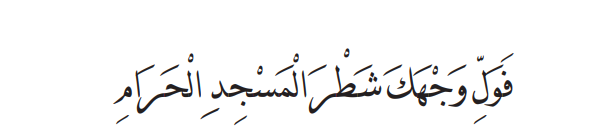
Y no hicimos de la qibla a la que solías dirigirte sino para distinguir a quien sigue al Mensajero de quien da la vuelta sobre sus talones.5
And We appointed the qibla to which you were used only to test those who followed the messenger from those who would turn on their heels.5
En este aleya, Allah سبحانه وتعالى menciona la primera orden, que era orientarse hacia Jerusalén, como una orden suya propia. Esto deja claro al lector que el mismo Allah سبحانه وتعالى estaba detrás de la orden de dirigirse hacia la Mezquita de al-Aqsa. Sin embargo, al leer el Corán no encontramos ninguna aleya en la que Allah سبحانه وتعالى ordene a los musulmanes rezar hacia Jerusalén.
In this aya, Allah سبحانه وتعالى.mentions the first order, which was to face towards Jerusalem, as His own order. This impresses upon the reader the fact that Allah سبحانه وتعالى. himself was behind the order to face Masjid al-Aqüó. But when we read the Qur’an we do not find any such aya in which Allah سبحانه وتعالى. ordered the Muslims to pray towards Jerusalem.
El hecho es que esta orden provino del Bendito Profeta ﷺ y no de ningún aleya del Corán. El aleya no dice: "El Bendito Profeta ﷺ estableció la orden…", sino que dice: "Hemos designado la qibla…". Esto nos lleva a comprender que la orden del Bendito Profeta ﷺ no es diferente de la orden de Allah سبحانه وتعالى.
The fact is that this order came from the Blessed Prophet صلى الله عليه وسلم and not from any aya of the Qur’an. The aya does not say, “The Blessed Prophet صلى الله عليه وسلم enacted the order…” rather it says, “We appointed the qibla….” This brings us to the understanding that the order of the Blessed Prophet صلى الله عليه وسلم is no different from the order of Allah سبحانه وتعالى..
La prueba es tan evidente que no requiere ninguna aclaración adicional. Esta clara afirmación del Corán sobre la orden dada por el Profeta Muhammad ﷺ demuestra una creencia fundamental sobre los ḥadīths del Profeta Muhammad ﷺ: que son una forma de revelación. Y esto es lo que se conoce como la revelación no recitada o no recitativa.
The proof is so self-evident it does not require any further clarification. This clear statement from the Qur’an regarding the order given by the Blessed Prophet صلى الله عليه وسلم demonstrates a fundamental belief about the aúódõth of the Blessed Prophet صلى الله عليه وسلم: that they are a form of revelation. And this is what is known as the unspoken or unrecited revelation.
El aya mencionado anteriormente también revela algunos otros puntos importantes:
The aya mentioned above also reveals some other important points:
1. Se envió un tipo especial de revelación al Profeta bendito ﷺ, la cual no formaba parte del Corán.
1. A special type of revelation was sent to the Blessed Prophet صلى الله عليه وسلم which was not a part of the Qur’an.

Quien sigue al Profeta bendito ﷺ ha seguido a Allah (SWT).6
Whosoever follows the Blessed Prophet صلى الله عليه وسلم has followed Allah ‹.6
En este aleya el Corán ordena seguir el camino del Profeta bendito ﷺ, pues seguir al Profeta bendito ﷺ es seguir a Allah سبحانه وتعالى. Una vez, una mujer acudió al famoso compañero رضي الله عنه ‘Abd Allāh ibn Mas‘ūd رضي الله عنه. Ella dijo: «He oído que prohíbes a la gente hacer ciertas cosas, aunque yo he leído el Corán de principio a fin y nunca he leído que el Corán nos ordene abstenernos de esas cosas». ‘Abd Allāh ibn Mas‘ūd رضي الله عنه respondió: «Si hubieras leído el Corán, lo habrías encontrado. ¿No has leído esta aleya del Corán?».
In this aya the Qur’an orders us to adhere to the way of the Blessed Prophet صلى الله عليه وسلم, as adherence to the Blessed Prophet صلى الله عليه وسلم is adherence to Allah سبحانه وتعالى.. Once, a woman came to the famous Sahaba رضي الله عنه), ‘Abd Allóh ibn Mas‘ñdرضي الله عنه. She said, “I have heard you stop people from doing certain things even though I have read the Qur’an from cover to cover and I have never read the Qur’an ordering us to abstain from these things.” ‘Abd Allóh ibn Mas‘ñd رضي الله عنه) replied, “Had you read the Qur’an you would have found it. Have you not read this aya of the Qur’an:

"Lo que el Profeta ﷺ les dé, acéptenlo; y lo que les prohíba, absténganse de ello."7
Whatever the Prophet صلى الله عليه وسلم gives you, accept it; and whatever he disapproves of, abstain from it.7
De este incidente aprendemos que esta aya incorpora el ḥadīth del Profeta bendito ﷺ y establece la autoridad del ḥadīth en el Islam.
From this incident we learn that this aya incorporates the aúódõth of the Blessed Prophet صلى الله عليه وسلم and establishes the authority of the aúódõth in Islam.