3. 我们看到的是谁和什么?
3. Who And What Do We See?
图像的力量
The Power Of An Image
我们如何看待自己,以及我们想象自己如何被他人看待,都会影响我们的自我认同,也关系到“自我”与“他者”之间的关系。这一点在这幅题为《恐惧仍是我》的动人图像中得到了视觉上的体现(见下图)。图像呈现的是一个受折磨囚犯的兽性形象:他戴着头套,遮掩了他那熊一般的身份。18
How we see ourselves and how we imagine ourselves being seen has a bearing on our self-identity and on the relationship between ‘self’ and ‘other’. This is reflected visually here in an evocative image entitled ‘The Fear Is Still Me’ (see below). The image suggests a bestial persona of a tortured prisoner donning a hood that conceals his bear-like identity.18
尽管"他看不见",他仍然很容易被视为一个核心焦点,仿佛被看守们簇拥着、引人注目。图中出现了一圈光环。我们不禁要问,围绕在他周围的这圈光晕,究竟是来自他身后的手电筒光束,还是照向他的泛光灯,抑或是艺术家在邀请我们思考二元对立:人性化与非人性化的生命象征由此并置在一起。身后看守们的聚集与囚犯的孤立形成对照,看守们如群兽般的阵型与孤身一人、形似熊的囚犯之间的反差,极具讽刺意味。受伤的、形似熊的囚犯是被猎杀的对象,而看守们却像在为他开道、引他登场。
Though “he cannot see” he is very much to be seen as a centre-piece as if heralded by the prison guards. In the image, there appears a halo. We wonder whether the halo etched around him is the beam of a torch from behind him, a floodlight shining onto him or whether the artist challenges us to consider binary oppositions wherein symbols of humanised and dehumanised life become juxtaposed. The togetherness of the guards behind him is set against the isolation of the prisoner though the pack-like formation of the guards and the lone bear-like prisoner is strikingly ironic. It is the wounded bear-like prisoner who has been hunted and the prison guards herald him.
画面中有很多值得留意之处。这幅漫画把人物画得比真人还要高大,但他外凸的双脚或许象征着因遭受殴打而肿胀的四肢,因此这名囚犯看起来显得失衡。不过,他的双脚并没有伤痕,它们是否反而,或者同时,暗示着他那被践踏的存在?我们看不到他的双手,只能想象它们可能带有怎样的伤痕。
There is much to be seen. The cartoon suggests a larger-than-life individual though his protruding feet perhaps reflect limbs swollen by beating, and in this the prisoner appears imbalanced. Since however his feet bear no injuries might they instead or simultaneously suggest his stamped presence? We cannot see his hands however and imagine what injuries they might bear.
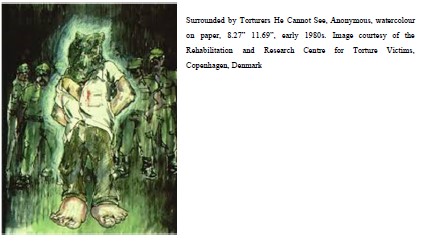
囚犯衣着邋遢,衬衫纽扣和裤子拉链都没扣好,这与狱警整洁得体的“文明”着装形成进一步的对比。囚犯被蒙住头,这一点表明他缺乏自我认同。然而,那个像熊一样的头套所传达的,并非人们想象中的恐惧、忧虑与痛苦,而是反抗与力量。
The scruffy clothes of the prisoner with shirt buttons and trouser zip undone are a further contrast to the ‘civilised’ and neat attire of the prison guards. The fact that the prisoner is hooded reveals a lack of self-identity. Though, in place of his assumed fear, worry and pain, the bear-like hood projects defiance and strength.
毫无疑问,穆斯林不断面对铺天盖地的媒体报道,这些报道或诋毁他们的信仰,或诋毁其他穆斯林。这种持续的“他者化”加剧了人们的焦虑,并逐渐塑造了我们看待自身的方式,使我们这个群体在很大程度上被定义为与暴力相连。野蛮、落后等意象,以及围绕恐惧与未知所构建的戴希贾布或布卡的女性形象,随处可见。巴特勒指出:“我们借以理解或恰恰未能理解他人的生命是否被失去或受伤(即可失去、可伤害)的那些框架,都浸透着政治色彩。它们本身就是权力的运作。它们并非单方面决定呈现的条件,但其目的仍在于划定呈现本身的范围。”19
Undoubtedly, Muslims face a constant barrage of press reports that vilify their faith or other Muslims. This constant othering heightens anxieties and comes to shape the way we see ourselves as a people largely defined through violence. Motifs of barbarity, backwardness, images of women in hijab or burqa framed around narratives of fear and the unknown are commonplace. Butler notes that ‘the frames through which we apprehend or, indeed, fail to apprehend the lives of others as lost or injured (lose-able or injurable) are politically saturated. They are themselves operations of power. They do not unilaterally decide the conditions of appearance, but their aim is nevertheless to delimit the sphere of appearance itself.’19
Tudor(2011)举了下面这个例子,来说明人们对他人的态度和看法会在很大程度上影响其同情或共情的立场。他虽然告诫人们不要一概而论,但仍写道:
Tudor (2011) strikes the following example to reflect how attitudes and perceptions of others have a strong bearing on sympathetic or empathic outlooks. Though cautioning against generalisations, he writes:
“当施刑者注视他的受害者时,他确实能够直接看到对方脸上的痛苦和身姿中的屈辱。问题在于他看的是什么样的光。这并不是说施刑者需要再往更深一层推断,去某个‘更内在’的领域,才能揭示他人处境的‘道德属性’。问题在于他如何看待他人的处境。施刑者面前摆着他人痛苦的真实情形,在一束清晰的光照之下,但那束光不知怎的是错的。它是一种格外冰冷、严酷的光,把他人压平、暴露,将其切开并摊开,好让施刑者更便于探究和戏弄。所需要的,是另一种光。”20
“When a torturer looks upon his victim he can certainly directly see agony in his face and humiliation in his posture. The problem, though, is the light in which he sees it. It is not a matter of the torturer needing to infer a little further to another, ‘more inner’ realm in which the ‘moral properties’ of the Other’s situation will be revealed. It is a matter of how he sees the Other’s condition. The torturer has the reality of the Other’s suffering squarely in front of him, under a clear light – but that light is somehow wrong. It is a peculiarly cold and harsh light, one that flattens and exposes the Other, cuts and holds him open, all the better to probe and toy with him. What is needed is a different light.”20
《荧幕上的恶劣阿拉伯人》
Reel Bad Arabs
Lendenman(1983)的研究揭示了美国报纸中对阿拉伯人接连出现的负面刻画,这些报纸包括《华盛顿邮报》《华盛顿星报》《迈阿密新闻报》《巴尔的摩太阳报》等。Palmer(1995)分析了《华盛顿邮报》在以色列1956年、1957年和1973年的战争以及巴勒斯坦大起义之后刊登的政治漫画。即便在第一次海湾战争之前,同样的倾向也已有所体现,即对阿拉伯人,尤其常常是对巴勒斯坦阿拉伯人,进行负面且去人性化的刻画。此类负面形象常被用来为美国的战争造势,或者,就Palmer(1995)的分析而言,被用来为以色列针对巴勒斯坦人的行动造势。26 Nasir(1979)考察了1894年至1960年间美国电影中阿拉伯人的形象
Lendenman’s (1983) research has revealed successive negative portrayals of Arabs in political cartoons in American newspapers such as The Washington Post, The Washington Star, The Miami News, The Baltimore Sun and others. Palmer’s (1995) analysis of political cartoons in The Washington Post following Israel’s wars of 1956, 1957 and 1973, the Palestinian Intifida. Even prior to the first Gulf War, there was reflected the same tendency of negative and dehumanising portrayals of Arabs, and oftentimes specifically Palestinian Arabs. Such negative images are often used to promote American wars, or in the case of Palmer’s (1995) analysis, to promote Israel’s campaigns against Palestinians.26 Nasir’s (1979) study of the portrayal of Arabs in American movies between 1894 and 1960
这些研究揭示出一种占主导地位的形象:阿拉伯人被描绘为落后、邪恶且不人道。27 在沙欣(Shaheen)对1896年至2001年间发布的900多部好莱坞电影所做的全面研究中,媒体呈现阿拉伯人为非人化反派的主流趋势清晰可见。28
revealed a predominant image of Arabs as backwards, evil and inhumane.27 In Shaheen’s comprehensive study of over 900 Hollywood movies released between 1896 and 2001, a dominant trend of media presentations of Arabs as the dehumanised villain is evident.28
类似地,Kamalipour(2000)评估了广播、电视和电影中对阿拉伯人的负面描绘,揭示了阿拉伯人如何被塑造成倾向于对美国人实施恐怖主义行为的形象。29 Ayish(1994)和Qazzaz(1975)的进一步研究表明,这种将阿拉伯人视为天生邪恶、暴力、没有文化且具有威胁性的神话式形象,在小学、初中和高中的社会科学教科书中十分突出,从而延续了关于阿拉伯人的负面刻板印象。30
Similarly, Kamalipour (2000) assessed the negative portrayal of Arabs in radio, television, and movies, revealing how Arabs are prone to committing acts of terrorism against Americans.29 Further works by Ayish (1994) and Qazzaz (1975) showed how such mythical images of Arabs as inherently evil, violent, uncultured and threatening are prominent in social science textbooks in elementary school, junior high and high school, which perpetuated negative stereotypes about Arabs.30
需要有一个层层剥离的揭示过程,剥开那被敌意扭曲了的想象。爱德华·萨义德曾写道:
There needs to be an unmasking, a successive peeling away of an imagination disfigured by hostility. Edward Said has written:
“阿拉伯人被描绘成性欲过剩的堕落者,诚然有能力进行狡猾诡诈的阴谋,但本质上残忍、背信、卑劣……在新闻片和报纸上,阿拉伯人总是以大量人群的形象出现。没有个性,没有个人特征或经历。大多数画面所呈现的是群体的愤怒与苦难,或是非理性的(因而毫无希望地怪异的)姿态。”31
“The Arab appears as an oversexed degenerate, capable, it is true, of cleverly devious intrigues, but essentially sadistic, treacherous, low…In news reels and or newspapers, the Arab is always shown in large numbers. No individuality, no personal characteristics or experiences. Most of the pictures represent mass rage and misery, or irrational (hence hopelessly eccentric) gestures.”31
18 Kahleen McCullough-Zander 与 Sharyn Larson,《恐惧依然是我》 - http://www.nursingcenter.com/upload/static/230543/fear.pdf。
18 Kahleen McCullough-Zander and Sharyn Larson, ‘The Fear Is Still Me’ - http://www.nursingcenter.com/upload/static/230543/fear.pdf.
19 Judith Butler (2010)《Performative Agency》,载于《Journal of Cultural Economy》,第3卷第2期,第1页。
19 Judith Butler (2010) ‘Performative Agency’ in Journal of Cultural Economy, 3:2, p. 1.
20 K. Tudor (2011). Understanding Empathy. Transactional Analysis Journal, 41(1), 39–57. Garber: 2004, p. 83.
20 K. Tudor (2011). Understanding Empathy. Transactional Analysis Journal, 41(1), 39–57. Garber: 2004, p. 83.
21 R. Srikanth,《构建敌人:美国文学与法律中的共情与反感》(费城:坦普尔大学出版社,2012年),第158页。
21 R. Srikanth, Constructing the Enemy: Empathy/Antipathy in U.S. Literature and Law (Philadelphia, Temple University Press: 2012), p. 158.
22 Kayla Williams,《Love My Rifle More Than You》(W.W. Norton,2006),第249页。
22 Kayla Williams, Love My Rifle More Than You (W.W. Norton, 2006), p. 249.
23 Herbert Kelman,《没有道德约束的暴力:关于受害者与施害者非人化的思考》,《社会问题杂志》,第29卷,第4期(1973年),第48页。
23 Herbert Kelman, “Violence Without Moral Restraint: Reflections on the Dehumanization of Victims and Victimizers”, Journal of Social Issues, Vol. 29, No.4, (1973), p. 48.
24 Jodi Halpern and Harvey M. Weinstein, Rehumanizing the Other: Empathy and Reconciliation, Human Rights Quarterly, Vol. 26, No. 3 (Aug., 2004), pp. 568-9.
24 Jodi Halpern and Harvey M. Weinstein, Rehumanizing the Other: Empathy and Reconciliation, Human Rights Quarterly, Vol. 26, No. 3 (Aug., 2004), pp. 568-9.
25 Jodi Halpern, From Detached Concern to Empathy: Humanizing Medical Practice 1 7-18 (2001 ), pp. 130-133;143.
25 Jodi Halpern, From Detached Concern to Empathy: Humanizing Medical Practice 1 7-18 (2001 ), pp. 130-133;143.
26 A. Palmer, (1995). The Arab image in newspaper cartoon. 载于 Y. R. Kamalipour (编), The U.S. media and the Middle East: Image and perception (第139–150页). 康涅狄格州韦斯特波特: Greenwood Press. 27 S. Nasir, (1979). The Arabs and the English. 纽约: Longman.