6. Ƙasusuwa
6. Bones
Kuma Muka mayar da wannan guntun nama ya zama ƙasusuwa.
and We made that lump into bones
Daga matakin mudghah ne ake halittar `idhaam. Wannan shi ne mataki na gaba. Kalmar `idhaam a harshen Larabci tana nufin kashi, kuma ana amfani da ita musamman ga kasusuwan hannaye da ƙafafu, ko kasusuwan hannu da kafafu na dabba, waɗanda tsoka take a kansu.70
From the mudghah stage, `idhaam are created. This is the next stage. The word `idhaam in the Arabic language means bone, and is specifically applied to the bones of the hands and feet, or of the arms and legs of an animal, upon which is the flesh.70
FASSARAR KIMIYYA
SCIENTIFIC INTERPRETATION
Mataki na `idhaam (idhaam stage) ya shafi ci gaban kwarangwal na ginshiki (axial) da na gaɓoɓi, wanda ke faruwa kusan a mako na 5. Barry Mitchell da Ram Sharma sun bayyana haka.
The `idhaam stage pertains to the development of the axial and limb skeleton, occuring at around the 5th week. Barry Mitchell and Ram Sharma explain:
Asalin ƙwayoyin mesenchymal da ke samar da kyallen ƙashi ya bambanta a sassa daban-daban na jiki. Ƙwayoyin mesenchymal da ke samar da kashin axial (kashin tsakiya) suna fitowa daga mesodermal somites, yayin da ƙasusuwan appendicular skeleton (kashin gaɓoɓi) suna samuwa daga somatopleuric mesenchyme na lateral plate mesoderm. Bayan sun isa wurinsu, ƙwayoyin mesenchymal suna taruwa su samar da sifofin ƙasusuwa. Daga baya, bambancewar ƙwayoyin mesenchymal zuwa chondroblasts ko osteoblasts tana ƙarƙashin kulawar kwayoyin halitta (genes).71.
The origin of mesenchymal cells forming the skeletal tissues varies in different regions of the body. Mesenchymal cells forming the axial skeleton arise from the mesodermal somites, whereas the bones of the appendicular skeleton are derived from the somatopleuric mesenchyme of the lateral plate mesoderm. After reaching their destination the mesenchymal cells condense and form models of bones. The subsequent differentiation of mesenchymal cells into chondroblasts or osteoblasts is genetically controlled.71.
Ma'anar kalmar `idhaam shi ne "ƙasusuwan gaɓɓai", don haka tana iya nufin ci gaban ƙwayoyin farko na gaɓɓai (limb buds), waɗanda ke haifar da ci gaban gaɓɓai da kuma ƙashin gaɓɓai (appendicular skeleton). Barry Mitchell da Ram Sharma sun yi bayani dalla-dalla kan samuwar gaɓɓai da ƙashin gaɓɓai:
‘Limb bones’ is the specified meaning of the word `idhaam, and therefore can refer to the development of the limb buds which give rise to the development of the limbs and the appendicular skeleton. Barry Mitchell and Ram Sharma elaborate on the formation of the limb and appendicular skeleton:
Kashin kashin gaɓoɓi (appendicular skeleton) ya ƙunshi ƙugu da kafaɗu (limb girdles) da ƙasusuwan gaɓoɓi. Ƙasusuwan kashin kashin gaɓoɓi suna samuwa ne daga tarin ƙwayoyin mesenchyme waɗanda ke zama samfurin guringuntsi (cartilaginous models).72 [See Figure 7]
The appendicular skeleton consists of limb girdles and the bones of the limbs. The bones of the appendicular skeleton develop from mesenchymal condensations which become cartilaginous models.72 [See Figure 7]
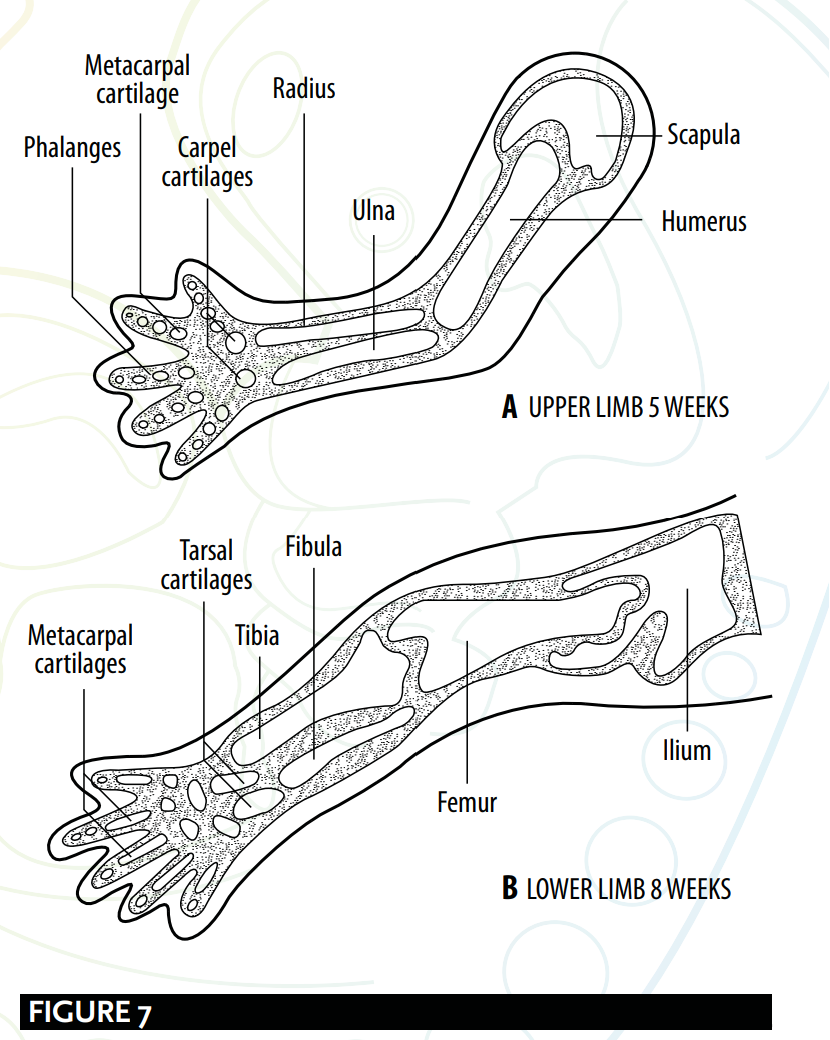
John Allen da Beverley Kramer su ma sun yi sharhi kan samuwar ƙasusuwan gaɓoɓi.
John Allen and Beverley Kramer also comment on limb bone formation.
Mesenchyme na gaɓa a farko taro ne mai kama ɗaya, amma ba da daɗewa ba sai a samu taruwar ƙwayoyin halitta a cikinsa, waɗanda kuma suke zama guringuntsi (cartilage) su samar da sifofin guringuntsi na ƙasusuwa daban-daban. Kowane sifar guringuntsi tana kewaye da perichondrium, wato taruwar mesenchyme. Ana samar da cibiyar ossification ta farko (primary ossification centre) a kan kowace sifar guringuntsi ta hanyar shigowar osteoblasts (ƙwayoyin da ke samar da ƙashi) daga mesenchyme da ke kewaye. Mesenchyme da ke kewaye yanzu ana kiranta periosteum (wanda ke kewaye da ƙashi). Osteoblasts yanzu suna samar da ƙashi, wanda ke haifar da abubuwan ƙasusuwan gaɓoɓi. 73.
The limb mesenchyme is at first a homogenous mass but soon condensations occur in it and these chondrify to form cartilaginous models of the various bones. Each cartilage model is surrounded by perichondrium which is a condensation of mesenchyme. An ossific centre (primary ossification centre) is formed upon each cartilage model by the ingrowth of osteobalsts (bone-forming cells) from the surrounding mesenchyme. The surrounding mesenchyme is now termed periosteum (surrounding the bone). Osteoblasts now produce bone which give rise to the skeletal elements of the limbs. 73.
Akwai kamanceceniya bayyanannu tsakanin matakin ʿiżām a cikin Alkur'ani da ra'ayin ilimin halittar tayi na zamani, watau ci gaban kwarangwal na tsakiya, na gaɓoɓi, da kwarangwal na gaɓoɓin jiki.
There are clear parallels between the qur'anic `idhaam stage and the view modern embryology takes i.e. the development of the axial, limb and appendicular skeleton.
TAKAITATTU
SUMMARY
Matakin `idhaam: Samuwar kashin baya na tsakiya (axial), na gaɓoɓi (limb) da kuma na ƙarin gaɓoɓi (appendicular).
The `idhaam stage: The formation of the axial, limb and appendicular skeleton.
DAGA KASHI ZUWA KASUSUWA
FROM A LUMP TO BONES
Wata babbar fahimta ce da ba masana harshen Larabci ke yi ba, wadda ake yawan yi, cewa ana iya fassara wannan ayar kai tsaye da cewa "sai Muka mayar da wancan guntun nama ya zama ƙasusuwa". Daga nan sai su ce ayar ba ta da alaƙa da kimiyya, saboda ba zai yiwu guntun nama ya zama ƙasusuwa ba. Amma wannan ya samo asali ne daga fahimta marar zurfi game da nahawun Larabci da kuma balagar harshen Alƙur'ani. Ta fuskar nahawu, wannan ayar tana nufin: "sai Muka sanya ƙasusuwa daga/cikin/ta cikin guntun namar".
A common misconception, usually made by non-Arabists, is that this verse can be literally translated as “and We made that lump into bones”. From this, they conclude that this verse is unscientific because a lump of flesh cannot turn into a mass of bones. However, this is based upon a crude understanding of Arabic grammar and the Qur’an's eloquence. This verse, from a grammatical perspective, has the meanings of: “and We made of/from/out of the lump bones”.
Wannan shi ne dalilin da ya sa Yusuf Ali ya fassara wannan ayar da cewa "sai muka sanya daga wannan dunƙule ƙasusuwa"74; Shakir ya fassara ta da cewa "sai Muka sanya (a cikin) dunƙulen nama ƙasusuwa"; A. J. Arberry kuwa, a cikin fassararsa ta Alƙur'ani wadda har yanzu malamai ke amfani da ita, ya fassara wannan ayar da cewa "sai Muka halicci na kayan jiki ƙasusuwa".75
This is why Yusuf Ali translates this verse as “then we made out of that lump bones”74; Shakir translates it as “then We made (in) the lump of flesh bones”; and A J Arberry, in his translation of the Qur’an which is still used by academics today, translates this verse as “then We created of the tissue bones”.75
KASUSSUKA BA NA GASKIYA BA
NOT REAL BONES
Wata shawara daga masu sharhi ita ce cewa a wannan mataki babu ƙasusuwa na gaske. Ana cewa ƙasusuwan da ake gani kawai guringuntsi ne, saboda ossification (tauruwar ƙasusuwa) bai cika ba, don haka Alƙur'ani dole ya zama bai yi daidai ba. Duk da cewa wannan jayayya tana da nauyi, amma ba ta dace ba. Kalmar `idhaam` tana ƙunshe da siffar guringuntsi ta ƙasusuwan yayin da ake kafa tsarin ƙashin jiki. Bugu da ƙari, tsarin ossification yana farawa zuwa mako na 8,76 yana ci gaba bayan haihuwa, kuma yana cika gaba ɗaya kusan lokacin balaga. Barry Mitchell da Ram Sharma sun bayyana haka:
Another proposition from commentators is that at this stage there are no real bones. It is argued that the apparent bones are mere cartilage as ossification is incomplete and, as such, the Qur’an must therefore be inaccurate. Although a valid contention, it is misplaced. `idhaam encompasses the cartilaginous form of the bones as the skeletal framework is put in place. Additionally, the process of ossification begins by the 8th week,76 continuing on after birth, with the eventual completion of the ossification process at around puberty. Barry Mitchell and Ram Sharma explain:
Cibiyoyin ossification (taurin ƙashi) suna fara bayyana a ƙasusuwan gaɓoɓi a mako na takwas. Zuwa mako na goma sha biyu, ƙashin tsakiyar ƙasusuwan gaɓoɓi ya riga ya zama ƙashi, amma ƙasusuwan wuyan hannu (carpal bones) suna ci gaba da zama guringuntsi har bayan haihuwa. Ossification na manyan ƙasusuwan diddige guda uku na ƙafa (tarsal bones) yana farawa kusan mako na goma sha shida, amma wasu ƙananan ƙasusuwan tarsal ba sa zama ƙashi sai shekara 3 bayan haihuwa.77.
The centres of ossification first appear in the limb bones during the eighth week. By the twelfth week, the shafts of the limb bones are ossified, though the carpal bones of the wrist remain cartilaginous until after birth. The ossification of the three largest tarsal bones of the ankle begins about 16 weeks, but some of the smaller tarsal bones do not ossify until 3 years after birth.77.
Daga wannan mahanga, zai zama rashin hankali a likitance a ɗauka cewa jarirai ko matasa ƙanana ba su da ƙasusuwa kawai saboda suna buƙatar ossification (tauraruwar ƙashi), musamman tunda ossification yana kammaluwa a ƙarshen lokacin girma a lokacin balaga. Duk da haka, idan haka ne, kuma za a ɗauki wannan matakin a matsayin wanda babu ƙasusuwa a cikinsa, kamar yadda ake cewa, to fassarar kalmar `idhaam` tana ba da damar ma'ana mai cikakken rufe komai, domin "samfuran guringuntsi na ƙasusuwa daban-daban"78 na cikin ma'anarta.
From this perspective, it would be a medical absurdity to assume newborns or young teenagers do not have bones simply because they require ossification, especially since ossification completes at the end of the growth-spurt of puberty. Nevertheless if this were the case, and we are to take this stage as being ‘boneless’, as it were, the derisions of the word `idhaam allow for an all encompassing interpretation because the “cartilaginous models of the various bones”78 is included in its meaning.