USA A Cikin Duniyar Bayan Amurka
USA In A Post American World
Jihohi 13 na Arewacin Amurka sun kafa Tarayyar Amurka a shekarar 1776 bayan sun ci Birtaniya a yakin neman 'yancin kai na Amurka. Ta hanyar akidar "manifest destiny", Amurka ta fadada har sai da jihohi kusan 50 suka zama wani bangare na tarayyar. Yakin basasa na Amurka na shekarar 1865 ya tabbatar da makomar kasar da tsarin tattalin arzikinta. Bukatun makamai na yakin basasar sun kafa tushen tattalin arzikin masana'antu na Amurka na zamani. Bukatun yaki sun habaka masana'antu sosai, suna hanzarta tsarin tattalin arziki wanda ya dogara da amfani da karfen baƙin ƙarfe, tururi, da wutar lantarki, da kuma ci gaban kimiyya da kirkire-kirkire. Tun daga tsakiyar shekarun 1880 Amurka ta kasance babbar tattalin arziki a duniya a kowace shekara.
13 federal states of North America formed United States of America in 1776 after defeating Britain in the American war of independence. Through manifest destiny the USA expanded until nearly 50 states became part of the union. The American civil war of 1865 sealed the destiny of the nation and its economic system. The armament needs of the civil war laid the groundwork for the modern US industrial economy. War needs had enormously stimulated manufacturing, speeding an economic process based on the exploitation of iron, steam, and electric power, as well as the forward march of science and invention. Since the middle of the 1880’s the USA has been the world’s largest economy every year.
Amurka ta canza daga ƙasar baƙi a nahiyar Arewacin Amurka zuwa ƙasar da a yau take samar da dukiya fiye da ƙasashe huɗu na gaba haɗe. Ta fuskar soja, Amurka ta mamaye duniya kuma tana sarrafa tekunan duniya. Ta fuskar siyasa, Amurka tana cikin mafi yawan al'amuran ƙasashen duniya da rikice-rikice. Kamfanonin Amurka suna mamaye mafi yawan fannoni na tattalin arzikin duniya, kuma alamomi da sunayen kayayyakin Amurka suna cikin waɗanda aka fi sani a faɗin duniya.
The US turned from a nation of immigrants in the North American continent to a nation today that produces more wealth then the next four nations combined. Militarily the US dominates the world and controls the world’s oceans. Politically the US is involved in most international issues and disputes. US companies dominate most sectors of the global economy and US brands and symbols are some of the most recognised across the globe.
Amurka ta fito a matsayin babbar ƙasa a duniya yayin da Yaƙin Duniya na Biyu ke zuwa ƙarshe. Shigar Amurka a yankin Pasifik na yaƙin, da ikonta na samar da injinan masana'antu da kayan aikin soja da yawa ga ƙawayenta, sun taka rawar gani wajen kawo ƙarshen yaƙin, a lokacin da Birtaniya ta kasance an cinye ta gaba ɗaya saboda ƙoƙarin yaƙin Jamus. Amurka ta mamaye Japan da sojoji dubu ɗari biyar, kuma ta raba mamayar Jamus tare da Rasha da Birtaniya.
America emerged a world power as WW2 drew to a close. US participation in the Pacific zone of the conflict and its ability to produce on mass industrial machinery and military equipment for the allies was decisive in bringing the war to its conclusion when Britain had been completely consumed due to the German war effort. The US occupied Japan with half a million of its troops and shared the occupation of Germany with Russia and Britain.
Yaƙi a tarihi ya kasance ginshiƙin ci gaban Amurka. George Friedman ya bayyana haka a cikin littafinsa: The Next 100 Years: "Kusan dukkan sauran ƙasashe masu masana'antu a duniya sun fuskanci mummunan yaƙi a ƙarni na 20. Amurka ta yi yaƙi, amma Amurka kanta ba ta taɓa fuskantar yaƙi ba. Ƙarfin soji da hakikanin yanayin ƙasa sun haifar da hakikanin tattalin arziƙi. Sauran ƙasashe sun rasa lokaci wajen murmurewa daga yaƙe-yaƙe. Amurka ba ta yi haka ba. A gaskiya ta ƙara girma saboda su."2
War historically has been central to America’s development. George Friedman outlined this in his book: The Next 100 Years: “Virtually every other industrialised power in the world experienced devastating warfare in the 20th century. The United States waged war, but America itself never experienced it. Military power and geographical reality created an economic reality. Other countries have lost time recovering from wars. The United States has not. It has actually grown because of them.”2
Yana Amurka ce ta gina duniyar bayan yaƙi. Bayan ta yi amfani da fasahar kere-kere mafi ci gaba a lokacin – makamin nukiliya, wajen kawo ƙarshen Yaƙin Duniya na Biyu cikin lokaci guda, Amurka ta sami damar yanke shawarar sharuddan duniyar bayan yaƙi, kuma Tarayyar Soviet ce kawai ta tsaya mata a hanya. Yayin da taron Yalta a shekarar 1945 ya raba ganima tsakanin masu nasara, taron Bretton Woods ya kafa Asusun Ba da Lamuni na Duniya (IMF), Bankin Duniya da Babban Yarjejeniya kan Haraji da Kuɗin Fito (GATT), kuma ya sa Dala ta zama kuɗin ajiyar duniya – duk wannan ya kafa tasirin Amurka a matsayin tsari, wanda Turai ta karɓa saboda yaƙi ya lalata ta. Cibiyar Brookings ta tabbatar a wani rahoto: "Amurka ta duba dukkan ƙungiyoyi na ɓangarori da yawa, ciki har da Bankin Duniya, a matsayin kayan aikin manufofin ƙasashen waje da za a yi amfani da su wajen goyon bayan manufofi da burika na musamman na Amurka… ra'ayoyin Amurka game da yadda tattalin arzikin duniya ya kamata a tsara shi, yadda ya kamata a raba albarkatu, da yadda ya kamata a cimma shawarwarin zuba jari, an sanya su a cikin Yarjejeniyar da manufofin aiki na bankin."3
It was the United States that constructed the post war world. Having used the most technologically advanced invention at the time – nuclear weapons, to bring to an end in one stroke to WW2, America was well placed to dictate the terms of the post war world, only the Soviet Union presented any obstacle. Whilst the Yalta conference in 1945 distributed the spoils amongst the victors the Bretton Woods conference created the International Monetary Fund, the World Bank and the General Agreement on taxes and Tariffs (GATT), it also made the Dollar the world’s reserve currency – all this institutionalised US influence, which Europe accepted as it was devastated by the war. The Brookings institute confirmed in a report: "The United States has viewed all multilateral organisations including the World Bank, as instruments of foreign policy to be used in support of specific US aims and objectives…US views regarding how the world economy should be organised, how resources should be allocated and how investment decisions should be reached were enshrined in the Charter and the operational policies of the bank."3
Yayin da ake gina gine-ginen bayan Yakin Duniya na Biyu, wani sabon yaki yana farawa – Yakin Cacar Baki. Amurka da Tarayyar Soviet suna gasa da juna, kuma maimakon ruguza Japan da Jamus, Amurka ta yanke shawarar mayar da su kasashen Jari-hujja masu nasara a matsayin ma'auni don dakile yaduwar Kwaminisanci. Yayin da Turai ta samu taimako ta shirin Marshall domin sake ginawa, Japan da Jamus sun samu damar amfani da fasahar Amurka na tsawon shekaru da dama, wanda ya taimaka sosai wajen saurin bunkasar tattalin arzikinsu.4
As the post –WW2 architecture was being constructed a new war was beginning – the cold war. The US and the USSR competed with each other, the US rather then deconstructing both Japan and Germany decided to turn them into successful Capitalist nations as a counter weight to the expansion of Communism. Whilst Europe received aid through the Marshall plan for reconstruction, Japan and Germany for decades received access to US technology which significantly aided their rapid economic development.4
Yaƙin Cacar Baki ya haifar da ci gaba da dama a fannin soja, inda Amurka ta jagoranci gasar makamai da gasar sararin samaniya da Tarayyar Soviet. Amurka ta kafa kawancen Yamma, wanda ya kunshi yawancin kasashe masu dimokuradiyya na sassan duniya, a matsayin ma'auni ga kawancen Gabas. Wannan ya ba Amurka damar yada al'adunta a duniya. Hollywood ta zama jigo a rayuwar Amurkawa, tana shiga zukatan masu kallo a duniya baki daya. An kuma daukaka mai sayen kaya a Amurka saboda mafarkin Amurka da ake iya bi, masana falsafa da masu tunani na Amurka kuma sun jagoranci tunanin siyasa da falsafa.
The Cold War resulted in numerous military developments which the US led in its arms and space race with the Soviet Union. The US created the Western bloc which consisted of most of the liberal democracies around the world as a counter weight to the Eastern bloc. This allowed the US to disseminate its culture around the world. Hollywood became central to the American way of life infiltrating the minds of the global audience. The US consumer became idolised for the American dream that could be pursued and American philosophers and thinkers led the way on political and philosophical ideas.
Post – Americanism
Post – Americanism
A ƙarshen karni na 20, Amurka ce ƙasa mafi ƙarfi a duniya babu abokin hamayya, bayan ta ci gurguzanci, ta kafa NATO a matsayin babbar ƙungiyar tsaro ta duniya, kuma ta mamaye tattalin arzikin duniya. Saboda haka, an yi tsammanin sosai cewa duniya za ta ci gaba da rubutawa da bugawa game da ƙwarewar Amurka na tsawon shekaru masu yawa.
At the end of the 20th century the US was the unrivalled world power, having defeated Communism, established NATO as the world’s default security organisation and dominated the world economy, it was considered very likely that the world would be writing and printing about US prowess for decades to come.
Amma Amurka a karni na 21 babbar ƙasa ce ta duniya daban da wadda take a karni na 20.
The US in the 21st century however is a very different global power to the one of the 20th century.
A yau Amurka tana zubar da jini daga raunuka biyu a buɗe a Iraki da Afghanistan, waɗanda ba su nuna alamar raguwa ba. Yaƙe-yaƙen biyu sun daɗe yanzu fiye da Yaƙin Duniya na Biyu. Sojojin Amurka, mafiya ci gaban fasaha a tarihi, sun kasa cin nasara a kan wata ƙungiyar mayaƙa da ke amfani da makamai da aka ƙera a shekarun 1960. Saboda haka, dole ne ta dogara ga wakilai iri-iri don kaucewa kunya. An kwatanta yaƙe-yaƙen Iraki da Afghanistan, da kuma gazawar Amurka wajen fita daga cikinsu, da Yaƙin Boer na 1899, wanda ake ɗauka a matsayin farkon ƙarshen daular Birtaniya. Cikakkun bayanan yaƙin suna kama da na Amurka a Iraki da Afghanistan.
Today America is bleeding from two open wounds in Iraq and Afghanistan that show no signs of abating. Both wars have now lasted longer than WW2. The US army, the most technologically advanced in history has been unable to defeat a band of fighters using weapons developed in the 1960’s. As a result it has to rely on a variety of surrogates to avoid embarrassment. The Iraq and Afghan wars and the fact that the US has been unable to extricate itself has been compared to the Boer war of 1899, which is considered the beginning of the end of the British empire. The details of the war bear a similar resemblance to the US in Iraq and Afghanistan.
Yaƙin Boer
Boer War
Bayan nasarar kammala yakin Omdurman a Sudan, inda sojojin Birtaniya suka kasance sun yi kasa da sau biyu, Birtaniya kamar yadda Amurka ta yi, ta gabatar da dalilan yakin. Daular ta bayar da hujjar cewa dole ne a kare haqqoqin masu magana da Turanci, waɗanda ake yi wa kallon 'yan ƙasa na ajin biyu. A zahiri, Boers, manoma da ke zaune a filayen lu'u-lu'u, sai da aka gano zinariya a shekarar 1886, sai baƙi da yawa suka yi gaggawar zuwa wurin da yake yau Afirka ta Kudu domin shiga cikin hauhawar neman zinariya. A shekarar 1899 yankin Boer na Afirka ta Kudu yana samar da kashi 25 cikin 100 na zinariyar duniya.
After successfully concluding the war of Omdurman in Sudan where the British army was outnumbered two to one. Britain just like the US presented their reasons for the war, the Empire argued the rights of the English speaking people, who were treated as second class citizens had to be protected. In reality the Boers – farmers, resided over diamond fields and with the discovery of Gold in 1886, many foreigners hurried to what is today South Africa to participate in its Gold rush. In 1899 the Boer area of South Africa was producing 25% of the world’s gold.
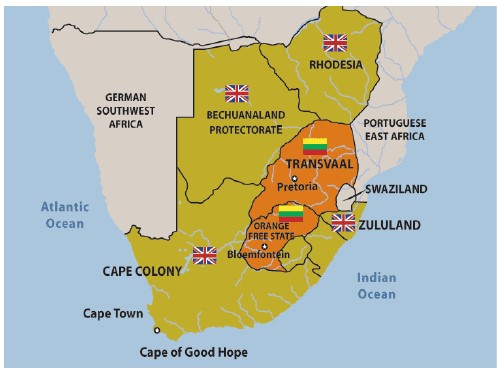
Daular ta fuskanci kimanin manoma 45,000 a Transvaal da Orange Free State waɗanda suka san yadda za su kare ƙasarsu. Suna da goyon bayan yawancin 'yan asalin ƙasar, kuma suna amfani da dabarun yaƙin sari-ka-noke wanda ba a iya dakatar da shi ba, duk da cewa Daular Birtaniya tana da babbar runduna a ƙasar. Saboda haka, Daular ta koma ga hanyoyi marasa tausayi, waɗanda suka haɗa da ƙona ƙauyuka gaba ɗaya, ƙirƙirar sansanonin tara jama'a domin mazauna, da kashe mutane ba tare da shari'a ba.
The Empire faced around 45,000 farmers the Transvaal and the Orange Free State who knew how to defend their land, they had the support of most of the indigenous population and utilised guerrilla tactics which was impossible to contain when the British Empire had such a large army on the ground. As a result the Empire resorted to brutal tactics that included burning down whole villages, creating concentration camps for the population and resorting to summery executions.
Boerowie wytrzymali do 1902 roku, kiedy w końcu się poddali. Chociaż Wielka Brytania ostatecznie wygrała wojnę, pokonując wroga, w rzeczywistości poniosła porażkę. Pod koniec wojny Wielka Brytania miała na polu walki 450,000 żołnierzy, którzy walczyli z zaledwie 45,000 członkami milicji. Brytyjczycy stracili 45,000 żołnierzy, znacznie przekroczyli wydatki na wysiłek wojenny i doprowadzili swoje siły zbrojne niemal do granic wytrzymałości. Jej brutalne metody jednak na zawsze podważyły sprawę brytyjską, zarówno w kraju, jak i za granicą. Podczas gdy wszystkie ówczesne mocarstwa potępiały brytyjskie metody, w kraju zakwestionowano rolę Wielkiej Brytanii na świecie, skoro zabijano masy, by dać im wolność. Wait, that output is in Polish, but the task is English to Hausa. Here is the correct translation: Boers sun yi tsayin daka har zuwa 1902, lokacin da daga ƙarshe suka miƙa wuya. Duk da cewa Birtaniya ta ci yaƙin a ƙarshe, ta ci nasara a kan abokin gābanta, amma a zahiri ta sha kaye. Zuwa ƙarshen yaƙin, Birtaniya tana da sojoji 450,000 a fagen daga suna yaƙi da ƙungiyar sojan sa-kai ta mutum 45,000 kawai. Birtaniya ta yi asarar sojoji 45,000, ta kashe kuɗi fiye da kima a ƙoƙarin yaƙin, kuma ta miƙa sojojinta har zuwa iyakar karyewa. Sai dai dabarunta na zalunci sun raunana dalilin Birtaniya har abada, a gida da kuma a ƙasashen waje. Yayin da dukkan manyan ƙasashen zamanin suka soki dabarun Birtaniya, a cikin ƙasar an tambayi matsayin Birtaniya a duniya, tunda ana kashe taro don a ba su 'yanci.
The Boers held out until 1902 when they eventually surrendered. Whilst Britain actually won the war as they defeated the enemy in reality they had lost. By the wars end Britain had 450,000 troops on the ground fighting a mere militia of 45,000. Britain lost 45,000 troops and had massively overspent in the war effort and has stretched its military to breaking point. However its brutal tactics undermined the British cause forever at home and abroad. Whilst all the powers of the day exposed British tactics, domestically Britain’s role in the world was questioned when you kill the masses in order to give them freedom.