Kitab yang Dinamai "Perjanjian Baru"
The Book Christened "the New Testament"
"Why 'according To?'" → Mengapa "according To?"
Why "according To?"
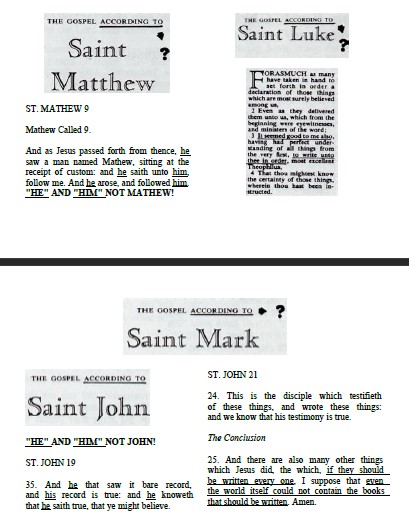
Mengapa setiap Injil dimulai dengan pengantar — ACCORDING TO ... ACCORDING TO ... (Lihat di bawah)? Mengapa "according to"? Karena tidak satu pun dari empat ribu salinan yang konon termasyhur itu memuat tulisan tangan asli penulisnya! Karena itulah diasumsikan "according to"! Bahkan bukti internal membuktikan bahwa Matius bukanlah penulis Injil pertama yang menyandang namanya.
What about the so-called New Testament? 1 1 Why does every Gospel begin with the introduction — ACCORDING TO ... ACCORDING TO ... (See below). Why "according to?" Because not a single one of the vaunted four thousand copies extant carries its author's autograph! Hence the supposition "according to!" Even the internal evidence proves that Matthew was not the author of the first Gospel which bears his name.
"Dan ketika Yesus berjalan dari sana, Ia (Yesus) melihat seorang laki-laki bernama Matius, sedang duduk di rumah cukai; dan Ia (Yesus) berkata kepadanya (Matius): Ikutlah Aku (Yesus). Lalu ia (Matius) bangkit dan mengikuti Dia (Yesus)." (Matius 9:9)
"And as Jesus passed forth thence, HE (JESUS) saw a man, named Matthew, sitting at the receipt of custom: and HE (JESUS) saith unto HIM (MATTHEW), follow ME (JESUS) And HE (MATTHEW) arose, and followed HIM (JESUS)." (Matthew 9:9)
1. Istilah "yang disebut-sebut," karena tidak ada satu tempat pun dalam "Perjanjian Baru" yang menyebut dirinya Perjanjian Baru, dan tidak ada tempat dalam Perjanjian Lama yang menyebut dirinya Perjanjian Lama. Selain itu, kata "Alkitab" tidak dikenal di dalam halaman-halaman Alkitab itu sendiri. Tuhan lupa memberi judul pada "kitab-kitab-Nya"! Tanpa perlu banyak berimajinasi, orang dapat melihat bahwa kata "Dia" dan "Dia" dalam narasi di atas tidak merujuk kepada Yesus atau Matius sebagai penulisnya, melainkan kepada seorang pihak ketiga yang menulis apa yang ia lihat dan dengar, sebuah kisah dari kabar angin. Jika kita bahkan tidak dapat mengaitkan "kitab mimpi" ini (sebagaimana Injil pertama juga digambarkan) dengan murid Matius, bagaimana kita dapat menerimanya sebagai Firman Tuhan?
1. The "so-called," because nowhere does the "New Testament" calls itself the New Testament, and nowhere the Old Testament calls itself the Old Testament. And also the word "Bible" is unknown within the pages of the Bible. God forgot to give a title to "HIS" books! Without any stretch of the imagination, one can see that the "He's" and the "Him's" of the above narration do not refer to Jesus or Matthew as its author, but some third person writing what he saw and heard — a hearsay account. If we cannot even attribute this "book of dreams" (as the first Gospel is also described) to the disciple Matthew, how can we accept it as the Word of God?
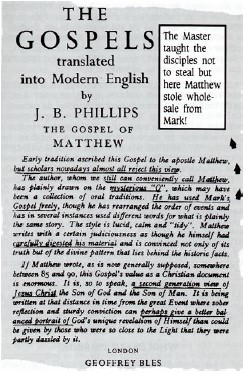
Kami tidak sendirian dalam penemuan ini bahwa Matius tidak menulis "Injil menurut Santo Matius" dan bahwa injil tersebut ditulis oleh tangan yang tidak diketahui namanya. J. B. Phillips sependapat dengan kami dalam temuan kami. Ia adalah hamba yang digaji oleh Gereja Anglikan, seorang prebendari di Katedral Chichester, Inggris. Ia tentu tidak punya alasan untuk berdusta atau berkhianat yang merugikan pandangan resmi Gerejanya! Silakan lihat pengantarnya untuk "Injil Santo Matius" (direproduksi di bawah ini). Phillips mengatakan hal berikut tentang kepengarangannya.
We are not alone in this discovery that Matthew did not write the "Gospel according to St. Matthew" and that it was written by some anonymous hand. J. B. Phillips concurs with us in our findings. He is the paid servant of the Anglican Church, a prebendary of the Chichester Cathedral, England. He would have no reason to lie or betray to the detriment of the official view of his Church! Refer to his introduction to the "Gospel of St. Matthew" (reproduced here below). Phillips has this to say about its authorship.
"AWAL TRADISI MENISBATKAN INJIL INI KEPADA RASUL MATIUS, NAMUN PARA SARJANA DEWASA INI HAMPIR SEMUANYA MENOLAK PANDANGAN INI." Dengan kata lain, Santo Matius tidak menulis Injil yang menyandang namanya. Ini adalah temuan para sarjana Kristen yang paling terkemuka, bukan dari kaum Hindu, Muslim, dan Yahudi yang mungkin dituduh berpihak. Mari kita simak lanjutan sahabat Anglikan kita: "PENULISNYA, YANG MASIH DAPAT KITA SEBUT DENGAN NYAMAN SEBAGAI MATIUS." "Dengan nyaman" karena jika tidak, setiap kali kita merujuk kepada "Matius" kita harus mengatakan "KITAB PERTAMA PERJANJIAN BARU" pasal sekian, ayat sekian. Dan berulang-ulang "Kitab pertama . . ." dan seterusnya. Oleh karena itu, menurut J. B. Phillips, adalah wajar bahwa kita memberi kitab ini suatu nama. Jadi mengapa bukan "Matius"? Anggaplah itu nama yang sama baiknya dengan nama lain! Phillips melanjutkan: "PENULIS TELAH JELAS MENGAMBIL DARI 'Q' YANG MISTERIUS, YANG MUNGKIN MERUPAKAN KUMPULAN TRADISI LISAN." Apa maksud "Q yang misterius"? "Q" adalah singkatan dari kata Jerman "quelle" yang berarti "sumber." Diduga ada dokumen lain, sebuah sumber bersama, yang dapat diakses oleh Matius, Markus, dan Lukas yang kita kenal sekarang. Ketiga penulis ini, siapa pun mereka, memiliki pandangan yang sama terhadap bahan yang ada di tangan mereka. Mereka menulis seolah-olah memandang melalui "satu" mata. Dan karena mereka sependapat, ketiga "Injil" pertama itu dikenal sebagai Injil Sinoptik.
"EARLY TRADITION ASCRIBED THIS GOSPEL TO THE APOSTLE MATTHEW, BUT SCHOLARS NOWADAYS ALMOST ALL REJECT THIS VIEW." In other words, St. Matthew did not write the Gospel which bears his name. This is the finding of Christian scholars of the highest eminence — not of Hindus, Muslims and Jews who may be accused of bias. Let our Anglican friend continue: "THE AUTHOR, WHOM WE STILL CAN CONVENIENTLY CALL MATTHEW" "Conveniently" because otherwise everytime we made a reference to "Matthew" we would have to say — "THE FIRST BOOK OF THE NEW TESTAMENT" Chapter so and so, verse so and so. And again and again "The first book . . ." etc. Therefore, according to J. B. Phillips it is convenient that we give the book some name. So why not "Matthew?" Suppose its as good a name as any other! Phillips continues: "THE AUTHOR HAS PLAINLY DRAWN ON THE MYSTERIOUS 'Q' WHICH MAY HAVE BEEN A COLLECTION OF ORAL TRADITIONS." What is this "mysterious 'Q'?" "Q" is short for the German word "quella" which means "sources." There is supposed to be another document — a common source — to which our present Matthew, Mark and Luke had access. All these three authors, whoever they were, had a common eye on the material at hand. They were writing as if looking through "one" eye. And because they saw eye to eye, the first three "Gospels" came to be known as the Synoptic Gospels.
Penjiplakan Massal
Wholesale Cribbing
Tetapi bagaimana dengan soal "ilham" ini? Prebendari Anglikan itu telah tepat sasaran. Dia, lebih dari siapa pun, berhak untuk mengatakannya. Seorang pelayan Gereja yang digaji, seorang Kristen evangelis ortodoks, seorang sarjana Alkitab yang terkenal, yang memiliki akses langsung ke naskah Yunani "asli", biarlah DIA yang menjelaskannya kepada kita. (Perhatikan betapa halusnya dia membocorkan rahasia itu): "HE (Matthew) HAS USED MARK'S GOSPEL FREELY," yang dalam bahasa guru sekolah berarti "telah MENYALIN MENTAH-MENTAH dari Mark!" Namun orang-orang Kristen menyebut plagiarisme besar-besaran ini sebagai Firman Tuhan?
But what about that "inspiration" business? The Anglican prebendary has hit the nail on the head. He is, more than anyone else, entitled to do so. A paid servant of the Church, an orthodox evangelical Christian, a Bible scholar of repute, having direct access to the "original" Greek manuscripts, let HIM spell it out for us. (Notice how gently he lets the cat out of the bag): "HE (Matthew) HAS USED MARK'S GOSPEL FREELY" which in the language of the school-teacher — "has been copying WHOLESALE from Mark!" Yet the Christians call this wholesale plagiarism the Word of God?
Bukankah ini membuat Anda bertanya-tanya: seorang saksi mata dan saksi telinga atas pelayanan Yesus, yang diyakini sebagai murid Matius, mengapa ia justru menyalin dari tulisan seorang pemuda (Markus), yang adalah anak berusia sepuluh tahun ketika Yesus menegur bangsanya, dan yang menulis berdasarkan kabar dari orang lain? Mengapa seorang saksi mata dan saksi telinga menyalin dari orang yang sendiri menulis dari kabar angin? Murid Matius tidak akan melakukan hal bodoh semacam itu. Sebuah dokumen anonim telah dipaksakan atas nama baik Matius.
Does it not make you wonder that an eye-witness and an ear-witness to the ministry of Jesus, which the disciple Matthew was supposed to be, instead of writing his own first hand impressions of the ministry of "his Lord" would go and steal from the writings of a youth (Mark), who was a ten year old lad when Jesus upbraided his nation? Why would an eye-witness and ear-witness copy from a fellow who himself was writing from hearsay? The disciple Matthew would not do any such silly thing. For an anonymous document has been imposed on the fair name of Matthew.
Plagiarisme atau Penculikan Sastra
Plagiarism Or Literary Kidnapping
Plagiarisme berarti pencurian sastra. Seseorang yang menyalin kata demi kata (secara harfiah) dari tulisan orang lain lalu mengakuinya sebagai karyanya sendiri disebut plagiarisme. Ini merupakan ciri yang umum di antara sekitar 40 penulis anonim dari kitab-kitab Alkitab. Orang-orang Kristen membanggakan adanya benang merah yang konon sama di antara para penulis 66 kitab Protestan dan para penulis 73 kitab Katolik Roma yang disebut "Alkitab Suci." Memang ada sejumlah kesamaan, sebab Matius dan Lukas, atau siapa pun mereka, telah menjiplak 85% kata demi kata dari Markus! Tuhan Yang Maha Kuasa tidak mendiktekan kata-kata yang sama kepada para penulis Injil sinoptik (bermata satu). Orang-orang Kristen sendiri mengakui hal ini, karena mereka tidak meyakini inspirasi verbal sebagaimana kaum Muslim meyakini tentang Al-Qur'an yang mulia. 1 1
Plagiarism means literary theft. Someone copies ad verbatim (word for word) from another's writing and palms it off as his own, is known as plagiarism. This is a common trait amongst the 40 or so anonymous authors of the books of the Bible. The Christians boast about a supposedly common cord amongst the writers of the 66 Protestant booklets and the writers of the 73 Roman Catholic booklets called the "Holy Bible." Some common cord there is, for Matthew and Luke, or whoever they were, had plagiarised 85% word for word from Mark! God Almighty did not dictate the same wordings to the synoptists (one-eyed). The Christians themselves admit this, because they do not believe in a verbal inspiration, as the Muslims do about the Holy Qur’ân. 1 1
Persentase 85% plagiarisme dari Matius dan Lukas itu tidak ada apa-apanya dibandingkan dengan "penculikan sastra" terhadap para penulis Perjanjian Lama, di mana pencurian seratus persen terjadi dalam apa yang disebut Kitab Allah. Para sarjana Kristen sekaliber Uskup Kenneth Cragg menyebut pencurian ini dengan halus sebagai "reproduksi"2, dan mereka berbangga karenanya.
This 85% plagiarism of Matthew and Luke pales into insignificance compared to the literary kidnapping of the authors of the Old Testament where a hundred percent stealing occurs in the so-called Book of God. Christian scholars of the calibre of Bishop Kenneth Cragg euphemistically calls this stealing, "reproduction"2 and take pride in it.
1. Lihat "AL-QURAN — The Miracles of Miracles" (segera hadir)
1. See "AL-QURAN — The Miracles of Miracles" (coming soon)
2. Lihat awal bab satu untuk kutipan lengkapnya.
2. See beginning of chapter one for the full quotation.
Standar-Standar yang Menyimpang
Perverted Standards
Dr. Scroggie (yang disebutkan sebelumnya) dengan sangat antusias mengutip dalam bukunya1 seorang Dr. Joseph Parker atas pujiannya yang unik terhadap Alkitab:
Dr. Scroggie (referred to earlier on) most enthusiastically quotes in his book Scroggie (referred to earlier on) most enthusiastically quotes in his book1 a Dr. Joseph Parker for his unique eulogy of the Bible:
"APA BUKU YANG LUAR BIASA ALKITAB DALAM HAL KERAGAMAN ISINYA! . . . HALAMAN DEMI HALAMAN DIPENUHI DENGAN NAMA-NAMA YANG TIDAK JELAS, DAN LEBIH BANYAK DIKISAHKAN TENTANG SILSILAH DARIPADA TENTANG HARI PENGHAKIMAN. KISAH-KISAH DISAMPAIKAN SETENGAH-SETENGAH, DAN MALAM SUDAH TIBA SEBELUM KITA BISA MENGATAKAN DI MANA KEMENANGAN ITU TERLETAK. DI MANAKAH ADA SESUATU" (dalam Literatur Keagamaan dunia) "YANG SEBANDING DENGAN INI?" Sebuah kalung kata dan frasa yang indah, tidak diragukan lagi! Itu adalah keributan tanpa arti, dan penghujatan yang nyata terhadap Tuhan Yang Mahakuasa karena mengizinkan kumpulan yang memalukan seperti itu. Namun orang-orang Kristen justru bersukacita atas cacat-cacat dari kitab mereka sendiri, seperti Romeo yang bersukacita atas "tahi lalat" di bibir Juliet! 1. "Is the Bible the Word of God?" oleh Moody Press. oleh Moody Press.
"WHAT A BOOK IS THE BIBLE IN THE MATTER OF VARIETY OF CONTENTS! . . . WHOLE PAGES ARE TAKEN UP WITH OBSCURE NAMES, AND MORE IS TOLD OF A GENEALOGY THAN OF THE DAY OF JUDGMENT. STORIES ARE HALF TOLD, AND THE NIGHT FALLS BEFORE WE CAN TELL WHERE VICTORY LAY. WHERE IS THERE ANYTHING" (in the Religious Literature of the world) "TO CORRESPOND WITH THIS?" A beautiful necklace of words and phrases undoubtedly! It is much ado about nothing, and rank blasphemy against God Almighty for authorising such an embarrassing hotch potch. Yet the Christians gloat over the very defects of their book, like Romeo over the "mole" on Juliet's lip! 1. "Is the Bible the Word of God?" by the Moody Press. by the Moody Press.
Tidak Kurang dari 100%
Nothing Less Than 100%
Untuk menunjukkan tingkat plagiarisme yang dilakukan para penulis Alkitab yang "terilhami", saya meminta hadirin dalam sebuah simposium di University of Cape Town, yang saya selenggarakan bersama Profesor Cumpsty, Kepala Departemen Teologi, dengan tema "Apakah Alkitab Firman Tuhan?", untuk membuka Alkitab mereka.
To demonstrate the degree of plagiarism practised by the "inspired" Bible writers, I asked my audience during a symposium at the University of Cape Town conducted between myself and Professor Cumpsty the Head of the Department of Theology on the subject "Is the Bible God's Word?" to open their Bibles.
Banyak orang Kristen sangat senang membawa Alkitab mereka di bawah ketiak ketika diskusi atau debat keagamaan berlangsung. Mereka tampak sama sekali tidak berdaya tanpa buku ini. Atas saran saya, sejumlah hadirin mulai membolak-balik halaman. Saya meminta mereka membuka pasal 37 dalam "Kitab Yesaya." Ketika hadirin sudah siap, saya meminta mereka membandingkan "Yesaya 37" saya dengan "Yesaya 37" milik mereka selama saya membaca, untuk melihat apakah keduanya identik. Saya mulai membaca dengan perlahan. Ayat 1, 2, 4, 10, 15, dan seterusnya, sampai akhir pasal. Setelah setiap ayat, saya terus bertanya apakah yang saya baca itu identik dengan ayat-ayat dalam Alkitab mereka. Berulang kali mereka serempak menjawab, "Yeh!", "Yeh!". Pada akhir pasal, dengan Alkitab yang masih terbuka di tangan saya pada tempat saya membaca, saya meminta Ketua mengungkapkan kepada hadirin bahwa saya sama sekali tidak membaca dari Yesaya 37, melainkan dari 2 RAJA-RAJA 19! Terjadi kegemparan hebat di antara hadirin! Dengan demikian saya telah membuktikan adanya plagiarisme 100% dalam "Alkitab Suci." (Lihat di bawah)
Some Christians are very fond of carrying their Bibles under their arms when religious discussions or debates take place. They seem to be utterly helpless without this book. At my suggestion a number of the audience began ruffling the pages. I asked them to open chapter 37 in the "Book of Isaiah." When the audience was ready, I asked them to compare my "Isaiah 37" with their "Isaiah 37" while I read, to see whether they were identical. I began, readingly slowly. Verses 1, 2, 4,10, 15, and so on, until the end of the chapter. I kept on asking after every verse if what I had been reading, was identical with the verses in their Bibles. Again and again they chorused — "Yeh!", "Yeh!". At the end of the chapter with the Bible still open in my hands at the place from which I had been reading, I made the Chairman to reveal to the audience that I was not reading from Isaiah 37 at all but from 2 KINGS 19! There was a terrible consternation in the audience! I had thus established 100% plagiarism in the "Holy Bible." (See below)
Dengan kata lain, Yesaya 37 dan 2 Raja-raja 19 identik kata demi kata. Namun keduanya dikaitkan dengan dua pengarang yang berbeda, terpaut berabad-abad, yang menurut orang Kristen diilhamkan oleh Tuhan.
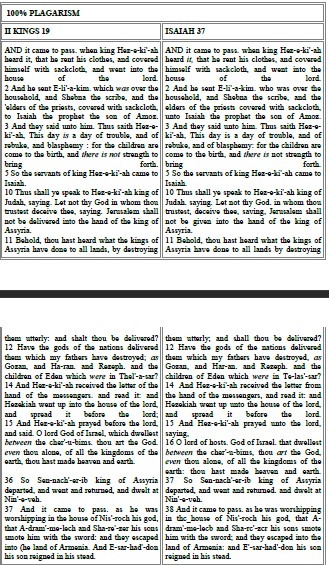
Ayat-ayat ini diambil dari Authorised Version, tetapi Anda akan menemukan hal yang sama di setiap terjemahan.
These verses are culled from the Authorised Version, but you will find the same in every Version.
Tidak Ada Ilham Verbal
No Verbal Inspiration
(Untuk daftar lengkap semua kitab Alkitab beserta pengarangnya, silakan merujuk pada "Collins'" R.S.V. "dengan" catatan-catatannya.) Apa yang dikatakan para cendekiawan Kristen tentang "Kitab Yesaya"? Mereka mengatakan: "UMUMNYA DIKAITKAN KEPADA YESAYA. BAGIAN-BAGIANNYA MUNGKIN DITULIS OLEH ORANG LAIN." Mengingat pengakuan para ahli Alkitab ini, kita tidak akan menyalahkan Yesaya yang malang. Dapatkah kita kemudian menimpakan plagiarisme ini kepada Tuhan? Sungguh suatu penghujatan! Profesor Cumptsy menegaskan pada sesi tanya jawab, di akhir simposium yang disebutkan tadi, bahwa "orang-orang Kristen tidak percaya pada inspirasi verbal Alkitab." Jadi Tuhan Yang Mahakuasa tidak secara tidak sengaja mendiktekan kisah yang sama dua kali! Tangan-tangan manusia, yang sangat manusiawi, telah mengacak-acak apa yang disebut Firman Tuhan ini — Alkitab. Namun para penganut Alkitab garis keras akan tetap bersikeras bahwa "setiap kata, koma, dan titik dalam Alkitab adalah Firman Tuhan!"
(For a complete list of all the books of the Bible and their authors, avail yourself of the "Collins'" R.S.V. 'with' its annotations). What have Christian scholars to say about the "Book of Isaiah?" They say: "MAINLY CREDITED TO ISAIAH. PARTS MAY HAVE BEEN WRITTEN BY OTHERS" In view of the confessions of Bible scholars, we will not take poor Isaiah to task. Can we then nail this plagiarism on the door of God? What blasphemy! Professor Cumptsy confirmed at question time, at the end of the aforementioned symposium that the "Christians do not believe in a verbal inspiration of the Bible" So God Almighty had not absent-mindedly dictated the same tale twice! Human hands, all too human, had played havoc with this so-called Word of God — the Bible. Yet, Bible-thumpers will insist that "every word, comma and full stop of the Bible is God's Word!"