Twee soorten openbaring: de gesproken en de ongesproken
Two Types Of Revelation: The Spoken And The Unspoken
De gezegende Profeet ﷺ ontving twee soorten goddelijke openbaringen. De ene is de gesproken [matluww] en de tweede, de niet-gesproken [ghair-matluww]. De gesproken openbaring is datgene wat wordt gereciteerd [d.w.z. de Qur’an]; de niet-gesproken openbaring is datgene wat niet wordt gereciteerd [d.w.z. de aúódõth van de gezegende Profeet ﷺ]. Een aanwijzing naar de wortels van de niet-gesproken openbaring kan worden gevonden in de ayas van de Qur’an. Allah zegt in de Heilige Qur’an:
The Blessed Prophet صلى الله عليه وسلم received two types of divine revelations. One is the spoken [matluww] and the second, the unspoken [ghair-matluww]. The spoken revelation is that which is recited [i.e., the Qur’an]; the unspoken revelation is that which is not recited [i.e., the aúódõth of the Blessed Prophet صلى الله عليه وسلم]. An indication of the roots of the unspoken revelation can be found in the ayas of the Qur’an. Allah صلى الله عليه وسلم says in the Holy Qur’an:

En Wij hebben de gebedsrichting (Qiblah) tot which u gewend was, slechts aangesteld om hen die de Boodschapper ﷺ volgden te testen van hen die zich zouden omdraaien op hun hielen.3
And We appointed the qibla to which you were used only to test those who followed the Messenger from those who would turn on their heels.3
Om een breder begrip van deze aya te krijgen, is het belangrijk dat we naar de historische achtergrond ervan kijken.
To gain a broader understanding of this aya, it is important that we look into its historical background.
Kort na de migratie naar Madina werd de gezegende Profeet ﷺ en de metgezellen (Sahabah) bevolen om in de richting van Masjid al-Aqsa in Jeruzalem te bidden. Masjid al-Aqsa werd zeventien maanden lang de gebedsrichting (Qiblah) van de moslims. Na zeventien maanden werd het bevel om in de richting van Masjid al-Aqsa te bidden ingetrokken en werd de moslims bevolen om in de richting van Makka te bidden. Dit bevel werd vastgesteld door de volgende aya:
Shortly after the migration to Madina, the Blessed Prophet صلى الله عليه وسلم and the Sahaba رضي الله عنه) were told to pray towards Masjid al-Aqüó in Jerusalem. Masjid al-Aqüó became the qibla of the Muslims for seventeen months. After seventeen months, the order to pray towards Masjid al-Aqüó was abrogated and Muslims were ordered to pray towards Makka. This order was established through the following aya:
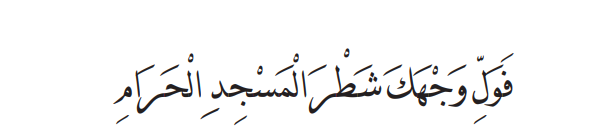
En Wij hebben de gebedsrichting (Qiblah) tot which u gewend was, slechts aangesteld om hen die de Boodschapper ﷺ volgden te beproeven van hen die zich zouden omdraaien op hun hielen.5
And We appointed the qibla to which you were used only to test those who followed the messenger from those who would turn on their heels.5
In deze aya vermeldt Allah (SWT) het eerste gebod, namelijk om richting Jeruzalem te wenden, als Zijn eigen gebod. Dit maakt de lezer zich ervan bewust dat Allah (SWT) zelf achter het gebod stond om richting Masjid al-Aqsa te bidden. Maar wanneer we de Qur’an lezen, vinden we geen enkele dergelijke aya waarin Allah (SWT) de moslims beval om richting Jeruzalem te bidden.
In this aya, Allah سبحانه وتعالى.mentions the first order, which was to face towards Jerusalem, as His own order. This impresses upon the reader the fact that Allah سبحانه وتعالى. himself was behind the order to face Masjid al-Aqüó. But when we read the Qur’an we do not find any such aya in which Allah سبحانه وتعالى. ordered the Muslims to pray towards Jerusalem.
Het feit is dat dit bevel kwam van de gezegende Profeet ﷺ en niet van een aya van de Qur’an. De aya zegt niet: “De gezegende Profeet ﷺ vaardigde het bevel uit...”, maar zegt eerder: “Wij hebben de gebedsrichting (Qiblah) aangewezen...”. Dit brengt ons tot het inzicht dat het bevel van de gezegende Profeet ﷺ niet verschilt van het bevel van Allah (SWT).
The fact is that this order came from the Blessed Prophet صلى الله عليه وسلم and not from any aya of the Qur’an. The aya does not say, “The Blessed Prophet صلى الله عليه وسلم enacted the order…” rather it says, “We appointed the qibla….” This brings us to the understanding that the order of the Blessed Prophet صلى الله عليه وسلم is no different from the order of Allah سبحانه وتعالى..
Het bewijs is zo vanzelfsprekend dat het geen verdere verduidelijking behoeft. Deze duidelijke verklaring uit de Qur’an met betrekking tot het bevel gegeven door de gezegende Profeet ﷺ demonstreert een fundamenteel geloof over de Sunnah van de gezegende Profeet ﷺ: dat deze een vorm van openbaring is. En dit is wat bekend staat als de onuitgesproken of niet-opgezegde openbaring.
The proof is so self-evident it does not require any further clarification. This clear statement from the Qur’an regarding the order given by the Blessed Prophet صلى الله عليه وسلم demonstrates a fundamental belief about the aúódõth of the Blessed Prophet صلى الله عليه وسلم: that they are a form of revelation. And this is what is known as the unspoken or unrecited revelation.
De bovenstaande aya onthult ook enkele andere belangrijke punten:
The aya mentioned above also reveals some other important points:
1. Een speciaal type openbaring werd naar de gezegende Profeet ﷺ gezonden, die geen deel uitmaakte van de Qur’an.
1. A special type of revelation was sent to the Blessed Prophet صلى الله عليه وسلم which was not a part of the Qur’an.
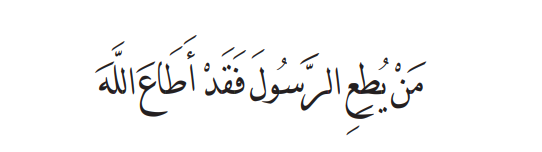
Wie de gezegende Profeet ﷺ volgt, heeft Allah gevolgd.6
Whosoever follows the Blessed Prophet صلى الله عليه وسلم has followed Allah ‹.6
In deze aya beveelt de Qur'an ons om vast te houden aan de weg van de gezegende Profeet ﷺ, aangezien het vasthouden aan de gezegende Profeet ﷺ het vasthouden aan Allah (SWT) is. Op een keer kwam een vrouw naar de beroemde metgezellen (Sahabah) رضي الله عنه, ‘Abd Allóh ibn Mas‘ñd رضي الله عنه. Zij zei: “Ik heb gehoord dat u mensen ervan weerhoudt bepaalde dingen te doen, ook al heb ik de Qur'an van begin tot eind gelezen en heb ik in de Qur'an nooit gelezen dat ons wordt bevolen deze dingen te vermijden.” ‘Abd Allóh ibn Mas‘ñd رضي الله عنه antwoordde: “Als je de Qur'an had gelezen, dan had je het gevonden. Heb je deze aya van de Qur'an niet gelezen:
In this aya the Qur’an orders us to adhere to the way of the Blessed Prophet صلى الله عليه وسلم, as adherence to the Blessed Prophet صلى الله عليه وسلم is adherence to Allah سبحانه وتعالى.. Once, a woman came to the famous Sahaba رضي الله عنه), ‘Abd Allóh ibn Mas‘ñdرضي الله عنه. She said, “I have heard you stop people from doing certain things even though I have read the Qur’an from cover to cover and I have never read the Qur’an ordering us to abstain from these things.” ‘Abd Allóh ibn Mas‘ñd رضي الله عنه) replied, “Had you read the Qur’an you would have found it. Have you not read this aya of the Qur’an:

Wat de Profeet ﷺ aan jullie geeft, accepteer het; en waar hij geen goedvinden over heeft, onthoud je daarvan.7
Whatever the Prophet صلى الله عليه وسلم gives you, accept it; and whatever he disapproves of, abstain from it.7
Uit dit voorval leren we dat deze aya de aúódõth van de gezegende Profeet ﷺ omvat en de autoriteit van de aúódõth in de Islam vestigt.
From this incident we learn that this aya incorporates the aúódõth of the Blessed Prophet صلى الله عليه وسلم and establishes the authority of the aúódõth in Islam.