Anas rivoyat qilgan: Abu Bakr as-Siddiq ﷺ uni Bahrayinga yuborganida ushbu xatni yozgan:
Anas narrated that Abu Bakr, the Truthful wrote this message when he sent him to Bahrain:
Eng rahmli va rahmi keng Alloh nomi bilan. Bu Alloh tomonidan unga farz qilib buyurilgan, Alloh Elchisi ﷺ musulmonlarga yuklagan sadaqa vajibidir.
In the name of God, most merciful, most gracious. This is the obligation of sadaqah imposed on Muslims by the Messenger of God (P), as ordained to him by God.
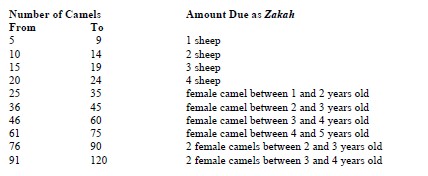
Ushbu qoidalarga ko'ra kimdan to'lash talab qilinsa, u to'lashi kerak; kimdan ko'proq to'lash talab qilinsa, u rad etishi kerak. Har 24 tagacha bo'lgan tuya uchun zakot qo'y bilan to'lanadi. Har besh tuyaga bir qo'y talab qilinadi. Ular 25 ga yetganda va 35 gacha bo'lganda, bir yoshdan ikki yoshgacha bo'lgan bitta urg'ochi tuya talab qilinadi. 36 dan 45 gacha bo'lganda, ikki yoshdan uch yoshgacha bo'lgan bitta urg'ochi tuya bo'ladi.
Whoever is asked to pay it according to these rules must give it, and whoever is asked to pay more should refuse. On each 24 camels or less, zakah is due in sheep. On each five camels, one sheep is required. Once they reach 25 and up to 35 one female camel, one to two years old, is required. From 36 to 45, there is one she-camel two to three years old.
Agar ular 46 dan 60 gacha yetsa, uch yoshdan to'rt yoshgacha bo'lgan bir dona urg'ochi tuya zakot sifatida lozim bo'ladi, u bo'g'oz qolishga yaroqli bo'lishi kerak. Agar ular 61 dan 75 gacha yetsa, to'rt yoshdan besh yoshgacha bo'lgan bir dona urg'ochi tuya lozim bo'ladi. Agar ular 76
If they reach 46 to 60, there is one she-camel three to four years old due, one that can be bred. If they reach 61 to 75, one she-camel four to five years old is due. If they reach 76
91 dan 120 gacha bo‘lsa, uch yoshdan to‘rt yoshgacha bo‘lgan ikkita urg‘ochi tuya to‘lanadi. 120 dan ortiq bo‘lsa, har 40 tadan
to 90, there is two she-camels two to three years old due. If they reach 91 to 120, there are two she-camels, three to four years old due. If they are more than 120, for each 40
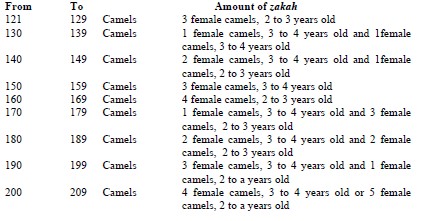
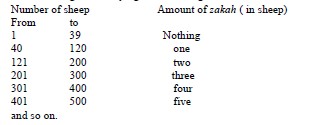
Har bir 25 ta tuyada bir yoshli, ikki yoshdan uch yoshgacha bo'lgan bitta urg'ochi tuya, har bir 50 ta tuyada esa uch yoshdan to'rt yoshgacha bo'lgan bitta urg'ochi tuya lozim bo'ladi. To'rt tagacha tuyaga ega bo'lgan kishi, o'z ixtiyori bilan bermasa, zakotga tortilmaydi, lekin tuyalar besh taga yetsa, ularga zakot sifatida bitta qo'y lozim bo'ladi. Qo'ylardagi sadaqada, agar ular tabiiy ravishda, hech qanday xarajatsiz o'tlatilgan bo'lib, qirqtadan bir yuz yigirmatagacha bo'lsa, bitta qo'y lozim bo'ladi. Bir yuz yigirmadan ko'p, ammo ikki yuztagacha bo'lsa, ikkita qo'y lozim bo'ladi.
there is one she-camel two to three years old, and for each 50 there is one she-camel three to four years old. A person who owns [up to] four camels is not zakatable unless he volunteers, but if they reach five camels, one sheep is due on them as zakah. In the sadaqah on sheep, if they are naturally, cost-free pastured, and number between 40 and 120 sheep, there is one sheep due. For more than 120 and up to 200, there are two sheep.
200 dan 300 gacha bo‘lsa, uchta qo‘y bo‘ladi. 300 dan ko‘p bo‘lsa, zakot miqdori har 100 ta uchun bitta qo‘y yoki uning bir qismi uchundir. Agar kishi 40 tadan kam (qo‘y) egalik qilsa,
For more than 200 up to 300 there are three sheep. For more than 300, the amount of zakah is one sheep for each 100 or a fraction therein. If a person owns less than 40
Odatda o'tloqda boqiladigan qo'ylar bepul bo'lib, ularda sadaqa yo'q, agar egasi ixtiyoriy ravishda bermoqchi bo'lmasa. Darhamlar (tanga pullar) zakotida o'ndan bir qismining to'rtdan biri lozim bo'ladi. Agar kishida faqat 190 dirham bo'lsa, egasining o'z ixtiyori bilan qilmagan holda ulardan hech narsa lozim bo'lmaydi.
naturally cost-free pastured sheep, there is no sadaqah unless the person wishes to volunteer. On mint currency there is one-fourth of one-tenth due . If a person own only 190 dirhams27 there is nothing on them except by the voluntary initiative of the owner".
Xat yana shunday deydi: "Kimning zakotı ikki yoshdan uch yoshgacha bo'lgan urg'ochi tuya bo'lsa-yu, o'sha yoshda bo'lmasa-da, undan yuqoriroq yoshdagi tuyasi bo'lsa, qabul qilinadi va zakot yig'uvchi unga farqni qaytaradi: yigirma dirham yoki ikki qo'y. Agar kimning zakot sifatida ikki yoshdan uch yoshgacha bo'lgan urg'ochi tuya majburiyati bo'lsa-yu, uni topa olmasa, uning o'rniga ikki yoshdan uch yoshgacha bo'lgan erkak tuya qabul qilinadi. Kimning zakot sifatida to'rt yoshdan besh yoshgacha bo'lgan bitta urg'ochi tuya majburiyati bo'lsa-yu, o'sha yoshda bo'lmasa, lekin bir yosh kichik urg'ochi tuyasi bo'lsa, agar mavjud bo'lsa, ikki qo'y bilan birga yoki yigirma dirham bilan kichikroq tuyani berishi mumkin. Kimning zakot sifatida uch yoshdan to'rt yoshgacha bo'lgan bitta urg'ochi tuya majburiyati bo'lsa-yu, o'sha yoshda tuyasi bo'lmasa, undan yuqoriroq yoshdagi bitta urg'ochi tuyani berishi mumkin, zakot yig'uvchi esa unga yigirma dirham yoki ikki qo'y qaytaradi. Uch yoshdan to'rt yoshgacha bo'lgan bitta urg'ochi tuya sadaqasi lozim bo'lgan, lekin faqat ikki yoshdan uch yoshgacha bo'lgan urg'ochi tuyasi bo'lgan kishidan ham, ikki qo'y yoki yigirma dirham bilan birga, qabul qilinadi. Ikki yoshdan uch yoshgacha bo'lgan bitta urg'ochi tuya sadaqasi lozim bo'lgan, lekin undan bir yosh katta tuyasi bo'lgan kishi uchun, bu o'rnini bosuvchi sifatida qabul qilinadi, zakot yig'uvchi unga yigirma dirham yoki ikki qo'y qaytaradi. Agar kimning sadaqasi ikki yoshdan uch yoshgacha bo'lgan bitta urg'ochi tuya bo'lsa-yu, uni topa olmasa, lekin bir yosh kichik tuyasi bo'lsa, u yigirma dirham yoki ikki qo'y bilan birga zakot sifatida qabul qilinadi. Qari, shikastlangan yoki nuqsonli hayvon zakot sifatida qabul qilinmaydi, zakot yig'uvchi ham, zakot beruvchi o'z ixtiyori bilan qo'shimcha sadaqa sifatida bermasa, qo'chqorni olmasligi kerak. Bo'lingan narsa birlashtirilmasligi kerak, birlashgan zakot birligi esa zakotdan qochish maqsadida bo'lib yuborilmasligi kerak. Sheriklar o'rtasidagi mollar uchun sheriklar hisob-kitobni o'z ulushlariga mutanosib ravishda o'zaro hal qilishadi. An-Nawawiy aytadi: "Bu xatni al-Bukhoriy o'zining to'g'ri to'plamida, zakot bobi bo'ylab tarqoq holda rivoyat qilgan." "U buni qayta yig'dim."31 Buni Ahmad, Abu Dovud, an-Nasoiy va ad-Daraqutniy ham rivoyat qilgan.
The letter further states, "The person whose zakah is a female camel, one to two years old, and who has none of that age , but one in the next higher age bracket, it is acceptable, and the zakah collector returns to him the difference, twenty dirhams or two sheep. If he owes a she-camel one to two years old but does not have it, a male camel between two and three years old is accepted in its place. A person who owes as zakah one she-camel four to five years old and has none in that age group, but has a she-camel one year younger, may pay the younger along with two sheep if available, or twenty dirhams. A person who owes as zakah one female camel three to four years old and does not have any in that age bracket can pay one female camel in the next higher age bracket and the collector then returns to him 20 dirhams or two sheep. Nor a person who is required to pay sadaqah in the amount of one female camel three to four years old and has only a female camel in the age group of two to three years old, it can be accepted from him, along with two sheep or 20 dirhams. For a person whose sadaqah should be one female camel two-three years old who has one a year older, it is an acceptable substitute the zakah collector returns to him 20 dirhams or two sheep. If a person sadaqah is one female camel two to three years old and he does not have it, but has one a year younger, it is acceptable as zakah along with 20 dirhams or two sheep.28 An old, damaged or defected animal is not accepted as zakah, nor should the collector take a ram unless it is volunteered as extra sadaqah by the zakah payer. What is divided should not be added together, and what is together a zakatable unit must not be divided in order to avoid zakah.29 For cattle owned by partners,30 partners would settle the account among themselves in proportion to their shares. Al Nawawi says "this letter is reported by al Bukhari in his correct collection, scattered throughout the chapter on zakah. I put it back together."31 It is also reported by Ahmad, 'Abu Daud, al Nasai and al Daraqutni.
Ikkinchisi "Isnod sahih, rovilarning barchasi ishonchli" degan qo'shimchani qo'shadi, xuddi al-Muntaqoda bo'lgani kabi.32 Ash-Shavkoniy shunday deydi: "Uni ash-Shavkoniy, al-Bayhaqiy va al-Hokim ham rivoyat qilgan. Ibn Hazm bu xabarning sihati eng yuqori darajada ekanini aytadi. Ibn Hibbon va boshqalar ham uni sahih deb baholagan."33
The latter adds "The chain is correct and the narrators are all trustworthy," as in al Muntaqa.32 Al Shaukani says "It is also reported by al Shaukani, al Baihaqi, and al Hakim, Ibn Hazm says this message is maximum in correctness. It is also graded correct by Ibn Habban and others.33
Ibn Umar'dan rivoyat qilingan hadis: Sufyon ibn Husayn az-Zuhriydan, u Solimdan, u esa otasi Abdulloh ibn Umardan naql qiladi: Xudoning Elchisi ﷺ sadaqa haqida xatni yozdi, ammo vafot etguncha uni o'z hokimlariga yubormadi. U xatni qilichiga bog'lab qo'ydi. U vafot etgach, Abu Bakr vafot etguncha unga amal qildi, so'ngra Umar ham vafot etguncha. Xatda shunday deyilgan: "Besh tuyaga bitta qo'y, o'nta tuyaga ikkita qo'y..." va hokazo, Anas rivoyatida keltirilgan xuddi shu miqdorlar davom etadi. An-Nawaviy aytdi: uni Abu Dovud va at-Termiziy rivoyat qilgan, at-Termiziy uni yaxshi hadis deb belgilagan. Ash-Shavkoniy qo'shimcha qiladi: "Bu hadisni ad-Daraqutniy, al-Hokim va al-Bayhaqiy ham rivoyat qilgan."35
The saying from Ibn 'Umar, is narrated by Sufian bin Husain from al Zuhri from Salim from his father, 'Abdullah bin 'Umar: The Messenger of God (p) wrote the message on sadaqah but did not send it to his commissioners until he died. He tied it to his sword, and when he died, Abu Bakr applied it until he died, and then 'Umar, until he died. The letter contains "For five camels there is one sheep due, for ten, two sheep.."etc, continuing with the same rates listed in the saying from Anas. Al Nawawi said it is reported by Abu Daud and al Tirmidhi, who marks it a good saying.34 Al Shaukani adds "This saying is reported also by al Daraqutni, al Hakim and al Baihaq".35
Ibn Hazm, o'zining Anas rivoyat qilgan hadis haqidagi sharhida shunday deydi: "Bu hadis rivoyat sahihligi jihatidan eng yuqori darajadadir. Rost so'zli Abu Bakr uni barcha sahobalar huzurida qo'llagan, ulardan hech biri bu borada ixtilof qilgani ma'lum emas. Holbuki, ko'pincha bundan ancha kam darajadagi kelishuvga ham ijmo' da'vo qilinadi."
Bu ummatning ulug' olimlarining ko'pchiligi bu xabarlarni qabul qilib, amalda tatbiq etganlar. Biroq, Yahyo ibn Ma'in kabi ba'zi yetakchi hadis olimlari, rivoyat qiluvchilarni va ularning o'zaro silsilasini tekshirishda o'ziga xos yondashuvi tufayli, bu xabarlarni sahih deb hisoblashda tereddudda qolganlar.
Ibn Hazm says in his commentary on the saying from Anas "This saying is maximum in correctness. The Truthful Abu Bakr applied it in the presence of all the Companions, and none of them is known to have disagreed at all, although ijma' is usually claimed in much lees unanimitty than this."36 The great majority of scholars of this nation have received these messages with acceptance, and practically apply them, although some of the leading scholars of hadith, such as Yahya bin Ma'in hesitate in considering them correct, in consistency with his special approach in scrutinising narrators and the links among them.
Ko'rinadiki, orientalist Shaxt Ibn Ma'inning qarashidan suiiste'mol qilib, zakot haqidagi barcha rivoyatlarga va zakot institutining o'ziga shubha solmoqchi bo'lgan. U fiqhchilarning bu masaladagi fikrlari rivoyatning o'ziga muhr bosganini da'vo qiladi va shunday qo'shimcha qiladi: "Bu jihatdan shuni qayd etamizki, odatda Abu Bakrga nisbat beriladigan zakotning batafsil tizimi ba'zan Payg'ambarga ﷺ, 'Umar ibn al-Xattobga yoki 'Ali ibn Abu Tolibga nisbat beriladi".37 Shaxt Payg'ambar ﷺ rivoyatlariga nisbatan dushmanligi bilan tanilgan.
It seems that the Orientalist Schacht abuses the stand of Ibn Ma'in in order to shed doubt on all the sayings on zakah and the whole institution itself. He claims that the jurists' opinions on the issue have their stamp on the saying itself, and adds "we note, in this respect, that the detailed system of zakah commonly attributed to Abu Bakr is sometimes attributed to the Prophet (p), to 'Umar bin al Khattab, or 'Ali bin Abi Taleb".37 Schacht is known for his hostility toward the traditions of the Prophet (p).
U bu yerda ko‘p marta u ularga shubha tug‘dirish uchun sabablar o‘ylab topadi va o‘quvchini ular haqida chalg‘itadi. Uning kitoblarida Sunnatga qarshi barcha noto‘g‘ri talqinlar, chalg‘ituvchi bayonlar, to‘qib chiqarilgan va yolg‘on tahrifları to‘planган. Men Xudoga shukr qilamanki, mening aziz va hurmatli hamkasbim, doktor Muhammad Mustafo al-A‘zamiy ushbu yolg‘onlarni ularning muallifiga qaytarib berdi — hadis haqidagi ingliz tilidagi keng qamrovli tadqiqotida, u Kembrij universitetiga falsafa doktori dissertatsiyasi sifatida topshirilgan edi. U ko‘rsatdiki, adolatli va oqilona bo‘lish uchun, sharqshunos Payg‘ambar (ﷺ) o‘z davridagi arablar boyligining asosiy qismi aynan shu yerda bo‘lgan tuya, qo‘y va boshqa mollarning zakotini, uning eng kam miqdorlarini va stavkalarini belgilamasdan qoldirishi juda ehtimoldan yiroq ekanini anglashi kerak edi. Payg‘ambar (ﷺ) zakot yig‘uvchilar va komissarlarni vohalar va cho‘l hududlariga yuborib, har yili tarqoq qabilalardan zakot yig‘ish va taqsimlashni buyurgan. Ana shu yig‘uvchilarni yuborish, zakot to‘lashi lozim bo‘lgan shaxslarga qanday munosabatda bo‘lish, nimani olish, nimani olmaslik, mol egalarining javobi qanday bo‘lishi va yig‘uvchilarga qanday muomala qilishlari kerakligi haqida ko‘plab rivoyatlar mavjud. Hech bir adolatli va oqilona tadqiqotchi bu so‘zlarning barchasi Ravshan Elchi (ﷺ) nomidan to‘qib chiqarilgan deb da’vo qila olmaydi.
Very often he fabricates reasons to shed doubt on them and to disorient the reader about them. In his books he collects all the misinterpretations and misleading statements and the fabricated and false misrepresentations against the Sunnah. I thank God that my dear and respected colleague, Dr. Muhammad Mustafa al Azami threw these falsehoods back in the face of their author in his extensive study on hadith in English, which was submitted to Cambridge University as his Ph.D. dissertation.38 It showed that to be fair and reasonable, the Orientalist should have realised that it is extremely unlikely that the Prophet (p) would leave such an important issue like zakah on camels, sheep, etc., without determining its minimums and its rates, since this was where the majority of the wealth of the Arabs at his time lay. The zakah collectors and commissioners were sent by him to oasis and deserted areas to collect and distribute zakah every year from the scattered tribesman. There are many reports about sending those collectors and the way they were told to treat zakatable individuals, what to take, what not to take, what the response of cattle owners should be and how they should treat the collectors. No fair and reasonable researcher can claim that all these sayings are fabricated on behalf of the Messenger (p).
Payg'ambarimiz (s.a.v.) zamonlarida eng ko'p tarqalgan va ularning muhitida ustun bo'lgan chorva mollari hamda o'sadigan boshqa boylik turlariga nisob va zakot miqdorini belgilovchi ko'rsatmalarni Payg'ambar (s.a.v.) yuborgani tabiiy hol edi. Buni Abu Bakrning ko'rsatma xatida, shuningdek, Umarning xatida ham tasdiqlangan, ikkalasi ham Payg'ambarga (s.a.v.) bog'lanadi. Yuqorida keltirilgan Abu Bakr xatida shunday ko'rsatilgan: "Bu Allohning Payg'ambari (s.a.v.) musulmonlarga farz qilgan sadaqa majburiyatidir..." Umarning yozgan va o'g'li Abdulloh rivoyat qilgan xatida esa shunday deyilgan: "Albatta, Allohning Elchisi (s.a.v.) sadaqa haqida ko'rsatma xatini yozdi..." Alining ibn Abu Tolib ko'rsatma xatiga kelsak, uning Payg'ambarga (s.a.v.) bog'liq yoki bog'liq emasligi haqida olimlar o'rtasida kelishuv yo'q.
It is no surprise that the Prophet (p) sent instructions determining nisabs and rates of zakah on cattle and other growing items of wealth that were most dominant at his time and within his environment. This is testified by the message of instruction of Abu Bakr as well as in that of 'Umar, and both of them are linked to the Prophet (p). It was shown in the previously quoted message of Abu Bakr that "This is the obligation of sadaqah that the Prophet of God (p) imposed on Muslims..,". The letter written by 'Umar, and narrated by his son, Abd Allah reads "Verily the Messenger of God (p) wrote the letter of instructions on sadaqah..." As for the letter of inetruction of 'Ali bin Abi Talib, there is no agreement among scholars about whether or not it was linked up to the Prophet (p).
Ushbu xat Abu Bakr va 'Umar xatlari kabi mashhur emas va ularning isnodi kuchi bilan teng ham emas. Shuni ta'kidlash kerakki, zakot haqida, chorva mollari bo'yicha batafsil ko'rsatmalar beruvchi xatlar bular bilan cheklanmaydi. Yana bir qancha xatlar bor, masalan, Najron xalqiga yo'llangan 'Amr ibn Hazm xati, unda majburiy zakotning tafsilotlari, shuningdek, tasodifiy o'limlar yoki a'zolarning yo'qolishi uchun to'lanadigan diyat (qon puli) haqida yozilgan. Shuningdek, Mu'azning sigirlardagi sadaqani bayon qilgan xati va yana bir qancha boshqa xatlar ham mavjud.
This anyhow is not as famous as the letters of Abu Bakr or 'Umar, nor does it have the same strength of chain they do. It should be noted that these were not the only letters of instructions that provide details of zakah on livestock, There are several other messages, such as that of 'Amr bin Hazm which was addressed to the people of Najran, about the details of obligated zakah, and ransoms compensating accidental deaths or the loss of parts of the body. We have also the message of Mu'adh that delineates sadaqah on cows, and several other letters.
Bu ko‘rsatmalarning bir qator asosiy masalalarda farq qilmasligini ta’kidlash joiz, masalan:
It is worth observing that all these instructions do not differ on certain major points, such as:
Besh tadan kam tuyaga zakot farz emas.
1. There is no zakah obligated on anything less than five camels.
2. Qo‘ylarning soni 40 tadan kam bo‘lsa, ularda zakot yo‘q.
2. There is no zakah on any number of sheep lees than 40.
3. 200 dirhamdan kam gumushda zakot yo‘q.
3. There is no zakah on less than 200 dirham of silver.
4. Ya'ni 25 tadan kam bo'lgan tuyalarga majburiy bo'lgan zakot miqdori qo'ylar bilan hisoblanadi.
4. The amount of zakah that is obligated on less than 25 camels is calculated in sheep.
5. Yigirmata tuyagacha bo‘lgan zakot har besh tuyaga bitta qo‘y hisobidandir.
5. Zakah on up to 25 camels is one sheep for each five camels.
6. Ular 25 tadan 120 tagacha tuyaning zakoti sifatida beriladigan tuyalarning yoshi va sonida kelishganlar.
6. They agree on the ages and number of camels due as zakah on the wealth of 25 to 120 camels.
7. Ular, shuningdek, qo‘ylardan zakot miqdori borasida ham kelishgan: 40 tadan 300 tagacha bo‘lgan qo‘ylarda zakot miqdori bir tadir, undan keyingi har 100 ta uchun esa bitta qo‘y beriladi.
7. They also agree on the rate of zakah on sheep from 40 to 300, and that the rate afterward is one for each 100.
8. Kumush va kumush pullardagi zakot miqdori o‘ndan bir qismining to‘rtdan biridir.
8. The rate on silver and silver money is one-fourth of one-tenth.
9. Zakot sifatida na shikastlangan hayvonlar, na eng sara hayvonlar olinmaydi.
9. Both damaged animals and the top quality animals are not taken as zakah.
Talab qilinadigan narsa o'rtacha sifatdagi hayvonlardir.
What is required is animals of about average quality.
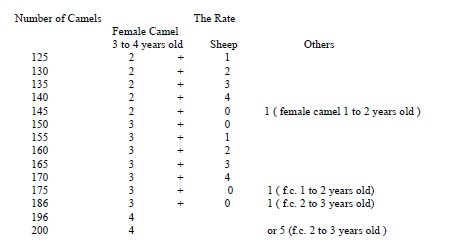
Bu ko'rsatmalar kichik va ikkinchi darajali tafsilotlarda, masalan, 120 dan keyingi tuya zakoti miqdorida, bir-biriga mos kelmaydi. Abu Bakrning ko'rsatmalarida har 40 ta tuyaga ikki-uch yoshli bitta urg'ochi tuya, har 50 ta tuyaga esa uch-to'rt yoshli bitta urg'ochi tuya belgilangan, 'Ali va Amr ibn Hazmning xatlaridagi ko'rsatmalarda esa 125 tadan keyin yana besh tadan boshlanadigan o'sha miqdor qayta boshlanadi. Shuningdek, bu ko'rsatmalarda oltin pul va sigir kabi boshqa mol-mulk turlari zikr etilmagan. Menimcha, bu o'zi ham bu matnlarning Payg'ambar ﷺ ga to'g'ri nisbat berilganligiga qo'shimcha dalil bo'la oladi va ular Schacht da'vo qilganidek, fuqahoning fikrlari ta'sirida shakllanmagan, chunki fuqahoning ko'plab batafsil fikrlari bu ko'rsatmalarda uchramaydi.
Those instructions do not agree, however, on certain minute and secondary details such as the rate on camels after 120. The instructions of Abu Bakr put the rate at one female camel two to three years old for each 40, and one female camel three to four years old for each 50, while the instructions in the letters of 'Ali and Amr bin Hazm start again with the same rate as that between five and 125. Also, these instructions do not mention some other items of wealth, such as gold money and cows. It seems to me that this itself provides us with some additional proof that these texts are rightly attributed to the Prophet (p), and that they were not influenced by the jurists' opinions as Schacht claims, because many detailed thoughts of jurists do not appear in these instructions.
Payg'ambar (ﷺ) turli kishilarga ularning ehtiyoji va sharoitiga qarab amaliy ko'rsatmalar yozar edi. U gold pul haqida gapirmagan, chunki o'sha davr arablari uni tez-tez ishlatmas edi, sigirlar haqida ham gapirmagan, chunki ular Madinada keng tarqalmagan edi. Faqat Yamanga yuborilayotgan Mu'od ibn Jabalga bergan ko'rsatmalarida Payg'ambar (ﷺ) sigirlarni eslatgan, chunki ular Yamanda keng tarqalgan edi.
The Prophet (p) was writing practical instructions to different people according to their needs and circumstances, he did not mention gold money because Arabs of his time did not frequently use it and did not mention cows because they were not common in Madinah. Only in his instructions to Mu'adh, who was being sent to Yemen, did the Prophet mention cows, because they were common in Yemen.