6.7 Masomo na hatua za kusoma
6.7 Study subjects and stages
Kama tulivyosema hapo awali, elimu ya shule imegawanywa katika mihula 36 ya masomo, iliyosambazwa katika hatua 3 kulingana na umri wa wanafunzi, kwa namna ambayo kila hatua inadhibitiwa na hukumu husika za Shari'ah. Kuhusu masomo, kila hatua ina masomo mahsusi pamoja na kanuni mahsusi zinazohusiana na kushindwa na kufaulu (kuhamia kutoka kozi moja hadi nyingine). Masomo ya kila hatua yamegawanywa katika sehemu mbili: Masomo ya msingi na Masomo ya Ujuzi na Shughuli.
As we have said before, the school education is divided into 36 school terms distributed between 3 stages according to student ages such that each stage is regulated by the relevant Shari’ah rules. With respect to study subjects, each stage has specific subjects together with specific rules related to failure and progress (transferring from one course to the next). Study subjects in each stage are divided into two: Basic subjects and Skills and Activities Subjects.

Katika hatua ya kwanza ya shule, walimu wawili huanza kuwafundisha wanafunzi tangu muhula wa kwanza. Wa kwanza anawafundisha utamaduni wa Kiislamu na lugha ya Kiarabu, wa pili anawafundisha sayansi na hisabati. Wote wawili hushiriki katika kufundisha stadi na shughuli. Mwalimu anapaswa kubaki na wanafunzi wake katika hatua hii kwa angalau mihula mitatu mfululizo ya shule.
In the 1st school stage, two teachers begin teaching students from the first term. The first teaches them Islamic culture and Arabic language, the second teaches them sciences and mathematics. Both share in teaching skills and activities. The teacher should remain with his students in this stage for at least three consecutive school terms.
Katika somo la stadi, mwalimu humpa mtoto shughuli za kukuza uwezo wake wa kuunganisha na kufikiri, kwa mfano kujenga na kubomoa vitu. Ni lazima kuchukua tahadhari ya kuhusisha shughuli hizi na stadi hizo na masomo makuu yaliyochaguliwa kwa muhula huo.
In the skills subject, the teacher gives the child activities to develop his ability to link and think e.g. building and dismantling of things. Care must be taken to relate these activities and skills to the term’s basic adopted subjects.
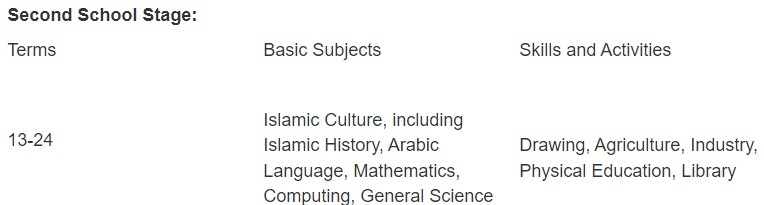
Somo la "Sayansi za Jumla" katika hatua hii linajumuisha misingi ya kemia, baiolojia, fizikia na jiografia.
The “General Sciences” subject in this stage includes principles of chemistry, biology, physics and geography.
Hatua ya Tatu ya Shule:
Third School Stage:
Hatua hii inashughulikia mihula ya 25 hadi 36. Katika hatua hii, wanafunzi wote hushiriki masomo yaleyale katika mihula ya 25 hadi 30 pekee. Baada ya hapo, katika mihula ya 31 hadi 36, wanafunzi hujiunga na matawi ya hiari (furoo’) wanayopendelea. Chaguo hizi ni:
This stage covers the terms 25 to 36. In this stage, all students participate in the same study subjects in terms 25 to 30 only. Thereafter, in terms 31 to 36 students join the optional branches (furoo’) they prefer. These options are:
- Chaguo la Kiutamaduni - Chaguo la Kisayansi - Chaguo la Kiviwanda au Kiufundi (kompyuta, mekanika, umeme, mawasiliano, uchoraji wa ramani n.k.)
- Cultural Option - Scientific Option - Industrial or Technical Option (computing, mechanics, electrical, communications, cartography etc.)
- Chaguo la Kilimo - Chaguo la Biashara - Chaguo la Nyumbani (kwa wanawake)
- Agricultural Option - Commerce Option - Domestic Option (for females)
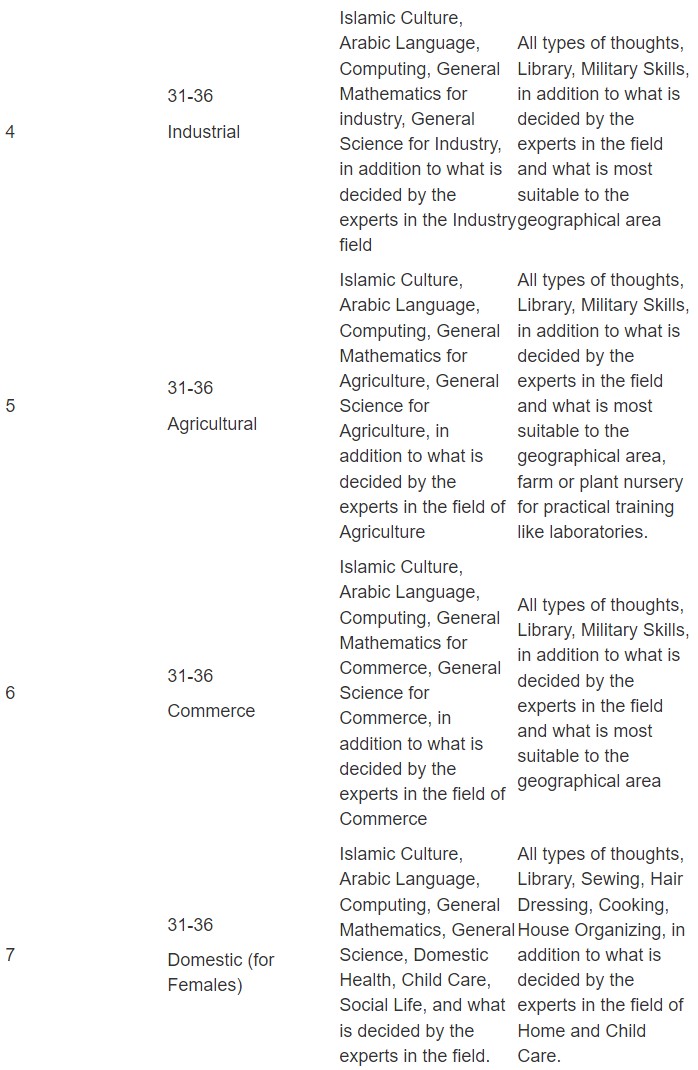
Chati ifuatayo inaonyesha masomo yanayosomwa katika kila moja ya chaguo hizi:
The following chart shows the subjects studied in each of these options:
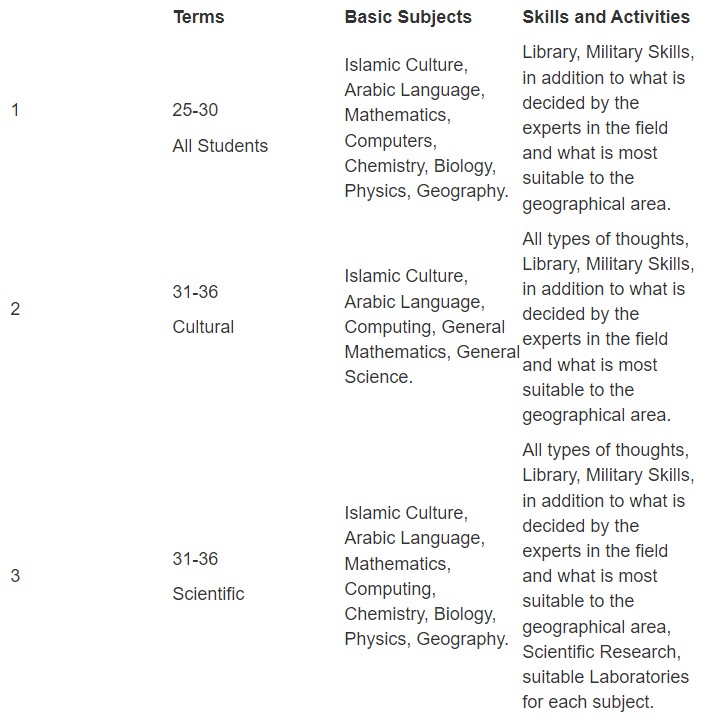
Katika chaguo la utamaduni wa Kiislamu la hatua ya tatu ya masomo, mwanafunzi huchukua mada zilizopanuliwa katika Utamaduni wa Kiislamu na Lugha ya Kiarabu. Wataalamu huamua mahitaji katika masomo ya Fiqh, Usul, Tafseer, 'Ulum Al-Hadith, Historia na chaguo zingine za utamaduni wa Kiislamu. Vilevile, hupitisha kozi maalum (manaahij) katika chaguo za lugha ya Kiarabu zinazohitajika kwa hatua hii, kama vile Ufasaha (Balagha), matini za fasihi n.k.
In the cultural option of the third school stage, the student takes extended topics in both Islamic Culture and Arabic Language. Experts determine the requirements in the subjects of Fiqh, Usul, Tafseer, '‘Ulum Al-Hadith, History and other Islamic culture options. Likewise, they adopt specific courses (manaahij) in the Arabic language options required for this stage such as Eloquence (Balagha), Literature texts etc.
Katika chaguo zisizo za kisayansi, mwanafunzi huchukua Hisabati na Sayansi kwa kifupi, akizingatia tu mada zinazohitajika kwa chaguo lake. Kwa hiyo mwanafunzi wa chaguo la Biashara huchukua mada za Hisabati zinazohusiana na Biashara, kwa mfano Uhasibu, Hesabu za Zakat na Urithi, Hesabu za Faida na Hasara, pamoja na Utunzaji wa Vitabu na Hesabu za Kitabu cha Fedha taslimu; vivyo hivyo huchukua mada katika Takwimu. Ama mwanafunzi wa chaguo la Viwanda huchukua mada mahususi kwa Viwanda kama vile Uchoraji wa Kijiometri, Maumbo, Hesabu za Eneo na Ujazo, na nyinginezo.
In non-scientific options, the student takes Mathematics and Sciences in a concise form with focus paid only to the topics required for their option. Thus the Commerce option student takes Mathematics topics related to Commerce e.g. Accounting, Zakat and Inheritance Accounts, Profits and Loss Accounts together with Bookkeeping and Cashbook Accounts; likewise he/she takes topics in Statistics. Whereas the Industrial option student takes topics specific to Industry such as Geometrical Drawing, Shapes, Area and Volume Calculation etc.
Mwanafunzi wa Sayansi ya Jumla wa chaguo lisilo la kisayansi husoma mada zinazolenga utafiti wa Mwili wa Binadamu, Magonjwa, Usalama wa Umma, pamoja na mada za kisayansi zinazohusiana na binadamu na mazingira yake. Katika chaguo la kilimo, mada zinazohusiana na kilimo na lishe huongezwa, kama vile mbinu za Kilimo cha Mimea, magonjwa yake na matibabu yake, aina za udongo, mbolea, dawa za kuua wadudu n.k.
The General Sciences student of the non-scientific option takes topics focusing upon studies of the Human Body, Diseases, Public Safety as well as scientific topics related to man and his environment. In the agricultural option, topics related to agriculture and nutrition are added such as methods of Plant Agriculture, their diseases and treatment, types of soil, fertilisers, insecticides etc.