2.3 圣门先贤的《穆斯哈夫》(Masahif)
2.3 The Masahif Of The Companions
有许多迹象见于圣训文献,表明几位圣门弟子曾编纂过他们各自的《古兰经》启示文字汇编。[苏尤蒂:《古兰学通论》,第一卷,第62页]其中最著名的来自伊本·麦斯欧德、欧拜伊·本·凯尔卜和宰德·本·萨比特。[参见Dodge, B:《伊本·奈丁的书目》(The Fihrist of al-Nadim),纽约,1970年(简称 fihrist),第53-63页。]据记载,曾拥有自己书面汇编的圣门弟子包括以下人员:伊本·麦斯欧德、欧拜伊·本·凯尔卜、阿里、伊本·阿拔斯、艾卜·穆萨、哈福赛、艾奈斯·本·马立克、欧麦尔、宰德·本·萨比特、伊本·祖拜尔、阿卜杜拉·本·阿慕尔、阿伊莎、萨利姆、乌姆·赛莱麦、欧拜杜·本·欧麦尔。[参见伊本·艾卜·达乌德:《古兰经抄本》,第14页;安萨里,M.:《古兰经的基础与穆斯林社会的结构》,卡拉奇,1973年,该书综合参考多种资料,指出(第1卷,第76页,注2)在先知在世时至少存在15部《古兰经》手抄本。除上述15个名字外,他还列出艾卜·伯克尔、奥斯曼、穆阿兹·本·哲白勒、艾卜·达尔达、艾卜·艾尤卜·安萨里、欧巴代·本·萨米特、塔米姆·达里。如此算来,在先知在世期间共存在23部《古兰经》手抄本。]还有记载称,先知去世后,阿伊莎和哈福赛也各自命人抄写了经文。[拉希穆丁,M.(译):]
There are numerous indications in the literature of hadith that several of the Companions of the Prophet had prepared their own written collections of the revelations. [Suyuti. Itqan, I, p 62] The best-known among these are from Ibn Mas'ud, Ubay bin Ka'b and Zaid bin Thabit. [See Dodge, B, The Fihrist of al-Nadim, New York, 1970 (abbr. as fihrist), pp 53-63.] A list of Companions of whom it is related that they had their own written collections included the following: Ibn Mas'ud, Ubay bin Ka'b, 'All, Ibn 'Abbas, Abu Musa, Hafsa, Anas bin Malik, 'Umar, Zaid bin Thabit, Ibn Al-Zubair, 'Abdullah ibn 'Amr, 'A'isha, Salim, Umm Salama, 'Ubaid bin 'Umar. [See Ibn Abi Dawud: Masahif, p 14 Ansari, M.: The qura'nic Foundations and Structure of Muslim Society; Karachi, 1973, drawing upon various sources, says (1, p.76, note 2) that there existed at least 15 written copies of the Qur'an in the Prophet's lifetime. In addition to the list of 15 names quoted above, he includes Abu Bakr, 'Uthman, Mu'adh b. Jabal, Abu Darda', Abu Ayyub Ansari, 'Ubada b. al-Samit, Tamim Dari. This would add up to 23 written copies of the Qur'an, which existed while the Prophet was alive.] It is also known that 'A'isha and Hafsa had their own scripts written after the Prophet had died. [Rahimuddin, M. (transl.):
Muwatta) Imam Malik, Lahore, 1980, No. 307, 308; Malik b. Anas: al-muwatta', Cairo, n.d., p. 105.] 以下是对一些归于先知的同伴名下的马斯哈夫(masdhif)的简要介绍。
Muwatta) Imam Malik, Lahore, 1980, No. 307, 308; Malik b. Anas: al-muwatta', Cairo, n.d., p. 105.] The following is a very brief description of some of the masdhif, which are attributed to the Companions of the Prophet.
所有信息均基于古典文献。 [For details see Ibn Abi Dawud, also fihrist and Itqan]
All the information is based on classical sources. [For details see Ibn Abi Dawud, also fihrist and Itqan]
伊本·麦斯欧德的穆斯哈夫(卒于公元653年,即伊历33年)
The Mushaf Of Ibn Mas'ud (d. 33/653)
他撰写了一部穆斯哈夫(抄本),其中未收录第1、113和114章。伊本·纳迪姆(《目录》,第一卷,第57-8页)然而说,他曾见过一部伊本·麦斯欧德的《古兰经》抄本,其中不包含《开端章》(第1章)。章节的排列也与奥斯曼定本不同。据称伊本·麦斯欧德抄本的顺序如下(《目录》,第一卷,第53-7页):2、4、3、7、6、5、10、9、16、11、12、17、21、23、26、37、33、28、24、8、19、29、30、36、25、22、13、34、35、14、38、47、31、35、40、43、41、46、45、44、48、57、59、32、50、65、49、67、64、63、62、61、72、71、58、60、66、55、53、51、52、54、69、56、68、79、70、73、74、83、80、76、75、77、78、81、82、88、87、92、89、85、84、96、90、93、94、86、100、107、101、98、91、95、104、105、106、102、97、110、108、109、111、112。
He wrote a mushaf, in which sudras 1, 113 and 114 were not included. Ibn al-Nadim [Fihrist, I, pp. 57-8.] however said he had seen a copy of the Qur'an from Ibn Mas'ud which did not contain al-fatiha (Sura 1). The arrangement of the suras differed from the 'Uthmanic text. The following is the order attributed to Ibn Mas'ud's copy: [Fihrist, I, pp. 53-7.] 2, 4, 3, 7, 6, 5, 10, 9, 16, 11, 12, 17, 21, 23, 26, 37, 33, 28, 24, 8, 19, 29, 30, 36, 25, 22, 13, 34, 35, 14, 38, 47, 31, 35, 40, 43, 41, 46, 45, 44, 48, 57, 59, 32, 50, 65, 49, 67, 64, 63, 62, 61, 72, 71, 58, 60, 66, 55, 53, 51, 52, 54, 69, 56, 68, 79, 70, 73, 74, 83, 80, 76, 75, 77, 78, 81, 82, 88, 87, 92, 89, 85, 84, 96, 90, 93, 94, 86, 100, 107, 101, 98, 91, 95, 104, 105, 106, 102, 97, 110, 108, 109, 111, 112.
这份列表显然并不完整。它只包含106个章,而不是伊本·纳丁所写的110个。
This list is obviously incomplete. It contains only 106 suras and not 110, as Ibn Nadim wrote.
在《黄牛章》中,以它为例,共有101种异读。其中大多涉及拼写,也有一些涉及用词(同义词)、虚词的使用等。
In Sura al-baqara, which I take as an example, there are a total of 101 variants. Most of them concern spelling, some also choice of words (synonyms), use of particles, etc.
示例:
Examples:
发音:
Pronunciation:
2:70 伊本·麦斯欧德读作 al-baqira,而不是 al-baqara。拼写:
2:70 Ibn Mas'ud reads al-baqira in place of al-baqara Spelling:
2:19 他把"kulla ma"读作"kullama"的位置上的读法 同义词:
2:19 He reads kulla ma in place of kullama Synonyms:
2:68 他读作 sal(寻求、恳求)
2:68 He reads sal (seek, beseech)
代替 ud'u(祈求)
in place of ud'u (beseech)
假设所有这些都是可靠的传述,那么伊本·麦斯欧德的那份抄本就应当是为他个人使用而编写的,并且是在全部114章都已降示之前写成的。
Assuming that all these are reliable reports, the copy of Ibn Mas'ud would then have been prepared for his personal use and written before all 114 suras were revealed.
《乌贝价·本·凯尔卜的穆斯哈夫》(卒于公元649年,即伊历29年)
The Mushaf Of Ubay Bin Ka'b (d. 29 H/649)
他编写了一部穆斯哈夫,据报道,其中发现了两章“额外的”经文和另一节“额外的”节文。
He wrote a mushaf, in which two 'additional suras and another 'additional aya' were reportedly found.
[《Itqan》,第一卷,第65页;Ibn Abi Dawud,《masahif》,第18–51页;另见Noldeke, T. 等:《Ceschichte des Qorans》,莱比锡,1909–38年(缩写为GdQ),第二卷,第33–38页。]
[Itqan, I, p. 65; Ibn Abi Dawud, masahif, pp. 18S1; also Noldeke, T. et al.: Ceschichte des Qorans, Leipzig, 1909-38 (abbr. as GdQ), 11, pp. 33-8.
第一段所谓的“章”名为“al-khal'”(离弃),译文如下:“主啊,我们求你相助,求你饶恕,我们赞美你,我们不对你不信。我们与那些违背你的人断绝关系,并离开他们。”第二段所谓的“章”名为“al-hafd”(疾速),译文如下:“主啊,我们崇拜你,向你祈祷、叩拜,为你奔走,急于侍奉你。我们期盼你的慈悯,畏惧你的惩罚。你的惩罚必定会降临到不信者身上。” 显然,这两段文字构成所谓的“盖努特”(qunut),即先知有时在晨礼或witr礼中诵读《古兰经》章节之后所说的祈祷词。事实上,它们与圣训集中所载盖努特的某些部分完全相同。参见:Nawawi, al-adhkar, Cairo, 1955, pp. 57-8。
The first so called sura entitled al-khal' (separation), translates as follows: 'O Allah, we seek your help and ask your forgiveness, and we praise you and we do not disbelieve in you. We separate from and leave who sins against you.' The second so-called sura, entitled al-hafd (haste) translates as follows: 'O Allah, we worship You and to You we pray and prostrate and to You we run and hasten to serve You. We hope for Your mercy and we fear Your punishment. Your punishment will certainly reach the disbelievers.' Obviously these two pieces constitute so-called 'qunut', i.e. supplications which the Prophet sometimes said in the morning prayer or witr prayer after recitation of suras from the Qur'an. They are in fact identical to some parts of qunut reported in the collections of hadith. See: Nawawi, al-adhkar, Cairo, 1955, pp. 57-8.
至于那段所谓的额外"经文",其译文如下:"如果亚当之子拥有一山谷的财富,他必然希望再得到第二座;如果他拥有两山谷的财富,他必然希望得到第三座。除了泥土,什么都无法填满亚当之子的腹部。凡悔罪归主者,安拉都会宽恕他。"这段文字已知是先知的圣训。参见《布哈里圣训实录》第八卷,第444-447条。据伊本·阿拔斯(第445条)和乌拜(第446条)所述,这段文字曾一度被认为是古兰经的一部分。然而乌拜本人澄清,在第102章(《争多》章)降示之后,圣门弟子们并不认为上述内容属于古兰经。参见《布哈里圣训实录》第八卷,第446条。乌拜的这一说明也非常清楚地表明,圣门弟子们在启示终止之后,对于什么属于古兰经、什么不属于古兰经,并无任何分歧。至于这段圣训若出现在乌拜的经卷中,那只是他个人使用的抄本,也就是他的私人笔记本。他并不总是区分古兰经的内容与圣训,因为这些笔记并非供普遍使用,而他本人十分清楚如何理解自己的笔记。圣门弟子中某些人为个人使用而持有的其他古兰经抄本,情况亦是如此。此外,那些向我们转述这些圣门弟子抄本相关记载的人,也只是依据传到他们那里的报道,向我们叙述了其中出现的各种差异,例如《布哈里圣训实录》第八卷第446条中的圣训。
As to the single additional so-called aya, its translation is as follows: 'If the son of Adam was given a valley full of riches, he would wish a second one, and if he was given two valleys full of riches, he would surely ask for a third one. Nothing will fill the belly of the son of Adam except dust, and Allah is forgiving to him who is repentant. ' Again this text is known to be a hadith from the Prophet. See Bukhari, VIII, No. 444-47. According to Ibn 'Abbas (No. 445) and 'Ubay (No. 446) this text was at times thought to be part of the Qur'an. However Ubay himself clarifies that after sura 102: I had been revealed, they (i.e. the sahaba) did not consider the above to be part of the Qur'an. See Bukhari, VIII, No. 446. This explanation of Ubay also makes it very clear that the Companions did not differ at all about what was part of the Qur'an and what was not part of the Qur'an. when the revelation had ceased. and if e.g. this hadith occurred in the mushaf of Ubay, it was a mushaf for his own personal use, in other words, his private notebook, where he did not always distinguish between Qur'anic material and hadith, since it was not meant for general use and he himself knew well what to make of his own notes. The same is true of the other copies of the Qur'an, which some of the Companions had for their own personal use. Also those who transmitted to us the reports about these copies of the Qur'an of the Companions have only narrated to us the various differences which occurred there according to reports that reached them (e.g. the hadith in Bukhari, VIII, No. 446
伊本·阿拔斯的穆斯哈夫(卒于公元687年,即伊历68年)
The Mushaf of Ibn 'Abbas (d. 68H/687)
伊本·阿拔斯也写过一部穆斯哈夫,据《伊特qan》(第一卷,第65页;伊本·阿比·达武德,《穆萨希夫》,第193页)记载,其中也包括乌贝伊所有的那两章附加的章节。他对各章的排列同样与其他抄本不同。在《黄牛章》中,他共有21处异文,其中一些与伊本·麦斯欧德、乌贝伊以及其他圣门弟子的读法相同。
Ibn 'Abbas also wrote a mushaf, which according to the Itqan [I, p. 65; Ibn Abi Dawud, masahif, p. 193.] also included the two additional suras which Ubay had. Again his arrangement of the suras differed from the other copies. In Sura albaqara, he has a total of 21 variants, some of them identical with Ibn Mas'ud and Ubay as well as other Companions.
其他的圣门弟子
Some Other Companions
根据《Itqan》[I, p. 65;Ibn Abi Dawud, masahif, p. 210.],阿布·穆萨·al-Ash'ari(卒于44年/公元664年)的穆斯哈夫
According to the Itqan [I, p. 65; Ibn Abi Dawud, masahif, p. 210.] the mushaf of Abu Musa al-Ash'ari (d. 44H/664)
其内容与乌拜伊所拥有的相同。
contained the same material as Ubay had.
在《黄牛章》中,只有一个传自他的异读,即他将“Ibraham”读作“Ibrahim”的位置。
There is only one variant reported from him in Sura al- baqara, namely that he read Ibraham in place of Ibrahim.
哈福赛(卒于公元665年,即伊历45年)在同一章中有三种读法,安那斯·本·马立克(卒于公元709年,即伊历91年)则有五种。
Hafsa (d. 45H/665) had three variants in the same sura, and Anas b. Malik (d. 91H/709) had five.
示例:
Examples:
为进一步说明,这里列举若干例子。这些例子尽可能取自广为人知的章节。
To further illustrate, here are a number of examples. They have been taken, as far as possible, from well-known suras.
虽然或许有更好的例子可以说明所讨论的要点,但对于不太熟悉《古兰经》文本的读者来说,这些例子可能不易理解。
While perhaps better examples exist to illustrate the points under discussion, they might not be understood as easily by readers less familiar with the Qur'anic text.
元音符号的差异
Difference in vowelling:
伊本·阿拔斯读《古兰经》第111章时,读作(……)。4
Ibn 'Abbas [I, p. 65; Ibn Abi Dawud, masahif, p. 208.] is reported to have read in sura 111:4
Hamilatun al-hatab 是用来替代 hammalata-l-hatab 的读法。由于早期的书写文本既没有标注元音符号(harakah),也省略了 alif,两者无法据此区分。
hamilatun al-hatab, in place of hammalata-l-hatab which could not be distinguished on the basis of the early written text, which omitted both haraka and alif.
拼写差异:
Difference In Spelling:
据传伊本·阿拔斯[I, p. 65; Ibn Abi Dawud, masahif, p. 195.]在第1章第6节以及其他所有地方,都将"alsirat"写作"al-sirat"。
Ibn 'Abbas [I, p. 65; Ibn Abi Dawud, masahif, p. 195.] reportedly wrote in sura 1:6 as well as all other places the word alsirat as al-sirat.
一些归于伊本·麦斯欧德的异文: [I, p. 65; Ibn Abi Dawud, masahif, p. 25.]
Some variants attributed to Ibn Mas'ud: [I, p. 65; Ibn Abi Dawud, masahif, p. 25.]
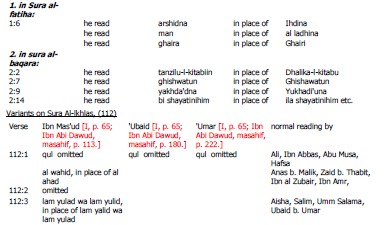
即便在今天,那些被归于伴教徒名下的经文抄本中,异文和同义词依然可见。这些异文在某种意义上对我们仍有价值,因为它们或许曾作为早期一种初步的注释(tafsir)形式而存在。例如,据一些传述,Hafsa、Ubay 和 Ibn 'Abbas 曾将"salat al-wusta"(中间的拜功)读作并书写为"salat al-'asr"(即晡礼)。[Muwatta' Malik; Jeffery, p. 214.] [Jeffery, p. 122.] [Jeffery, p. 196.]
Even today the variants and synonyms are found in such copies of the text as are attributed to the Companions and are of some value to us in the sense that they may have served as an early rudimentary form of tafsir. For example, according to some reports the words 'salat al-wusta' (middle prayer) were read and written by Hafsa, [Muwatta' Malik; Jeffery, p. 214.] Ubay [Jeffery, p. 122.] and Ibn 'Abbas [Jeffery, p. 196.] as 'salat al-'asr' (i.e. afternoon prayer).
只要圣门弟子是为了个人使用而抄写自己的副本,那么即使他们没有严格遵循《古兰经》的章序,也没有什么不妥。后来,奥斯曼的抄本成为标准版本,众圣门弟子便采用了这一抄本的章序,包括与之分歧可能最大的伊本·麦斯欧德。[伊本·阿比·达乌德,第12页;Salih, S.: Mabahith fi 'ulum al-qura'n, 贝鲁特, 1964]如前所示,这些抄本中也存在一些异读,即某些词的读音和拼写略有不同等。然而,应当指出,异读通常只由一人传述,偶尔也只有两三人传述,而被称为奥斯曼本的文本则是穆塔瓦திர(mutawatir,即由众多人传述)的,无疑是真实可靠的。
As long as the sahaba wrote their own copies for personal use only, there was nothing wrong, if they did not strictly adhere to the order of suras which was the order of the Qur'an. Later on, when 'Uthman's copy became the standard version, the Companions adopted the order of this copy including Ibn Mas'ud who perhaps differed most. [Ibn Abi Dawud, p. 12; Salih, S.: Mabahith fi 'ulum al-qura'n, Beirut, 1964,] There were also, as indicated, some variant readings in these copies, [See also below, seven readings and qira'at.] when some words were pronounced and spelt in slightly different ways, etc. However, it should be noted that variant readings are usually reported by a single person only, and occasionally by perhaps two or three while the version called the 'Uthmanic text is mutawatir, i.e. transmitted by numerous people and is without doubt authentic.