La Prueba del Ácido
The Acid Test
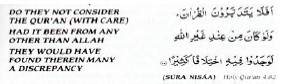
¿Cómo sabemos que un libro que afirma venir de Dios es realmente el Libro de Dios? Una de las pruebas, entre muchas otras, es que un Mensaje que procede de un Ser Omnisciente DEBE ser coherente consigo mismo. Debe estar libre de todas las discrepancias y contradicciones. Esto es exactamente lo que dice el ÚLTIMO TESTAMENTO, el Libro de Dios:
How do we know that a book claimed to be from God is really the Book of God? One of the tests, out of many such tests, is — that a Message emanating from an Omniscient Being MUST be consistent with itself. It ought to be free from all discrepancies and contradictions. This is exactly what the LAST TESTAMENT, the Book of God says:
¿Dios o el diablo?
God Or The Devil?
Si Dios Todopoderoso quiere que verifiquemos la autenticidad de Su Libro (El Sagrado Corán) con esta prueba de fuego, ¿por qué no deberíamos aplicar exactamente la misma prueba a cualquier otro libro que afirme provenir de Él? No queremos engañar a nadie con palabras, como han estado haciendo los cristianos. Se estaría de acuerdo de inmediato, a partir de las referencias que he dado de eruditos cristianos, en que ellos nos han estado demostrando que la Biblia NO es la Palabra de Dios, y aun así nos hacen creer que nos han convencido de lo contrario.
If God Almighty wants us to verify the authenticity of His Book (The Holy Qur’ân) with this acid test, why should we not apply the very same test to any other Book claiming to be from Him? We do not want to bamboozle anybody with words as the Christians have been doing. It would be readily agreed from the references, I have given from Christian scholars, that they have been proving to us that the Bible is NOT the Word of God, yet making us believe that they have actually convinced us to the contrary.
Un ejemplo clásico de esta enfermedad volvió a manifestarse apenas "ayer". El sínodo anglicano estaba reunido en Grahamstown. El Rvdmo. Bill Burnett, el Arzobispo, predicaba a su rebaño. Creó una confusión en su comunidad anglicana. Un erudito inglés, dirigiéndose a un grupo de sacerdotes y obispos ingleses eruditos, en su propia lengua materna, el inglés, que sus colegas eruditos malinterpretaron drásticamente: hasta tal punto que el Sr. McMillan, quizás también anglicano, director de un diario inglés, "The Natal Mercury", con fecha 11 de diciembre de 1979, dijo lo siguiente sobre la confusión que el Arzobispo había creado entre su propio clero erudito:
A classic example of this sickness was in evidence again only "yesterday" The Anglican synod was in session in Grahamstown. The Most. Rev. Bill Burnett, the Archbishop was preaching to his flock. He created a confusion in his Anglican community. An erudite Englishman, addressing a group of learned English priests and bishops, in their own mother-tongue — English, which his learned colleagues drastically misunderstood: to such an extent that Mr. McMillan, perhaps also an Anglican, the Editor of an English daily — "The Natal Mercury" dated December 11, 1979, had this to say about the confusion the Archbishop had created among his own learned clergy:
"EL ARZOBISPO BURNETT, EN SUS DECLARACIONES EN EL SÍNODO, NO FUE PRECISAMENTE UN MODELO DE CLARIDAD, Y MUCHOS DE LOS PRESENTES LO MALINTERPRETARON AMPLIA Y DRAMÁTICAMENTE." "No hay nada malo en el inglés como lengua, pero ¿no ves que el cristiano está adiestrado en un pensamiento confuso en todas las cuestiones religiosas? ¿El "pan" de su Sagrada Comunión no es "pan", sino "carne"? ¿El "vino" es "sangre"? ¿"Tres es uno"? ¿"El humano es divino"? Pero no te equivoques: cuando trata con el reino terrenal no es tan simple, sino entonces muy preciso. ¡Tendrás que ser doblemente cuidadoso al firmar un contrato con él! Puede dejarte vendido sin que te des cuenta."
"ARCHBISHOP BURNETTS REMARKS AT THE SYNOD WERE HARDLY A MODEL OF CLARITY AND WERE WIDELY AND DRAMATICALLY MISINTERPRETED BY MANY OF THOSE PRESENT." There is nothing wrong with English as a language, but can't you see that the Christian is trained in muddled thinking in all matters religious. The "bread" in his Holy Communion is not "bread" but "flesh?" The "wine" is "blood?" "Three is one?" and "Human is Divine?" But don't make a mistake, he is not that simple when dealing with the earthly kingdom, he is then most precise. You will have to be doubly careful when entering into a contract with him! He can have you sold out, without you realising it.
Los ejemplos que presentaré para fundamentar los puntos que he planteado sobre las contradicciones en el llamado Libro de Dios serían tan fáciles de seguir y entender que incluso un niño podría hacerlo. Véase a continuación.
The examples that I shall furnish in substantiating the points I have raised about the contradictions in the so-called Book of God, would be found so easy even for a child to follow and understand. See below.
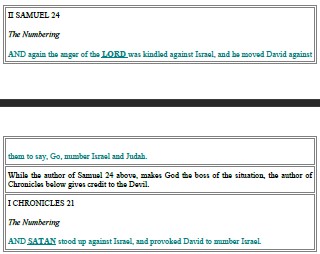
Aparte de mostrar lealtad a Dios, como se señala en otros pasajes, también se le da al Diablo (Satanás) lo que le corresponde. Esta dicotomía por parte del autor de Crónicas recuerda la historia de la anciana que encendió una vela a San Miguel y otra al diablo. San Miguel estaba pisoteando al demonio, de modo que, ya fuera que ella fuera al Cielo o al Infierno, tendría un amigo. Este tal Crónicas se aseguró de tener un amigo en la corte de Arriba, así como un amigo en la corte de Abajo. Quería tenerlo todo: o quería tener su pastel y comérselo también.
Apart from showing allegiance to God as is noted elsewhere, the Devil (Satan) is also given his due. This dichotomy on the part of the author of Chronicles reminds one of the story of the old woman who lit one candle to St. Michael and another to the devil. St. Michael was trampling underfoot, so that whether she went to Heaven or Hell, she would have a friend. This Chronicles fellow, made sure that he had a friend at court Above, as well as a friend at court Below. He wanted to have it both ways, or wanted to have his cake and eat it too.
Observáis que los autores de los libros de "Crónicas" y de "Samuel" nos cuentan la misma historia sobre David haciendo un censo de los judíos. ¿De dónde sacó David esta "inspiración" para semejante acto novedoso? El autor de 2 Samuel 24:1 dice que fue el "SEÑOR" Dios quien INCITÓ (RSV: "incitó") a David, pero el autor de 1 Crónicas 21:1 dice que fue "SATANÁS" quien PROVOCÓ (RSV: "incitó") a David a hacer una cosa tan infame. ¿Cómo pudo el Dios Todopoderoso ser la fuente de estas "INSPIRACIONES" contradictorias? ¿Es Dios o es Satanás? ¿En qué religión el DIABLO es sinónimo de DIOS? No hablo del "satanismo", un reciente brote del cristianismo, en el que ex cristianos adoran al Diablo. El cristianismo ha sido el más prolífico en engendrar "ismos". Ateísmo, comunismo, fascismo, totalitarismo, nazismo, mormonismo, moonismo, cienciología cristiana y ahora satanismo. ¿Qué más parirá el cristianismo?
You will observe that the authors of the books of "Chronicles" and of "Samuel" are telling us the same story about David taking a census of the Jews. Where did David get his "inspiration" to do this novel deed? The author of 2 Samuel 24:1 says that it was the "LORD" God who MOVED (RSV: "incited") David, but the author of 1 Chronicles 21:1 says that it was "SATAN" who PROVOKED (RSV: "incited") David to do such a dastardly thing! How could the Almighty God have been the source of these contradictory "INSPIRATIONS?" Is it God or is it Satan! In which religion is the DEVIL synonymous with GOD? I am not talking about "Satanism" a recent fungus growth of Christianity, in which ex-Christians worship the Devil. Christianity has been most prolific of spawning isms. Atheism, Communism, Fascism, Totalitarianism, Nazism, Mormonism, Moonism, Christian Scientism and now Satanism. What else will Christianity give birth to?
¿Quiénes son los verdaderos autores?
Who Are The Real Authors?
Como se aportarán más pruebas de "Samuel" y "Crónicas", considero conveniente determinar primero sus autores, en lugar de atribuir a Dios las incongruencias de esos libros. Los revisores de la RSV dicen:
As further evidence will be adduced from "Samuel" and "Chronicles" I deem it advisable first to determine their authors instead of suspecting God of those books' incongruities. The Revisers of the RSV say:
(a) SAMUEL: Autor «Desconocido» (solo una palabra)
(a) SAMUEL: Author "Unknown" (Just one word)
(b) CRÓNICAS: Autor: «Desconocido, probablemente recopilado y editado por Esdras». Debemos admirar la humildad de estos eruditos bíblicos, pero sus «probablemente», «quizás» y «seguramente» siempre son interpretados como ACTUALMENTE por sus ovejas esquiladas. ¿Por qué hacer de los pobres Esdras o Isaías los chivos expiatorios de estos escritores anónimos?
(b) CHRONICLES: Author "Unknown, probably collected and edited by Ezra." We must admire the humility of these Bible scholars, but their "possiblys" "probablys" and "likelys" are always construed as ACTUALLY'S by their fleeced sheep. Why make poor Ezra or Isaiah the scapegoats for these anonymous writers?
¿Qué decretó el Señor: tres años de hambruna o siete años de hambruna?
What Did The Lord Decree 3 Years Famine Or 7 Years Famine?
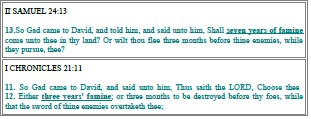
Si Dios es el Autor de cada palabra, coma y punto de la Biblia, como afirman los cristianos, ¿es también el Autor de la discrepancia aritmética mencionada arriba?
If God is the Author of every single word, comma and full-stop in the Bible, as the Christians claim, then is He the Author of the above arithmetical discrepancy as well?
¿Tres o siete?
Three Or Seven ?
Observe la reproducción de arriba. Compare ambas citas. 2 Samuel 24:13 nos dice: "Entonces Gad vino a David, Y LE DIJO, y le habló..." Estas palabras se repiten palabra por palabra en 1 Crónicas 21:11, salvo que la redundante frase "Y LE DIJO" se omite. Pero al recortar la frase inútil, el autor también redujo el período de tiempo de "SIETE" años a "TRES" años. ¿Qué dijo Dios a Gad: tres o siete años de plaga "sobre ambas casas"?
Note the reproduction of above. Compare both the quotations. 2 Samuel 24:13 tells us — "So Gad came to David, AND TOLD HIM, and said unto him . . ." These words are repeated word for word in 1 Chronicles 21:11, except the redundant "AND TOLD HIM" is removed! But while trimming the useless phrase, the author also pruned the time factor from "SEVEN" years to "THREE" years. What did God say to Gad — Three or Seven years plague — "on both your houses?"
Ocho o dieciocho?
Eight Or Eighteen?
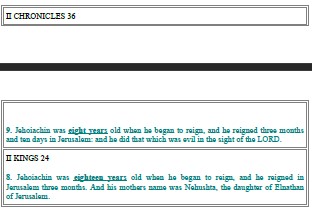
Compare las dos citas. 2 Crónicas 36:9 nos dice que JEHOIACHIN tenía "ocho" años cuando comenzó a reinar, mientras que 2 Reyes 24:8 dice que tenía "dieciocho" años cuando comenzó a reinar. El "desconocido" autor de REYES debió razonar que qué posible "maldad" podía cometer un niño de ocho años para merecer su abdicación, así que generosamente añadió diez años para hacer a JEHOIACHIN lo bastante maduro como para ser objeto de la ira de Dios. Sin embargo, tenía que compensar su manipulación, así que acortó su reinado en 10 días. ¿Añadir DIEZ años a la edad y restar DIEZ días al reinado? ¿Podría Dios Todopoderoso decir dos cosas tan diferentes sobre el mismo asunto?
See below. Compare the two quotations. 2 Chronicles 36:9 tells us that JEHOIACHIN was "eight" years old when he began to reign, while 2 Kings 24:8 says that he was "eighteen" when he began to reign. The "unknown" author of KINGS must have reasoned that what possible "evil" could a child of eight do to deserve his abdication, so he generously added ten years to make JEHOIACHIN mature enough to become liable to God's wrath. However, he had to balance his tampering, so he cut short his reign by 10 days! Add TEN years to age and deduct TEN days from rule? Could God Almighty say two widely differing things on the same subject?
¿Qué edad tenía Joaquín? ¿8 o 18?
How Old Was Jehoiachin? 8 Or 18 ?
Entre los ocho y los dieciocho años hay una diferencia de exactamente diez años. ¿Podemos decir (¡Dios no lo quiera!) que el Todopoderoso, el Omnisciente, no sabía contar y que, por tanto, no conocía la diferencia entre 8 y 18? Si hemos de creer en la Biblia como Palabra de Dios, la dignidad y el estatus del Señor Todopoderoso caerían a un nivel mínimo histórico.
Between Eight and Eighteen years, there is a gap or difference at a full 10 years. Can we say (God forbid!) that the all-knowing Almighty could not count, and thus did not know the difference between 8 and 18? If we are to believe in the Bible as the Word of God, then the Dignity and Status of the Lord Almighty will hit an all-time low!
¿Caballería o infantería?
Cavalry Or Infantry?
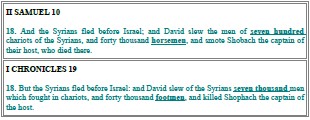
Compare the two quotations on page 40. How many chariot riders did David slay? Seven hundred or seven thousand? And further, did he slay 40000 "HORSEMEN" or 40000 "FOOTMEN?" The implication in the conflicting records between 2 Samuel 10:18 and 1 Chronicles 19:18 is not only that God could not discern the difference between hundreds and thousands, but that He could not even distinguish "CAVALRY" from "INFANTRY!" It is obvious that blasphemy masquerades in the Christian dictionary as "inspiration!" 700 or 7 000?
Compare the two quotations on page 40. How many chariot riders did David slay? Seven hundred or seven thousand? And further, did he slay 40000 "HORSEMEN" or 40000 "FOOTMEN?" The implication in the conflicting records between 2 Samuel 10:18 and 1 Chronicles 19:18 is not only that God could not discern the difference between hundreds and thousands, but that He could not even distinguish "CAVALRY" from "INFANTRY!" It is obvious that blasphemy masquerades in the Christian dictionary as "inspiration!" 700 or 7 000?
Ciertamente no es ningún consuelo para los amantes de la Biblia que se haya añadido un cero completo (0) al 700, o se le haya restado al 7 000, haciendo así que la confusa matemática bíblica se confunda aún más.
It is certainly naught for Bible-lovers' comfort that a whole nought (0) was either added to 700, or subtracted from 7 000, thus making the confused Biblical Mathematics even more confounded!*
* Los comentarios sobre el Zero se analizarán próximamente.
* The remarks on the Zero will be discussed soon.
¿Dios confundido entre «caballería» e «infantería»?
God Confused Between "cavalry" And "infantry"?
Y en cuanto a que los "escritores inspirados" de la Biblia no supieran distinguir entre "soldados de a pie" y "jinetes", es todavía más grave, pues el propio Dios queda así acusado de ser fuente de esa "inspiración" que no sabía diferenciar entre caballería e infantería. ¿O es posible que los sirios que huyeron ante Israel fueran centauros (es decir, una raza de criaturas con cuerpo y patas de caballo y tronco, cabeza y brazos de hombre), y que estas "criaturas" hubieran salido de repente de la mitología clásica para asombrar a unos autores demasiado crédulos?
As for the "inspired writers" of the Bible not knowing the difference between "footmen" and "horsemen," is all the more serious because God himself here stands accused, as a source of that "inspiration" for not knowing the difference between cavalry and infantry. Or is it possible that the Syrians who fled before Israel were centaurs (i.e. a race of creatures with the body and legs of a horse and the torso, head and arms of a man), is it possible that these "creatures" had suddenly stepped out of Classical Mythology to bemuse the all too gullible authors.
Practical Homework
Practical Homework
Salomón, que la paz sea con él, comenzó a construir un palacio real para sí mismo, lo cual le llevó trece años. Esto lo sabemos por el Primer Libro de los Reyes, capítulo 7. ¿Recuerdas la jactancia del Dr. Parker (más arriba) sobre "páginas enteras ocupadas por nombres oscuros"? Pues bien, en cuanto a pura puerilidad, este capítulo 7 y el capítulo 45 de Ezequiel no tienen rival. Te debes a ti mismo leerlo al menos una vez en la vida. Después, realmente apreciarás el Sagrado Corán! A continuación se reproducen los pasajes para tu aburrido disfrute. Consigue tu propia Biblia y márcala con colores para facilitar la consulta: puedes colorear las distintas referencias de este folleto en tu Biblia: "amarillo" para todas las contradicciones; "rojo" para los pasajes pornográficos; y "verde" para las citas sensatas y aceptables, como las que he mencionado al principio de este ensayo, es decir, palabras que puedes reconocer sin esfuerzo como las de Dios y Sus Santos Mensajeros. Con solo esta preparación, estarás listo para refutar y confundir a cualquier misionero o estudioso de la Biblia que se cruce en tu camino! "SI SUDAMOS MÁS EN TIEMPOS DE PAZ, SANGRAREMOS MENOS EN TIEMPOS DE GUERRA." (Chiang Kai-Shek)
Solomon is his glory began building a royal palace for himself which took him thirteen years. We learn this from the 1st Book of Kings, chapter 7. You remember Dr. Parker's boast (earlier on) about "whole pages being taken up by obscure names?" Well, for sheer puerility you cannot beat this chapter 7 and Ezekiel chapter 45. You owe it to yourself to read it just once in your lifetime. After that, you will really appreciate the Holy Qur’ân! Reproduced below, you will read the passages for your boring pleasure. Obtain your own Bible and colour code it for easy reference. You may colour the various references from this booklet in your Bible: "Yellow" for all contradictions; use "Red" for pornographic passages; and "Green" for sensible, acceptable quotations as the ones I have mentioned at the beginning of this essay — that is words that you can effortlessly recognize as being those of God and His Holy Messengers. With just this preparation, you will be ready to confute and confuse any missionary or Bible scholar that comes your way! "IF WE PERSPIRE MORE IN TIMES OF PEACE, WE WILL BLEED LESS IN TIMES OF WAR." (Chiang Kai-Shek)
DIOS COMO CONSTRUCTOR, INGENIERO Y ARTESANO (SI TIENES PACIENCIA, LEE ESTE CAPÍTULO Y COMPLETA EL RESTO DEL CAPÍTULO EN TU BIBLIA)
GOD, AS BUILDER, ENGINEER AND CRAFTSMAN (IF YOU HAVE PATIENCE, READTHIS CHAPTER AND COMPLETE THE REST OF THE CHAPTER IN YOUR BIBLE)
DIOS, COMO AGRIMENSOR Y ARQUITECTO (SI TIENES PACIENCIA, LEE ESTE CAPÍTULO Y COMPLETA EL RESTO DEL CAPÍTULO EN TU BIBLIA)
GOD, AS LAND SURVEYOR AND ARCHITECT (IF YOU HAVE PATIENCE, READ THIS CHAPTER AND COMPLETE THE REST OF THE CHAPTER IN YOUR BIBLE)
¿Qué tan higiénico?
How Hygienic?
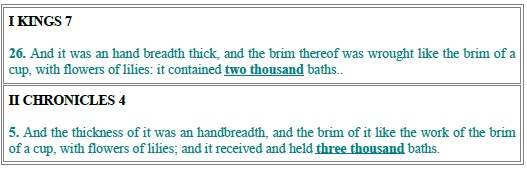
Ahora, observa lo siguiente: el autor de 1 Reyes 7:26 cuenta 2.000 baños en el palacio de Salomón, mientras que el autor de 2 Crónicas 4:5 aumenta la cifra real en un 50 %, hasta 3.000. ¡Qué derroche y qué error en el "Libro de Dios"! Aunque Dios Todopoderoso no tuviera nada más que hacer, ¿se ocuparía de "inspirar" a los judíos semejantes necedades contradictorias y triviales? ¿Es la Biblia el Libro de Dios? ¿Es la Palabra de Dios?
Now, look below and note that the author of 1 Kings 7:26 has counted 2 000 baths in Solomon's palace, but the author of 2 Chronicles 4:5 increases the kingly count by 50% to 3 000! What extravagance and error in the "Book of God?" Even if God Almighty had nothing else to do, would He occupy Himself "inspiring" such trivial contradictory nonsense to the Jews? Is the Bible God's Book? Is it the Word of God?
La diferencia entre 2000 y 3000 es un 50 % de exageración.
The Difference 2000 And 3000 Is 50% Exaggeration!
Ni siquiera un milagro demostraría que dos y dos son cinco, o que un círculo tiene cuatro ángeles; y ningún milagro, por numeroso que fuera, podría eliminar una contradicción que yace en la superficie de las enseñanzas y registros del cristianismo. — (Albert Schweitzer), de su libro: "En busca del Jesús histórico". Página 22.
Whether it is witting or unwitting, the "inspired" writer's singular inability to grasp the difference between 2 000 and 3 000 is unforgivable. It is an obvious contradiction. "AND NO MIRACLE WOULD PROVE THAT TWO AND TWO MAKES FIVE, OR THAT A CIRCLE HAS FOUR ANGELS; AND NO MIRACLES, HOWEVER NUMEROUS COULD REMOVE A CONTRADICTION WHICH LIES ON THE SURFACE OF THE TEACHINGS AND RECORDS OF CHRISTIANITY." — (Albert Schweizer), from his book: "In Search of the Historical Jesus." Page 22.
Contradicciones acumuladas
Piled Contradictions
Antes de concluir esta serie de contradicciones, permítame darle solo un ejemplo más. Hay cientos de otros en la Biblia. Véase a continuación. Es Salomón otra vez. Ciertamente hace las cosas a lo grande. ¡El ex Sha de Irán era un niño de guardería en comparación! El autor de 2 Crónicas 9:25 le atribuye a Salomón mil establos de caballos más que el número de baños que le había asignado. "Y Salomón tenía CUATRO mil establos para caballos..." Pero el autor de 1 Reyes 4:26 tuvo pensamientos verdaderamente regios sobre su real protector. Multiplicó los establos de Salomón en un 1 000 %, ¡de 4 000 a 40 000 establos de caballos! Antes de que algún evangelista superficial le haga creer que la diferencia es solo un cero, un "0"; que algún escriba o copista añadió inadvertidamente un cero a 4 000 para convertirlo en 40 000, permítame decirle que los judíos de la época de Salomón no conocían el cero, "O"! Fueron los árabes quienes introdujeron el cero en Oriente Medio y en Europa siglos después. Los judíos escribían sus cifras con palabras en sus obras literarias y no con números. Nuestra pregunta es: ¿quién fue el verdadero autor de esta asombrosa discrepancia de 36 000? ¿Fue Dios o el hombre? Encontrará estas referencias y muchos otros datos relacionados en un libro muy completo: "THE BIBLE — Word of God or Word of Man?" de A. S. K. Joommal.
Before I conclude this series of contradictions, let me give you just one more example. There are hundreds of others in the Bible. See below. It is Solomon again. He really does things in a big way. The ex-Shah of Iran was a nursery kid by comparison! The author of 2 Chronicles 9:25 gives Solomon one thousand more stalls of horses than the number of baths he had given him. "And Solomon had FOUR thousand stalls for horses ..." But the author of 1 Kings 4:26 had real kingly thoughts about his royal patron. He multiplied Solomon's stalls by 1 000% — from 4 000 to 40000 stalls of horses! Before some glib evangelist draws the wool over your eyes that the difference is only a nought, a zero — "0"; that some scribe or copyist had inadvertently added a zero to 4 000 to make it 40 000, let me tell you that the Jews in the time of Solomon knew nothing about the zero — "O"! It was the Arabs who introduced the zero to the Middle East and to Europe centuries later. The Jews spelt out their figures in words in their literary works and did not write them in numerals. Our Question is — Who was the real author of this staggering discrepency of 36000? Was it God or man? You will find these references and many more allied facts in a very comprehensive book — "THE BIBLE — Word of God or Word of Man?" by A. S. K. Joommal.
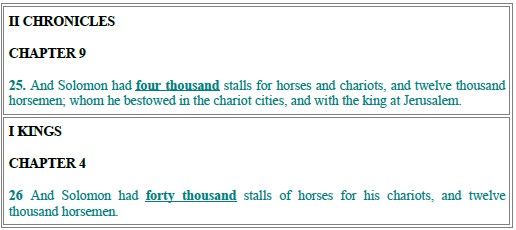
La diferencia entre 4 mil y 40 mil es solo 36 OOO! Los judíos no usaban el "0" (cero) en el Antiguo Testamento entre 4 mil y 40 mil es solo 36 OOO! Los judíos no usaban el "0" (cero) en el Antiguo Testamento
The Difference between 4 thousand and 40 thousand is only 36 OOO! The Jews did not use The "0" (Zero) in the Old Testament between 4 thousand and 40 thousand is only 36 OOO! The Jews did not use The "0" (Zero) in the Old Testament