El Libro denominado «el Nuevo Testamento»
The Book Christened "the New Testament"
"Why 'according To?'" is a question, so per the rules I'm translating it as text rather than answering it: ¿Por qué "according To?"
Why "according To?"
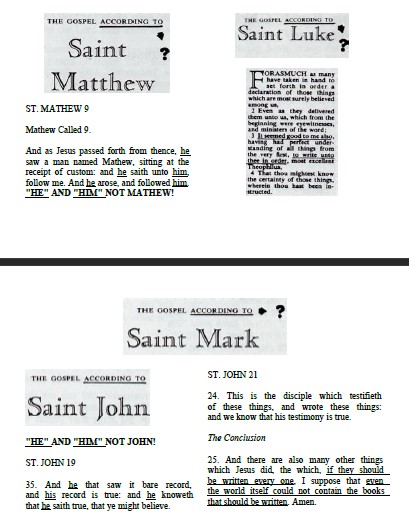
¿Y qué ocurre con el llamado Nuevo Testamento? 1 1 ¿Por qué cada Evangelio comienza con la introducción —SEGÚN ... SEGÚN ... (véase abajo)? ¿Por qué "según"? ¡Porque ninguno de los tan cacareados cuatro mil manuscritos existentes lleva la firma autógrafa de su autor! De ahí la suposición del "según". Incluso la evidencia interna demuestra que Mateo no fue el autor del primer Evangelio que lleva su nombre.
What about the so-called New Testament? 1 1 Why does every Gospel begin with the introduction — ACCORDING TO ... ACCORDING TO ... (See below). Why "according to?" Because not a single one of the vaunted four thousand copies extant carries its author's autograph! Hence the supposition "according to!" Even the internal evidence proves that Matthew was not the author of the first Gospel which bears his name.
«Y al pasar Jesús de allí, VIO a un hombre llamado Mateo, sentado en el telonio; y LE dijo: SígueME. Y ÉL se levantó y LE siguió.» (Mateo 9:9)
"And as Jesus passed forth thence, HE (JESUS) saw a man, named Matthew, sitting at the receipt of custom: and HE (JESUS) saith unto HIM (MATTHEW), follow ME (JESUS) And HE (MATTHEW) arose, and followed HIM (JESUS)." (Matthew 9:9)
1. El llamado "así llamado", porque en ninguna parte el "Nuevo Testamento" se llama a sí mismo Nuevo Testamento, ni en ninguna parte el "Antiguo Testamento" se llama a sí mismo Antiguo Testamento. Además, la palabra "Biblia" es desconocida dentro de las páginas de la Biblia. ¡Dios se olvidó de dar título a "Sus" libros! Sin ningún esfuerzo de la imaginación, se puede ver que los "Él" y los "Le" de la narración anterior no se refieren a Jesús ni a Mateo como su autor, sino a una tercera persona que escribe lo que vio y oyó: un relato de oídas. Si ni siquiera podemos atribuir este "libro de sueños" (como también se describe el primer Evangelio) al discípulo Mateo, ¿cómo podemos aceptarlo como la Palabra de Dios?
1. The "so-called," because nowhere does the "New Testament" calls itself the New Testament, and nowhere the Old Testament calls itself the Old Testament. And also the word "Bible" is unknown within the pages of the Bible. God forgot to give a title to "HIS" books! Without any stretch of the imagination, one can see that the "He's" and the "Him's" of the above narration do not refer to Jesus or Matthew as its author, but some third person writing what he saw and heard — a hearsay account. If we cannot even attribute this "book of dreams" (as the first Gospel is also described) to the disciple Matthew, how can we accept it as the Word of God?
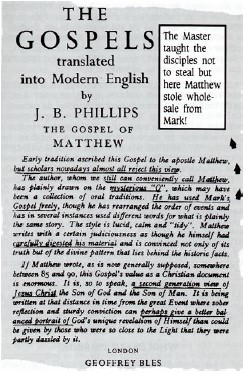
No estamos solos en este descubrimiento de que Mateo no escribió el «Evangelio según San Mateo» y de que fue escrito por alguna mano anónima. J. B. Phillips coincide con nosotros en nuestras conclusiones. Es un servidor remunerado de la Iglesia anglicana, prebendado de la catedral de Chichester, Inglaterra. No tendría ninguna razón para mentir o traicionar en perjuicio de la postura oficial de su Iglesia. Véase su introducción al «Evangelio de San Mateo» (reproducida aquí abajo). Phillips afirma lo siguiente sobre su autoría.
We are not alone in this discovery that Matthew did not write the "Gospel according to St. Matthew" and that it was written by some anonymous hand. J. B. Phillips concurs with us in our findings. He is the paid servant of the Anglican Church, a prebendary of the Chichester Cathedral, England. He would have no reason to lie or betray to the detriment of the official view of his Church! Refer to his introduction to the "Gospel of St. Matthew" (reproduced here below). Phillips has this to say about its authorship.
"LA TRADICIÓN ANTIGUA ATRIBUYÓ ESTE EVANGELIO AL APÓSTOL MATEO, PERO HOY EN DÍA CASI TODOS LOS ESTUDIOSOS RECHAZAN ESTA OPINIÓN." En otras palabras, San Mateo no escribió el Evangelio que lleva su nombre. Este es el hallazgo de los eruditos cristianos de mayor eminencia, no de hindúes, musulmanes o judíos, a quienes se podría acusar de parcialidad. Sigamos con nuestro amigo anglicano: "EL AUTOR, A QUIEN TODAVÍA PODEMOS LLAMAR CÓMODAMENTE MATEO". "Cómodamente" porque, de lo contrario, cada vez que hiciéramos referencia a "Mateo" tendríamos que decir "EL PRIMER LIBRO DEL NUEVO TESTAMENTO", capítulo tal, versículo tal. Y una y otra vez "El primer libro...", etc. Por eso, según J. B. Phillips, es conveniente dar al libro algún nombre. Entonces, ¿por qué no "Mateo"? ¡Supongamos que es tan buen nombre como cualquier otro! Phillips continúa: "EL AUTOR HA RECURRIDO CLARAMENTE A LA MISTERIOSA 'Q', QUE PUDO HABER SIDO UNA COLECCIÓN DE TRADICIONES ORALES." ¿Qué es esta "misteriosa 'Q'"? "Q" es la abreviatura de la palabra alemana "Quelle", que significa "fuentes". Se supone que existe otro documento, una fuente común, al que tuvieron acceso nuestros actuales Mateo, Marcos y Lucas. Estos tres autores, fueran quienes fuesen, tenían una mirada común sobre el material que tenían delante. Escribían como si miraran con "un solo" ojo. Y como coincidían plenamente, los tres primeros "Evangelios" llegaron a conocerse como los Evangelios Sinópticos.
"EARLY TRADITION ASCRIBED THIS GOSPEL TO THE APOSTLE MATTHEW, BUT SCHOLARS NOWADAYS ALMOST ALL REJECT THIS VIEW." In other words, St. Matthew did not write the Gospel which bears his name. This is the finding of Christian scholars of the highest eminence — not of Hindus, Muslims and Jews who may be accused of bias. Let our Anglican friend continue: "THE AUTHOR, WHOM WE STILL CAN CONVENIENTLY CALL MATTHEW" "Conveniently" because otherwise everytime we made a reference to "Matthew" we would have to say — "THE FIRST BOOK OF THE NEW TESTAMENT" Chapter so and so, verse so and so. And again and again "The first book . . ." etc. Therefore, according to J. B. Phillips it is convenient that we give the book some name. So why not "Matthew?" Suppose its as good a name as any other! Phillips continues: "THE AUTHOR HAS PLAINLY DRAWN ON THE MYSTERIOUS 'Q' WHICH MAY HAVE BEEN A COLLECTION OF ORAL TRADITIONS." What is this "mysterious 'Q'?" "Q" is short for the German word "quella" which means "sources." There is supposed to be another document — a common source — to which our present Matthew, Mark and Luke had access. All these three authors, whoever they were, had a common eye on the material at hand. They were writing as if looking through "one" eye. And because they saw eye to eye, the first three "Gospels" came to be known as the Synoptic Gospels.
Robo masivo
Wholesale Cribbing
But what about that "inspiration" business? The Anglican prebendary has hit the nail on the head. He is, more than anyone else, entitled to do so. A paid servant of the Church, an orthodox evangelical Christian, a Bible scholar of repute, having direct access to the "original" Greek manuscripts, let HIM spell it out for us. (Notice how gently he lets the cat out of the bag): "HE (Matthew) HAS USED MARK'S GOSPEL FREELY" which in the language of the school-teacher — "has been copying WHOLESALE from Mark!" Yet the Christians call this wholesale plagiarism the Word of God?
But what about that "inspiration" business? The Anglican prebendary has hit the nail on the head. He is, more than anyone else, entitled to do so. A paid servant of the Church, an orthodox evangelical Christian, a Bible scholar of repute, having direct access to the "original" Greek manuscripts, let HIM spell it out for us. (Notice how gently he lets the cat out of the bag): "HE (Matthew) HAS USED MARK'S GOSPEL FREELY" which in the language of the school-teacher — "has been copying WHOLESALE from Mark!" Yet the Christians call this wholesale plagiarism the Word of God?
¿No te hace pensar que un testigo ocular y auditivo del ministerio de Jesús, que se suponía que era el discípulo Mateo, en lugar de escribir sus propias impresiones de primera mano sobre el ministerio de "su Señor", fuera a robar de los escritos de un joven (Marcos), que tenía diez años cuando Jesús reprendió a su nación? ¿Por qué un testigo ocular y auditivo copiaría de un hombre que escribía de oídas? El discípulo Mateo no haría una tontería semejante. Pues un documento anónimo ha sido impuesto sobre el buen nombre de Mateo.
Does it not make you wonder that an eye-witness and an ear-witness to the ministry of Jesus, which the disciple Matthew was supposed to be, instead of writing his own first hand impressions of the ministry of "his Lord" would go and steal from the writings of a youth (Mark), who was a ten year old lad when Jesus upbraided his nation? Why would an eye-witness and ear-witness copy from a fellow who himself was writing from hearsay? The disciple Matthew would not do any such silly thing. For an anonymous document has been imposed on the fair name of Matthew.
Plagio o secuestro literario
Plagiarism Or Literary Kidnapping
El plagio significa robo literario. Cuando alguien copia palabra por palabra (literalmente) los escritos de otro y los presenta como propios, eso se conoce como plagio. Este es un rasgo común entre los unos 40 autores anónimos de los libros de la Biblia. Los cristianos se jactan de una supuesta unidad común entre los escritores de los 66 libros protestantes y los escritores de los 73 libros católicos romanos llamados la "Santa Biblia". Hay cierta unidad en ello, pues Mateo y Lucas, o quienesquiera que fueran, habrían plagiado en un 85% palabra por palabra a Marcos! Dios Todopoderoso no dictó las mismas palabras a los sinópticos (de visión única). Los propios cristianos lo admiten, porque no creen en una inspiración verbal, como sí creen los musulmanes respecto al Sagrado Qur'an. 1 1
Plagiarism means literary theft. Someone copies ad verbatim (word for word) from another's writing and palms it off as his own, is known as plagiarism. This is a common trait amongst the 40 or so anonymous authors of the books of the Bible. The Christians boast about a supposedly common cord amongst the writers of the 66 Protestant booklets and the writers of the 73 Roman Catholic booklets called the "Holy Bible." Some common cord there is, for Matthew and Luke, or whoever they were, had plagiarised 85% word for word from Mark! God Almighty did not dictate the same wordings to the synoptists (one-eyed). The Christians themselves admit this, because they do not believe in a verbal inspiration, as the Muslims do about the Holy Qur’ân. 1 1
Este supuesto plagio del 85 % de Mateo y Lucas palidece en comparación con el secuestro literario de los autores del Antiguo Testamento, donde se produce un robo del cien por ciento en el llamado Libro de Dios. Eruditos cristianos de la talla del obispo Kenneth Cragg denominan eufemísticamente este robo "reproducción"2 y se enorgullecen de ello.
This 85% plagiarism of Matthew and Luke pales into insignificance compared to the literary kidnapping of the authors of the Old Testament where a hundred percent stealing occurs in the so-called Book of God. Christian scholars of the calibre of Bishop Kenneth Cragg euphemistically calls this stealing, "reproduction"2 and take pride in it.
1. Véase "AL-QURAN — The Miracles of Miracles" (próximamente)
1. See "AL-QURAN — The Miracles of Miracles" (coming soon)
2. Véase el inicio del capítulo uno para la cita completa.
2. See beginning of chapter one for the full quotation.
Estándares Pervertidos
Perverted Standards
El Dr. Scroggie (mencionado anteriormente) cita con gran entusiasmo en su libro1 al Dr. Joseph Parker por su singular elogio de la Biblia:
Dr. Scroggie (referred to earlier on) most enthusiastically quotes in his book Scroggie (referred to earlier on) most enthusiastically quotes in his book1 a Dr. Joseph Parker for his unique eulogy of the Bible:
"¡QUÉ LIBRO ES LA BIBLIA EN CUANTO A LA VARIEDAD DE SU CONTENIDO! . . . PÁGINAS ENTERAS SE LLENAN DE NOMBRES OSCUROS, Y SE CUENTA MÁS DE UNA GENEALOGÍA QUE DEL DÍA DEL JUICIO. LAS HISTORIAS SE CUENTAN A MEDIAS, Y LA NOCHE CAE ANTES DE QUE PODAMOS DECIR DÓNDE ESTABA LA VICTORIA. ¿DÓNDE HAY ALGO" (en la literatura religiosa del mundo) "QUE SE LE PAREZCA?" ¡Un hermoso collar de palabras y frases, sin duda! Es mucho ruido y pocas nueces, y una blasfemia manifiesta contra Dios Todopoderoso por autorizar semejante mezcolanza vergonzosa. Sin embargo, los cristianos se regodean precisamente en los defectos de su libro, como Romeo en el "lunar" del labio de Julieta. 1. "¿Es la Biblia la Palabra de Dios?", por Moody Press. por Moody Press.
"WHAT A BOOK IS THE BIBLE IN THE MATTER OF VARIETY OF CONTENTS! . . . WHOLE PAGES ARE TAKEN UP WITH OBSCURE NAMES, AND MORE IS TOLD OF A GENEALOGY THAN OF THE DAY OF JUDGMENT. STORIES ARE HALF TOLD, AND THE NIGHT FALLS BEFORE WE CAN TELL WHERE VICTORY LAY. WHERE IS THERE ANYTHING" (in the Religious Literature of the world) "TO CORRESPOND WITH THIS?" A beautiful necklace of words and phrases undoubtedly! It is much ado about nothing, and rank blasphemy against God Almighty for authorising such an embarrassing hotch potch. Yet the Christians gloat over the very defects of their book, like Romeo over the "mole" on Juliet's lip! 1. "Is the Bible the Word of God?" by the Moody Press. by the Moody Press.
Nada menos que el 100%
Nothing Less Than 100%
Para demostrar el grado de plagio practicado por los escritores bíblicos "inspirados", pedí a mi audiencia, durante un simposio en la Universidad de Ciudad del Cabo, celebrado entre yo y el profesor Cumpsty, jefe del Departamento de Teología, sobre el tema "¿Es la Biblia la Palabra de Dios?", que abriera sus Biblias.
To demonstrate the degree of plagiarism practised by the "inspired" Bible writers, I asked my audience during a symposium at the University of Cape Town conducted between myself and Professor Cumpsty the Head of the Department of Theology on the subject "Is the Bible God's Word?" to open their Bibles.
Algunos cristianos sienten gran aprecio por llevar su Biblia bajo el brazo cuando se celebran discusiones o debates religiosos. Parecen totalmente desvalidos sin este libro. Siguiendo mi sugerencia, varios miembros del público comenzaron a hojear las páginas. Les pedí que abrieran el capítulo 37 del "Libro de Isaías". Cuando el público estuvo listo, les pedí que compararan mi "Isaías 37" con su "Isaías 37" mientras yo leía, para ver si eran idénticos. Comencé a leer muy despacio. Versículos 1, 2, 4, 10, 15, y así sucesivamente, hasta el final del capítulo. Después de cada versículo, seguía preguntando si lo que había leído era idéntico a los versículos de sus Biblias. Una y otra vez respondieron a coro: "¡Sí!", "¡Sí!". Al final del capítulo, con la Biblia todavía abierta en mis manos por el lugar desde donde había estado leyendo, hice que el presidente revelara al público que en realidad no estaba leyendo de Isaías 37, sino de ¡2 REYES 19! Hubo una terrible consternación entre el público. Con ello había demostrado un 100% de plagio en la "Santa Biblia". (Véase abajo)
Some Christians are very fond of carrying their Bibles under their arms when religious discussions or debates take place. They seem to be utterly helpless without this book. At my suggestion a number of the audience began ruffling the pages. I asked them to open chapter 37 in the "Book of Isaiah." When the audience was ready, I asked them to compare my "Isaiah 37" with their "Isaiah 37" while I read, to see whether they were identical. I began, readingly slowly. Verses 1, 2, 4,10, 15, and so on, until the end of the chapter. I kept on asking after every verse if what I had been reading, was identical with the verses in their Bibles. Again and again they chorused — "Yeh!", "Yeh!". At the end of the chapter with the Bible still open in my hands at the place from which I had been reading, I made the Chairman to reveal to the audience that I was not reading from Isaiah 37 at all but from 2 KINGS 19! There was a terrible consternation in the audience! I had thus established 100% plagiarism in the "Holy Bible." (See below)
En otras palabras, Isaías 37 y 2 Reyes 19 son idénticos palabra por palabra. Sin embargo, se les atribuye a dos autores diferentes, separados por siglos, a quienes los cristianos afirman que Dios inspiró.
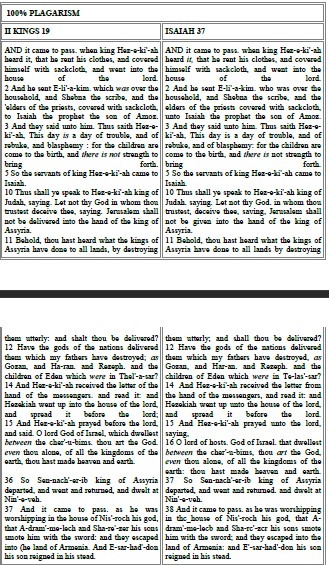
Estos versículos están extraídos de la Versión Autorizada, pero los encontrará igual en todas las versiones.
These verses are culled from the Authorised Version, but you will find the same in every Version.
Sin inspiración verbal
No Verbal Inspiration
(Para obtener una lista completa de todos los libros de la Biblia y sus autores, consúltese la R.S.V. de "Collins" con sus anotaciones). ¿Qué tienen que decir los eruditos cristianos sobre el "Libro de Isaías"? Dicen: "ATRIBUIDO PRINCIPALMENTE A ISAÍAS. ALGUNAS PARTES PUEDEN HABER SIDO ESCRITAS POR OTROS". Ante las confesiones de los eruditos bíblicos, no vamos a acusar al pobre Isaías. ¿Podemos, entonces, clavar este plagio en la puerta de Dios? ¡Qué blasfemia! El profesor Cumptsy confirmó, durante la sesión de preguntas al final del mencionado simposio, que los "cristianos no creen en una inspiración verbal de la Biblia". ¡Así que Dios Todopoderoso no había dictado distraídamente el mismo relato dos veces! Manos humanas, demasiado humanas, habían causado estragos en esta supuesta Palabra de Dios: la Biblia. Y, sin embargo, los fanáticos de la Biblia insistirán en que "cada palabra, coma y punto de la Biblia es Palabra de Dios".
(For a complete list of all the books of the Bible and their authors, avail yourself of the "Collins'" R.S.V. 'with' its annotations). What have Christian scholars to say about the "Book of Isaiah?" They say: "MAINLY CREDITED TO ISAIAH. PARTS MAY HAVE BEEN WRITTEN BY OTHERS" In view of the confessions of Bible scholars, we will not take poor Isaiah to task. Can we then nail this plagiarism on the door of God? What blasphemy! Professor Cumptsy confirmed at question time, at the end of the aforementioned symposium that the "Christians do not believe in a verbal inspiration of the Bible" So God Almighty had not absent-mindedly dictated the same tale twice! Human hands, all too human, had played havoc with this so-called Word of God — the Bible. Yet, Bible-thumpers will insist that "every word, comma and full stop of the Bible is God's Word!"