Het boek gedoopt "het Nieuwe Testament"
The Book Christened "the New Testament"
Waarom "volgens"?
Why "according To?"
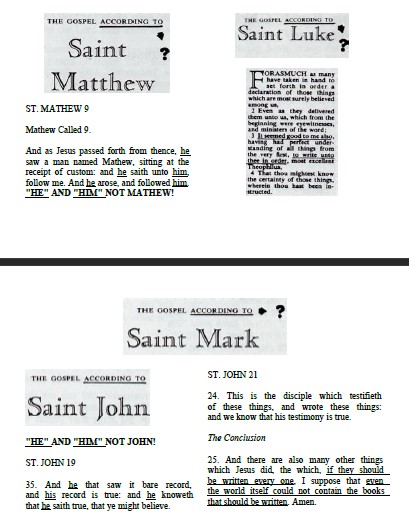
Wat te doen met het zogenaamde Nieuwe Testament? 1 1 Waarom begint elk Evangelie met de inleiding — VOLGENS ... VOLGENS ... (Zie hieronder). Waarom "volgens"? Omdat geen enkele van de geprezen vierduizend bestaande kopieën het originele handschrift van de auteur draagt! Daarom de aanname "volgens"! Zelfs het interne bewijs bewijst dat Matteüs niet de auteur was van het eerste Evangelie dat zijn naam draagt.
What about the so-called New Testament? 1 1 Why does every Gospel begin with the introduction — ACCORDING TO ... ACCORDING TO ... (See below). Why "according to?" Because not a single one of the vaunted four thousand copies extant carries its author's autograph! Hence the supposition "according to!" Even the internal evidence proves that Matthew was not the author of the first Gospel which bears his name.
"En terwijl Jezus van daar wegging, zag HIJ (JEZUS) een man, genaamd Matthew, zittend bij de tollen: en HIJ (JEZUS) zei tegen HEM (MATTHEW), volg MIJ (JEZUS). En HIJ (MATTHEW) stond op en volgde HEM (JEZUS)." (Matthew 9:9)
"And as Jesus passed forth thence, HE (JESUS) saw a man, named Matthew, sitting at the receipt of custom: and HE (JESUS) saith unto HIM (MATTHEW), follow ME (JESUS) And HE (MATTHEW) arose, and followed HIM (JESUS)." (Matthew 9:9)
1. Het "zogenaamde", omdat nergens het "Nieuwe Testament" zichzelf het Nieuwe Testament noemt, en nergens het Oude Testament zichzelf het Oude Testament noemt. En ook het woord "Bijbel" is onbekend binnen de pagina's van de Bijbel. God is vergeten een titel te geven aan "ZIJN" boeken! Zonder enige verbeelding te gebruiken, kan men zien dat de "Hij" en de "Hem" van de bovenstaande vertelling niet verwijzen naar Jezus of Matthew als de auteur ervan, maar naar een derde persoon die opschrijft wat hij zag en hoorde — een verhaal op basis van horen zeggen. Als we zelfs dit "boek van dromen" (zoals het eerste Evangelie ook wordt beschreven) niet aan de discipel Matthew kunnen toeschrijven, hoe kunnen we het dan accepteren als het Woord van God?
1. The "so-called," because nowhere does the "New Testament" calls itself the New Testament, and nowhere the Old Testament calls itself the Old Testament. And also the word "Bible" is unknown within the pages of the Bible. God forgot to give a title to "HIS" books! Without any stretch of the imagination, one can see that the "He's" and the "Him's" of the above narration do not refer to Jesus or Matthew as its author, but some third person writing what he saw and heard — a hearsay account. If we cannot even attribute this "book of dreams" (as the first Gospel is also described) to the disciple Matthew, how can we accept it as the Word of God?
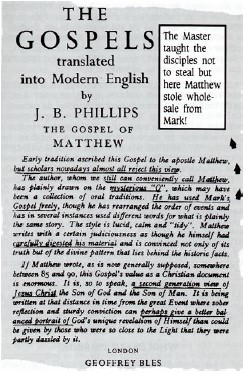
Wij staan niet alleen in de ontdekking dat Matteüs niet het "Evangelie volgens de heilige Matteüs" heeft geschreven en dat het door een anonieme hand is geschreven. J. B. Phillips stemt met ons overeen in onze bevindingen. Hij is de betaalde dienaar van de Anglicaanse Kerk, een prebendair van de Chichester Cathedral, Engeland. Hij zou geen reden hebben om te liegen of te verraden ten nadele van het officiële standpunt van zijn Kerk! Raadpleeg zijn inleiding bij het "Evangelie van de heilige Matteüs" (hieronder gereproduceerd). Phillips zegt het volgende over het auteurschap ervan.
We are not alone in this discovery that Matthew did not write the "Gospel according to St. Matthew" and that it was written by some anonymous hand. J. B. Phillips concurs with us in our findings. He is the paid servant of the Anglican Church, a prebendary of the Chichester Cathedral, England. He would have no reason to lie or betray to the detriment of the official view of his Church! Refer to his introduction to the "Gospel of St. Matthew" (reproduced here below). Phillips has this to say about its authorship.
"DE VROEGE TRADITIE SCHRE de dit evangelie toe aan de apostel Matthüs, maar tegenwoordig verwerpen bijna alle geleerden deze visie." Met andere woorden, de heilige Matthüs heeft het evangelie dat zijn naam draagt niet geschreven. Dit is de bevinding van christelijke geleerden van de hoogste eminentie — niet van hindoes, moslims en joden die van partijdigheid beschuldigd kunnen worden. Laat onze Anglicaanse vriend verdergaan: "DE AANSLUITENDE AUTEUR, DIE WIJ NOG STEEDS GEMAKKELIJK MATTHÜS KUNNEN NOEMEN" "Gemakkelijk" omdat we anders elke keer dat we naar "Matthüs" zouden verwijzen, zouden moeten zeggen — "HET EERSTE BOEK VAN HET NIEUWE TESTAMENT" Hoofdstuk zulk en zulk, vers zulk en zulk. En steeds weer "Het eerste boek . . ." enzovoort. Daarom is het volgens J. B. Phillips handig dat we het boek een naam geven. Dus waarom niet "Matthüs?" Stel dat het een even goede naam is als een andere! Phillips vervolgt: "DE AUTEUR HEEFT DUIDELIJK GELEUND OP HET MYSTERIEUSE 'Q', DAT EEN VERZAMELING VAN MONDELIJKE TRADITIES KAN ZIJN GEWEEST." Wat is dit "mysterieuze 'Q'"? "Q" is een afkorting van het Duitse woord "quella", wat "bronnen" betekent. Er zou een ander document moeten zijn — een gemeenschappelijke bron — waartoe onze huidige Matthüs, Markus en Lucas toegang hadden. Al deze drie auteurs, wie zij ook waren, hadden een gemeenschappelijke blik op het beschikbare materiaal. Ze schreven alsof ze door "één" oog keken. En omdat ze oog in oog met elkaar stonden, werden de eerste drie "evangelies" bekend als de Synoptische evangeliën.
"EARLY TRADITION ASCRIBED THIS GOSPEL TO THE APOSTLE MATTHEW, BUT SCHOLARS NOWADAYS ALMOST ALL REJECT THIS VIEW." In other words, St. Matthew did not write the Gospel which bears his name. This is the finding of Christian scholars of the highest eminence — not of Hindus, Muslims and Jews who may be accused of bias. Let our Anglican friend continue: "THE AUTHOR, WHOM WE STILL CAN CONVENIENTLY CALL MATTHEW" "Conveniently" because otherwise everytime we made a reference to "Matthew" we would have to say — "THE FIRST BOOK OF THE NEW TESTAMENT" Chapter so and so, verse so and so. And again and again "The first book . . ." etc. Therefore, according to J. B. Phillips it is convenient that we give the book some name. So why not "Matthew?" Suppose its as good a name as any other! Phillips continues: "THE AUTHOR HAS PLAINLY DRAWN ON THE MYSTERIOUS 'Q' WHICH MAY HAVE BEEN A COLLECTION OF ORAL TRADITIONS." What is this "mysterious 'Q'?" "Q" is short for the German word "quella" which means "sources." There is supposed to be another document — a common source — to which our present Matthew, Mark and Luke had access. All these three authors, whoever they were, had a common eye on the material at hand. They were writing as if looking through "one" eye. And because they saw eye to eye, the first three "Gospels" came to be known as the Synoptic Gospels.
Groothandel in cribbing
Wholesale Cribbing
Maar hoe zit het met die kwestie van "inspiratie"? De Anglicaanse prebendary heeft de spijker op de kop geslagen. Hij is, meer dan wie dan ook, gerechtigd om dat te doen. Een betaalde dienaar van de Kerk, een orthodox evangelisch christen, een gerespecteerd bijbelgeleerde met directe toegang tot de "originele" Griekse manuscripten; laat HEM het voor ons uitleggen. (Let op hoe voorzichtig hij het geheim prijsgeeft): "HIJ (Mattheüs) HEEFT HET EVANGELIE VAN MARCUS VRIJ MOEDIG GEBRUIKT", wat in de taal van de leraar betekent — "heeft op GROOTSE SCHAL uit Marcus gekopieerd!" Toch noemen de christenen dit grootschalige plagiaat het Woord van God?
But what about that "inspiration" business? The Anglican prebendary has hit the nail on the head. He is, more than anyone else, entitled to do so. A paid servant of the Church, an orthodox evangelical Christian, a Bible scholar of repute, having direct access to the "original" Greek manuscripts, let HIM spell it out for us. (Notice how gently he lets the cat out of the bag): "HE (Matthew) HAS USED MARK'S GOSPEL FREELY" which in the language of the school-teacher — "has been copying WHOLESALE from Mark!" Yet the Christians call this wholesale plagiarism the Word of God?
Zou het u niet verwonderen dat een ooggetuige en een oorgetuige van de bediening van Jezus, wat de discipel Matthew had moeten zijn, in plaats van zijn eigen eerstehandsindrukken van de bediening van "zijn Heer" op te schrijven, de geschriften zou gaan stelen van een jongeling (Mark), die een tienjarige knaap was toen Jezus zijn natie berispte? Waarom zou een ooggetuige en een oorgetuige kopiëren van een man die zelf schreef op basis van horen zeggen? De discipel Matthew zou nooit zoiets dwaas doen. Want een anoniem document is opgelegd aan de eerbiedwaardige naam van Matthew.
Does it not make you wonder that an eye-witness and an ear-witness to the ministry of Jesus, which the disciple Matthew was supposed to be, instead of writing his own first hand impressions of the ministry of "his Lord" would go and steal from the writings of a youth (Mark), who was a ten year old lad when Jesus upbraided his nation? Why would an eye-witness and ear-witness copy from a fellow who himself was writing from hearsay? The disciple Matthew would not do any such silly thing. For an anonymous document has been imposed on the fair name of Matthew.
Plagiaat of literaire ontvoering
Plagiarism Or Literary Kidnapping
Plagiaat betekent literaire diefstal. Wanneer iemand ad verbatim (woord voor woord) kopieert uit het geschrift van een ander en dit als het zijne presenteert, staat dat bekend als plagiaat. Dit is een veelvoorkomend kenmerk onder de ongeveer 40 anonieme auteurs van de boeken van de Bijbel. De christenen pochen met een vermeend gemeenschappelijke draad tussen de schrijvers van de 66 protestantse boekjes en de schrijvers van de 73 Rooms-Katholieke boekjes die de "Heilige Bijbel" worden genoemd. Wat een gemeenschappelijke draad, want Matteüs en Lucas, of wie zij ook waren, hadden 85% woord voor woord van Marcus geplagieerd! God Almachtig dicteerde niet dezelfde bewoordingen aan de synoptici (eenogigen). De christenen zelf geven dit toe, omdat zij niet geloven in een verbale inspiratie, zoals de moslims dat doen over de Heilige Qur’ân. 1 1
Plagiarism means literary theft. Someone copies ad verbatim (word for word) from another's writing and palms it off as his own, is known as plagiarism. This is a common trait amongst the 40 or so anonymous authors of the books of the Bible. The Christians boast about a supposedly common cord amongst the writers of the 66 Protestant booklets and the writers of the 73 Roman Catholic booklets called the "Holy Bible." Some common cord there is, for Matthew and Luke, or whoever they were, had plagiarised 85% word for word from Mark! God Almighty did not dictate the same wordings to the synoptists (one-eyed). The Christians themselves admit this, because they do not believe in a verbal inspiration, as the Muslims do about the Holy Qur’ân. 1 1
Deze 85% plagiaat van Mattheüs en Lucas doet er niet toe in vergelijking met de literaire ontvoering van de auteurs van het Oude Testament, waarbij er honderd procent diefstal plaatsvindt in het zogenaamde Boek van God. Christelijke geleerden van het kaliber van Bishop Kenneth Cragg noemen deze diefstal eufemistisch "reproductie"2 en zijn er trots op.
This 85% plagiarism of Matthew and Luke pales into insignificance compared to the literary kidnapping of the authors of the Old Testament where a hundred percent stealing occurs in the so-called Book of God. Christian scholars of the calibre of Bishop Kenneth Cragg euphemistically calls this stealing, "reproduction"2 and take pride in it.
1. Zie "AL-QURAN — De Mirakels van Mirakels" (binnenkort beschikbaar)
1. See "AL-QURAN — The Miracles of Miracles" (coming soon)
2. Zie het begin van hoofdstuk één voor het volledige citaat.
2. See beginning of chapter one for the full quotation.
Verwrongen Standaarden
Perverted Standards
Dr. Scroggie (eerdere vermelding) citeert in zijn boek met de meeste enthousiasme een Dr. Joseph Parker vanwege zijn unieke lofzang op de Bijbel:
Dr. Scroggie (referred to earlier on) most enthusiastically quotes in his book Scroggie (referred to earlier on) most enthusiastically quotes in his book1 a Dr. Joseph Parker for his unique eulogy of the Bible:
"WAT E BOEK IS DE BIJBEL ALS HET GAAT OM DE VERSCHILLENDE INHOUD! . . . HELE PAGINA'S WORDEN INNEM DOOR ONDUIDELICKE NAMEN, EN ER WORDT MEER VERTELD OVER EEN GENEALOGIE DAN OVER DE DAG DES OORDEELS. VERHALEN WORDEN HALF VERTELD, EN DE NACHT VALT IN BEFORE WE KUNNEN ZEGGEN WAAR DE OVERWINNING LAG. WAAR IS ER IETS" (in de Religieuze Literatuur van de wereld) "DAT HIER BIJ PASST?" Ongetwijfeld een prachtige ketting van woorden en zinnen! Het is veel opwindend om niets, en grove godslastering tegen God Almachtig voor het toestaan van een dergelijke verwarrende brij. Toch juichen de christenen over precies de gebreken van hun boek, zoals Romeo over het "moedervlekje" op de lip van Juliet! 1. "Is de Bijbel het Woord van God?" door de Moody Press. door de Moody Press.
"WHAT A BOOK IS THE BIBLE IN THE MATTER OF VARIETY OF CONTENTS! . . . WHOLE PAGES ARE TAKEN UP WITH OBSCURE NAMES, AND MORE IS TOLD OF A GENEALOGY THAN OF THE DAY OF JUDGMENT. STORIES ARE HALF TOLD, AND THE NIGHT FALLS BEFORE WE CAN TELL WHERE VICTORY LAY. WHERE IS THERE ANYTHING" (in the Religious Literature of the world) "TO CORRESPOND WITH THIS?" A beautiful necklace of words and phrases undoubtedly! It is much ado about nothing, and rank blasphemy against God Almighty for authorising such an embarrassing hotch potch. Yet the Christians gloat over the very defects of their book, like Romeo over the "mole" on Juliet's lip! 1. "Is the Bible the Word of God?" by the Moody Press. by the Moody Press.
Niets minder dan 100%
Nothing Less Than 100%
Om de mate van plagiaat aan te tonen die werd gepraktiseerd door de "geïnspireerde" Bijbschrijvers, vroeg ik mijn publiek tijdens een symposium aan de University of Cape Town, dat tussen mij en Professor Cumpsty, het hoofd van de afdeling Theologie, werd gehouden over het onderwerp "Is de Bijbel het Woord van God?", om hun Bijbels te openen.
To demonstrate the degree of plagiarism practised by the "inspired" Bible writers, I asked my audience during a symposium at the University of Cape Town conducted between myself and Professor Cumpsty the Head of the Department of Theology on the subject "Is the Bible God's Word?" to open their Bibles.
Sommige christenen zijn er zeer aan gehecht om hun Bijbels onder hun arm te dragen wanneer er religieuze discussies of debatten plaatsvinden. Het lijkt erop dat zij volkomen hulpeloos zijn zonder dit boek. Op mijn suggestie begon een aantal van het publiek door de bladzijden te bladeren. Ik vroeg hen hoofdstuk 37 in het "Boek van Jesaja" te openen. Toen het publiek er klaar voor was, vroeg ik hen om mijn "Jesaja 37" te vergelijken met hun "Jesaja 37" terwijl ik voorlas, om te zien of ze identiek waren. Ik begon, lezend op een langzame manier. Versen 1, 2, 4, 10, 15, enzovoort, tot het einde van het hoofdstuk. Na elke vers bleef ik vragen of wat ik had voorgelezen, identiek was aan de versen in hun Bijbels. Keer op keer riepen zij in koor — "Ja!", "Ja!". Aan het einde van het hoofdstuk, met de Bijbel nog steeds open in mijn handen op de plaats waar ik had voorgelezen, liet ik de voorzitter aan het publiek onthullen dat ik helemaal niet uit Jesaja 37 voorlas, maar uit 2 KONINGEN 19! Er heerste een verschrikkelijke verwarring in het publiek! Ik had hiermee 100% plagiaat in de "Heilige Bijbel" vastgesteld. (Zie hieronder)
Some Christians are very fond of carrying their Bibles under their arms when religious discussions or debates take place. They seem to be utterly helpless without this book. At my suggestion a number of the audience began ruffling the pages. I asked them to open chapter 37 in the "Book of Isaiah." When the audience was ready, I asked them to compare my "Isaiah 37" with their "Isaiah 37" while I read, to see whether they were identical. I began, readingly slowly. Verses 1, 2, 4,10, 15, and so on, until the end of the chapter. I kept on asking after every verse if what I had been reading, was identical with the verses in their Bibles. Again and again they chorused — "Yeh!", "Yeh!". At the end of the chapter with the Bible still open in my hands at the place from which I had been reading, I made the Chairman to reveal to the audience that I was not reading from Isaiah 37 at all but from 2 KINGS 19! There was a terrible consternation in the audience! I had thus established 100% plagiarism in the "Holy Bible." (See below)
Met andere woorden, Jesaja 37 en 2 Koningen 19 zijn woord voor woord identiek. Toch zijn ze toegeschreven aan twee verschillende auteurs, eeuwen uit elkaar, die de christenen beweren dat zij door God zijn geïnspireerd.
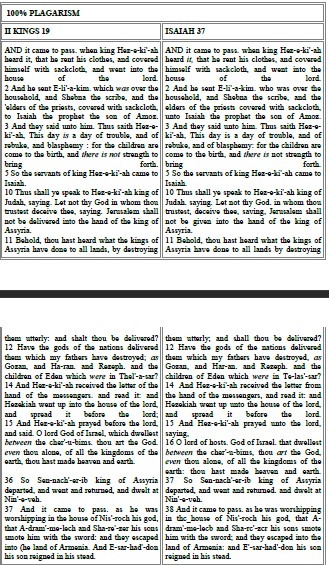
Deze verzen zijn ontleend aan de Authorised Version, maar u zult hetzelfde vinden in elke versie.
These verses are culled from the Authorised Version, but you will find the same in every Version.
Geen verbale inspiratie
No Verbal Inspiration
(Voor een volledige lijst van alle boeken van de Bijbel en hun auteurs kunt u de "Collins'" R.S.V. met zijn annotaties raadplegen). Wat zeggen christelijke geleerden over het "Boek van Jesaja?" Zij zeggen: "VOORNAMELIJK TOEGEËSCHRIJVEN AAN JESAJA. DELEN ZIJN MOGELIJK DOOR ANDEREN GESCHREVEN." Gezien de bekentenissen van Bijbelgeleerden zullen wij de arme Jesaja niet ter verantwoording roepen. Kunnen we dit plagiaat dan op de deur van God spijkeren? Wat een godslastering! Professor Cumptsy bevestigde tijdens het vragenuurtje aan het einde van het eerder genoemde symposium dat "christenen niet geloven in een verbale inspiratie van de Bijbel". Dus God Almachtig had niet onoplettend twee keer hetzelfde verhaal gedicteerd! Menselijke handen, al te menselijk, hadden een puinhoop gemaakt van dit zogenaamde Woord van God — de Bijbel. Toch zullen Bijbel-beukers volhouden dat "elk woord, komma en punt van de Bijbel het Woord van God is!"
(For a complete list of all the books of the Bible and their authors, avail yourself of the "Collins'" R.S.V. 'with' its annotations). What have Christian scholars to say about the "Book of Isaiah?" They say: "MAINLY CREDITED TO ISAIAH. PARTS MAY HAVE BEEN WRITTEN BY OTHERS" In view of the confessions of Bible scholars, we will not take poor Isaiah to task. Can we then nail this plagiarism on the door of God? What blasphemy! Professor Cumptsy confirmed at question time, at the end of the aforementioned symposium that the "Christians do not believe in a verbal inspiration of the Bible" So God Almighty had not absent-mindedly dictated the same tale twice! Human hands, all too human, had played havoc with this so-called Word of God — the Bible. Yet, Bible-thumpers will insist that "every word, comma and full stop of the Bible is God's Word!"