O Livro Chamado "o Novo Testamento"
The Book Christened "the New Testament"
"Segundo"
Why "according To?"
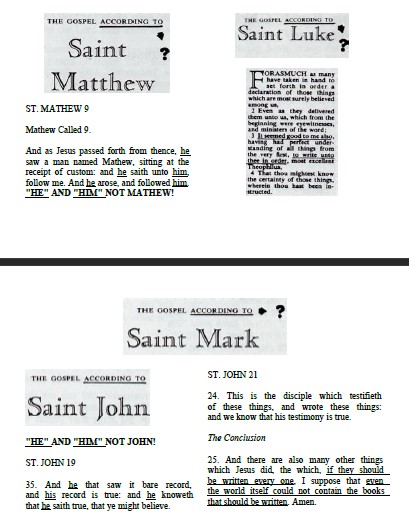
O chamado Novo Testamento? 1 1 Por que cada Evangelho começa com a introdução — SEGUNDO ... SEGUNDO ... (veja abaixo)? Por que "segundo"? Porque nenhum dos vangloriados quatro mil manuscritos existentes traz o autógrafo de seu autor! Daí a suposição "segundo"! Até a evidência interna prova que Mateus não foi o autor do primeiro Evangelho que leva o seu nome.
What about the so-called New Testament? 1 1 Why does every Gospel begin with the introduction — ACCORDING TO ... ACCORDING TO ... (See below). Why "according to?" Because not a single one of the vaunted four thousand copies extant carries its author's autograph! Hence the supposition "according to!" Even the internal evidence proves that Matthew was not the author of the first Gospel which bears his name.
"E, ao passar Jesus dali, viu um homem chamado Mateus, sentado na coletoria de impostos; e disse-lhe: Segue-me. E ele se levantou e o seguiu."
"And as Jesus passed forth thence, HE (JESUS) saw a man, named Matthew, sitting at the receipt of custom: and HE (JESUS) saith unto HIM (MATTHEW), follow ME (JESUS) And HE (MATTHEW) arose, and followed HIM (JESUS)." (Matthew 9:9)
1. O chamado "so-called" ("assim chamado"), porque em nenhum lugar o "Novo Testamento" se chama a si mesmo de Novo Testamento, e em nenhum lugar o Antigo Testamento se chama a si mesmo de Antigo Testamento. Além disso, a palavra "Bíblia" é desconhecida nas páginas da própria Bíblia. Deus se esqueceu de dar um título aos "SEUS" livros! Sem nenhum esforço de imaginação, pode-se perceber que os "Ele" e os "Dele" da narrativa acima não se referem a Jesus nem a Mateus como seu autor, mas a alguma terceira pessoa que escreve o que viu e ouviu, um relato de segunda mão. Se nem sequer conseguimos atribuir este "livro de sonhos" (como também é descrito o primeiro Evangelho) ao discípulo Mateus, como podemos aceitá-lo como a Palavra de Deus?
1. The "so-called," because nowhere does the "New Testament" calls itself the New Testament, and nowhere the Old Testament calls itself the Old Testament. And also the word "Bible" is unknown within the pages of the Bible. God forgot to give a title to "HIS" books! Without any stretch of the imagination, one can see that the "He's" and the "Him's" of the above narration do not refer to Jesus or Matthew as its author, but some third person writing what he saw and heard — a hearsay account. If we cannot even attribute this "book of dreams" (as the first Gospel is also described) to the disciple Matthew, how can we accept it as the Word of God?
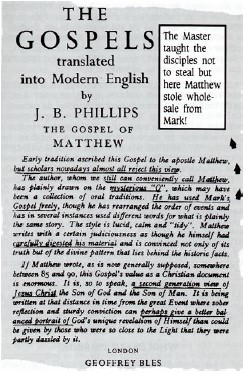
Não estamos sós nesta descoberta de que Mateus não escreveu o "Evangelho segundo São Mateus" e de que ele foi escrito por alguma mão anônima. J. B. Phillips concorda conosco em nossas conclusões. Ele é um servo remunerado da Igreja Anglicana, um prebendário da Catedral de Chichester, na Inglaterra. Ele não teria motivo para mentir ou trair em detrimento da visão oficial de sua Igreja! Veja sua introdução ao "Evangelho de São Mateus" (reproduzida abaixo). Phillips tem o seguinte a dizer sobre sua autoria.
We are not alone in this discovery that Matthew did not write the "Gospel according to St. Matthew" and that it was written by some anonymous hand. J. B. Phillips concurs with us in our findings. He is the paid servant of the Anglican Church, a prebendary of the Chichester Cathedral, England. He would have no reason to lie or betray to the detriment of the official view of his Church! Refer to his introduction to the "Gospel of St. Matthew" (reproduced here below). Phillips has this to say about its authorship.
"A TRADIÇÃO ANTIGA ATRIBUIU ESTE EVANGELHO AO APÓSTOLO MATEUS, MAS OS ESTUDIOSOS HOJE QUASE TODOS REJEITAM ESSA VISÃO." Em outras palavras, São Mateus não escreveu o Evangelho que leva o seu nome. Esta é a conclusão dos estudiosos cristãos da mais alta eminência, e não de hindus, muçulmanos e judeus, que poderiam ser acusados de parcialidade. Deixemos nosso amigo anglicano continuar: "O AUTOR, A QUEM AINDA PODEMOS CONVENIENTEMENTE CHAMAR DE MATEUS". "Convenientemente", porque, caso contrário, toda vez que fizéssemos referência a "Mateus" teríamos de dizer: "O PRIMEIRO LIVRO DO NOVO TESTAMENTO", capítulo tal, versículo tal. E de novo e de novo "O primeiro livro...", e assim por diante. Portanto, segundo J. B. Phillips, é conveniente que demos ao livro algum nome. Então por que não "Mateus"? Suponhamos que seja um nome tão bom quanto qualquer outro! Phillips continua: "O AUTOR CLARAMENTE RECORREU AO MISTERIOSO 'Q', QUE PODE TER SIDO UMA COLETÂNEA DE TRADIÇÕES ORAIS." O que é esse "misterioso 'Q'"? "Q" é a abreviação da palavra alemã "Quelle", que significa "fontes". Supõe-se que existia outro documento, uma fonte comum, ao qual o nosso atual Mateus, Marcos e Lucas tiveram acesso. Esses três autores, quem quer que fossem, tinham os olhos voltados para o mesmo material. Escreviam como se olhassem com "um só" olho. E, por verem de maneira semelhante, os três primeiros "Evangelhos" passaram a ser conhecidos como Evangelhos Sinóticos.
"EARLY TRADITION ASCRIBED THIS GOSPEL TO THE APOSTLE MATTHEW, BUT SCHOLARS NOWADAYS ALMOST ALL REJECT THIS VIEW." In other words, St. Matthew did not write the Gospel which bears his name. This is the finding of Christian scholars of the highest eminence — not of Hindus, Muslims and Jews who may be accused of bias. Let our Anglican friend continue: "THE AUTHOR, WHOM WE STILL CAN CONVENIENTLY CALL MATTHEW" "Conveniently" because otherwise everytime we made a reference to "Matthew" we would have to say — "THE FIRST BOOK OF THE NEW TESTAMENT" Chapter so and so, verse so and so. And again and again "The first book . . ." etc. Therefore, according to J. B. Phillips it is convenient that we give the book some name. So why not "Matthew?" Suppose its as good a name as any other! Phillips continues: "THE AUTHOR HAS PLAINLY DRAWN ON THE MYSTERIOUS 'Q' WHICH MAY HAVE BEEN A COLLECTION OF ORAL TRADITIONS." What is this "mysterious 'Q'?" "Q" is short for the German word "quella" which means "sources." There is supposed to be another document — a common source — to which our present Matthew, Mark and Luke had access. All these three authors, whoever they were, had a common eye on the material at hand. They were writing as if looking through "one" eye. And because they saw eye to eye, the first three "Gospels" came to be known as the Synoptic Gospels.
Compra e venda em atacado (cribbing)
Wholesale Cribbing
But what about that "inspiration" business? The Anglican prebendary has hit the nail on the head. He is, more than anyone else, entitled to do so. A paid servant of the Church, an orthodox evangelical Christian, a Bible scholar of repute, having direct access to the "original" Greek manuscripts, let HIM spell it out for us. (Notice how gently he lets the cat out of the bag): "HE (Matthew) HAS USED MARK'S GOSPEL FREELY" which in the language of the school-teacher — "has been copying WHOLESALE from Mark!" Yet the Christians call this wholesale plagiarism the Word of God?
But what about that "inspiration" business? The Anglican prebendary has hit the nail on the head. He is, more than anyone else, entitled to do so. A paid servant of the Church, an orthodox evangelical Christian, a Bible scholar of repute, having direct access to the "original" Greek manuscripts, let HIM spell it out for us. (Notice how gently he lets the cat out of the bag): "HE (Matthew) HAS USED MARK'S GOSPEL FREELY" which in the language of the school-teacher — "has been copying WHOLESALE from Mark!" Yet the Christians call this wholesale plagiarism the Word of God?
Não lhe parece estranho que uma testemunha ocular e auditiva do ministério de Jesus, que se supõe ser o discípulo Mateus, em vez de escrever as suas próprias impressões de primeira mão sobre o ministério de "seu Senhor", fosse copiar dos escritos de um jovem (Marcos), que tinha dez anos quando Jesus repreendeu a sua nação? Por que razão uma testemunha ocular e auditiva copiaria de um homem que escrevia a partir de ouvir dizer? O discípulo Mateus não faria uma coisa tão tola. Pois um documento anónimo foi imposto sobre o bom nome de Mateus.
Does it not make you wonder that an eye-witness and an ear-witness to the ministry of Jesus, which the disciple Matthew was supposed to be, instead of writing his own first hand impressions of the ministry of "his Lord" would go and steal from the writings of a youth (Mark), who was a ten year old lad when Jesus upbraided his nation? Why would an eye-witness and ear-witness copy from a fellow who himself was writing from hearsay? The disciple Matthew would not do any such silly thing. For an anonymous document has been imposed on the fair name of Matthew.
Plágio ou Sequestro Literário
Plagiarism Or Literary Kidnapping
Plágio significa roubo literário. Quando alguém copia palavra por palavra (ad verbatim) a escrita de outra pessoa e a apresenta como sua, isso é conhecido como plágio. Este é um traço comum entre os cerca de 40 autores anônimos dos livros da Bíblia. Os cristãos se gabam de uma suposta ligação comum entre os autores dos 66 livretos protestantes e dos 73 livretos católicos romanos chamados de "Bíblia Sagrada". Existe, de fato, alguma ligação comum: Mateus e Lucas, ou quem quer que fossem, teriam plagiado 85% palavra por palavra de Marcos! Deus Todo-Poderoso não ditou as mesmas palavras aos sinóticos (unilaterais). Os próprios cristãos admitem isso, pois não acreditam numa inspiração verbal, como os muçulmanos creem a respeito do Sagrado Alcorão. 1 1
Plagiarism means literary theft. Someone copies ad verbatim (word for word) from another's writing and palms it off as his own, is known as plagiarism. This is a common trait amongst the 40 or so anonymous authors of the books of the Bible. The Christians boast about a supposedly common cord amongst the writers of the 66 Protestant booklets and the writers of the 73 Roman Catholic booklets called the "Holy Bible." Some common cord there is, for Matthew and Luke, or whoever they were, had plagiarised 85% word for word from Mark! God Almighty did not dictate the same wordings to the synoptists (one-eyed). The Christians themselves admit this, because they do not believe in a verbal inspiration, as the Muslims do about the Holy Qur’ân. 1 1
Este plágio de 85% de Mateus e Lucas empalidece em insignificância quando comparado ao sequestro literário dos autores do Antigo Testamento, onde ocorre um roubo de cem por cento no chamado Livro de Deus. Estudiosos cristãos do calibre do Bispo Kenneth Cragg eufemisticamente chamam esse roubo de "reprodução"2 e se orgulham disso.
This 85% plagiarism of Matthew and Luke pales into insignificance compared to the literary kidnapping of the authors of the Old Testament where a hundred percent stealing occurs in the so-called Book of God. Christian scholars of the calibre of Bishop Kenneth Cragg euphemistically calls this stealing, "reproduction"2 and take pride in it.
1. Veja "AL-QURAN — The Miracles of Miracles" (em breve)
1. See "AL-QURAN — The Miracles of Miracles" (coming soon)
2. Veja o início do capítulo um para a citação completa.
2. See beginning of chapter one for the full quotation.
Padrões Pervertidos
Perverted Standards
O Dr. Scroggie (mencionado anteriormente) cita com grande entusiasmo, em seu livro, um Dr. Joseph Parker por seu elogio singular à Bíblia:
Dr. Scroggie (referred to earlier on) most enthusiastically quotes in his book Scroggie (referred to earlier on) most enthusiastically quotes in his book1 a Dr. Joseph Parker for his unique eulogy of the Bible:
"QUE LIVRO É A BÍBLIA NO QUE DIZ RESPEITO À VARIEDADE DE CONTEÚDOS! . . . PÁGINAS INTEIRAS SÃO OCUPADAS POR NOMES OBSCUROS, E MAIS SE CONTA DE UMA GENEALOGIA DO QUE DO DIA DO JUÍZO. HISTÓRIAS SÃO CONTADAS PELA METADE, E A NOITE CAI ANTES QUE POSSAMOS DIZER ONDE ESTAVA A VITÓRIA. ONDE HÁ ALGO" (na literatura religiosa do mundo) "QUE SE COMPARE A ISSO?" Um belo colar de palavras e frases, sem dúvida! É muito barulho por nada, e uma blasfêmia flagrante contra Deus Todo-Poderoso por autorizar uma miscelânea tão constrangedora. No entanto, os cristãos se regozijam justamente com os defeitos de seu livro, como Romeu com a "pinta" no lábio de Julieta! 1. "Is the Bible the Word of God?" by the Moody Press. by the Moody Press.
"WHAT A BOOK IS THE BIBLE IN THE MATTER OF VARIETY OF CONTENTS! . . . WHOLE PAGES ARE TAKEN UP WITH OBSCURE NAMES, AND MORE IS TOLD OF A GENEALOGY THAN OF THE DAY OF JUDGMENT. STORIES ARE HALF TOLD, AND THE NIGHT FALLS BEFORE WE CAN TELL WHERE VICTORY LAY. WHERE IS THERE ANYTHING" (in the Religious Literature of the world) "TO CORRESPOND WITH THIS?" A beautiful necklace of words and phrases undoubtedly! It is much ado about nothing, and rank blasphemy against God Almighty for authorising such an embarrassing hotch potch. Yet the Christians gloat over the very defects of their book, like Romeo over the "mole" on Juliet's lip! 1. "Is the Bible the Word of God?" by the Moody Press. by the Moody Press.
Nada Menos Que 100%
Nothing Less Than 100%
Para demonstrar o grau de plágio praticado pelos escritores bíblicos "inspirados", pedi à minha plateia, durante um simpósio na Universidade da Cidade do Cabo, conduzido entre mim e o Professor Cumpsty, Chefe do Departamento de Teologia, sobre o tema "A Bíblia é a Palavra de Deus?", que abrisse as suas Bíblias.
To demonstrate the degree of plagiarism practised by the "inspired" Bible writers, I asked my audience during a symposium at the University of Cape Town conducted between myself and Professor Cumpsty the Head of the Department of Theology on the subject "Is the Bible God's Word?" to open their Bibles.
Muitos cristãos gostam de levar a sua Bíblia debaixo do braço quando têm lugar discussões ou debates religiosos. Parecem completamente incapazes sem este livro. Por minha sugestão, vários membros da audiência começaram a folhear as páginas. Pedi-lhes que abrissem o capítulo 37 do "Livro de Isaías". Quando a audiência estava pronta, pedi-lhes que comparassem o meu "Isaías 37" com o seu "Isaías 37" enquanto eu lia, para ver se eram idênticos. Comecei a ler bastante devagar. Versículos 1, 2, 4, 10, 15, e assim por diante, até ao fim do capítulo. Continuei a perguntar após cada versículo se o que eu estava a ler era idêntico aos versículos nas suas Bíblias. Repetidas vezes, responderam em coro: "Sim!", "Sim!". No fim do capítulo, com a Bíblia ainda aberta nas minhas mãos na passagem de onde eu estava a ler, pedi ao Presidente que revelasse à audiência que eu não estava a ler de Isaías 37, mas sim de 2 REIS 19! Houve uma terrível consternação na audiência! Tinha assim estabelecido 100% de plágio na "Santa Bíblia." (Ver abaixo)
Some Christians are very fond of carrying their Bibles under their arms when religious discussions or debates take place. They seem to be utterly helpless without this book. At my suggestion a number of the audience began ruffling the pages. I asked them to open chapter 37 in the "Book of Isaiah." When the audience was ready, I asked them to compare my "Isaiah 37" with their "Isaiah 37" while I read, to see whether they were identical. I began, readingly slowly. Verses 1, 2, 4,10, 15, and so on, until the end of the chapter. I kept on asking after every verse if what I had been reading, was identical with the verses in their Bibles. Again and again they chorused — "Yeh!", "Yeh!". At the end of the chapter with the Bible still open in my hands at the place from which I had been reading, I made the Chairman to reveal to the audience that I was not reading from Isaiah 37 at all but from 2 KINGS 19! There was a terrible consternation in the audience! I had thus established 100% plagiarism in the "Holy Bible." (See below)
Em outras palavras, Isaías 37 e 2 Reis 19 são idênticos palavra por palavra. No entanto, têm sido atribuídos a dois autores diferentes, separados por séculos, que os cristãos afirmam terem sido inspirados por Deus.
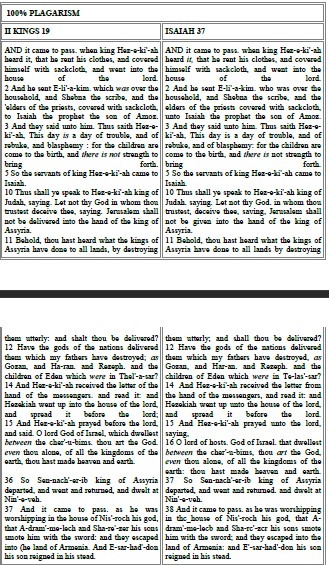
Estes versículos são extraídos da Versão Autorizada, mas você encontrará o mesmo em todas as versões.
These verses are culled from the Authorised Version, but you will find the same in every Version.
Sem Inspiração Verbal
No Verbal Inspiration
(Para uma lista completa de todos os livros da Bíblia e dos seus autores, consulte a edição "Collins'" R.S.V. "com" as suas anotações.) O que dizem os estudiosos cristãos sobre o "Livro de Isaías"? Eles dizem: "CREDITADO PRINCIPALMENTE A ISAÍAS. PARTES PODEM TER SIDO ESCRITAS POR OUTROS." Diante das confissões dos estudiosos da Bíblia, não vamos acusar o pobre Isaías. Podemos então pregar este plágio na porta de Deus? Que blasfêmia! O Professor Cumptsy confirmou, no fim do já mencionado simpósio, quando surgiram perguntas, que os "cristãos não acreditam numa inspiração verbal da Bíblia". Então Deus Todo-Poderoso não tinha, distraidamente, ditado a mesma história duas vezes! Mãos humanas, humanas demais, tinham feito estragos nesta chamada Palavra de Deus — a Bíblia. No entanto, os "bíblia-batedores" insistirão que "cada palavra, vírgula e ponto final da Bíblia é a Palavra de Deus!"
(For a complete list of all the books of the Bible and their authors, avail yourself of the "Collins'" R.S.V. 'with' its annotations). What have Christian scholars to say about the "Book of Isaiah?" They say: "MAINLY CREDITED TO ISAIAH. PARTS MAY HAVE BEEN WRITTEN BY OTHERS" In view of the confessions of Bible scholars, we will not take poor Isaiah to task. Can we then nail this plagiarism on the door of God? What blasphemy! Professor Cumptsy confirmed at question time, at the end of the aforementioned symposium that the "Christians do not believe in a verbal inspiration of the Bible" So God Almighty had not absent-mindedly dictated the same tale twice! Human hands, all too human, had played havoc with this so-called Word of God — the Bible. Yet, Bible-thumpers will insist that "every word, comma and full stop of the Bible is God's Word!"