5. 一块肉团
5. A Lump Of Flesh
然后我们把那团凝血造成一块肉团。
and then We made that form into a lump of flesh
人类发展的下一个阶段,在《古兰经》中被称为"穆德加"(mudghah)。该词的含义包括:咀嚼、嚼碎、被咀嚼、一小块肉。它也用来描述胚胎进入另一阶段、变成血肉之后的状态。其他含义还包括:被牙齿咬过并留下痕迹的东西;以及在反复咀嚼的过程中发生变化的痕迹。关于"穆德加"阶段,《古兰经》的其他经文中还有进一步的阐述:
The next stage of human development defined in the Qur’an is mudghah. This term means to chew, mastication, chewing, to be chewed, and a small piece of meat.61 62 It also describes the embryo after it passes to another stage and becomes flesh.63 Other meanings include something that teeth have chewed and left visible marks on; and marks that change in the process of chewing due to the repetitive act.64 The mudghah stage is elaborated on further, elsewhere in the Qur'an:
然后是一块肉团(mudghah),有已成形的,也有未成形的。65
then from a fleshy lump (mudghah), formed and unformed. 65
阿拉伯语中用来表示“被造”的词是 mukhallqah,它也可以表示“被塑造”或“被塑形”。66
The Arabic word used here for ‘formed’ is mukhallqah which can also mean ‘shaped’ or ‘moulded’.66
科学的解释
SCIENTIFIC INTERPRETATION
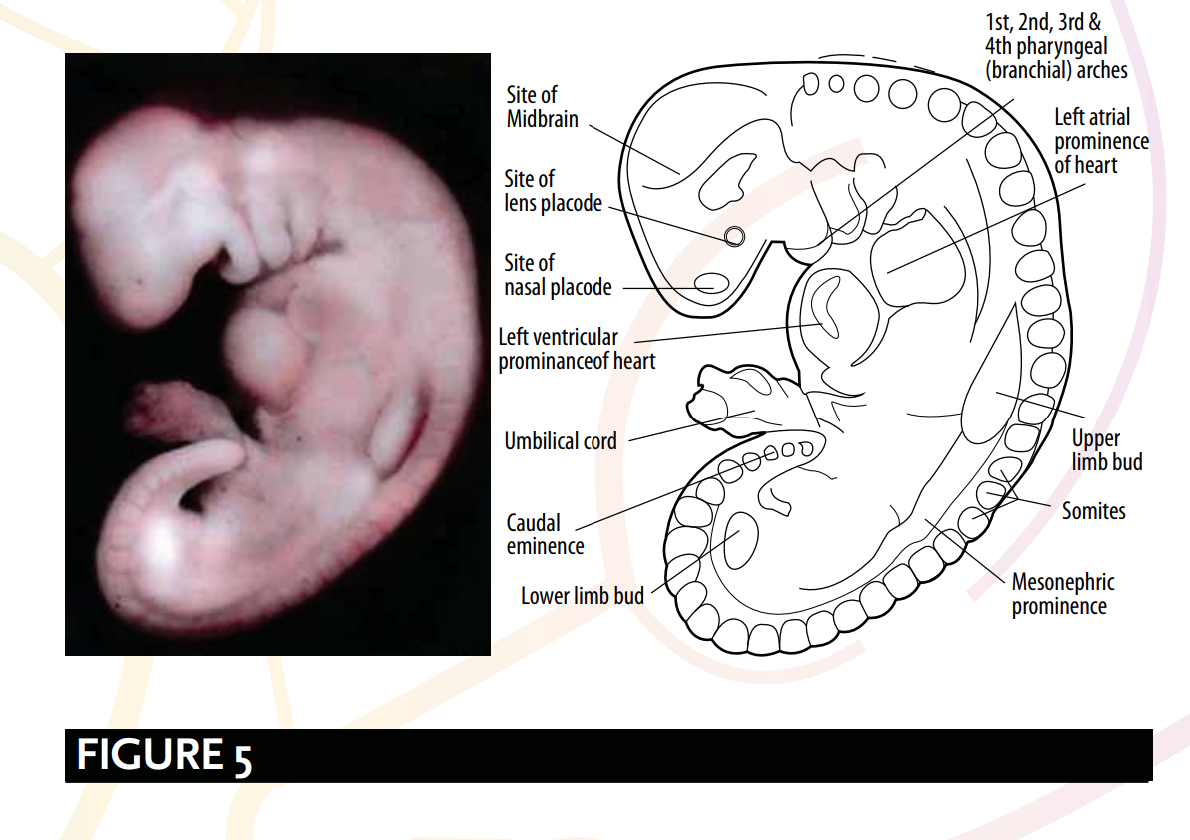
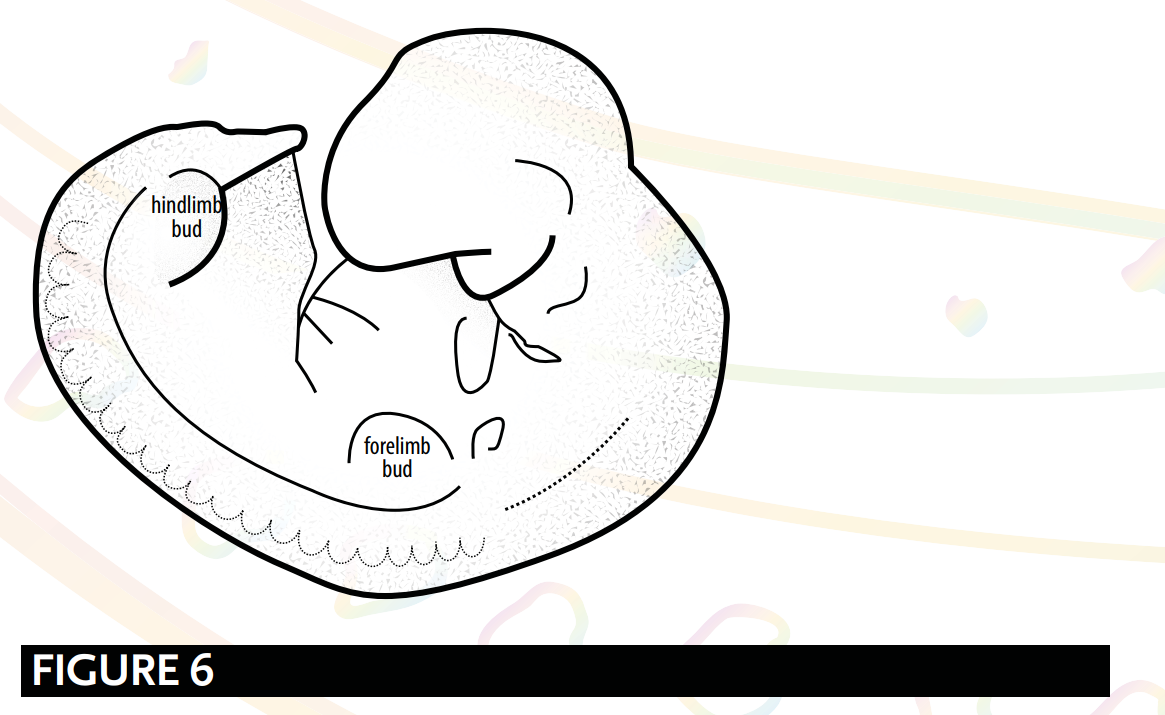
从词源学的角度解读这个词,这一阶段涉及第4周,此时开始出现体节(somites),其外观类似牙印[见图5和图6]。由于体节的发育,胚胎在此阶段的外观与“被咀嚼”和“被牙齿咀嚼并留下明显痕迹的东西”这两层含义相吻合。关于体节的发育,巴里·米切尔(Barry Mitchell)和拉姆·夏尔马(Ram Sharma)写道:
Taking a lexical approach to the interpretation of the word, this stage deals with the 4th week, when somites, which resemble tooth-marks [see Figures 5 and 6], begin to develop. The appearance of the embryo at this stage, due to somite development, corresponds with the meanings: ‘to be chewed’ and ‘something that teeth have chewed and left visible marks on’. Concerning somite development, Barry Mitchell and Ram Sharma write:
在第四周,体节中位置靠内侧的间充质细胞向脊索迁移,形成生骨节[间充质是胚胎中疏松排列的胚胎性结缔组织]。67
In the fourth week, the medially placed mesenchymal cells of the somites migrate towards the notochord to form scelerotomes [mesenchyme is the loosely arranged embryonic connective tissue in the embryo].67
另一种关于“mudghah”(肉块)一词的含义,是指看起来像一小块肉的东西。这同样准确地描述了胚胎在此阶段的样子。有趣的是,《古兰经》将mudghah解释为“既有形又无形”(formed and unformed),这可以指器官形成期(organogenetic period),在此期间所有主要器官已开始发育,但尚未完全成形。68 这一时期也大约发生在怀孕第4周。
Another meaning for the word mudghah includes something looking like a morsel of flesh. This too is an accurate description of the embryo's appearance at this stage. Interestingly, the qur’anic explanation of mudghah as being “formed and unformed”, can refer to the organogenetic period, during which all the main organs have begun to develop, but are not yet fully formed.68 This period also occurs at around the 4th week
一种被嚼过的物质
A CHEWED SUBSTANCE
关于"肉团"阶段,批评者提出的一个论点是:一块嚼过的肉或一团肉块,与现代胚胎学所描述的任何阶段的胚胎都不相似。要回应这一点,有必要说明什么才算是"嚼过的肉块"。它不仅包括反复咀嚼,也包括只被咬过一次的东西。这样就保持了"mudghah"一词的含义,因为咬痕确实与被咬过一次的肉块相似。这一点也由该词的另一层含义所凸显:即"被牙齿咀嚼过并留下可见咬痕的东西"。
An argument raised by critics concerning the mudghah stage is that a chewed piece of meat or a lump of flesh does not resemble the embryo at any stage described by modern embryology. In responding to this, it is necessary to clarify what constitutes a ‘chewed piece of flesh’. It includes, not just mastication, but also something being chewed just the once. This maintains the meaning of the word mudghah as the bite marks do resemble a piece of meat chewed once. This is highlighted by its other meaning: ‘something that teeth have chewed and left visible marks on’.
摘要
SUMMARY
“مضغة”阶段
The `mudghah stage:
体节的发育使胚胎呈现出一种类似被咀嚼过的物质的外观。看上去像一小块肉团——这是对胚胎在此阶段外观的准确描述。
The development of somites giving the embryo the appearance of a chewed substance. What looks like a morsel of flesh - an accurate description of embryo's appearance at this stage.
它也描述了器官发生期(器官开始形成、但尚未完全成型的阶段)。
It also describes the organogenetic period (the development of organs, not yet fully formed).
与往常一样,人们曾试图将《古兰经》中的“穆德加”(mudghah)一词与盖伦的著作相比较,以证明先知穆罕默德ﷺ抄袭了希腊人关于人类发育的著述。然而,在分析盖伦的著作,并将其与“穆德加”一词丰富多样的含义相对照之后,一个明显的差异便清晰地显现出来。盖伦写道:
As ever, there have been attempts to compare the qur’anic term mudghah with Galen’s work to substantiate the view that the Prophet Muhammad ﷺ plagiarised from Greek writings on human development. However, upon analysing Galen’s writings, bringing it in contrast to the various and extensive meanings of the word mudghah, a pointed difference is made distinct. Galen states:
第三个阶段紧随其后,正如前面所说,此时可以清楚地看到三个主导部分,并且能大致看出其他所有部分的轮廓,犹如剪影一般。三个主导部分的结构会看得更为清晰,胃的各部分则较为模糊,而四肢的结构就更加模糊了。之后它们会形成希波克拉底所说的“枝芽”,他用这个词来表明它们与树枝相似。69
The third period follows on this, when, as was said, it is possible to see the three ruling parts clearly and a kind of outline, a silhouette, as it were, of all the other parts. You will see the conformation of the three ruling parts more clearly, that of the parts of the stomach more dimly, and much more still, that of the limbs. Later on they form ‘twigs’, as Hippocrates expressed it, indicating by the term their similarity to branches.69
如前所述,《古兰经》提到“穆合扎”(mudghah),将其比作一种被咀嚼过的物质,以及一小块肉。相比之下,盖伦论述了“三个主导部分”的“构形”、“轮廓”和“细枝”,这很可能指的是肢体骨骼的形成。他详细描述了这三个主导部分比胃和四肢更为明显。然而,《古兰经》对此并无提及,其对肢体骨骼形成的描述出现在下一阶段。因此,认为先知穆罕默德ﷺ抄袭了盖伦的著作,既不合情理,也不切实际,因为《古兰经》在这一阶段并未包含盖伦所提供的任何描述。
As explored, the Qur’an mentions mudghah as a chewed-like substance and a small piece of flesh. In contrast, Galen discusses the “conformation” of “the three ruling parts”, “silhouettes” and “twigs”, which is most likely in reference to limb bone formation. He details these three ruling parts as being more visible than the stomach and the limbs. However, the Qur’an makes no mention of this, and its mention of the limb bone formation comes at the next stage. It is both implausible and impractical, therefore, to suggest the Prophet Muhammad ﷺ copied the works of Galen as the Qur’an does not include any of the descriptions provided by Galen at this stage