6. 骨头
6. Bones
然后我们把那血块变成骨头。
and We made that lump into bones
从肉块阶段开始,形成了骨骼(ʿiẓām)。这是下一个阶段。在阿拉伯语中,ʿiẓām一词的意思是骨头,特指手脚的骨头,或动物的手臂和腿的骨头,骨头上附着着肉。70
From the mudghah stage, `idhaam are created. This is the next stage. The word `idhaam in the Arabic language means bone, and is specifically applied to the bones of the hands and feet, or of the arms and legs of an animal, upon which is the flesh.70
科学的解释
SCIENTIFIC INTERPRETATION
“idhaam”阶段与轴骨和四肢骨骼的发育有关,大约发生在第5周。Barry Mitchell和Ram Sharma解释道:
The `idhaam stage pertains to the development of the axial and limb skeleton, occuring at around the 5th week. Barry Mitchell and Ram Sharma explain:
不同部位构成骨骼组织的间充质细胞的起源各不相同。构成中轴骨骼的间充质细胞起源于中胚层体节,而附属骨骼的骨骼则源自侧板中胚层的体壁中胚层间充质。间充质细胞到达其目的地后会聚集并形成骨的雏形。随后,间充质细胞分化为成软骨细胞或成骨细胞,这一过程受基因控制。71.
The origin of mesenchymal cells forming the skeletal tissues varies in different regions of the body. Mesenchymal cells forming the axial skeleton arise from the mesodermal somites, whereas the bones of the appendicular skeleton are derived from the somatopleuric mesenchyme of the lateral plate mesoderm. After reaching their destination the mesenchymal cells condense and form models of bones. The subsequent differentiation of mesenchymal cells into chondroblasts or osteoblasts is genetically controlled.71.
“肢骨”是词语“إِدَامٌ”(`idhaam)所规定的含义,因此它可以指肢芽的发育,而肢芽的发育又引起四肢和附肢骨骼的形成。巴里·米切尔(Barry Mitchell)与拉姆·夏尔马(Ram Sharma)对四肢和附肢骨骼的形成作了如下阐述:
‘Limb bones’ is the specified meaning of the word `idhaam, and therefore can refer to the development of the limb buds which give rise to the development of the limbs and the appendicular skeleton. Barry Mitchell and Ram Sharma elaborate on the formation of the limb and appendicular skeleton:
附肢骨骼由肢带和四肢的骨骼组成。附肢骨骼的骨骼源自间充质凝聚体,这些凝聚体随后形成软骨模型。72 [See Figure 7]
The appendicular skeleton consists of limb girdles and the bones of the limbs. The bones of the appendicular skeleton develop from mesenchymal condensations which become cartilaginous models.72 [See Figure 7]
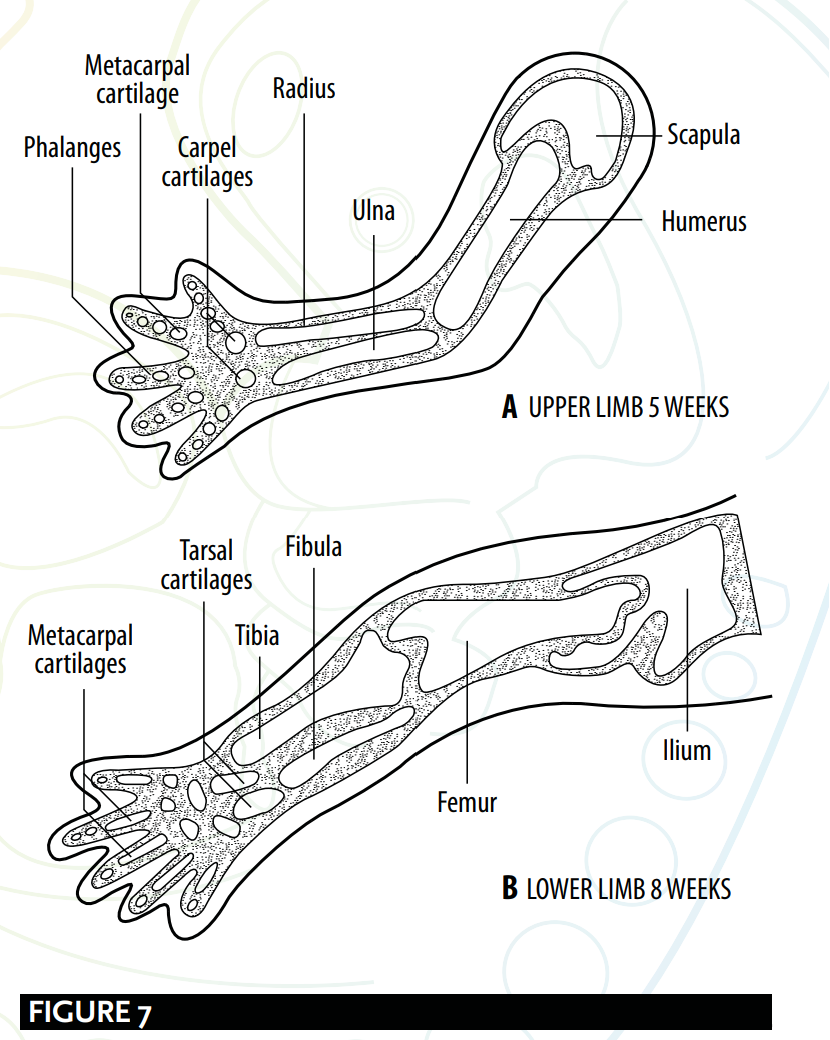
John Allen 和 Beverley Kramer 也对肢体骨骼的形成作了评论。
John Allen and Beverley Kramer also comment on limb bone formation.
肢体间充质起初是一个均匀的团块,但不久其中会出现凝聚,这些凝聚物软骨化,形成各块骨骼的软骨模型。每个软骨模型外面包绕着软骨膜,软骨膜是间充质的凝聚层。通过周围间充质中成骨细胞(造骨细胞)的长入,在每个软骨模型上形成一个骨化中心(原发骨化中心)。周围的间充质此时被称为骨膜(包绕骨骼)。成骨细胞随后产生骨质,形成肢体的骨骼成分。73.
The limb mesenchyme is at first a homogenous mass but soon condensations occur in it and these chondrify to form cartilaginous models of the various bones. Each cartilage model is surrounded by perichondrium which is a condensation of mesenchyme. An ossific centre (primary ossification centre) is formed upon each cartilage model by the ingrowth of osteobalsts (bone-forming cells) from the surrounding mesenchyme. The surrounding mesenchyme is now termed periosteum (surrounding the bone). Osteoblasts now produce bone which give rise to the skeletal elements of the limbs. 73.
在《古兰经》关于"ʿIdhām"(骨骼包裹)阶段的描述与现代胚胎学对中轴骨骼、四肢骨骼及附属骨骼发育的认识之间,存在明显的相似之处。
There are clear parallels between the qur'anic `idhaam stage and the view modern embryology takes i.e. the development of the axial, limb and appendicular skeleton.
摘要
SUMMARY
“idhaam”阶段:中轴骨骼、肢体骨骼和附属骨骼的形成。
The `idhaam stage: The formation of the axial, limb and appendicular skeleton.
从肉块到骨骼
FROM A LUMP TO BONES
一种常见的误解,通常出自不懂阿拉伯语的人之手,认为这节经文可以直译为"然后我使那块血块变成了骨头"。由此他们得出结论:这节经文不符合科学,因为一块肉团不可能变成一堆骨头。然而,这种看法建立在对阿拉伯语语法和《古兰经》修辞之美的粗浅理解之上。从语法角度来看,这节经文的意思是:"我们从那块肉团中造出了骨头"。
A common misconception, usually made by non-Arabists, is that this verse can be literally translated as “and We made that lump into bones”. From this, they conclude that this verse is unscientific because a lump of flesh cannot turn into a mass of bones. However, this is based upon a crude understanding of Arabic grammar and the Qur’an's eloquence. This verse, from a grammatical perspective, has the meanings of: “and We made of/from/out of the lump bones”.
这就是为什么尤素福·阿里将这节经文译为“然后我们从那块肉团中造出骨头”74;沙基尔将其译为“然后我们使肉团(中)成为骨骼”;而阿瑟·阿伯里在其《古兰经》译本中——至今仍被学者们使用——将这节经文译为“然后我们从组织中造出骨头”。75
This is why Yusuf Ali translates this verse as “then we made out of that lump bones”74; Shakir translates it as “then We made (in) the lump of flesh bones”; and A J Arberry, in his translation of the Qur’an which is still used by academics today, translates this verse as “then We created of the tissue bones”.75
非真骨头
NOT REAL BONES
另一种评论者的主张是,在这一阶段并不存在真正的骨骼。有人认为,所谓的骨骼只是软骨,因为骨化尚未完成,因此《古兰经》的说法必定不准确。这一反驳虽然言之成理,却是误解。"`idhaam"一词涵盖了骨骼的软骨形态,即骨架正在形成的阶段。此外,骨化过程从第8周开始,并在出生后继续进行,直至大约青春期时才最终完成。Barry Mitchell 与 Ram Sharma 对此作了解释:
Another proposition from commentators is that at this stage there are no real bones. It is argued that the apparent bones are mere cartilage as ossification is incomplete and, as such, the Qur’an must therefore be inaccurate. Although a valid contention, it is misplaced. `idhaam encompasses the cartilaginous form of the bones as the skeletal framework is put in place. Additionally, the process of ossification begins by the 8th week,76 continuing on after birth, with the eventual completion of the ossification process at around puberty. Barry Mitchell and Ram Sharma explain:
骨化中心最早在第八周出现于肢体长骨中。到第十二周时,肢体长骨的骨干已经骨化,但腕部的腕骨直到出生后才仍保持软骨状态。踝部三块最大的跗骨的骨化大约在第16周开始,而一些较小的跗骨要到出生后3岁才骨化。77.
The centres of ossification first appear in the limb bones during the eighth week. By the twelfth week, the shafts of the limb bones are ossified, though the carpal bones of the wrist remain cartilaginous until after birth. The ossification of the three largest tarsal bones of the ankle begins about 16 weeks, but some of the smaller tarsal bones do not ossify until 3 years after birth.77.
从这一角度看,若认为新生儿或青春期前的少年没有骨头,只因为他们的骨骼尚需骨化,这在医学上是荒谬的,尤其是骨化要到青春期生长突增结束时才完成。即便如此,若真将这一阶段视为某种意义上的“无骨”阶段,那么“idhaam”一词的词义引申(derisions)足以容纳一种全面的解释,因为“各类骨骼的软骨模型”78也包含在其含义之中。
From this perspective, it would be a medical absurdity to assume newborns or young teenagers do not have bones simply because they require ossification, especially since ossification completes at the end of the growth-spurt of puberty. Nevertheless if this were the case, and we are to take this stage as being ‘boneless’, as it were, the derisions of the word `idhaam allow for an all encompassing interpretation because the “cartilaginous models of the various bones”78 is included in its meaning.