Le Livre baptisé « le Nouveau Testament »
The Book Christened "the New Testament"
Pourquoi « selon » ?
Why "according To?"
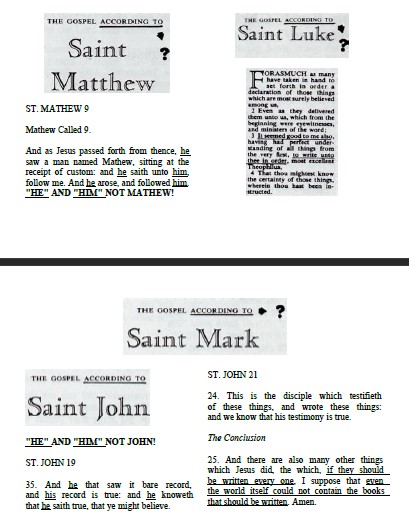
Qu'en est-il du prétendu Nouveau Testament ? 1 1 Pourquoi chaque Évangile commence-t-il par l'introduction — SELON ... SELON ... (Voir ci-dessous). Pourquoi « selon » ? Parce qu'aucune des quatre mille copies vantées qui subsistent ne porte l'autographe de son auteur ! D'où la supposition « selon » ! Même les preuves internes prouvent que Matthew n'était pas l'auteur du premier Évangile qui porte son nom.
What about the so-called New Testament? 1 1 Why does every Gospel begin with the introduction — ACCORDING TO ... ACCORDING TO ... (See below). Why "according to?" Because not a single one of the vaunted four thousand copies extant carries its author's autograph! Hence the supposition "according to!" Even the internal evidence proves that Matthew was not the author of the first Gospel which bears his name.
« Et comme Jésus passait de là, IL (JÉSUS) vit un homme nommé Matthew, assis au bureau des douanes : et IL (JÉSUS) lui dit : Suis-MOI (JÉSUS). Et LUI (MATTHEW) se leva, et le suivit (JÉSUS). » (Matthew 9:9)
"And as Jesus passed forth thence, HE (JESUS) saw a man, named Matthew, sitting at the receipt of custom: and HE (JESUS) saith unto HIM (MATTHEW), follow ME (JESUS) And HE (MATTHEW) arose, and followed HIM (JESUS)." (Matthew 9:9)
1. Le « soi-disant », car nulle part le « Nouveau Testament » ne s'appelle lui-même le Nouveau Testament, et nulle part l'Ancien Testament ne s'appelle lui-même l'Ancien Testament. De plus, le mot « Bible » est inconnu au sein même des pages de la Bible. Dieu a oublié de donner un titre à « SES » livres ! Sans aucun effort d'imagination, on peut voir que les « Il » et les « Lui » du récit ci-dessus ne se réfèrent pas à Jésus ou à Matthew comme étant son auteur, mais à une troisième personne écrivant ce qu'elle a vu et entendu — un récit de ouï-dire. Si nous ne pouvons même pas attribuer ce « livre de rêves » (comme le premier Évangile est également décrit) au disciple Matthew, comment pouvons-nous l'accepter comme la Parole de Dieu ?
1. The "so-called," because nowhere does the "New Testament" calls itself the New Testament, and nowhere the Old Testament calls itself the Old Testament. And also the word "Bible" is unknown within the pages of the Bible. God forgot to give a title to "HIS" books! Without any stretch of the imagination, one can see that the "He's" and the "Him's" of the above narration do not refer to Jesus or Matthew as its author, but some third person writing what he saw and heard — a hearsay account. If we cannot even attribute this "book of dreams" (as the first Gospel is also described) to the disciple Matthew, how can we accept it as the Word of God?
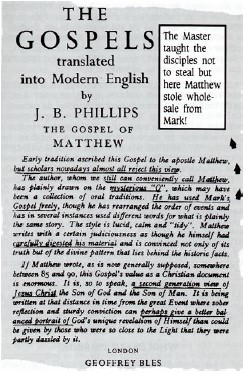
Nous ne sommes pas seuls dans cette découverte selon laquelle Matthieu n'a pas écrit l'« Évangile selon saint Matthieu » et qu'il a été écrit par une main anonyme. J. B. Phillips concorde avec nos conclusions. Il est le serviteur rémunéré de l'Église anglicane, un prébendier de la cathédrale de Chichester, en Angleterre. Il n'aurait aucune raison de mentir ou de trahir au détriment de la vue officielle de son Église ! Reportez-vous à son introduction à l'« Évangile de saint Matthieu » (reproduite ci-dessous). Phillips dit ceci à propos de son auteur.
We are not alone in this discovery that Matthew did not write the "Gospel according to St. Matthew" and that it was written by some anonymous hand. J. B. Phillips concurs with us in our findings. He is the paid servant of the Anglican Church, a prebendary of the Chichester Cathedral, England. He would have no reason to lie or betray to the detriment of the official view of his Church! Refer to his introduction to the "Gospel of St. Matthew" (reproduced here below). Phillips has this to say about its authorship.
« LA TRADITION ANCIENNE ATTRIBUAIT CE ÉVANGILE À L'APÔTRE MATTHIEU, MAIS LES ERUDITS D'AUJOURD'HUI REJETENT PRESQUE TOUS CETTE OPINION. » En d'autres termes, Saint Matthieu n'a pas écrit l'Évangile qui porte son nom. C'est la conclusion d'érudits chrétiens de la plus haute éminence — et non d'Hindous, de Musulmans ou de Juifs qui pourraient être accusés de partialité. Laissons notre ami anglican poursuivre : « L'AUTEUR, QUE NOUS POUVONS ENCORE APPELER CONVENABLEMENT MATTHIEU » « Convenablement » parce que, autrement, chaque fois que nous ferions référence à « Matthieu », nous devrions dire — « LE PREMIER LIVRE DU NOUVEAU TESTAMENT » Chapitre tant et tant, verset tant et tant. Et encore et encore « Le premier livre... » etc. Par conséquent, selon J. B. Phillips, il est pratique que nous donnions un nom au livre. Alors pourquoi pas « Matthieu » ? Supposons que ce soit un nom aussi bon qu'un autre ! Phillips continue : « L'AUTEUR S'EST CLAIREMENT APPUYÉ SUR LE MYSTÉRIEUX 'Q' QUI POURAIT ÊTRE UNE COLLECTION DE TRADITIONS ORALES. » Qu'est-ce que ce « mystérieux 'Q' » ? « Q » est l'abréviation du mot allemand « quella » qui signifie « sources ». On suppose qu'il existe un autre document — une source commune — auquel nos Matthieu, Marc et Luc actuels avaient accès. Ces trois auteurs, qui qu'ils fussent, avaient un regard commun sur le matériel disponible. Ils écrivaient comme s'ils regardaient à travers « un seul » œil. Et parce qu'ils étaient d'accord sur toute la ligne, les trois premiers « Évangiles » sont devenus connus sous le nom d'Évangiles synoptiques.
"EARLY TRADITION ASCRIBED THIS GOSPEL TO THE APOSTLE MATTHEW, BUT SCHOLARS NOWADAYS ALMOST ALL REJECT THIS VIEW." In other words, St. Matthew did not write the Gospel which bears his name. This is the finding of Christian scholars of the highest eminence — not of Hindus, Muslims and Jews who may be accused of bias. Let our Anglican friend continue: "THE AUTHOR, WHOM WE STILL CAN CONVENIENTLY CALL MATTHEW" "Conveniently" because otherwise everytime we made a reference to "Matthew" we would have to say — "THE FIRST BOOK OF THE NEW TESTAMENT" Chapter so and so, verse so and so. And again and again "The first book . . ." etc. Therefore, according to J. B. Phillips it is convenient that we give the book some name. So why not "Matthew?" Suppose its as good a name as any other! Phillips continues: "THE AUTHOR HAS PLAINLY DRAWN ON THE MYSTERIOUS 'Q' WHICH MAY HAVE BEEN A COLLECTION OF ORAL TRADITIONS." What is this "mysterious 'Q'?" "Q" is short for the German word "quella" which means "sources." There is supposed to be another document — a common source — to which our present Matthew, Mark and Luke had access. All these three authors, whoever they were, had a common eye on the material at hand. They were writing as if looking through "one" eye. And because they saw eye to eye, the first three "Gospels" came to be known as the Synoptic Gospels.
Calage en gros
Wholesale Cribbing
Mais qu'en est-il de cette affaire d'« inspiration » ? Le prébendier anglican a mis le doigt sur le problème. Il est, plus que quiconque, en droit de le faire. Serviteur rémunéré de l'Église, chrétien évangélique orthodoxe, érudit de la Bible de renom, ayant un accès direct aux manuscrits grecs « originaux », LAISSONS-LE nous expliquer cela. (Remarquez avec quelle douceur il révèle la vérité) : « IL (Matthieu) A UTILISÉ LIBREMENT L'ÉVANGILE DE MARC », ce qui, dans le langage d'un instituteur, signifie — « a copié massivement Marc ! » Pourtant, les chrétiens appellent ce plagiat massif la Parole de Dieu ?
But what about that "inspiration" business? The Anglican prebendary has hit the nail on the head. He is, more than anyone else, entitled to do so. A paid servant of the Church, an orthodox evangelical Christian, a Bible scholar of repute, having direct access to the "original" Greek manuscripts, let HIM spell it out for us. (Notice how gently he lets the cat out of the bag): "HE (Matthew) HAS USED MARK'S GOSPEL FREELY" which in the language of the school-teacher — "has been copying WHOLESALE from Mark!" Yet the Christians call this wholesale plagiarism the Word of God?
Cela ne vous fait-il pas vous demander pourquoi un témoin oculaire et auditif du ministère de Jésus, ce que le disciple Matthew était censé être, au lieu d'écrire ses propres impressions directes du ministère de « son Seigneur », irait voler les écrits d'un jeune homme (Mark), qui était un garçon de dix ans lorsque Jésus a réprimandé sa nation ? Pourquoi un témoin oculaire et auditif copierait-il un individu qui, lui-même, écrivait d'après ouï-dire ? Le disciple Matthew ne ferait pas une chose aussi stupide. Car un document anonyme a été imposé au beau nom de Matthew.
Does it not make you wonder that an eye-witness and an ear-witness to the ministry of Jesus, which the disciple Matthew was supposed to be, instead of writing his own first hand impressions of the ministry of "his Lord" would go and steal from the writings of a youth (Mark), who was a ten year old lad when Jesus upbraided his nation? Why would an eye-witness and ear-witness copy from a fellow who himself was writing from hearsay? The disciple Matthew would not do any such silly thing. For an anonymous document has been imposed on the fair name of Matthew.
Plagiat ou enlèvement littéraire
Plagiarism Or Literary Kidnapping
Le plagiat signifie le vol littéraire. Le fait que quelqu'un copie mot pour mot l'écriture d'un autre et la fasse passer pour la sienne est ce que l'on appelle le plagiat. C'est un trait commun parmi les quelque 40 auteurs anonymes des livres de la Bible. Les Chrétiens se vantent d'un prétendu fil conducteur commun entre les auteurs des 66 livrets protestants et les auteurs des 73 livrets catholiques romains appelés la « Sainte Bible ». Il y a certes un fil conducteur commun, car Matthieu et Luc, ou peu importe qui ils étaient, avaient plagié 85 % mot pour mot à partir de Marc ! Dieu Tout-Puissant n'a pas dicté les mêmes formulations aux synoptiques (à œil unique). Les Chrétiens eux-mêmes l'admettent, car ils ne croient pas en une inspiration verbale, contrairement aux Musulmans à propos du Saint Coran. 1 1
Plagiarism means literary theft. Someone copies ad verbatim (word for word) from another's writing and palms it off as his own, is known as plagiarism. This is a common trait amongst the 40 or so anonymous authors of the books of the Bible. The Christians boast about a supposedly common cord amongst the writers of the 66 Protestant booklets and the writers of the 73 Roman Catholic booklets called the "Holy Bible." Some common cord there is, for Matthew and Luke, or whoever they were, had plagiarised 85% word for word from Mark! God Almighty did not dictate the same wordings to the synoptists (one-eyed). The Christians themselves admit this, because they do not believe in a verbal inspiration, as the Muslims do about the Holy Qur’ân. 1 1
Ce plagiat à 85 % de Matthew et Luke ne représente rien comparé au kidnapping littéraire des auteurs de l'Ancien Testament, où un vol de cent pour cent se produit dans ce que l'on appelle le Book of God. Des érudits chrétiens de la trempe de Bishop Kenneth Cragg appellent par euphémisme ce vol une « reproduction »2 et en tirent une fierté.
This 85% plagiarism of Matthew and Luke pales into insignificance compared to the literary kidnapping of the authors of the Old Testament where a hundred percent stealing occurs in the so-called Book of God. Christian scholars of the calibre of Bishop Kenneth Cragg euphemistically calls this stealing, "reproduction"2 and take pride in it.
1. Voir « AL-QURAN — The Miracles of Miracles » (prochainement)
1. See "AL-QURAN — The Miracles of Miracles" (coming soon)
2. Voir le début du premier chapitre pour la citation complète.
2. See beginning of chapter one for the full quotation.
Normes perverties
Perverted Standards
Le Dr Scroggie (mentionné précédemment) cite avec le plus grand enthousiasme, dans son livre1, un certain Dr Joseph Parker pour son éloge unique de la Bible :
Dr. Scroggie (referred to earlier on) most enthusiastically quotes in his book Scroggie (referred to earlier on) most enthusiastically quotes in his book1 a Dr. Joseph Parker for his unique eulogy of the Bible:
« QUEL LIVRE EST LA BIBLE EN MATIÈRE DE VARIÉTÉ DE CONTENUS ! . . . DES PAGES ENTIÈRES SONT OCCUPÉES PAR DES NOMS OBSCURS, ET L'ON EN DIT PLUS SUR UNE GÉNÉALOGIE QUE SUR LE JOUR DU JUGEMENT. LES HISTOIRES SONT RACONTÉES À DEMI, ET LA NUIT TOMBE AVANT QUE NOUS PUISSIONS DIRE OÙ SE TROUVAIT LA VICTOIRE. OÙ Y A-T-IL QUELQUE CHOSE » (dans la littérature religieuse du monde) « POUR CORRESPONDRE À CELA ? » Un magnifique collier de mots et de phrases, sans aucun doute ! C'est beaucoup de bruit pour rien, et un blasphème pur et simple contre Dieu Tout-Puissant pour avoir autorisé un tel méli-mélo embarrassant. Pourtant, les chrétiens se réjouissent des défauts mêmes de leur livre, comme Roméo se réjouissant du « grain de beauté » sur la lèvre de Juliette ! 1. « La Bible est-elle la Parole de Dieu ? » par la Moody Press. par la Moody Press.
"WHAT A BOOK IS THE BIBLE IN THE MATTER OF VARIETY OF CONTENTS! . . . WHOLE PAGES ARE TAKEN UP WITH OBSCURE NAMES, AND MORE IS TOLD OF A GENEALOGY THAN OF THE DAY OF JUDGMENT. STORIES ARE HALF TOLD, AND THE NIGHT FALLS BEFORE WE CAN TELL WHERE VICTORY LAY. WHERE IS THERE ANYTHING" (in the Religious Literature of the world) "TO CORRESPOND WITH THIS?" A beautiful necklace of words and phrases undoubtedly! It is much ado about nothing, and rank blasphemy against God Almighty for authorising such an embarrassing hotch potch. Yet the Christians gloat over the very defects of their book, like Romeo over the "mole" on Juliet's lip! 1. "Is the Bible the Word of God?" by the Moody Press. by the Moody Press.
Rien de moins que 100 %
Nothing Less Than 100%
Pour démontrer le degré de plagiat pratiqué par les écrivains « inspirés » de la Bible, j'ai demandé à mon auditoire, lors d'un symposium à l'University of Cape Town organisé entre moi-même et le Professor Cumpsty, Chef du Département de Théologie, sur le sujet « La Bible est-elle la Parole de Dieu ? », d'ouvrir leurs Bibles.
To demonstrate the degree of plagiarism practised by the "inspired" Bible writers, I asked my audience during a symposium at the University of Cape Town conducted between myself and Professor Cumpsty the Head of the Department of Theology on the subject "Is the Bible God's Word?" to open their Bibles.
Certains chrétiens aiment beaucoup porter leurs Bibles sous le bras lorsque des discussions ou des débats religieux ont lieu. Ils semblent être totalement démunis sans ce livre. Sur ma suggestion, un certain nombre de personnes dans l'auditoire ont commencé à feuilleter les pages. Je leur ai demandé d'ouvrir le chapitre 37 dans le « Book of Isaiah ». Lorsque l'auditoire fut prêt, je leur ai demandé de comparer mon « Isaiah 37 » avec leur « Isaiah 37 » pendant que je lisais, afin de voir s'ils étaient identiques. Je commençai, en lisant très lentement. Les versets 1, 2, 4, 10, 15, et ainsi de suite jusqu'à la fin du chapitre. Je ne cessais de demander après chaque verset si ce que j'avais lu était identique aux versets de leurs Bibles. Encore et encore, ils répondaient en chœur — « Oui ! », « Oui ! ». À la fin du chapitre, la Bible toujours ouverte dans mes mains à l'endroit où je lisais, j'ai fait en sorte que le Président révèle à l'auditoire que je ne lisais pas du tout dans Isaiah 37, mais dans 2 KINGS 19 ! Il y eut une terrible consternation dans l'auditoire ! J'avais ainsi établi un plagiat à 100 % dans la « Holy Bible ». (Voir ci-dessous)
Some Christians are very fond of carrying their Bibles under their arms when religious discussions or debates take place. They seem to be utterly helpless without this book. At my suggestion a number of the audience began ruffling the pages. I asked them to open chapter 37 in the "Book of Isaiah." When the audience was ready, I asked them to compare my "Isaiah 37" with their "Isaiah 37" while I read, to see whether they were identical. I began, readingly slowly. Verses 1, 2, 4,10, 15, and so on, until the end of the chapter. I kept on asking after every verse if what I had been reading, was identical with the verses in their Bibles. Again and again they chorused — "Yeh!", "Yeh!". At the end of the chapter with the Bible still open in my hands at the place from which I had been reading, I made the Chairman to reveal to the audience that I was not reading from Isaiah 37 at all but from 2 KINGS 19! There was a terrible consternation in the audience! I had thus established 100% plagiarism in the "Holy Bible." (See below)
En d'autres termes, Ésaïe 37 et 2 Rois 19 sont identiques mot pour mot. Pourtant, ils ont été attribués à deux auteurs différents, à des siècles d'intervalle, que les chrétiens prétendent avoir été inspirés par Dieu.
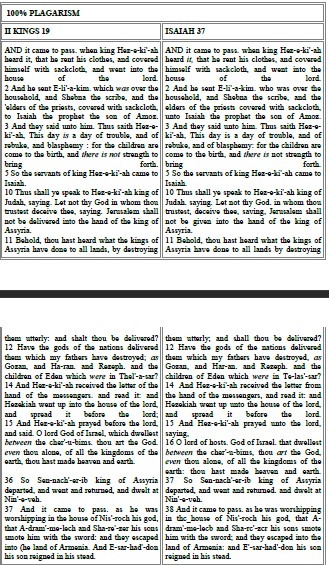
Ces versets sont tirés de l'Authorized Version, mais vous retrouverez les mêmes dans chaque version.
These verses are culled from the Authorised Version, but you will find the same in every Version.
Pas d'inspiration verbale
No Verbal Inspiration
(Pour une liste complète de tous les livres de la Bible et de leurs auteurs, utilisez la version « Collins' » R.S.V. avec ses annotations). Que disent les érudits chrétiens à propos du « Livre d'Isaïe » ? Ils disent : « PRINCIPALEMENT ATTRIBUÉ À ISAÏE. CERTAINES PARTIES ONT PU ÊTRE ÉCRITES PAR D'AUTRES ». Au vu des confessions des spécialistes de la Bible, nous ne demanderons pas de comptes au pauvre Isaïe. Pouvons-nous alors clouer ce plagiat sur la porte de Dieu ? Quelle blasphème ! Le professeur Cumptsy a confirmé lors de la séance de questions-réponses, à la fin du symposium susmentionné, que « les chrétiens ne croient pas en une inspiration verbale de la Bible ». Ainsi, Dieu Tout-Puissant n'avait pas dicté distraitement le même récit deux fois ! Des mains humaines, bien trop humaines, avaient semé le chaos dans cette soi-disant Parole de Dieu — la Bible. Pourtant, les « Bible-thumpers » insisteront pour dire que « chaque mot, chaque virgule et chaque point de la Bible est la Parole de Dieu ! »
(For a complete list of all the books of the Bible and their authors, avail yourself of the "Collins'" R.S.V. 'with' its annotations). What have Christian scholars to say about the "Book of Isaiah?" They say: "MAINLY CREDITED TO ISAIAH. PARTS MAY HAVE BEEN WRITTEN BY OTHERS" In view of the confessions of Bible scholars, we will not take poor Isaiah to task. Can we then nail this plagiarism on the door of God? What blasphemy! Professor Cumptsy confirmed at question time, at the end of the aforementioned symposium that the "Christians do not believe in a verbal inspiration of the Bible" So God Almighty had not absent-mindedly dictated the same tale twice! Human hands, all too human, had played havoc with this so-called Word of God — the Bible. Yet, Bible-thumpers will insist that "every word, comma and full stop of the Bible is God's Word!"