Ressurgimento Falso da Turquia
Turkeys Phoney Resurgence
Vários analistas descreveram o recente protagonismo da Turquia como um novo ressurgimento, com a nação desempenhando um papel de liderança em diversas questões internacionais. Com a 15ª maior economia do mundo, a localização geográfica da Turquia transformou o país em um centro energético entre o Oriente e o Ocidente. Alguns chegaram a usar o termo TRIC, em vez de BRIC, que foi originalmente cunhado pelo Goldman Sachs em um relatório de 2005 ao descrever as novas nações emergentes. Diversos especialistas agora descrevem a ascensão da Turquia como neo-otomanismo.
A number of analysts have described Turkey’s recent assertiveness as a new resurgence with the nation playing a leading role in a number of international issues. With the 15th largest economy in the world, Turkey’s geographical location has turned the country into a energy hub between the East and the West. Some have even used the term TRIC, rather than BRIC, which was originally coined by Goldman Sachs in a 2005 report when describing the new upcoming nations. Various experts are now describing Turkey's ascendency as neo-Ottomanism.
Stratfor disse:
Stratfor said:
"A Turquia, assim como a Rússia, também está em um caminho ascendente. Ancara está redescobrindo sua influência da era otomana depois de passar as últimas décadas como um eremita geopolítico. Sua influência se espalha pelo mundo islâmico, para o Oriente Médio, a Ásia Central e o Sul da Ásia, bem como pela Eurásia, no Cáucaso e nos Bálcãs. O que temos é uma estratégia turca cuidadosa, que envolve sondar as várias regiões ao seu redor, tentando aproveitar potenciais oportunidades. Onde os turcos encontram resistência, eles recuam. Em lugares onde encontram pouca ou nenhuma resistência, eles avançam. Esses movimentos muito preliminares e exploratórios definirão as tentativas turcas de renascimento geopolítico por algum tempo."19
“Turkey, like Russia, is also on an ascendant path. Ankara is rediscovering its Ottoman-era influence after spending the past several decades as a geopolitical hermit. Its influence spreads across the Islamic world to the Middle East, Central Asia and South Asia as well as through Eurasia in the Caucasus and the Balkans. What we have is a careful Turkish strategy that involves probing into its various surrounding regions, attempting to take advantage of potential opportunities. Where the Turks find resistance, they retreat. In places where they encounter little or no resistance, they advance. These very preliminary and exploratory moves will define Turkish attempts at geopolitical revival for some time to come.”19
John Feffer, codiretor do Foreign Policy In Focus, disse:
John Feffer, co-director of Foreign Policy In focus said:
“A Turquia rapidamente se torna uma candidata provável a superpotência futura. Ela possui a 17ª maior economia do mundo e, segundo a Goldman Sachs, tem boas chances de entrar no top 10 até 2050. Seu poderio econômico também é bem protegido: após décadas de assistência da Organização do Tratado do Atlântico Norte (OTAN), o exército turco é hoje uma potência regional. Talvez o mais importante seja que a Turquia ocupa uma encruzilhada vital entre a Europa, o Oriente Médio e a Ásia Central. Uma democracia predominantemente muçulmana erguida sobre as ruínas de Bizâncio, ela faz a ponte entre as tradições islâmica e judaico-cristã, ao mesmo tempo em que se situa no centro da política energética. Outrora, todas as estradas levavam a Roma; hoje, todos os oleodutos parecem levar à Turquia. Se o status de superpotência seguisse as regras do mercado imobiliário - localização, localização, localização -, a Turquia já estaria perto do topo da lista.”20
“Turkey promptly becomes a likely candidate for future superpower. It possesses the 17th top economy in the world and, according to Goldman Sachs, has a good shot at breaking into the top 10 by 2050. Its economic muscle is also well defended: after decades of assistance from the North Atlantic Treaty Organization (NATO), the Turkish military is now a regional powerhouse. Perhaps most importantly, Turkey occupies a vital crossroads between Europe, the Middle East and Central Asia. A predominantly Muslim democracy atop the ruins of Byzantium, it bridges the Islamic and Judeo-Christian traditions, even as it sits perched at the nexus of energy politics. All roads once led to Rome; today all pipelines seem to lead to Turkey. If superpower status followed the rules of real estate - location, location, location - then Turkey would already be near the top of the heap.”20
Poder Mundial
World Power
Em 1453, os otomanos concluíram a conquista de Constantinopla, a capital bizantina. Isso pôs fim a todos os resquícios do domínio romano, que havia sido a superpotência mundial por quase quatro séculos. Os otomanos eram um dos muitos grupos de cavaleiros turcomanos que começaram a entrar nas terras islâmicas em consequência das invasões mongóis do século XIII. Esses guerreiros turcomanos, que já haviam se convertido ao Islã, foram enviados para as fronteiras do estado pelos seljúcidas, que eram eles próprios de origem turca. Possuíam excelentes habilidades de combate e grande zelo, que os seljúcidas desejavam que fossem empregados ao longo da fronteira com os bizantinos. A casa de Osman revelou-se uma das mais bem-sucedidas dessas tribos: tomou muitas cidades e vilarejos do controle dos bizantinos, depois unificou os demais ghazis sob o seu estandarte e trouxe as terras ao redor de Constantinopla para o domínio do Islã, culminando na captura da capital do Império Bizantino, Constantinopla, em 1453.
In 1453 the Ottoman’s concluded the conquest of Constantinople, the Byzantine capital. This brought to an end all remnants of Roman rule, who had been the world’s superpower for nearly four centuries. The Ottoman’s were one of the many bands of Turkmen horsemen who began to come into the Islamic lands as a result of the Mongol invasions in the 13th century. These Turkmen warriors, who had converted to Islam, were sent to the frontiers of the state by the Seljuks, who themselves were of Turkish origin. They had excellent fighting skills and zeal, which the Seljuks wanted them to apply along the frontier with the Byzantines. The house of Uthman proved to be one of the most successful of these bands, taking many towns and villages from the control of the Byzantines, they then unified the other ghazis, under their banner, brought the lands surrounding Constantinople under Islam, culminating in the capture of Byzantine Empire capital - Constantinople in 1453.
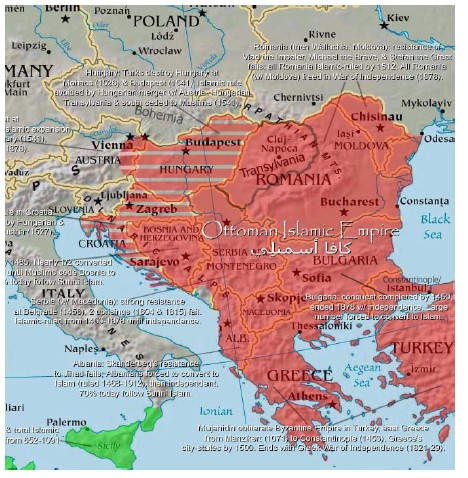
Os otomanos varreram os Bálcãs e a Europa Oriental de forma espetacular. A importante cidade de Tessalônica (Macedônia) foi conquistada dos venezianos em 1387. Em 1389, os reis da Áustria, da Bulgária, da Bósnia e da Hungria atacaram os otomanos, mas o Sultão Murad I os esmagou em Kosovo, o que chocou a Europa. Em 1396, toda a Europa, incluindo os exércitos franceses e alemães, lutou contra o Sultão Bayazid Yaldram em Nicópolis, mas foi completamente derrotada, e 20 governantes e dignitários foram levados à corte do Khaleefah como cativos. O Sultão Bayazid havia anexado todo o território da Bósnia até o Danúbio. Ele também conquistou a Grécia (Atenas) em 1398.
The Ottoman’s swept through the Balkans and Eastern Europe in spectacular fashion. The important city of Thessaloniki (Macedonia) was captured from the Venetians in 1387. In 1389, the kings of Austria, Bulgaria, Bosnia and Hungary attacked the Ottoman’s but Sultan Murad I crushed them at Kosovo, which shocked Europe. In 1396, the whole of Europe including French and German armies fought against Sultan Bayazid Yaldram at Nicopolis but were comprehensively defeated and 20 rulers and dignitaries were brought to the Khaleefah’s court as the captives. Sultan Bayazid had annexed all the territory from Bosnia to Danube. He had also conquered Greece (Athens) in 1398.
Antes do fim do reinado de Suleiman al-Qanooni em 1566, ele havia expandido as fronteiras islâmicas bem para dentro da Europa Oriental, trazendo Belgrado, capital da Sérvia, para o domínio do Islã, bem como recuperando a ilha grega de Rodes. Ele derrotou Luís II da Hungria e da Boêmia e colocou a maior parte da Hungria sob autoridade islâmica. Em 1578, a Geórgia e o que hoje é a Romênia estavam sob o Islã. Antes do início do século XVII, os otomanos haviam colocado sob autoridade islâmica o sul da Itália, a Hungria, a Áustria, a Romênia, a Macedônia, a Bulgária, a Albânia, Malta, Chipre, a Croácia, a Ucrânia, as Ilhas Canárias, partes da Islândia e a maior ilha das águas de Bristol, na Inglaterra, Reino Unido: Lundy.
Before Suleiman al Qanooni's reign came to an end in 1566 he had expanded the Islamic frontiers well into Eastern Europe bringing Belgrade the capital of Serbia under Islam as well as regaining the Greek island of Rhodes. He had defeated Louis II of Hungary and Bohemia and brought most of Hungary under Islamic authority. By 1578 Georgia and what is today Romania was under Islam. Before the beginning of the 17th century the Ottoman’s had brought Southern Italy, Hungary, Austria, Romania, Macedonia, Bulgaria, Albania, Malta, Cyprus, Croatia, Ukraine, the Canary Islands, parts of Iceland and the largest island of the Bristol waters in England, UK - Lundy under Islamic authority.
Tal era a ameaça percebida do Califado Otomano sob o reinado de Suleiman al Qanooni que o embaixador Busbecq, do monarca austríaco Ferdinand I, alertou para a iminente conquista da Europa: "De [dos turcos] lado estão os recursos de um poderoso império, força intacta, habituação à vitória, resistência ao esforço, unidade, disciplina, frugalidade e vigilância... Podemos duvidar do que será o resultado?... Quando os turcos tiverem acertado contas com a Pérsia, eles nos atacarão apoiados pelo poderio de todo o Oriente; o quão despreparados estamos, não ouso dizer."21
Partido da Justiça e do Desenvolvimento (AKP)
Justice and Development Party (AKP)
Desde que Abdullah Gul e Recep Tayyip Erdogan deixaram o partido Virtude e fundaram o Partido da Justiça e do Desenvolvimento, sob a liderança de Erdogan, ambos passaram a consolidar laços com a América, a fim de remover a influência da Grã-Bretanha e de suas ligações com o Exército. Embora muitas reformas tenham sido introduzidas para quebrar o domínio do exército sobre o poder, o eixo central da estratégia do AKP foi o "Documento de Visão Compartilhada", assinado entre os governos turco e americano por Abdullah Gul e Condoleezza Rice em 5 de julho de 2006. O encontro confirmou: "O documento de visão estratégica confirma o consenso turco-americano de transformar nossa visão compartilhada em esforços comuns por meio de cooperação efetiva e diálogo estruturado."22 O AKP e os EUA concordaram, entre uma série de questões, em:
Ever since Abdullah Gul and Recep Tayyip Erdogan left the Virtue party and formed the Justice and Development Party under the leadership of Erdogan, they both began cementing ties with America in order to remove the influence of Britain and its ties with the Army. Whilst many reforms have been introduced to break the armies hold on power the centrepiece of the AKP’s strategy was the ‘Shared Vision Document’ signed between the Turkish and American government by Abdulla Gul and Condoleezza Rice on 5th July 2006. The meeting confirmed: "The strategic vision document confirms Turkish-US consensus to translate our shared vision into common efforts through effective cooperation and structured dialogue."22 The AKP and the US agreed to amongst a number of issues:
1. Apoiar os esforços internacionais em direção a um acordo permanente para o conflito árabe-israelense, incluindo os esforços internacionais para resolver o conflito israelo-palestino com base em uma solução de dois Estados.
1.Supporting international efforts towards a permanent settlement of the Arab-Israeli conflict, including international efforts to resolve the Israeli-Palestinian conflict on the basis of a two-state solution.
2. Apoiar os esforços diplomáticos sobre o programa nuclear do Irã, incluindo a recente iniciativa do P5+1. Contribuir para a estabilidade, a democracia e a prosperidade na região do Mar Negro, no Cáucaso, na Ásia Central e no Afeganistão.
2.Supporting diplomatic efforts on Iran's nuclear program, including the recent P5+1 initiative Contributing to stability, democracy and prosperity in the Black Sea region, the Caucasus, Central Asia and Afghanistan.
3. Aumentar a segurança energética por meio da diversificação de rotas e fontes, inclusive da bacia do Cáspio.
3.Enhancing energy security through diversification of routes and sources, including from the Caspian basin.
Caucuses
Caucuses
A Turquia, sob o Califado Otomano, travou e perdeu várias guerras nos séculos XVIII e XIX, o que levou os otomanos a ceder território à Rússia. O colapso do Califado Otomano em 1924 deu origem a uma série de incidentes com a Armênia, que passaram a ser conhecidos como o massacre armênio. Isso definiu as relações hostis entre as nações do Cáucaso e a Turquia. Hoje, tanto a Rússia quanto a Turquia trabalham para ganhar uma posição firme na região.
Turkey under the Uthmani Khilafah fought and lost a number of wars in the 18th and 19th centuries which led to the Ottoman’s to cede territory to Russia. The collapse of the Ottoman Khilafah in 1924 led to a number of incidents with Armenia - which have come to be known as the Armenian massacre. This defined the hostile relations between the Caucasian nations and Turkey. Today both Russia and Turkey are working to gain a foothold in the region.
A Turquia está atualmente no meio de um longo processo para normalizar as relações com a Armênia. A normalização das relações inclui a abertura da fronteira comum. As negociações passaram por uma série de cúpulas e discussões, que resultaram em protocolos assinados por ambas as nações. Contudo, os protocolos continuam paralisados nos parlamentos turco e armênio devido à resistência, em ambos os países, de determinados setores. O desfecho dessas negociações está intrinsecamente ligado ao Azerbaijão, que deseja que o território de Nagorno-Karabakh seja resolvido em qualquer acordo entre a Armênia e a Turquia.
Turkey is currently in the middle of a lengthy process to normalise relations with Armenia. Normalising ties includes the opening of the shared border. The talks have gone through a number of summits and discussions, which has produced protocols both nations have signed. The protocols however remain stuck in both Turkish and Armenian parliaments due to the resistance in both nations by certain elements. The outcome of such negotiations is intrinsically linked to Azerbaijan who wants the Nagorno-Karabakh territory to be resolved under any agreement between Armenia and Turkey.
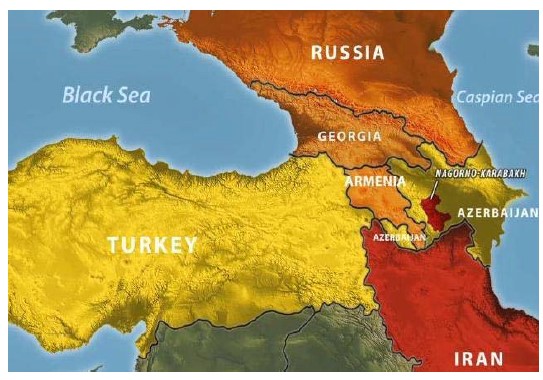
O território de Nagorno-Karabakh recebeu independência nos últimos dias da União Soviética. É um território que tanto a Armênia quanto o Azerbaijão reivindicam. O território continua a atormentar as relações entre Armênia e Azerbaijão, pois ambos já entraram em guerra em várias ocasiões por causa dele. Atualmente, estão em curso negociações entre o Azerbaijão e a Armênia, mediadas pela Rússia. O ressurgimento da Rússia fez com que ela voltasse a expandir-se para o Cáucaso e a trabalhar para colocar suas antigas repúblicas novamente sob a sua influência. O Cáucaso é importante para a Rússia, pois atua como zona-tampão entre a Rússia e outras potências regionais. A influência e o controle russos sobre as nações que compõem o Cáucaso impedem que outras potências ganhem uma posição na região.
The Nagorno-Karabakh territory was given independence in the dying days of the Soviet Union. It is a territory that both Armenia and Azerbaijan lay claim to. The territory continues to plague relations between Armenia and Azerbaijan as both have gone to war on a number of occasions over the territory. Currently negotiations are taking place between Azerbaijan and Armenia mediated by Russia. Russia’s resurgence has meant that it is expanding into the Caucuses again and working to bring its former republics under its influence once again. The Caucuses is important to Russia as it acts as buffer zone between Russia and other regional powers. Russian influence and control over the nations that comprise the Caucuses prevents other powers from gaining a foothold in the region.
O Azerbaijão tem dúvidas sobre a importância que a Turquia atribui às suas reivindicações sobre o território. Isso levou o Azerbaijão a recorrer à mediação da Rússia. A Rússia tem conseguido jogar o Azerbaijão, a Armênia e a Turquia uns contra os outros. Essa estratégia da Rússia também constitui um obstáculo à aparente ascendência da Turquia, pois a impede de ter uma linha direta de fornecimento da energia do Mar Cáspio, o que impede a Europa de acessar esses recursos enquanto tenta contornar sua dependência da energia russa.
Azerbaijan has doubts over the importance Turkey places upon its claims to the territory. This has resulted in Azerbaijan turning to Russia’s mediation. Russia has been able to play Azerbaijan, Armenia and Turkey off each other. This strategy by Russia also places an obstacle in the apparent ascendency of Turkey as it prevents it from a direct supply line to the energy of the Caspian Sea, which prevents Europe from accessing those resources as it attempts to circumnavigate around its dependence on Russia’s energy.
A Turquia tornou-se um seguro estratégico para a Geórgia por meio de seu contato direto com o Governo da Abecásia. Para a Geórgia, o comércio da Turquia com a Abecásia e a Ossétia do Sul ajuda a Abecásia a escapar do domínio total da Rússia.24
Energia
Energy
A localização geográfica da Turquia fez dela um canal para a energia. Situada entre a Europa e a Ásia, a Turquia recebe, por meio dos seus portos, petróleo bruto e gás natural, que são depois refinados e vendidos aos mercados europeus. A Turquia tem defendido regularmente projetos energéticos europeus, como o Nabucco, que contornam a rede russa. Como disse um analista: "O outro corredor mais seguro para a diversificação energética europeia é a Turquia, que já é ponto final de dois grandes oleodutos provenientes do Cáspio. O porto mediterrâneo turco de Ceyhan fornece à Europa petróleo alternativo de que tanto precisa. Mas, embora a Turquia tenha potencial para se tornar um polo energético para a Europa, resta ainda muito trabalho para a UE. A primeira prioridade seria uma ofensiva diplomática para concretizar o gasoduto Nabucco, que ligaria a Turquia à Áustria através da Bulgária, da Roménia e da Hungria. Este projeto proporcionaria outra rota alternativa fundamental para que os recursos do Cáspio cheguem à Europa, começando a atenuar a excessiva dependência da Rússia."25
Turkey's geographic location has turned it into a conduit for energy. Straddling Europe and Asia, Turkey's Ports receive crude oil and natural gas which is then refined and sold to European markets. Turkey has regularly advocated European energy projects, like Nabucco, that circumvent the Russian network. As one analyst put it: "The other more secure corridor for European energy diversification is Turkey - already an end point for two major pipelines from the Caspian. Turkey's Mediterranean port of Ceyhan supplies Europe with much needed alternative oil. But while Turkey has the potential to become an energy hub for Europe, there is much work left for the EU. The first order of business would be a diplomatic offensive to realize the Nabucco gas pipeline from Turkey to Austria through Bulgaria, Romania and Hungary. This project would provide another key alternative route for Caspian resources to reach Europe to begin to ameliorate overdependence on Russia."25
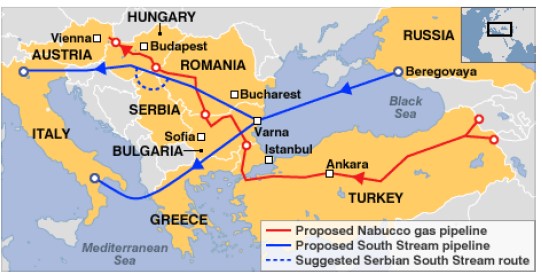
O uso que a Rússia faz de seus recursos energéticos como instrumento de política externa tem feito com que a Ucrânia, a Lituânia e, posteriormente, a Europa sejam mantidas como reféns pela antiga potência mundial. A dependência da Europa, e especialmente da França e da Alemanha, em relação aos hidrocarbonetos energéticos russos foi exposta mais de uma vez, e a Turquia representa atualmente a única alternativa à dependência energética da Rússia.
Russia’s use of its energy resources as a foreign policy tool has seen Ukraine, Lithuania and subsequently Europe being held hostage by the former world power. Europe and especially France and Germany’s dependency on Russia's energy hydrocarbons has been exposed one too many times and Turkey currently represents the only alternative to Russian energy dependency.
Oriente Médio
Middle East
A Turquia não faz parte dos países P5 + 1 que estão tentando elaborar um programa de sanções contra o Irã pelo enriquecimento de urânio. Os Estados Unidos abandonaram todos os acordos e tratados que haviam sido alcançados, o que permitiu que a questão nuclear iraniana chegasse ao nível de escalada em que se encontra. Isso mostra que os Estados Unidos não têm intenção de resolver este conflito e, na verdade, garantiram que nenhuma solução seja alcançada. Os EUA alcançam uma série de seus objetivos na região por meio dessa crise diplomática. A América obteve uma vantagem estratégica ao fornecer segurança aos países árabes do Golfo diante da retórica do Irã; também forçou os israelenses a firmar um pacto de segurança. A proposta de troca de combustível nuclear de Turquia e Brasil, para desescalar a controvérsia nuclear iraniana, ocorreu no mesmo dia em que os EUA apresentavam sanções contra o Irã. As diversas posições da Turquia no Oriente Médio não são diferentes das da América: a Turquia concorda com a solução de dois Estados e participou ativamente das negociações indiretas para dar início ao processo de paz. Da mesma forma, os Estados Unidos precisam de nações nas quais possam confiar para se retirar do Iraque, e a Turquia tem estado mais do que disposta a desempenhar o papel de patrono. Stephen Larrabee, Corporate Chair em Segurança Europeia da RAND Corporation, afirmou sobre o papel da Turquia no Oriente Médio: "O novo ativismo da Turquia é uma resposta às mudanças estruturais em seu ambiente de segurança desde o fim da Guerra Fria. E, se for bem administrado, pode ser uma oportunidade para Washington e seus aliados ocidentais usarem a Turquia como uma ponte para o Oriente Médio."26
Turkey is not part of the P5 + 1 nations who are attempting to construct a sanctions programme against Iran for enriching Uranium. The US has reneged all deals and agreements that have been reached which has allowed the Iran nuclear issue to escalate to the level it has. This shows that the US has no intention of solving this conflict and it has actually ensured no solution is ever reached. The US achieves a number of its aims in the region through this diplomatic crisis. America has gained a strategic advantage by providing security to the Gulf Arab countries in the face of Iran's rhetoric; it has also forced the Israelis into a security pact. Turkey and Brazil’s nuclear fuel swap proposal to de-escalate the Iranian nuclear controversy took place on the same day when the US was tabling sanctions against Iran. Turkey various positions in the Middle East are no different to America’s, Turkey agrees with the two state solution and has actively participated in the indirect talks to kick start the peace process. Similarly America needs nations it can rely on to extricate itself from Iraq and Turkey has been more than happy to play the patron. Stephen Larrabee, Corporate Chair in European Security at the RAND Corporation said regarding Turkey’s role in the Middle East “Turkey's new activism is a response to structural changes in its security environment since the end of the Cold War. And, if managed properly, it could be an opportunity for Washington and its Western allies to use Turkey as a bridge to the Middle East.”26
Ressurgimento Falso
Phoney Resurgence
A assertividade turca é tudo menos independente. Desde o fim da Segunda Guerra Mundial, ao longo da Guerra Fria e das guerras do Golfo, a Turquia tem se alinhado com os Estados Unidos. Atualmente, o Cáucaso é um ponto quente em que uma Rússia ressurgente procura trazer suas antigas repúblicas para a sua influência e criar uma zona-tampão para proteger o interior da Rússia. Na realidade, quer seja de forma independente ou por design, a Turquia não está apenas protegendo os interesses dos Estados Unidos, mas também os interesses europeus. Ao estabelecer relações com as nações da região, a Turquia tenta complicar os interesses russos, que é a estratégia dos Estados Unidos na região.
Turkish assertiveness is anything but independent. Since the end of WW2, throughout the Cold War and Gulf wars Turkey has sided with the US. Currently the Caucuses is a hot spot where a resurgent Russia is looking to bring its former republics under its influence and create a buffer zone to protect the Russia interior. Turkey in reality whether independently or by design is not just protecting US interests but also European interests. By forging relations with the nations of the region Turkey is attempting to complicate Russian interests, which is the US strategy in the region.
Na área da energia, a independência e a capacidade de manobra da Turquia são altamente questionáveis, quando o Ocidente, em muitas ocasiões, a apresentou como alternativa à Rússia. Parece que, na realidade, a Turquia está a proteger os interesses energéticos europeus e, por conseguinte, os interesses dos EUA, garantindo que a influência russa não ganhe qualquer impulso.
In the area of energy Turkish independence and manoeuvring is highly questionable when the West on many occasions has presented Turkey as the alternative to Russia. It appears Turkey is in reality protecting European energy interests and subsequently US interests in ensuring Russian influence doesn’t gain any momentum.
Da mesma forma, a mediação turca entre a Síria e Israel na solução do conflito palestino não é o ressurgimento de uma Turquia que busca moldar a política da região de acordo com seus objetivos. Ela decorre, antes, das tentativas dos Estados Unidos de iniciar negociações indiretas entre Israel e as nações muçulmanas da região para normalizar as relações, após uma década sem progresso no processo de paz e enquanto os EUA tentam se desvencilhar do Iraque e do Afeganistão.
Similarly Turkish mediation between Syria and Israel in solving the Palestinian conflict is not a resurgent Turkey looking to shape the politics of the region according to its aims but rather it comes under US attempts to start indirect talks between Israel and the Muslim nations of the region to normalise relations after a decade of no progress on the peace process and as the US attempts to extricate itself from Iraq and Afghanistan.
Conclusões
Conclusions
A Turquia possui recursos energéticos muito limitados, mas, devido à sua localização estratégica entre a Europa e a Ásia e entre os consumidores e os produtores de petróleo, é atravessada por vários grandes oleodutos e gasodutos. A posição geográfica da Turquia faz dela uma rota natural de trânsito entre as principais áreas produtoras de petróleo no Oriente Médio, na Ásia Central e no Cáucaso, por um lado, e os mercados consumidores na Europa, por outro. Como resultado, a Turquia desenvolveu uma indústria avançada de processamento de minerais e é líder mundial em muitos metais e produtos químicos essenciais. A Turquia também está entre os maiores produtores agrícolas do mundo.
Turkey has very limited energy resources, but because of its strategic location between Europe and Asia and between oil consumers and oil producers, it is crossed by several major oil and gas pipelines. Turkey’s geographical location makes it a natural trans shipment route between the major oil producing areas in the Middle East, Central Asia, and the Caucasus on the one hand, and consumer markets in Europe on the other. As a result Turkey has developed an advanced mineral processing industry and is a world leader in many key metals and chemicals. Turkey is also one of the world’s largest agricultural producers.
Em vez de proteger as necessidades de outras nações, a Turquia está em posição privilegiada para se tornar uma potência mundial por meio da busca de uma política externa independente. A assertividade atual, que muitos analistas descrevem como um "ressurgimento", não poderia estar mais longe da verdade, pois a Turquia está apenas manobrando dentro do espaço que os Estados Unidos lhe permitiram. A mediação turca na questão palestina ocorre quando os EUA decidiram que negociações indiretas sobre o acordo final devem ter lugar. Da mesma forma, a política americana de contenção da Rússia e de empurrar a assertividade russa de volta para o território russo fez com que a Turquia desempenhasse um papel de liderança no Cáucaso, para complicar os objetivos russos. A Turquia foi retribuída pelos EUA quando a Comissão de Relações Exteriores da Câmara aprovou uma resolução condenando a Turquia pelo suposto papel dos otomanos no Genocídio Armênio.
Rather then protecting the needs of other nations, Turkey is in pole position to become a world power through pursuing an independent foreign policy. The current assertiveness many analysts describe as a ‘resurgence,’ could not be further from the truth, this is because Turkey is only manoeuvring within the space the US has permitted it. Turkey's mediation in the Palestinian issue takes place when the US has decided indirect negotiations should take place on the final settlement. Similarly America's policy of containing Russia and pushing Russian assertiveness all the way back into Russian territory has seen Turkey play a leading role in the Caucuses to complicate Russian aims. Turkey's has been repaid by the US by the House Foreign Affairs Committee passing a resolution condemning Turkey for the apparent role of the Ottoman’s in the Armenian Genocide.