1.4 Udugu wa "Mu'akhaah" (mkataba wa undugu) ulifungwa lini, na Sahifah (ya Al-Madinah) iliandikwa lini?
1.4 When was the “Mu’akhaah” (brotherhood pact) concluded and when was the Sahifah (of Al-Madinah) written?
Maandiko ambayo tayari yamewasilishwa yanatosha, na kutokana nayo tunapata hitimisho lifuatalo:
The texts that have already been presented should be sufficient and from them we deduce the following:
1) Maoni sahihi ni kwamba undugu huu kati ya Muhajirina na Answar haukuweza kabisa kufanyika kabla ya kifo cha As'ad bin Zurarah (Allah amridhie), wakati wa ujenzi wa Msikiti, takriban miezi saba baada ya kuwasili kwa Mtume ﷺ. Haiwezekani kwamba ulifanyika wakati wa uhai wake bila yeye kutajwa ndani yake, kwa kuwa alikuwa kiongozi wa Answar na mmoja wa Naqeeb (viongozi waliochaguliwa wa Answar katika kiapo cha pili cha 'Aqabah). Kwa hiyo, kauli ya Abu 'Umar ibn Abd AlBarr:
1) The correct view is that this brotherhood between the Muhajirin and the Ansar could not possibly have taken place prior to the death of As’ad bin Zurarah (May Allah be pleased with him), during the building of the Masjid, about seven months following the arrival of the Prophet (peace be upon him). It is not conceivable that it took place in his lifetime without him having been mentioned in it, as he was chief of the Ansar and one of the Naqeebs (selected leaders of the Ansar at the second pledge of ‘Aqabah). Therefore, the statement of Abu ‘Umar ibn Abd AlBarr:
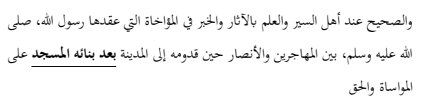
“Maoni sahihi kama yanavyoshikiliwa na wanazuoni wa Siyar na riwaya zinazohusiana na “Mu’akhaah” (udugu) ambao Mtume wa Allah ﷺ aliufanya kati ya Muhajirina (wahamiaji) na Answar (wasaidizi), alipofika Al-Madina, ni kwamba ulifanyika baada ya kujenga Msikiti wake, na ulikuwa juu ya msingi wa kutoa msaada na kuungwa mkono pamoja na Haqq (haki) …”
“The correct view as held by the scholars of Seera and reports in respect to the “Mu’akhaah” (brotherhood) which the Messenger of Allah (peace be upon him) concluded between the Muhajirin (emigrants) and the Ansar (helpers), when he came to Al-Madinah, was that it took place after his building of the Masjid and it was upon the basis of the provision of assistance/support and the Haqq (truth) …” .
Inaonekana inawezekana kabisa, hasa kwa kuwa kukamilika kwa ujenzi wa Msikiti na sherehe ya ufunguzi wake kulikuwa ni fursa nzuri kwa hatua kama hiyo kuchukuliwa. Zaidi ya hayo, lazima ilichukuliwa kabla ya vita vya Badr, kwa sababu Ubaida bin Al-Harith (bin Al-Muttalib bin Abd Manaf bin Qusayy Al-Qurashi Al-Muttalibi) anatajwa humo pamoja na ndugu yake ‘Umair bin Al-Humam (bin Al-Jamuh bin Zaid bin Haram bin Ka’b), na wote wawili waliuawa shahidi katika vita vya Badr, Allah awe radhi nao. Walikuwa ndugu katika uhai na katika kifo, nasi tunamwomba Allah wawe hivyo hivyo pia siku ya Hukumu. 2) Mtazamo sahihi ni kwamba udugu huu kati ya Muhajirina na Answar haukuandikwa kabisa mwanzoni, kwa sababu asili yake haikuendana na hilo. Hii ni kwa sababu simulizi zote, bila ubaguzi, hazitaji hati yoyote iliyoandikwa kabisa. Uchunguzi wa vitabu vya Siyr, historia na Hadith unaonyesha kwamba hakuna kutajwa kwa mkataba wowote, hati iliyoandikwa wala kanuni kabla ya Sahifah ya Madina. Isipokuwa kwa hilo ni pamoja na:
is very conceivable, and particularly as the completion of the building of the Masjid and the celebration for its opening, represented a good occasion for such a step to be undertaken. I addition, it must have been undertaken prior to the battle of Badr because Ubaida bin Al- Harith (bin Al-Muttalib bin Abd Manaf bin Qusayy Al-Qurashi Al-Muttalibi) is mentioned in it along with his brother ‘Umair bin Al- Humam (bin Al-Jamuh bin Zaid bin Haram bin Ka’b) and they were both martyred at the battle of Badr, may Allah be pleased with them. They were brothers in life and at death, and we hope from Allah that they be like that also, on the Day of Judgement. 2) The correct view is that this brotherhood between the Muhajirin and the Ansar was not written in origin as its nature was incompatible with that. That is because all of the narrations, without exception, do not mention a written document at all. An examination of the books of Seera, history and Hadith reveal the absence of the mention of any charter, written document or code prior to the Sahifah of Al-Madinah. The exception to that included:
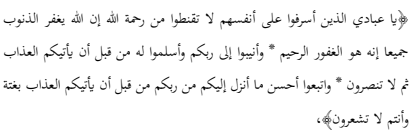
Sema: "Enyi waja Wangu ambao mmejidhulumu nafsi zenu [kwa kufanya madhambi], msikate tamaa na rehema ya Allah. Hakika Allah husamehe madhambi yote. Hakika Yeye ndiye Mwenye kusamehe, Mwenye rehema." Na rejeeni [kwa toba] kwa Mola wenu Mlezi na mjisalimishe Kwake kabla adhabu haijakufikieni; kisha hamtanusuriwa. Na fuateni yaliyo bora kabisa ya yale yaliyoteremshwa kwenu kutoka kwa Mola wenu Mlezi kabla adhabu haijakufikieni ghafla na nyinyi hamtambui." [TMQ 39:53-55]
“Say, “O My servants who have transgressed against themselves [by sinning], do not despair of the mercy of Allah. Indeed, Allah forgives all sins. Indeed, it is He who is the Forgiving, the Merciful”. And return [in repentance] to your Lord and submit to Him before the punishment comes upon you; then you will not be helped. And follow the best of what was revealed to you from your Lord before the punishment comes upon you suddenly while you do not perceive” [TMQ 39:53-55].
b) Majallah ya Luqman: Al-Majallah na vilevile As-Sijli ni Sahifah (hati iliyoandikwa) ambayo hugeuzwa au (kurasa zake) hugeuzwa. Hilo ni kama lilivyotajwa katika “Dala’il An-Nubuwwah” ya Al-Baihaqi (2/419). (Baada ya kutaja mlolongo mzima wa wapokezi) ‘Asim bin ‘Umar bin Qatadah Al-Ansaariy alipokea kutoka kwa Mashaykh (wazee) wa watu wake, kwamba walisema:
b) The Majallah of Luqman: Al-Majallah and likewise As-Sijli are a Sahifah (written document) that is turned or (its pages) turned over. That is like what came mentioned in “Dala’il An-Nubuwwah” of Al- Baihaqi (2/419). (After mentioning the full line of transmission) ‘Asim bin ‘Umar bin Qatadah Al-Ansaariy related from the Shuyukh (elders) of his people, that they said:
"Suwaid bin As-Samit, ndugu wa Bani 'Amr bin 'Awf, alikuja Makkah kwa ajili ya Hija au 'Umrah. Watu wake walimsifu Suwaid kuwa ndiye kielelezo cha ukamilifu miongoni mwao, kutokana na umri wake, ngozi yake na nywele zake. Yeye (msimulizi) alisema:"
“Suwaid bin As-Samit, the brother of Bani ‘Amr bin ‘Awf, came to Makkah as a pilgrim for Hajj of ‘Umrah. Suwaid was described by his people as being the model of perfection among them, due to his age, skin and hair. He (the narrator) said:
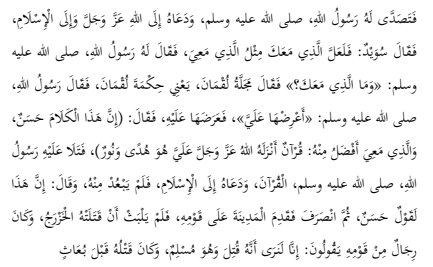
Kisha Mtume wa Allah (ﷺ) alimwendea, akamwalika kwa Allah ‘Azza Wa Jalla na kwenye Uislamu. Suwaid akasema: “Huenda kile ulichonacho ni kama kile nilichonacho.” Basi Mtume wa Allah (ﷺ) akauliza: “Na wewe unacho nini?” Akajibu kwa kusema kwamba alikuwa na Majallah ya Luqman, yaani Hikmah (busara) ya Luqman. Mtume wa Allah (ﷺ) kisha akasema: “Nionyeshe.” Basi akamwonyesha. Akasema (ﷺ): “Maneno haya ni mazuri, lakini kile nilichonacho ni bora kuliko hayo. Ni Qur’ani ambayo Allah ‘Azza Wa Jalla ameiteremsha, na ni mwongozo na nuru.” Kisha Mtume wa Allah (ﷺ) akamsomea Qur’ani na kumwalika kwenye Uislamu. Hakujitenga nayo, akasema: “Hakika hii ni kauli nzuri.” Kisha akaondoka, na baadaye akafika Al-Madinah kwa watu wake. Haikupita muda mrefu baada ya hapo akauawa na Khazraj. Kulikuwa na watu miongoni mwa watu wake waliokuwa wakisema: “Tunaona kwamba aliuawa akiwa Muislamu,” na kuuawa kwake kulitokea kabla ya vita vya Bu’ath. [Mwisho wa nukuu]. c) Hati (Sahifah) ya Mgomo (wa dhulma na wa laana) ambao Quraish waliuning’iniza ndani ya Ka’bah; hadithi yake, hadithi ya mchwa kuula, na kisha hadithi yake maarufu ya Mutawatir kuhusu kubatilishwa kwake. d) Kurasa (Suhuf) ambazo Mtume wa Allah (ﷺ) aliwapa makamanda wa safari za kijeshi, zenye maagizo, na zilikuwa zimefungwa muhuri au zimeunganishwa. Mfano wa hayo ni yale yaliyotajwa katika “Kitab ul-Maghazi” ya Al-Waqidi (1/13):
Then, the Messenger of Allah (peace be upon him) approached him and invited him to Allah ‘Azza Wa Jalla and to Islam. Suwaid said: “It may be that what you have is like that which I have”. So, the Messenger of Allah (peace be upon him) asked: “And what do you have?” He responded by saying that he had the Majallah of Luqman, meaning the Hikmah (wisdom) of Luqman. The Messenger of Allah (peace be upon him) then said: “Show it to me” and so he did. He (peace be upon him) said: “This speech is good but what I have is better than it. It is a Qur’an that Allah ‘Azza Wa Jalla has revealed and it is guidance and light”. The Messenger of Allah (peace be upon him) then recited the Qur’an to him and invited him to Islam. He didn’t distance himself from it and said: “Verily, this is a good speech”. He then left and later arrived to Al-Madinah to his people. It was not long thereafter that he was killed by the Khazraj. There were men from his people who would say: “We view that he was killed whilst he was a Muslim” and his killing occurred before the war of Bu’ath” [End of Quote]. c) The Sahifah (written document) of the (oppressive and accursed) Boycott which the Quraish hung inside the Ka’ba along; its story, the story of the termites eating it and then its well-known Mutawatir story concerning its nullification. d) The pages (Suhuf) which the Messenger of Allah (peace be upon him) gave to the commanders of the military expeditions, containing instructions, and they were sealed or patched together. And example of that is what came stated in Al-Waqidi’s “Kitab ul-Maghazi” (1/13):
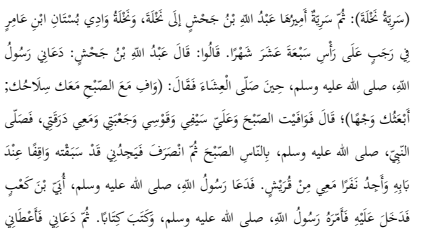
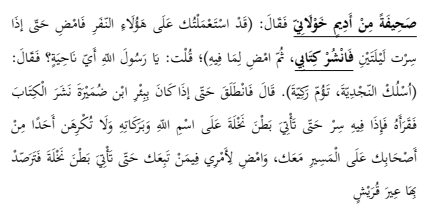
Msafara wa Nakhla ulioongozwa na Abdullah bin Jahsh (Nakhla ni bonde katika Bustan (Shamba la Matunda) la Ibn ‘Amir) ulifanyika katika mwezi wa Rajab, mwezi wa kumi na saba baada ya Hijra.
“The expedition to Nakhla commanded by Abdullah bin Jahsh (Nakhla is a valley in the Bustan (Orchard) of Ibn ‘Amir) took place in the month of Rajab, the seventeenth month AH.
Walisema: Abdullah bin Jahsh alisema: Mjumbe wa Allah ﷺ alimwita wakati aliposwali Ishaa, akasema: "Njoo kwangu alfajiri ukiwa na silaha zako, kwani nitakutuma katika msafara". Alisema: Basi nilikuja alfajiri nikiwa na upanga wangu, upinde wangu, aljaba yangu na ngao yangu. Nabii ﷺ aliswali Subh (yaani Alfajiri) pamoja na watu, kisha akatoka na kunikuta. Alinikuta nimemtangulia tayari nimesimama mlangoni kwake, na nilimkuta kundi la Quraysh (yaani Muhajirun) pamoja nami hapo. Mjumbe wa Allah ﷺ alimwita Ubayy bin Ka'b na kumwamuru aandike hati. Kisha aliniita na kunipa kipande cha ngozi kutoka Khawlan, akisema: "Nimekuweka juu ya kundi hili. Endelea hadi umesafiri kwa usiku mbili. Kisha fungua barua yangu na ufanye kama inavyosema". Nilisema: "Ee Mjumbe wa Mwenyezi Mungu, ni upande gani?" Akajibu: "Elekea Najdiyya hadi ufike kisima kidogo". Msimulizi alisema: Abdullah bin Jahsh alifanya haraka, hadi alipofika kisima cha Ibn Dumayra. Kisha akafungua barua na kuisoma. Ilisema: "Nenda, kwa jina la Allah na kwa baraka zake, hadi ufike bonde la Nakhla, lakini usimlazimishe yeyote kati ya wenzako kwenda nawe. Endelea kufuata amri zangu pamoja na yeyote atakayekufuata, hadi ufike bonde la Nakhla na uwavizie msafara wa Quraysh kutoka hapo". [Mwisho wa nukuu].
They said: Abdullah bin Jahsh said: The Messenger of Allah (peace be upon him) called for me when he prayed Ishaa’, and said: “Come to me at dawn with your weapons, as I will send you on a mission”. He said: So, I approached at dawn with my sword, my bow, my quiver and my shield. The Prophet prayed Subh (i.e. Fajr) with the people, and then he left and found me. He found me having preceded him already standing at his door whilst I found a group of the Quraysh (i.e. Muhajirun) with me there. The Messenger of Allah (peace be upon him) called for Ubayy bin Ka’b and commanded him to write a document. Then he called me and gave me the sheet of leather from Khawlan, saying: “I have appointed you over this group. Proceed until you have travelled for two nights. Then open my letter and do as it says”. I said: “O Messenger of God, in which direction?” He replied, “Go towards Najdiyya until you reach a small well”. The narrator said: Abdullah bin Jahsh hastened, until he reached the well of Ibn Dumayra. He then opened the letter and read it. It said: “Go, in the name of Allah and with His blessings, until you come to the valley of Nakhla, but do not force any one of your companions to go with you. Proceed according to my commands with whoever follows you, until you reach the valley of Nakhla and lie in wait for the caravan of Quraysh from there” [End of Quote].
Muhtasari wa Hitimisho
Summary Conclusion
Popote tunapokuta simulizi kuhusu Sahifah au hati ya maandishi kati ya Muhajirina na Ansar, au inayohusu haki za diyya (fidia ya damu), vita au amani, tunajua kwa lazima kwamba hayahusiani na "Mu'akhaah" hii (kuundwa kwa udugu). Simulizi hizo zingehusiana either na Sahifah ya Al-Madinah au na kitu kilichokuja au kuandikwa baadaye sana kuliko hiyo. Pia hakuna uhalali wowote katika kile kilichosimuliwa katika "As-Seera An-Nabawiyah" cha Ahmad Abu Zaid (uk. 71) chini ya kichwa "Tarehe ya kuandikwa kwa mkataba (Mu'ahadah) na Mayahudi": "Mtafiti mmoja wa kisasa aliona kuwa na nguvu zaidi kwamba hati hiyo kwa asili ilikuwa hati mbili, kisha wanahistoria wakazichanganya kuwa moja. Moja kati yake ilihusu mkataba wa Mtume wa Allah ﷺ na Mayahudi na iliandikwa kabla ya vita kuu ya Badr. Ilhali ya pili ilieleza majukumu (wajibu) wa Waislamu kutoka kwa Muhajirina na Ansar, haki zao na wajibu wao. Alisema: 'Ni yenye nguvu zaidi kwa mtazamo wangu kwamba hati ya mkataba wa amani (Muwada'ah) na Mayahudi iliandikwa kabla ya vita kuu ya Badr. Kwa upande wa hati ya pili, iliandikwa baada yake.'" Vyanzo vya kale vimeeleza yale yanayounga mkono mtazamo huu. Abu 'Ubaid Al-Qasim bin Salam alisema: "Wathiqa (hati) iliandikwa katika matukio mawili, wakati Mtume ﷺ alipofika Al-Madinah, kabla ya Uislamu kutawala na kuwa imara, na kabla ya kuamriwa kuchukua Jizyah kutoka kwa Ahl ul-Kitab (watu wa Kitabu)." Al-Baladhari alisema: "Mtume wa Allah ﷺ alipofika Al-Madinah alifanya mkataba wa amani (Muwada'ah) na Mayahudi, na akaandika hati kati yake na wao. Aliwawekea sharti kwamba wasiwaunge mkono wala kushirikiana na maadui zake, wamsaidie dhidi ya wale wanaomshambulia, na kwamba yeye hatapigana kwa ajili ya kuwalinda Ahl udh-Dhimmah." Hakupigana vita dhidi ya yeyote wakati huo, wala hawakumtukana, wala hakutuma kikosi cha kijeshi, mpaka Allah ‘Azza Wa Jalla alipoteremsha: “Ruhusa [ya kupigana] imetolewa kwa wale wanaopigwa vita, kwa sababu wamedhulumiwa. Na hakika Allah ana uwezo wa kuwapa ushindi. [Hao ni] wale waliofukuzwa majumbani mwao bila haki” (TMQ 22:39-40)”.
Wherever we find a narration about a Sahifah or a written document between the Muhajirin and the Ansar, or concerning blood money rights, war or peace, we know, by necessity, that it bears no relation to this “Mu’akhaah” (formation of brotherhood). It would either be related to the Sahifah of Al-Madinah or something that came or was written (much) later than it. There is also no validity in what came related in “As-Seera An- Nabawiyah” by Ahmad Abu Zaid (p. 71) under the heading “The date of the writing of the treaty (Mu’ahadah) with the Jews”: “One of the contemporary researchers found preponderant that the document was actually two documents in origin and then the historians combined them into one. One of them dealt with the treaty of the Messenger of Allah (peace be upon him) with the Jews and was written prior to the great battle of Badr. That is whilst the second clarified the commitments (duties) of the Muslims from the Muhajirin and the Ansar, their rights and obligations. He said: “It is preponderant in my view that the peace agreement (Muwada’ah) document with the Jews was written before the great battle of Badr. As for the second document, then it was written after it”. The classical sources have expressed that which supports this preponderance. Abu ‘Ubaid Al-Qasim bin Salam said: “The Wathiqa (document) was written on two occurrences, when the Prophet (peace be upon him) arrived in Al-Madinah, prior to the dominance of Islam and its becoming strong and before he was commanded to take the Jizyah from Ahl ul-Kitab (the people of the book)”. Al-Baladhari said: “When the Messenger of Allah (peace be upon him) arrived in Al-Madinah he made a treaty (Muwada’ah) with the Jews and wrote between himself and them a document. He stipulated upon them that they should not support or side with his enemies, to support him against those who attack him and that he would not fight in defence of the Ahl udh-Dhimmah. He did not then wage war against anyone, they did not defame him and he did not dispatch a military expedition, until Allah ‘Azza Wa Jalla revealed: “Permission [to fight] has been given to those who are being fought, because they were wronged. And indeed, Allah is capable of providing them victory. [They are] those who have been evicted from their homes without right” (TMQ 22:39- 40)”.

Ruhusa [ya kupigana] imetolewa kwa wale wanaopigwa vita, kwa sababu wamedhulumiwa. Na hakika Allah yuwezaye kuwapa ushindi.
“Permission [to fight] has been given to those who are being fought, because they were wronged. And indeed, Allah is capable of providing them victory.
“[Wao ni] wale ambao wamefukuzwa kutoka majumbani mwao bila haki” [TMQ 22:39-40]
[They are] those who have been evicted from their homes without right” [TMQ 22:39-40]
Hiyo ni kwa sababu "Muwada'ah" (amani na makubaliano ya kutoshambuliana) ndiyo hali ya asili na ya kwanza, na haihitaji kuitishwa ili kuanzishwa. Kisha, ikitokea vita, "Muwada'ah" huisha, na haitarudi hadi vita vitakapomalizika kwa njia ya makubaliano ya kusitisha mapigano, mkataba, au makubaliano ya amani.
That is because the “Muwada’ah” (peace and truce) is the natural and original situation and is not in need of being convened in order to establish it. Then, if war was to take place, the “Muwada’ah” would cease and it would not return until the war ends by way of a truce, treaty or peace agreement.
Kwa hiyo, "Muwada'ah" inawakilisha hali inayoweza kuwepo au kutokuwepo. Kwa hiyo, kauli ya Mjumbe wa Allah ﷺ: "Waachieni Waabyssinia mradi nao wawaachie ninyi" ina maana kwa lazima: Kuthibitisha na kuendelea na hali iliyopo ya Muwada'ah (amani na mapatano) mradi Abyssinia nayo inafanya hivyo. Hivyo basi, kuhusiana na kauli inayotumiwa na wanazuoni wa Siyar na riwaya zinazomhusu Nabii ﷺ kama: "Alipofika Al-Madinah alifanya amani na Mayahudi wote waliokuwa wakiishi huko", haifai kueleweka kwamba alianzisha Muwada'ah rasmi au kufunga agano (mkataba rasmi). Badala yake, maana yake ni kwamba alithibitisha na kuendeleza hali ya awali ya mapatano na amani iliyokuwepo kati yao.
Consequently, the “Muwada’ah” represents a status that could be present or absent. Therefore, the statement of the Messenger of Allah (peace be upon him): “Leave the Abyssinians be as long as they leave you be” means by necessity: Affirm and continue upon the status quo of the Muwada’ah (peace and truce) as long as Abyssinia does so. As such, in respect to the statement used by the scholars of Seera and reports concerning the Prophet (peace be upon him) like: “When he arrived in Al-Madinah he made peace with all of the Jews who were residing there”, it is not permissible to be understood to mean that he established an official “Muwada’ah” or contracted a covenant (official treaty). Rather, it means that he affirmed and continued upon the original status quo of the truce and peace existing between them.
Ikiwa tungezingatia yale yaliyopokewa kutoka kwake ﷺ: "Lau angelishikamana na yale ambayo wengine waliokuwa na mtazamo kama wake walishikamana nayo, asingeuawa. Lakini alituudhi na kutudhihaki kupitia mashairi, na hakuna hata mmoja wenu angefanya hivyo isipokuwa alikuwa na upanga," tungeona kwamba hili linathibitisha kikamilifu mtazamo wetu huu. Hiyo ni kwa sababu hakuna chochote kilichotajwa humo kuhusu agano au mkataba uliovunjwa na Ka'b bin Al-Ashraf. Badala yake, hakuendelea kushikamana na kuthibitisha amani ("Muwada'ah") ambayo wengine walikuwa wameshikamana nayo. Imam Ibn ul-Qayyim (rehema za Allah ziwe juu yake) alikuwa anafahamu baadhi ya haya. Alisema katika kitabu chake "Ahkam Ahu dh-Dhimmah" (3/1404):
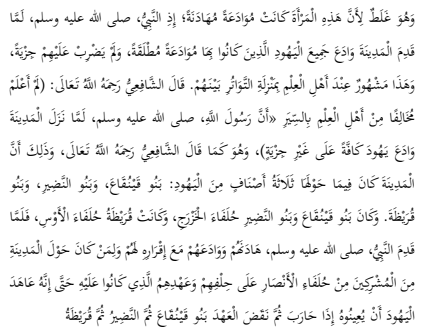
“Na hili ni kosa kwa sababu mwanamke huyu alikuwa katika amani na chini ya mapatano (Muhadanah). Hiyo ni kwa sababu Nabii ﷺ alipofika Al-Madinah alifanya amani na Mayahudi wote waliokuwa wanaishi huko kwa njia isiyo na vikwazo, wala hakuwawekea Jizyah. Jambo hili linajulikana sana miongoni mwa wanazuoni kiasi cha kufikia kiwango cha Tawatur (usimulizi wa kuaminika unaorithiwa na wengi kiasi cha kutowezekana kukubaliana kuwa ni uongo) miongoni mwao. Ash-Shafi’iy (rehma ya Allah imshukie) alisema: “Sijui kwa mmoja wa wanazuoni wa Siyar (historia ya maisha ya Mtume ﷺ) ambaye anapingana kuhusu jambo hili: ‘Kwamba Mjumbe wa Allah ﷺ alipokaa Al-Madinah, alifanya amani na Mayahudi wote bila kuwawekea Jizyah.’” Ni kama alivyosema Ash-Shafi’iy (rehma ya Allah imshukie). Hiyo ni kwa sababu Al-Madinah ilikuwa imezungukwa na makundi matatu ya Mayahudi: Banu Qainuqaa’, Banu An-Nadir na Banu Quraizha. Banu Qainuqaa’ na Banu An-Nadir walikuwa washirika wa Khazraj, huku Banu Quraizha wakiwa washirika wa Aws. Kisha Mjumbe wa Allah ﷺ alipofika Al-Madinah, alifanya nao mapatano na amani, akiwakubali pamoja na wale waliokuwa karibu na Al-Madinah miongoni mwa washirikina ambao walikuwa washirika wa Ansar, kwa msingi wa muungano wao na ahadi waliyokuwa nayo hapo awali. Hata alichukua ahadi kutoka kwa Mayahudi kwamba wangemsaidia endapo atapigwa vita. Kisha Banu Qainuqaa’ wakavunja ahadi hiyo, wakafuatiwa na An-Nadir, kisha Quraizha” [Mwisho wa nukuu].
“And it is a mistake because this woman was at peace and under a truce (Muhadanah). That is because when the Prophet (peace be upon him) came to Al-Madinah he made peace with all of the Jews residing there an unrestricted manner and he did not impose Jizyah upon them. This is well-known by the people of knowledge to the level of Tawatur (decisive concurrent transmission) among them. Ash- Shafi’iy (may Allah’s mercy be upon him) said: “I do not of any from the people of knowledge of Seera who disagree upon the point “That when the Messenger of Allah (peace be upon him) settled in Al- Madinah, he made peace with all of the Jews without the imposition of the Jizyah”. It is as Ash-Shafi’iy (May Allah’s mercy be upon him) stated. That is because Al-Madinah had three groups of Jews surrounding it: Banu Qainuqaa’, Banu An-Nadir and Banu Quraizha. Banu Qainuqaa’ and Banu An-Nadir were allies of the Khazraj, while Banu Quraizha were allies of the Aws. Then when the Messenger of Allah (peace be upon him) came to Al-Madinah, he made a truce and peace with them with his approval of them, alongside those who were around Al-Madinah from the polytheists who were allies of the Ansar, upon the basis of their alliance and covenant that they had previously been upon. He even took a covenant from the Jews that they would support him if he was fought against. Then, Banu Qainuqaa’ broke the covenant, followed by An-Nadir and then Quraizha” [End of Quote].
Hata ikiwa baadhi ya maneno yaliyotumika hapa huenda hayakuwa sahihi kabisa, kama kauli yake inayomweleza mwanamke Myahudi kuwa yuko chini ya “sulhu” (Muhadanah), ilhali hakukuwa hata na mapigano kiasi cha sulhu kuanza kutumika baadaye. Inawezekana kwamba hili lilikuwa ni kosa la kimaneno tu.

"Waraka (hati) ya Wathiqa iliandikwa katika matukio mawili (Hadathani), wakati Nabii ﷺ alipowasili Al-Madinah, kabla Uislamu haujashinda na kuwa imara, na kabla ya kuamriwa kuchukua Jizyah kutoka kwa Ahl ul-Kitab (watu wa Kitabu)."
“The Wathiqa (document) was written on two occurrences (Hadathani), when the Prophet (peace be upon him) arrived in Al- Madinah, prior to the dominance of Islam and its becoming strong and before he was commanded to take the Jizyah from Ahl ul-Kitab (the people of the book)” .
Neno "Hadathani" halitoi kwetu muda maalum unaoweza kuzingatiwa, kwa hiyo ni lisilo wazi. Uislamu ulijidhihirisha kwa kuenea sana na ukawa na nguvu kweli baada ya kushindwa kwa makundi yaliyoungana (al-Ahzab, yaani vita vya Khandaq). Hiyo ni kwa sababu Mtume ﷺ alianza kuwashambulia watu, nao hawakuwa tena wakimshambulia yeye. Zaidi ya hayo, hatujui ni lini aliamriwa kuchukua Jizya kutoka kwa watu. Wakati huo huo, kauli yake "chukueni Jizya kutoka kwa Ahl al-Kitab (watu wa Kitabu)" ni kurudia kosa linalojulikana, kwani ukweli ni kwamba Jizya ilichukuliwa hata kutoka kwa washirikina, wakiwemo Majusi, kama ilivyokuja katika Hadithi ya An-Nu'man bin Muqarrin, iliyopokelewa katika Sahih Muslim na vitabu vingine vya Hadithi. 2) Kuhusu kauli ya Al-Baladhari
is vague because the word “Hadathani” does not establish for us a determined time frame that can be taken into consideration. Islam only manifested in a prevalent manner and truly became powerful following the defeat of the confederates (Ahzab i.e. battle of the trench). That is because the Prophet (peace be upon him) began to go on the offensive against the people and they were no longer on the offensive against him. In addition, we do not know when he was commanded to take the Jizyah from the people. That is whilst his statement “take the Jizyah from Ahl ul-Kitab (the people of the book)” is a repetition of a well-known error, as the truth is that the Jizyah was taken even from the polytheists, including the Majus, as has come stated in the Hadith of An-Nu’man bin Muqarrin, recorded in Sahih Muslim and other collections. 2) As for the statement of Al-Baladhari
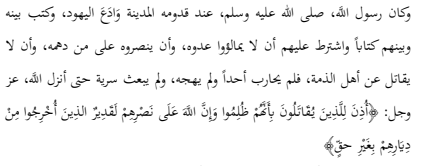
"Mtume wa Allah ﷺ alipofika Al-Madinah alifanya mkataba (Muwada’ah) na Mayahudi, na akaandika baina yake yeye na wao hati. Aliwawekea sharti kwamba wasiwaunge mkono wala kuwa upande wa maadui zake, wamsaidie dhidi ya wale wanaomshambulia, na kwamba yeye hatapigana vita kwa ajili ya kuwatetea Ahl udh-Dhimmah. Kisha hakupigana vita na yeyote, wala wao hawakumtukana, wala hakutuma kikosi cha kijeshi, hadi Allah ‘Azza Wa Jalla alipoteremsha: “Ruhusa [ya kupigana] imetolewa kwa wale wanaopigwa vita, kwa sababu wamedhulumiwa. Na hakika Allah ana uwezo wa kuwapa ushindi. [Ni] wale waliotolewa majumbani mwao bila haki” (TMQ 22:39-40)."
“When the Messenger of Allah (peace be upon him) arrived in Al- Madinah he made a treaty (Muwada’ah) with the Jews and wrote between himself and them a document. He stipulated upon them that they should not support or side with his enemies, to support him against those who attack him and that he would not fight in defence of the Ahl udh-Dhimmah. He did not then wage war against anyone, they did not defame him and he did not dispatch a military expedition, until Allah ‘Azza Wa Jalla revealed: “Permission [to fight] has been given to those who are being fought, because they were wronged. And indeed, Allah is capable of providing them victory. [They are] those who have been evicted from their homes without right” (TMQ 22:39-40)”.
Hotuba hii inajipinga yenyewe, kwa kuwa Mtume ﷺ hakuwa ameruhusiwa tangu mwanzo kushiriki katika vita kabla ya kuteremshwa kwa Aya hiyo, wala hakuwa katika hali ya vita na mtu yeyote. Pia haikutarajiwa kwamba Al-Madinah ingeshambuliwa. Kwa hiyo sentensi kutoka kwenye hotuba yake: "Aliwawekea sharti kwamba wasiwaunge mkono wala kushirikiana na maadui zake, na kumsaidia dhidi ya wale wanaomshambulia", ambayo ilifupisha baadhi ya yale yaliyoelezwa katika "Sahifah", haiwezekani kufikirika na haina uhalisia wowote katika kipindi hicho cha wakati. Mbaya zaidi ni kauli: "Na kwamba yeye hatapigana kwa kuwatetea Ahl udh-Dhimmah", ikidhania kwamba hakuna kosa katika uchapishaji. Kwanza, hakukuwa na "Ahl udh-Dhimmah" huko tangu mwanzo. Pili, inawezekanaje kwamba wao wana wajibu wa kumsaidia dhidi ya wale wanaomshambulia, wakati yeye hana wajibu wa kuwasaidia dhidi ya wale wanaowashambulia?! 3) Kauli ya Al-Baladhariy kuhusu Banu Qainuqaa’:
This speech is contradictory because he (peace be upon him) had not been permitted in origin to engage in fighting prior to the revelation of the Aayah and was not in a state of war with anyone. There was also no expectation for Al-Madinah to be attacked. Therefore, the sentence from his speech: “He stipulated upon them that they should not support or side with his enemies, to support him against those who attack him”, which summarized some of what came stated in the “Sahifah”, is inconceivable and has no reality to it during that time period. Even more atrocious is the statement: “And that he would not fight in defence of the Ahl udh-Dhimmah”, assuming there was no error in the printing. Firstly, there were no “Ahl udh-Dhimmah” there in origin. Secondly, how could it be that they are obliged to support him against those who attack him, whilst he is not obliged to support them against those who attack them?! 3) The statement of Al-Baladhariy concerning Banu Qainuqaa’:
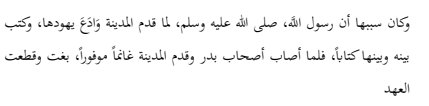
Sababu yake ilikuwa kwamba Mjumbe wa Mwenyezi Mungu (ﷺ), alipofika Al-Madinah, alifanya makubaliano ya amani na Mayahudi wake, na akaandika hati baina yake na wao. Kisha, Waislamu walipopata ushindi huko Badr na kurejea Al-Madinah wakiwa na ngawira nyingi, Mayahudi waliasi na kuvunja agano, basi hili nalo halina maana. Hii ni kwa sababu "Muwada'ah" (hali ya amani) ndiyo msingi na haihitaji kukubaliwa rasmi kwa pande zote mbili au kuandikwa. Ilhali Ka'b bin Al-Ashraf ndiye aliyekuwa wa kwanza kukiuka, kufanya vita na kuvunja "Muwada'ah" (hali ya amani au usitishaji vita), ambayo, kama ilivyotajwa awali, imethibitishwa kupitia usimulizi wa Mutawatir (usimulizi wa wengi usiokuwa na shaka), kisha yeye akaandika "Sahifah", ambayo lengo lake halikuwa kuanzisha "Muwada'ah" bali kuanzisha "Muungano wa Shirikisho (Ittihad Confedarali)". Baadaye, Bani Qainuqaa' walitoka katika "muungano" huo na kuanzisha vita, wakafuatiwa na Banu An-Nadir, kisha Quraizhah wakausaliti. 4) Kuhusu kauli ya At-Tabari:
“The reason for it was that the Messenger of Allah (peace be upon him), when he arrived in Al-Madinah, made a peace agreement with its Jews and wrote a document between himself and them. Then, when the Muslims were victorious at Badr and came back to Al- Madinah with abundant booty, the Jews rebelled and broke the covenant”, then this also has no meaning to it. That is because the “Muwada’ah” (state of peace) is the origin and does not need to be officially mutually contracted or write. That is while Ka’b bin Al-Ashraf was the first to transgress, war and cut the “Muwada’ah” (state of peace or truce) which, as previously mentioned, has been established via Mutawatir (decisive concurrent) transmissions and he then wrote the “Sahifah” which was not the purpose of establishing a “Muwada’ah” but rather to establish a “Confederal Union (Ittihad Confedarali)”. Thereafter, Bani Qainuqaa’ exited from the “union” and waged war, followed by Banu An-Nadir and then Quraizhah betrayed it. 4) Concerning the statement of At-Tabari:
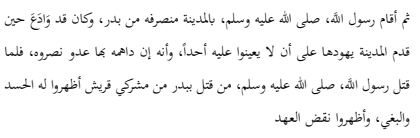
Kisha Mtume wa Allah ﷺ alibaki Al-Madinah baada ya kurudi kutoka Badr. Alipokuwa amefika Al-Madinah alikuwa amefanya makubaliano ya amani na Mayahudi wa humo kwa sharti kwamba wasimsaidie yeyote dhidi yake, na kwamba ikiwa angeshambuliwa Al-Madinah na adui, wao wangemuunga mkono. Kisha Mtume ﷺ alipowaua wale aliowaua katika Mushrikina (washirikina) wa Quraish, wao walidhihirisha wivu na uasi dhidi yake, na wakadhihirisha kuvunja agano.
“Then the Messenger of Allah (peace be upon him) remained in Al- Madinah after his return from Badr. When he had arrived in Al- Madinah he had made a peace agreement with its Jews upon the stipulation that they do not assist anyone against him and that if he was attacked in Al-Madinah by an enemy, they would support him. Then when the Messenger of Allah (peace be upon him) killed those whom he had killed from the Mushrikin (polytheists) of Quraish, they demonstrated envy and rebelliousness towards him and demonstrated the breaching of the covenant”,
Kwa hivyo ni sawa na hotuba ya Al-Baladhariy iliyotangulia, na jibu lake ni lile lile, ingawa lile la mwandishi huyu ni bora zaidi. Hiyo ni kwa sababu hakudai kwamba "Muwada'ah" (makubaliano ya amani/usitishaji vita) ya zamani, kabla ya Badr, ilikuwa hati iliyoandikwa, kama Al-Baladhariy alivyoteleza katika hilo, na maandishi yake pia hayajumuishi kitu sawa na sentensi ya kuchukiza "Na kwamba hatapigana kwa ajili ya kuwatetea Ahl udh-Dhimmah". Licha ya hayo, kauli ya At-Tabari "kuvunja mkataba (Naqdh Al-'Ahd)" si jambo linaloendana na uhalisia. Hiyo ni kwa sababu hapakuwepo "Ahd" (agano) hapo awali kimsingi, bali kulikuwa na "Muwada'ah" katika hali yake ya awali. Isipokuwa tuchukulie kwamba kukubali kwake na kuufuata kuwa ni "Ahd" (Agano/mkataba) kwa njia ya kudokezwa?! Kama kauli ya Ahmad Abu Zaid:
then it is in line with the speech of Al-Baladhariy above and the refutation to it is the same, although it is much better. That is because he did not assert that the old “Muwada’ah” (agreement of peace/truce), prior to Badr, was a written document, as Al-Baladhariy slipped up in, just as his text does not include something equal to the atrocious sentence “And that he would not fight in defence of the Ahl udh-Dhimmah”. Despite that, the statement of At-Tabari “breaching of the covenant (Naqdh Al‘Ahd)” is not something that fits with reality. That is because there was no prior “Ahd” (covenant) in origin but rather a “Muwada’ah” upon its original state. That is unless we were to consider its acceptance and adherence to it as being an “Ahd” (Covenant/treaty) implicitly?! As the statement of Ahmad Abu Zaid:

Katika ushahidi huu wa Mutawatir (usimulizi mwingi unaothibitisha jambo kwa uhakika), kuna ushahidi wa kutosha kuthibitisha kwa uzito mkubwa kwamba hati ya mkataba wa amani na Mayahudi iliandikwa katika mwaka wa kwanza wa Hijra. Zaidi ya hayo, uchambuzi wa vifungu na maandishi yake unaonyesha kuwa havionyeshi mvutano wowote kati ya Nabii ﷺ na Mayahudi. Kwa sababu ya haya yote, madai ya ensaiklopidia ya Kiislamu yanaanguka, na mashaka yao yanakataliwa. Hata hivyo, kuna makosa makubwa, hata ya kuharibu hoja nzima, ndani yake.
“In these Mutawatir (concurrent transmissions indicating decisiveness) testimonies, there is enough to establish preponderance to conclude that the peace agreement document with the Jews was written in the first year of the Hijrah. In addition, an analysis of its articles and texts indicate that they are not indicative of any tension between the Prophet (peace be upon him) and the Jews. As such, due to all of this, the claims of the Islamic encyclopaedia fall down and their doubts are refuted”, then there are significant, indeed fatal errors in it.
1) Kauli au maoni ya wanahistoria hayaitwi ushahidi (shahada) isipokuwa yanatoka kwa shahidi wa wakati huo (aliyeshuhudia kwa macho yake). Vinginevyo, maoni hayo ni dhana tu inayotegemea taarifa au misingi iliyo sahihi au isiyo sahihi. Idadi kubwa ya maoni yanayofanana au kukubaliana haiitwi Tawatur (yaani kuthibitika kwa uhakika kupitia upokezi wa wengi kwa pamoja), wala hayana thamani ya ushahidi wa uthibitisho wa kuamua (wa Tawatur).
1) The statements or views of the historians are not called testimonies (shahada) unless it is from a contemporary (first-hand) witness. Otherwise, such a view is merely an opinion based upon correct or incorrect information or premises. A large number of conforming or similar opinions is not called Tawatur (i.e. established definitely by concurrent transmission) and they do not hold the value of Tawatur (decisive) testimonies of affirmation.
2) Baadhi ya katiba zinaweza kuandikwa baada ya vita vya wenyewe kwa wenyewe, lakini maandishi yake hayaakisi kuwepo kwa mvutano wowote kati ya pande zinazohusika. Hiyo ni kwa sababu lengo la katiba ni kuweka kanuni za utawala wa nchi (yaani, mfumo wa umoja au wa shirikisho, n.k.). Kwa hiyo, tarehe ya mvutano au mzozo uliotokea kabla ya katiba hiyo haiandikwi wala kutajwa ndani yake. Kwa hiyo, kuhusu kauli "Hayo (yaani, maandiko hayo) hayaonyeshi mvutano wowote kati ya Nabii ﷺ na Mayahudi", kinyume chake pia ni sahihi. Hiyo ni kwa sababu kuandikwa kwa katiba ya kishirikisho au mkataba wa kimataifa lenyewe si ushahidi wa kuwepo kwa mvutano, mzozo au vita vilivyotangulia. Huenda vilikuwepo, au huenda visiwepo kabisa. Hili linaweza kujulikana tu kupitia dalili nyingine za kihistoria ambazo zinachunguzwa kwa kujitegemea kutoka kwenye hati inayochunguzwa, au kupitia maandishi ya hati yenyewe yanayoonyesha kumalizika kwa mzozo, kusimama kwa mapigano, au kutatuliwa kwa masuala ya fidia na malipo ya damu n.k. Ustadhi Ahmad Abu Zaid anataka kukanusha madai ya "Ensaiklopidia ya Kiislamu" ambayo yeye mwenyewe aliyatunga muda mfupi kabla ya hapo katika "As-Seera An-Nabawiyah" cha Ahmad Abu Zaid (uk. 70), kama ifuatavyo:
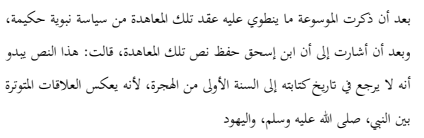
Baada ya ensaiklopidia kutaja kile ambacho kufungwa kwa mkataba huo (Mu’ahadah) kulikuwa na sera za busara za Mtume katika kuweka maamuzi, na baada ya kuonyesha kwamba Ibn Ishaq alihifadhi maandishi ya mkataba huo, ilisema: Inaonekana kwamba maandishi haya hayarudi, kwa upande wa tarehe ya kuandikwa kwake, hadi mwaka wa kwanza wa Hijra, kwa sababu yanaonyesha mahusiano ya wasiwasi kati ya Mtume ﷺ na Mayahudi.
“After the encyclopaedia mentioned what the contracting of that treaty (Mu’ahadah) contained in terms of wise prophetic policy making and after it indicated to Ibn Ishaq having preserved the text of that treaty, it stated: It appears that this text does not go back, in respect to the date of its writing, to the first year of the Hijrah, because it reflects the tense relations between the Prophet (peace be upon him) and the Jews”.
Ukweli ni kwamba Mkataba wa Madina (As-Sahifah ya Al-Madinah) uliandikwa mwanzoni mwa mwaka wa tatu baada ya Hijra, kwa kuzingatia ushahidi wa maandishi ya kihistoria yaliyopokelewa ambayo tumeyawasilisha awali. Kwa hiyo, ensaiklopidia ilikuwa sahihi kuhusu jambo hili. Kuhusu dhana ya wanaoriental, ambao ndio waandishi wa ensaiklopidia, kwamba maandishi hayo (yaani As-Sahifah)
The truth is that the Sahifah of Al-Madinah was written at the beginning of the third year of Hijrah based upon the evidence of the historical transmitted texts that we have presented earlier. As such, the encyclopaedia was correct regarding this matter. As for the deduction of the orientalists, who are the authors of the encyclopaedia, that the text (i.e. Sahifah)

"yalionyesha mahusiano yenye mvutano kati ya Mtume ﷺ na Mayahudi"
“reflected tense relations between the Prophet (peace be upon him) and the Jews”, .
Hivi haviridhishi, kwa sababu historia ni matukio na hali halisi ambazo zimepita tu, na taarifa zake lazima zichukuliwe kutoka kwa mashahidi wa moja kwa moja na kumbukumbu za watu waliokuwepo wakati huo, si kutoka kwa mawazo ya kubuni wala hata hitimisho la kimantiki. Ni kweli kwamba mazingira yaliyozunguka uandishi wa Sahifah yanaonyesha kwamba iliandikwa kutokana na kutokea kwa mvutano katika mahusiano na baadhi ya Mayahudi (Ka'b bin al-Ashraf hasa). Hata hivyo, maandishi yake hayajumuishi chochote kinachoashiria mvutano au mgogoro wowote uliotangulia, wala hata kwa mbali kabisa!
then this is not convincing and out of place. People have given free reign to their imaginations here. That is whilst history is merely events and realities that have passed by and its reports must be taken from first-hand witnesses and records of those living at the time, not from imaginations or even logical deductions. Yes, it is true that the circumstances surrounding the writing of the Sahifah reveal that it was written due to the occurrence of a tension in the relations with some of the Jews (Ka’b in Al-Ashraf specifically). However, its text does not include anything indicating to any prior tension or conflict and not even remotely!