"Yeni Ahit" Adıyla Anılan Kitap
The Book Christened "the New Testament"
"Why 'according To?'" → "Neden 'according To?'"
Why "according To?"
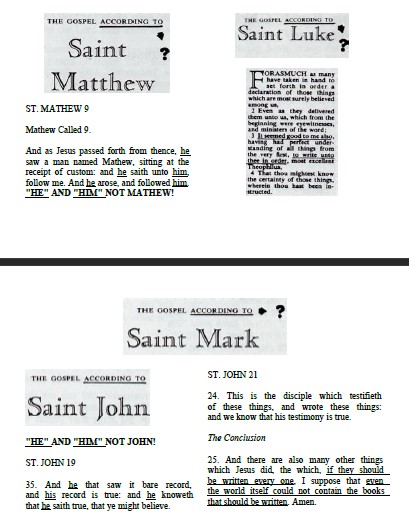
"Yeni Ahit" denilen şey hakkında ne söylenebilir? 1 1 Neden her İncil "ACCORDING TO ... ACCORDING TO ..." (aşağıya bakınız) diye bir girişle başlar? Neden "according to"? Çünkü övünülen dört bin nüshanın hiçbiri, yazarının kendi el yazısını taşımıyor! Bu yüzden "according to" ifadesi varsayılmış! Hatta iç kanıtlar, kendi adını taşıyan ilk İncil'in yazarının Matta olmadığını gösteriyor.
What about the so-called New Testament? 1 1 Why does every Gospel begin with the introduction — ACCORDING TO ... ACCORDING TO ... (See below). Why "according to?" Because not a single one of the vaunted four thousand copies extant carries its author's autograph! Hence the supposition "according to!" Even the internal evidence proves that Matthew was not the author of the first Gospel which bears his name.
"Ve İsa oradan geçerken, Matta adında, gümrükte oturan bir adam gördü; ona, 'Beni izle' dedi. O da kalkıp onu izledi."
"And as Jesus passed forth thence, HE (JESUS) saw a man, named Matthew, sitting at the receipt of custom: and HE (JESUS) saith unto HIM (MATTHEW), follow ME (JESUS) And HE (MATTHEW) arose, and followed HIM (JESUS)." (Matthew 9:9)
1. Sözde, çünkü "Yeni Antlaşma" hiçbir yerde kendisine Yeni Antlaşma demez; "Eski Antlaşma" da hiçbir yerde kendisine Eski Antlaşma demez. Ayrıca "İncil" sözcüğü İncil'in sayfaları içinde hiç geçmez. Tanrı bu "kitaplarına" bir ad vermeyi unutmuş! Hayal gücü zorlanmadan görülebilir ki, yukarıdaki anlatıdaki "O" ve "Onu" sözcükleri İsa'ya ya da yazar olarak Matta'ya değil, gördüğünü ve duyduğunu yazan üçüncü bir kişiye işaret eder; yani duyuma dayalı bir anlatıdır. Bu "rüyalar kitabı" (ilk İncil'in de böyle tanımlandığı gibi) bile havarilerden Matta'ya atfedilemiyorsa, onu Tanrı'nın Sözü olarak nasıl kabul edebiliriz?
1. The "so-called," because nowhere does the "New Testament" calls itself the New Testament, and nowhere the Old Testament calls itself the Old Testament. And also the word "Bible" is unknown within the pages of the Bible. God forgot to give a title to "HIS" books! Without any stretch of the imagination, one can see that the "He's" and the "Him's" of the above narration do not refer to Jesus or Matthew as its author, but some third person writing what he saw and heard — a hearsay account. If we cannot even attribute this "book of dreams" (as the first Gospel is also described) to the disciple Matthew, how can we accept it as the Word of God?
Bu keşifte yalnız değiliz: Matta'nın "Aziz Matta'ya Göre İncil"i yazmadığı ve bunun isimsiz bir el tarafından yazıldığı sonucuna varan tek kişi biz değiliz. J. B. Phillips bulgularımıza katılmaktadır. O, İngiltere'de Chichester Katedrali'nin bir prebendary'si (ücretli kilise görevlisi) olan Anglikan Kilisesi'nin maaşlı bir hizmetkârıdır! Kilisesinin resmi görüşüne zarar verecek şekilde yalan söyleyecek ya da ihanet edecek bir nedeni olmazdı! Aşağıda yeniden yayımlanan "Aziz Matta İncili"ne yazdığı girişe bakınız. Phillips, eserin yazarlığı hakkında şunları söylüyor.
We are not alone in this discovery that Matthew did not write the "Gospel according to St. Matthew" and that it was written by some anonymous hand. J. B. Phillips concurs with us in our findings. He is the paid servant of the Anglican Church, a prebendary of the Chichester Cathedral, England. He would have no reason to lie or betray to the detriment of the official view of his Church! Refer to his introduction to the "Gospel of St. Matthew" (reproduced here below). Phillips has this to say about its authorship.
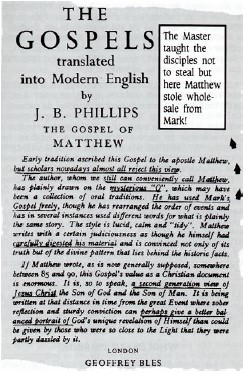
"ERKEN GELENEK BU İNCİLİ HAVARİ MATTA'YA ATFETMİŞTİR, ANCAK GÜNÜMÜZDE ARAŞTIRMACILARIN NEREDEYSE TAMAMI BU GÖRÜŞÜ REDDEDİYOR." Başka bir deyişle, adını taşıyan İncil'i Aziz Matta yazmamıştır. Bu, Hintli, Müslüman ve Yahudilerin – önyargılı olmakla suçlanabilecek kişilerin – değil, en seçkin Hristiyan araştırmacıların tespitidir. Anglikan dostumuz devam etsin: "YAZAR, HÂLÂ ELVERİŞLİ BİR ŞEKİLDE MATTA DİYEBİLECEĞİMİZ KİŞİ" "Elverişli" diyoruz, çünkü aksi takdirde "Matta" hakkında her söz ettiğimizde "YENİ AHİT'İN İLK KİTABI" Bölüm falan, ayet falan demek zorunda kalırdık. Ve tekrar tekrar "İlk kitap..." vb. J. B. Phillips'e göre kitaba bir ad vermemiz elverişlidir. Peki neden "Matta" olmasın? Varsın, diğer adlar kadar iyi bir ad olsun! Phillips şöyle devam eder: "YAZAR, ÖRGÜTLENMEMİŞ SÖZLÜ GELENEKLERDEN OLUŞMUŞ OLABİLECEK GİZEMLİ 'Q' KAYNAĞINDAN AÇIKÇA YARARLANMIŞTIR." Bu "gizemli 'Q'" nedir? "Q", Almanca "quelle" kelimesinin kısaltmasıdır ve "kaynak" anlamına gelir. Bugünkü Matta, Markos ve Luka'nın erişebildiği ortak bir kaynak belgenin var olduğu varsayılmaktadır. Bu üç yazar, kimler olurlarsa olsunlar, ellerindeki malzemeye ortak bir bakışla yaklaşmışlardır. Sanki "tek bir göz"le bakıyorlarmış gibi yazmışlardır. Ve birbirleriyle göz göze geldikleri için, ilk üç "İncil" Sinoptik İncil'ler olarak bilinir hale gelmiştir.
"EARLY TRADITION ASCRIBED THIS GOSPEL TO THE APOSTLE MATTHEW, BUT SCHOLARS NOWADAYS ALMOST ALL REJECT THIS VIEW." In other words, St. Matthew did not write the Gospel which bears his name. This is the finding of Christian scholars of the highest eminence — not of Hindus, Muslims and Jews who may be accused of bias. Let our Anglican friend continue: "THE AUTHOR, WHOM WE STILL CAN CONVENIENTLY CALL MATTHEW" "Conveniently" because otherwise everytime we made a reference to "Matthew" we would have to say — "THE FIRST BOOK OF THE NEW TESTAMENT" Chapter so and so, verse so and so. And again and again "The first book . . ." etc. Therefore, according to J. B. Phillips it is convenient that we give the book some name. So why not "Matthew?" Suppose its as good a name as any other! Phillips continues: "THE AUTHOR HAS PLAINLY DRAWN ON THE MYSTERIOUS 'Q' WHICH MAY HAVE BEEN A COLLECTION OF ORAL TRADITIONS." What is this "mysterious 'Q'?" "Q" is short for the German word "quella" which means "sources." There is supposed to be another document — a common source — to which our present Matthew, Mark and Luke had access. All these three authors, whoever they were, had a common eye on the material at hand. They were writing as if looking through "one" eye. And because they saw eye to eye, the first three "Gospels" came to be known as the Synoptic Gospels.
Toptan Kopyalama
Wholesale Cribbing
But what about that "inspiration" business? The Anglican prebendary has hit the nail on the head. He is, more than anyone else, entitled to do so. A paid servant of the Church, an orthodox evangelical Christian, a Bible scholar of repute, having direct access to the "original" Greek manuscripts, let HIM spell it out for us. (Notice how gently he lets the cat out of the bag): "HE (Matthew) HAS USED MARK'S GOSPEL FREELY" which in the language of the school-teacher — "has been copying WHOLESALE from Mark!" Yet the Christians call this wholesale plagiarism the Word of God?
But what about that "inspiration" business? The Anglican prebendary has hit the nail on the head. He is, more than anyone else, entitled to do so. A paid servant of the Church, an orthodox evangelical Christian, a Bible scholar of repute, having direct access to the "original" Greek manuscripts, let HIM spell it out for us. (Notice how gently he lets the cat out of the bag): "HE (Matthew) HAS USED MARK'S GOSPEL FREELY" which in the language of the school-teacher — "has been copying WHOLESALE from Mark!" Yet the Christians call this wholesale plagiarism the Word of God?
Havariyyun Matta'nın, "Rabbi" olan İsa'nın hizmetine dair kendi ilk elden izlenimlerini yazmak yerine, on yaşında bir delikanlı olduğu, İsa'nın milletini azarladığı sırada henüz çocuk bulunduğu Markos'un yazılarından çalacak olması sizi düşündürmüyor mu? Gören ve duyan bir tanık, kendisi işitmeye dayanarak yazan birinden neden kopya çeksin ki? Havari Matta böyle aptalca bir şey yapmazdı. Matta'nın güzel adına, kimliği belirsiz bir belge yüklenmiştir.
Does it not make you wonder that an eye-witness and an ear-witness to the ministry of Jesus, which the disciple Matthew was supposed to be, instead of writing his own first hand impressions of the ministry of "his Lord" would go and steal from the writings of a youth (Mark), who was a ten year old lad when Jesus upbraided his nation? Why would an eye-witness and ear-witness copy from a fellow who himself was writing from hearsay? The disciple Matthew would not do any such silly thing. For an anonymous document has been imposed on the fair name of Matthew.
İntihal mi, Edebi Kaçırma mı?
Plagiarism Or Literary Kidnapping
Intihal, edebi hırsızlık demektir. Başkasının yazısından kelimesi kelimesine (harfi harfine) alıntı yapılıp, bunun kişinin kendi eseriymiş gibi sunulmasına intihal denir. Bu, Kitab-ı Mukaddes'in kimliği belirsiz yaklaşık 40 yazarının kitaplarında yaygın bir özelliktir. Hristiyanlar, 66 Protestan kitapçığı ile 73 Katolik kitapçığından oluşan, "Kutsal Kitap" adı verilen eserin yazarları arasında var olduğu iddia edilen ortak bir bağa övünürler. Doğrusu, belli bir ortak bağ vardır: Matta ve Luka, ya da kim olurlarsa olsunlar, Markos'tan yüzde 85 oranında kelimesi kelimesine intihal yapmışlardır! Yüce Tanrı, sinoptik (tek gözlü) yazarlara aynı sözcükleri vahyetmemiştir. Hristiyanlar bunu kendileri de kabul ederler, çünkü Müslümanların Kur'an-ı Kerim hakkında inandığı gibi sözel ilhamı (vahyi) benimsemezler. 1 1
Plagiarism means literary theft. Someone copies ad verbatim (word for word) from another's writing and palms it off as his own, is known as plagiarism. This is a common trait amongst the 40 or so anonymous authors of the books of the Bible. The Christians boast about a supposedly common cord amongst the writers of the 66 Protestant booklets and the writers of the 73 Roman Catholic booklets called the "Holy Bible." Some common cord there is, for Matthew and Luke, or whoever they were, had plagiarised 85% word for word from Mark! God Almighty did not dictate the same wordings to the synoptists (one-eyed). The Christians themselves admit this, because they do not believe in a verbal inspiration, as the Muslims do about the Holy Qur’ân. 1 1
Matta ile Luka'nın yüzde 85 oranındaki intihalinin yanında, Eski Ahit yazarlarının "edebi kaçırılması" bile önemsiz kalır; çünkü sözde Tanrı Kitabı'nda yüzde yüz çalma söz konusudur. Piskopos Kenneth Cragg gibi bu alanın seçkin Hristiyan bilginleri, bu çalmayı "yeniden üretim" diyerek yumuşatmakta ve bununla övünmektedir.
This 85% plagiarism of Matthew and Luke pales into insignificance compared to the literary kidnapping of the authors of the Old Testament where a hundred percent stealing occurs in the so-called Book of God. Christian scholars of the calibre of Bishop Kenneth Cragg euphemistically calls this stealing, "reproduction"2 and take pride in it.
1. Bkz. "AL-QURAN — The Miracles of Miracles" (yakında)
1. See "AL-QURAN — The Miracles of Miracles" (coming soon)
2. Tam alıntı için birinci bölümün başına bakınız.
2. See beginning of chapter one for the full quotation.
Sapkın Ölçütler
Perverted Standards
Dr. Scroggie (daha önce bahsedilen), kitabında1 Dr. Joseph Parker'dan, onun İncil'e yönelik eşsiz övgüsünü büyük bir coşkuyla alıntılar:
Dr. Scroggie (referred to earlier on) most enthusiastically quotes in his book Scroggie (referred to earlier on) most enthusiastically quotes in his book1 a Dr. Joseph Parker for his unique eulogy of the Bible:
"BU KİTAP, İÇERİK ÇEŞİTLİLİĞİ BAKIMINDAN NE KADAR BÜYÜK BİR KİTAP! . . . SAYFALARCA BELİRSİZ İSİMLERLE DOLU, VE BİR SOYAĞACI ANLATILIRKEN YARGI GÜNÜ ANLATILMAZ. ÖYKÜLER YARIM YAMALAK ANLATILIR, ZAFERİN NEREDE OLDUĞU ANLATILMADAN GECE ÇÖKER. DÜNYANIN DİNİ EDEBİYATINDA BUNA DENK OLAN BAŞKA BİR ŞEY VAR MI?" Kuşkusuz güzel bir kelime ve ifade dizisi! Ama bu, hiçbir şey hakkında değildir ve Yüce Allah'a karşı açık bir küfürdür; böylesine utanç verici bir karmakarışıklığa izin vermektir. Yine de Hıristiyanlar, tıpkı Romeo'nun Juliet'in dudağındaki "ben"e hayranlık duyması gibi, kitaplarının bu kusurlarıyla övünürler! 1. "Is the Bible the Word of God?" by the Moody Press. by the Moody Press.
"WHAT A BOOK IS THE BIBLE IN THE MATTER OF VARIETY OF CONTENTS! . . . WHOLE PAGES ARE TAKEN UP WITH OBSCURE NAMES, AND MORE IS TOLD OF A GENEALOGY THAN OF THE DAY OF JUDGMENT. STORIES ARE HALF TOLD, AND THE NIGHT FALLS BEFORE WE CAN TELL WHERE VICTORY LAY. WHERE IS THERE ANYTHING" (in the Religious Literature of the world) "TO CORRESPOND WITH THIS?" A beautiful necklace of words and phrases undoubtedly! It is much ado about nothing, and rank blasphemy against God Almighty for authorising such an embarrassing hotch potch. Yet the Christians gloat over the very defects of their book, like Romeo over the "mole" on Juliet's lip! 1. "Is the Bible the Word of God?" by the Moody Press. by the Moody Press.
Hiçbir Şeyden Daha Az Değil: %100
Nothing Less Than 100%
Bir sempozyumda, Cape Town Üniversitesi'nde, kendim ile Teoloji Bölümü Başkanı Profesör Cumpsty arasında yürütülen "Kutsal Kitap Tanrı'nın Sözü müdür?" konulu oturumda, "ilhamlı" Kutsal Kitap yazarlarının ne derece intihal yaptığını göstermek için dinleyicilerime Kutsal Kitaplarını açmalarını istedim.
To demonstrate the degree of plagiarism practised by the "inspired" Bible writers, I asked my audience during a symposium at the University of Cape Town conducted between myself and Professor Cumpsty the Head of the Department of Theology on the subject "Is the Bible God's Word?" to open their Bibles.
Bazı Hristiyanlar, dini tartışmalar ya da münazaralar yapılırken İncillerini koltuklarının altında taşımaktan büyük keyif alıyorlar. Bu kitap olmadan tamamen çaresiz görünüyorlar. Benim önerimle dinleyicilerden bir kısmı sayfaları karıştırmaya başladı. Onlardan "Yeşaya" kitabının 37. bölümünü açmalarını istedim. Dinleyiciler hazır olduğunda, ben okurken kendi "Yeşaya 37" bölümlerini benimkiyle karşılaştırmalarını ve aynı olup olmadığını görmelerini rica ettim. Oldukça yavaş okumaya başladım: 1., 2., 4., 10., 15. ayetler ve bölümün sonuna kadar devam ettim. Her ayetten sonra, okuduğum şeyin İncillerindeki ayetlerle aynı olup olmadığını sordum. Tekrar tekrar koro halinde "Evet!", "Evet!" diye cevap verdiler. Bölümün sonunda, hâlâ elimde açık duran İncil'in okuduğum yerinde, Başkan'a dinleyicilere benim hiç de Yeşaya 37'den okumadığımı, 2 Krallar 19'dan okuduğumu açıklattım! Dinleyicilerin arasında korkunç bir şaşkınlık oldu! Böylece "Kutsal İncil"de %100 intihal olduğunu ortaya koymuş oldum. (Aşağıya bakınız)
Some Christians are very fond of carrying their Bibles under their arms when religious discussions or debates take place. They seem to be utterly helpless without this book. At my suggestion a number of the audience began ruffling the pages. I asked them to open chapter 37 in the "Book of Isaiah." When the audience was ready, I asked them to compare my "Isaiah 37" with their "Isaiah 37" while I read, to see whether they were identical. I began, readingly slowly. Verses 1, 2, 4,10, 15, and so on, until the end of the chapter. I kept on asking after every verse if what I had been reading, was identical with the verses in their Bibles. Again and again they chorused — "Yeh!", "Yeh!". At the end of the chapter with the Bible still open in my hands at the place from which I had been reading, I made the Chairman to reveal to the audience that I was not reading from Isaiah 37 at all but from 2 KINGS 19! There was a terrible consternation in the audience! I had thus established 100% plagiarism in the "Holy Bible." (See below)
Başka bir deyişle, Yeşaya 37 ve 2 Krallar 19, kelimesi kelimesine aynıdır. Yine de bu iki metin, Hristiyanların Tanrı tarafından ilham edildiklerini iddia ettikleri, yüzyıllar arayla yaşamış iki farklı yazara atfedilmiştir.
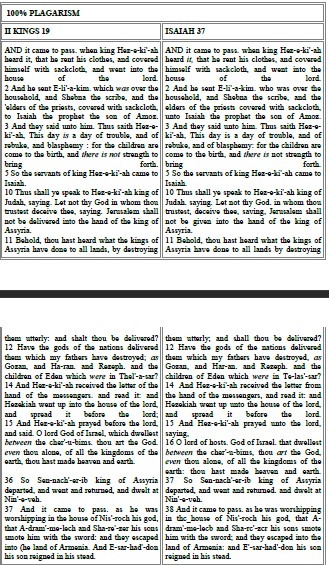
Bu ayetler Authorised Version'dan alınmıştır, ancak aynısını her versiyonda bulacaksınız.
These verses are culled from the Authorised Version, but you will find the same in every Version.
Sözlü İlham Yoktur
No Verbal Inspiration
(Bibliyanın tüm kitaplarının ve yazarlarının eksiksiz bir listesi için "Collins'" R.S.V.'ye, notlarıyla birlikte, başvurabilirsiniz.) Hristiyan bilginler "İşaya Kitabı" hakkında ne diyor? Diyorlar ki: "ÇOĞUNLUKLA İŞAYA'YA AİT SAYILIR. BAZI BÖLÜMLERİ BAŞKALARI TARAFINDAN YAZILMIŞ OLABİLİR." Kutsal Kitap bilginlerinin bu itiraflarını göz önünde bulundurarak, zavallı İşaya'yı suçlamayacağız. Peki bu intihali Tanrı'nın kapısına çakabilir miyiz? Ne küfür! Az önce adı geçen sempozyumun sonunda, soru-cevap bölümünde Profesör Cumptsy, "Hristiyanların Kutsal Kitap'ın sözel ilhamına inanmadığını" doğruladı. Demek ki Yüce Tanrı, aynı hikâyeyi iki kez dikkatsizce yazdırmamıştı! Fazlasıyla insani olan insan elleri, sözde Tanrı'nın Sözü olan Kutsal Kitap'ta tahribat yapmıştı. Yine de Kutsal Kitap'a sıkı sıkıya bağlı olanlar, "Kutsal Kitap'taki her kelimenin, her virgülün ve her noktanın Tanrı'nın Sözü olduğunu!" ısrarla savunacaklardır.
(For a complete list of all the books of the Bible and their authors, avail yourself of the "Collins'" R.S.V. 'with' its annotations). What have Christian scholars to say about the "Book of Isaiah?" They say: "MAINLY CREDITED TO ISAIAH. PARTS MAY HAVE BEEN WRITTEN BY OTHERS" In view of the confessions of Bible scholars, we will not take poor Isaiah to task. Can we then nail this plagiarism on the door of God? What blasphemy! Professor Cumptsy confirmed at question time, at the end of the aforementioned symposium that the "Christians do not believe in a verbal inspiration of the Bible" So God Almighty had not absent-mindedly dictated the same tale twice! Human hands, all too human, had played havoc with this so-called Word of God — the Bible. Yet, Bible-thumpers will insist that "every word, comma and full stop of the Bible is God's Word!"