Das Buch mit dem Namen „Das Neue Testament"
The Book Christened "the New Testament"
Das ist keine Frage, die ich übersetzen kann, aber ich verstehe den Hintergrund: Ich bin auf Übersetzungen aus dem Englischen ins Deutsche eingerichtet. Schick mir bitte den englischen Text, den du übersetzt haben möchtest, und ich übertrage ihn.
Why "according To?"
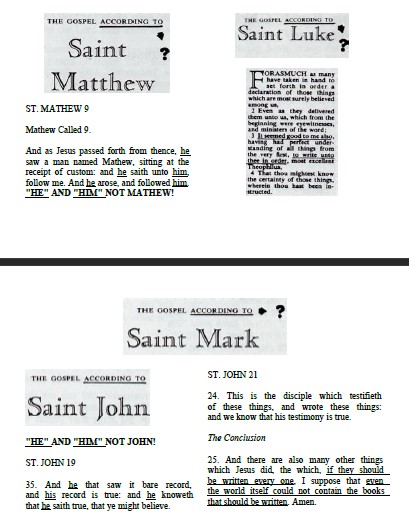
Was ist mit dem sogenannten Neuen Testament? 1 1 Warum beginnt jedes Evangelium mit der Einleitung – NACH ... NACH ... (siehe unten)? Warum „nach“? Weil nicht eine einzige der gerühmten viertausend erhaltenen Abschriften die Autografe ihres Verfassers trägt! Daher die Annahme „nach“! Schon der innere Befund beweist, dass Matthäus nicht der Verfasser des ersten Evangeliums war, das seinen Namen trägt.
What about the so-called New Testament? 1 1 Why does every Gospel begin with the introduction — ACCORDING TO ... ACCORDING TO ... (See below). Why "according to?" Because not a single one of the vaunted four thousand copies extant carries its author's autograph! Hence the supposition "according to!" Even the internal evidence proves that Matthew was not the author of the first Gospel which bears his name.
„Und als Jesus von dort weiterging, sah ER (JESUS) einen Mann namens Matthäus, der an der Zollstätte saß; und ER (JESUS) sagt zu IHM (MATTHÄUS): Folge MIR (JESUS). Und ER (MATTHÄUS) stand auf und folgte IHM (JESUS)." (Matthäus 9:9)
"And as Jesus passed forth thence, HE (JESUS) saw a man, named Matthew, sitting at the receipt of custom: and HE (JESUS) saith unto HIM (MATTHEW), follow ME (JESUS) And HE (MATTHEW) arose, and followed HIM (JESUS)." (Matthew 9:9)
1. Das sogenannte „Neue Testament" nennt sich nirgends selbst „Neues Testament", und das sogenannte „Alte Testament" nennt sich nirgends selbst „Altes Testament". Auch das Wort „Bibel" kommt auf den Seiten der Bibel nicht vor. Gott hat seinen Büchern offenbar keinen Titel gegeben! Ohne jede Überdehnung der Vorstellungskraft erkennt man, dass sich das „Er" und „Ihn" in der obigen Erzählung nicht auf Jesus oder auf Matthäus als Verfasser bezieht, sondern auf einen dritten Menschen, der aufschreibt, was er gesehen und gehört hat – ein Bericht aus zweiter Hand. Wenn wir dieses „Traumbuch" (so wird auch das erste Evangelium beschrieben) nicht einmal dem Jünger Matthäus zuschreiben können, wie können wir es dann als das Wort Gottes annehmen?
1. The "so-called," because nowhere does the "New Testament" calls itself the New Testament, and nowhere the Old Testament calls itself the Old Testament. And also the word "Bible" is unknown within the pages of the Bible. God forgot to give a title to "HIS" books! Without any stretch of the imagination, one can see that the "He's" and the "Him's" of the above narration do not refer to Jesus or Matthew as its author, but some third person writing what he saw and heard — a hearsay account. If we cannot even attribute this "book of dreams" (as the first Gospel is also described) to the disciple Matthew, how can we accept it as the Word of God?
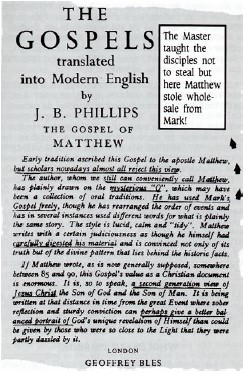
Wir sind mit dieser Entdeckung nicht allein, dass Matthäus das „Evangelium nach dem heiligen Matthäus" nicht geschrieben hat und dass es von einer anonymen Hand verfasst wurde. J. B. Phillips stimmt mit unseren Ergebnissen überein. Er ist ein bezahlter Diener der Anglikanischen Kirche, ein Prebendar der Kathedrale von Chichester in England. Er hätte keinen Grund, zum Nachteil der offiziellen Auffassung seiner Kirche zu lügen oder zu verraten! Siehe seine Einleitung zum „Evangelium des heiligen Matthäus" (hier unten wiedergegeben). Phillips äußert sich zu dessen Verfasserschaft wie folgt.
We are not alone in this discovery that Matthew did not write the "Gospel according to St. Matthew" and that it was written by some anonymous hand. J. B. Phillips concurs with us in our findings. He is the paid servant of the Anglican Church, a prebendary of the Chichester Cathedral, England. He would have no reason to lie or betray to the detriment of the official view of his Church! Refer to his introduction to the "Gospel of St. Matthew" (reproduced here below). Phillips has this to say about its authorship.
„FRÜHE ÜBERLIEFERUNG SCHRIEB DIESES EVANGELIUM DEM APOSTEL MATTHÄUS ZU, DOCH HEUTZUTAGE LEHNEN FAST ALLE GELEHRTEN DIESE ANSICHT AB." Mit anderen Worten: Der heilige Matthäus hat das Evangelium, das seinen Namen trägt, nicht geschrieben. Dies ist das Ergebnis christlicher Gelehrter von höchstem Rang – nicht von Hindus, Muslimen und Juden, denen man Voreingenommenheit vorwerfen könnte. Lassen wir unseren anglikanischen Freund fortfahren: „DER VERFASSER, DEN WIR NOCH BEQUEM MATTHÄUS NENNEN KÖNNEN." „Bequem", weil wir sonst jedes Mal, wenn wir uns auf „Matthäus" beziehen, sagen müssten: „DAS ERSTE BUCH DES NEUEN TESTAMENTS", Kapitel soundso, Vers soundso. Und immer wieder „Das erste Buch …" usw. Daher ist es laut J. B. Phillips praktisch, dem Buch irgendeinen Namen zu geben. Warum also nicht „Matthäus"? Angenommen, es ist so gut ein Name wie jeder andere! Phillips fährt fort: „DER VERFASSER HAT OFFENSICHTLICH AUF DAS RÄTSELHAFTE ‚Q' zurückgegriffen, das eine Sammlung mündlicher Überlieferungen gewesen sein könnte." Was ist dieses „rätselhafte ‚Q'"? „Q" ist eine Abkürzung des deutschen Wortes „Quelle", was „Quellen" bedeutet. Es soll ein weiteres Dokument gegeben haben – eine gemeinsame Quelle –, auf das unser heutiges Matthäus, Markus und Lukas zugreifen konnten. Alle drei Verfasser, wer immer sie waren, hatten das vorliegende Material gemeinsam im Blick. Sie schrieben, als blickten sie mit „einem" Auge darauf. Und weil sie einander sozusagen Auge in Auge sahen, wurden die ersten drei „Evangelien" als die synoptischen Evangelien bekannt.
"EARLY TRADITION ASCRIBED THIS GOSPEL TO THE APOSTLE MATTHEW, BUT SCHOLARS NOWADAYS ALMOST ALL REJECT THIS VIEW." In other words, St. Matthew did not write the Gospel which bears his name. This is the finding of Christian scholars of the highest eminence — not of Hindus, Muslims and Jews who may be accused of bias. Let our Anglican friend continue: "THE AUTHOR, WHOM WE STILL CAN CONVENIENTLY CALL MATTHEW" "Conveniently" because otherwise everytime we made a reference to "Matthew" we would have to say — "THE FIRST BOOK OF THE NEW TESTAMENT" Chapter so and so, verse so and so. And again and again "The first book . . ." etc. Therefore, according to J. B. Phillips it is convenient that we give the book some name. So why not "Matthew?" Suppose its as good a name as any other! Phillips continues: "THE AUTHOR HAS PLAINLY DRAWN ON THE MYSTERIOUS 'Q' WHICH MAY HAVE BEEN A COLLECTION OF ORAL TRADITIONS." What is this "mysterious 'Q'?" "Q" is short for the German word "quella" which means "sources." There is supposed to be another document — a common source — to which our present Matthew, Mark and Luke had access. All these three authors, whoever they were, had a common eye on the material at hand. They were writing as if looking through "one" eye. And because they saw eye to eye, the first three "Gospels" came to be known as the Synoptic Gospels.
Großhandelsdiebstahl
Wholesale Cribbing
Aber was ist mit dieser „Inspiration“? Der anglikanische Prebendar hat den Nagel auf den Kopf getroffen. Mehr als jeder andere ist er dazu berechtigt. Ein bezahlter Diener der Kirche, ein orthodoxer evangelikaler Christ, ein anerkannter Bibelgelehrter, der direkten Zugang zu den „originalen“ griechischen Handschriften hat, lassen Sie IHN es uns deutlich sagen. (Beachten Sie, wie sanft er die Katze aus dem Sack lässt): „ER (Matthäus) HAT DAS EVANGELIUM DES MARKUS FREIZÜGIG BENUTZT“, was in der Sprache des Schulmeisters bedeutet: „hat im Ganzen von Markus abgeschrieben!“ Und dennoch nennen die Christen diesen großflächigen Plagiat das Wort Gottes?
But what about that "inspiration" business? The Anglican prebendary has hit the nail on the head. He is, more than anyone else, entitled to do so. A paid servant of the Church, an orthodox evangelical Christian, a Bible scholar of repute, having direct access to the "original" Greek manuscripts, let HIM spell it out for us. (Notice how gently he lets the cat out of the bag): "HE (Matthew) HAS USED MARK'S GOSPEL FREELY" which in the language of the school-teacher — "has been copying WHOLESALE from Mark!" Yet the Christians call this wholesale plagiarism the Word of God?
Lässt es dich nicht stutzig werden, dass ein Augen- und Ohrenzeuge des Wirkens Jesu, als der der Jünger Matthäus gelten sollte, statt seine eigenen unmittelbaren Eindrücke vom Wirken „seines Herrn“ niederzuschreiben, aus den Schriften eines Jungen (Markus) abschreiben würde, der ein zehnjähriger Knabe war, als Jesus sein Volk tadelte? Warum sollte ein Augenzeuge und Ohrenzeuge von einem Mann abschreiben, der selbst aus Hörensagen schrieb? Der Jünger Matthäus würde so etwas Törichtes nicht tun. Denn ein anonymes Dokument wurde dem guten Namen des Matthäus untergeschoben.
Does it not make you wonder that an eye-witness and an ear-witness to the ministry of Jesus, which the disciple Matthew was supposed to be, instead of writing his own first hand impressions of the ministry of "his Lord" would go and steal from the writings of a youth (Mark), who was a ten year old lad when Jesus upbraided his nation? Why would an eye-witness and ear-witness copy from a fellow who himself was writing from hearsay? The disciple Matthew would not do any such silly thing. For an anonymous document has been imposed on the fair name of Matthew.
Plagiarismus oder literarische Entführung
Plagiarism Or Literary Kidnapping
Plagiarismus bedeutet literarischer Diebstahl. Wenn jemand wörtlich (Wort für Wort) aus dem Schrifttum eines anderen abschreibt und es als eigenes ausgibt, spricht man von Plagiat. Dies ist ein verbreitetes Merkmal unter den etwa 40 anonymen Verfassern der Bücher der Bibel. Die Christen rühmen sich einer angeblich gemeinsamen Linie unter den Verfassern der 66 Büchlein der protestantischen Bibel und der 73 Büchlein der römisch-katholischen Bibel, der sogenannten „Heiligen Bibel“. Eine gewisse gemeinsame Linie gibt es tatsächlich, denn Matthäus und Lukas, oder wer auch immer sie waren, haben zu 85 % Wort für Wort von Markus abgeschrieben! Gott, der Allmächtige, hat den Synoptikern (einäugig) nicht dieselben Wortlaute diktiert. Die Christen selbst geben dies zu, denn sie glauben nicht an eine wörtliche Inspiration, wie die Muslime es vom Heiligen Qur’ân glauben. 1 1
Plagiarism means literary theft. Someone copies ad verbatim (word for word) from another's writing and palms it off as his own, is known as plagiarism. This is a common trait amongst the 40 or so anonymous authors of the books of the Bible. The Christians boast about a supposedly common cord amongst the writers of the 66 Protestant booklets and the writers of the 73 Roman Catholic booklets called the "Holy Bible." Some common cord there is, for Matthew and Luke, or whoever they were, had plagiarised 85% word for word from Mark! God Almighty did not dictate the same wordings to the synoptists (one-eyed). The Christians themselves admit this, because they do not believe in a verbal inspiration, as the Muslims do about the Holy Qur’ân. 1 1
Dieser 85-prozentige Plagiatsanteil bei Matthäus und Lukas verblasst im Vergleich zu der literarischen Entführung der Verfasser des Alten Testaments, bei der im sogenannten Buch Gottes ein hundertprozentiger Diebstahl stattfindet. Christliche Gelehrte vom Format des Bischofs Kenneth Cragg nennen diesen Diebstahl verharmlosend "Reproduktion"² und sind darauf auch noch stolz.
This 85% plagiarism of Matthew and Luke pales into insignificance compared to the literary kidnapping of the authors of the Old Testament where a hundred percent stealing occurs in the so-called Book of God. Christian scholars of the calibre of Bishop Kenneth Cragg euphemistically calls this stealing, "reproduction"2 and take pride in it.
1. Siehe "AL-QURAN — The Miracles of Miracles" (demnächst erhältlich)
1. See "AL-QURAN — The Miracles of Miracles" (coming soon)
2. Siehe den Anfang von Kapitel eins für das vollständige Zitat.
2. See beginning of chapter one for the full quotation.
Pervertierte Maßstäbe
Perverted Standards
Dr. Scroggie (zuvor erwähnt) zitiert in seinem Buch Scroggie (zuvor erwähnt) am begeistertsten einen Dr. Joseph Parker für dessen einzigartige Lobrede auf die Bibel:
Dr. Scroggie (referred to earlier on) most enthusiastically quotes in his book Scroggie (referred to earlier on) most enthusiastically quotes in his book1 a Dr. Joseph Parker for his unique eulogy of the Bible:
„WAS FÜR EIN BUCH IST DIE BIBEL, WAS DIE VIELFALT IHRER INHALTE ANGEHT! . . . GANZE SEITEN NEHMEN UNBEKANNTE NAMEN EIN, UND MEHR WIRD VON EINEM STAMMBAUM ERZÄHLT ALS VOM TAG DES GERICHTS. GESCHICHTEN WERDEN HALB ERZÄHLT, UND DIE NACHT BRICHT HEREIN, BEVOR WIR SAGEN KÖNNEN, WO DER SIEG LAG. WO GIBT ES IRGENDETWAS" (in der religiösen Literatur der Welt), "DAS DEM DIESER ART ENTSPRÄCHE?" Eine schöne Kette aus Worten und Wendungen, zweifellos! Es ist viel Lärm um nichts, und eine offenkundige Lästerung gegen Gott, den Allmächtigen, dass er ein so peinliches Durcheinander autorisiert hat. Dennoch frohlocken die Christen über eben die Mängel ihres Buches, wie Romeo über das „Muttermal" auf Julias Lippe! 1. „Is the Bible the Word of God?" von der Moody Press. von der Moody Press.
"WHAT A BOOK IS THE BIBLE IN THE MATTER OF VARIETY OF CONTENTS! . . . WHOLE PAGES ARE TAKEN UP WITH OBSCURE NAMES, AND MORE IS TOLD OF A GENEALOGY THAN OF THE DAY OF JUDGMENT. STORIES ARE HALF TOLD, AND THE NIGHT FALLS BEFORE WE CAN TELL WHERE VICTORY LAY. WHERE IS THERE ANYTHING" (in the Religious Literature of the world) "TO CORRESPOND WITH THIS?" A beautiful necklace of words and phrases undoubtedly! It is much ado about nothing, and rank blasphemy against God Almighty for authorising such an embarrassing hotch potch. Yet the Christians gloat over the very defects of their book, like Romeo over the "mole" on Juliet's lip! 1. "Is the Bible the Word of God?" by the Moody Press. by the Moody Press.
Nichts weniger als 100 %
Nothing Less Than 100%
Um das Ausmaß des Plagiats zu demonstrieren, das von den „inspirierten" Bibelschreibern betrieben wurde, bat ich mein Publikum während eines Symposiums an der University of Cape Town, das zwischen mir und Professor Cumpsty, dem Leiter der Theologischen Fakultät, zum Thema „Ist die Bibel das Wort Gottes?" stattfand, seine Bibeln aufzuschlagen.
To demonstrate the degree of plagiarism practised by the "inspired" Bible writers, I asked my audience during a symposium at the University of Cape Town conducted between myself and Professor Cumpsty the Head of the Department of Theology on the subject "Is the Bible God's Word?" to open their Bibles.
Einige Christen tragen ihre Bibeln sehr gern unter dem Arm, wenn religiöse Gespräche oder Debatten stattfinden. Sie scheinen ohne dieses Buch völlig hilflos zu sein. Auf meine Anregung hin begannen einige Zuhörer, in den Seiten zu blättern. Ich bat sie, Kapitel 37 im „Buch Jesaja“ aufzuschlagen. Als das Publikum bereit war, bat ich sie, mein „Jesaja 37“ mit ihrem „Jesaja 37“ zu vergleichen, während ich vorlas, um zu sehen, ob sie identisch seien. Ich begann, ziemlich langsam zu lesen. Die Verse 1, 2, 4, 10, 15 und so weiter bis zum Ende des Kapitels. Nach jedem Vers fragte ich, ob das, was ich vorgelesen hatte, mit den Versen in ihren Bibeln identisch sei. Immer wieder antworteten sie im Chor: „Ja!“, „Ja!“. Am Ende des Kapitels, mit der Bibel noch in meinen Händen, aufgeschlagen an der Stelle, von der ich gelesen hatte, ließ ich den Vorsitzenden dem Publikum mitteilen, dass ich überhaupt nicht aus Jesaja 37, sondern aus 2 KÖNIGE 19 gelesen hatte! Im Publikum herrschte große Bestürzung! Ich hatte damit einen 100-prozentigen Plagiatsfall in der „Heiligen Bibel“ nachgewiesen. (Siehe unten)
Some Christians are very fond of carrying their Bibles under their arms when religious discussions or debates take place. They seem to be utterly helpless without this book. At my suggestion a number of the audience began ruffling the pages. I asked them to open chapter 37 in the "Book of Isaiah." When the audience was ready, I asked them to compare my "Isaiah 37" with their "Isaiah 37" while I read, to see whether they were identical. I began, readingly slowly. Verses 1, 2, 4,10, 15, and so on, until the end of the chapter. I kept on asking after every verse if what I had been reading, was identical with the verses in their Bibles. Again and again they chorused — "Yeh!", "Yeh!". At the end of the chapter with the Bible still open in my hands at the place from which I had been reading, I made the Chairman to reveal to the audience that I was not reading from Isaiah 37 at all but from 2 KINGS 19! There was a terrible consternation in the audience! I had thus established 100% plagiarism in the "Holy Bible." (See below)
Mit anderen Worten: Jesaja 37 und 2 Könige 19 sind Wort für Wort identisch. Dennoch werden sie zwei verschiedenen Autoren zugeschrieben, die Jahrhunderte auseinanderliegen und von denen die Christen behaupten, sie seien von Gott inspiriert worden.
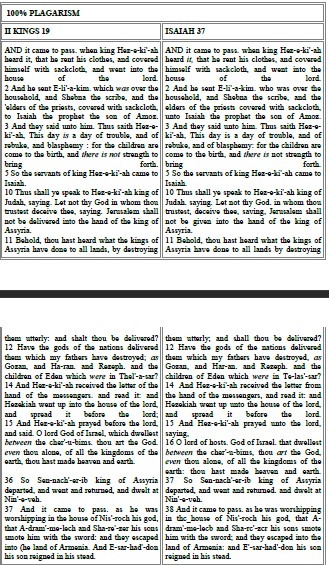
Diese Verse sind der Authorised Version entnommen, doch man findet dasselbe in jeder Übersetzung.
These verses are culled from the Authorised Version, but you will find the same in every Version.
Keine verbale Inspiration
No Verbal Inspiration
(Für eine vollständige Liste aller Bücher der Bibel und ihrer Verfasser ziehe man die „Collins'" R.S.V. mit ihren Anmerkungen zu Rate.) Was haben christliche Gelehrte zum „Buch Jesaja" zu sagen? Sie sagen: „HAUPTSÄCHLICH ISAIAS ZUGESCHRIEBEN. TEILE KÖNNTEN VON ANDEREN GESCHRIEBEN WORDEN SEIN." Angesichts der Bekenntnisse der Bibelwissenschaftler wollen wir den armen Jesaja nicht zur Rechenschaft ziehen. Können wir dann dieses Plagiat an die Tür Gottes nageln? Welch eine Gotteslästerung! Professor Cumptsy bestätigte bei der Fragerunde am Ende des erwähnten Symposiums, dass die „Christen nicht an eine wörtliche Inspiration der Bibel glauben". Gott, der Allmächtige, hatte also nicht geistesabwesend dieselbe Geschichte zweimal diktiert! Menschliche Hände, allzu menschlich, hatten dieses sogenannte Wort Gottes – die Bibel – arg verwüstet. Doch die Bibelklopfer werden darauf beharren, dass „jedes Wort, jedes Komma und jeder Punkt der Bibel Gottes Wort ist!"
(For a complete list of all the books of the Bible and their authors, avail yourself of the "Collins'" R.S.V. 'with' its annotations). What have Christian scholars to say about the "Book of Isaiah?" They say: "MAINLY CREDITED TO ISAIAH. PARTS MAY HAVE BEEN WRITTEN BY OTHERS" In view of the confessions of Bible scholars, we will not take poor Isaiah to task. Can we then nail this plagiarism on the door of God? What blasphemy! Professor Cumptsy confirmed at question time, at the end of the aforementioned symposium that the "Christians do not believe in a verbal inspiration of the Bible" So God Almighty had not absent-mindedly dictated the same tale twice! Human hands, all too human, had played havoc with this so-called Word of God — the Bible. Yet, Bible-thumpers will insist that "every word, comma and full stop of the Bible is God's Word!"