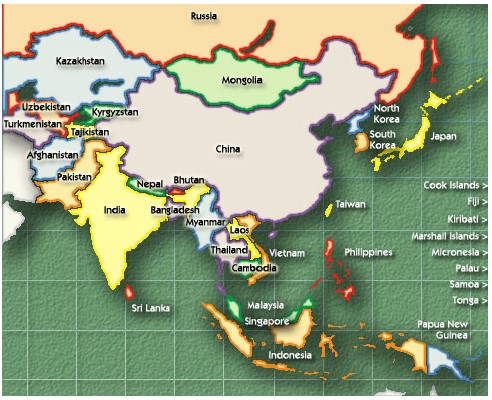
In Chinas 5000-jähriger Geschichte war es nie eine Supermacht und hat nie das globale Machtgleichgewicht beeinflusst. Selbst als es den Kommunismus übernahm, trug es ihn nie über seine Grenzen hinaus und beeinflusste keine der Regionen der Welt. Ein großer Teil der 5000-jährigen Geschichte Chinas besteht aus inneren Kriegen und Kämpfen zur Einigung des Heimatlandes. Chinas Außenpolitik ist auf die wirtschaftliche Entwicklung im Inland und die Beschaffung aller notwendigen Rohstoffe zur Erreichung dieser Ziele ausgerichtet. China hat die Eindämmungspolitik der USA herausgefordert, indem es versucht, die Staaten zu schwächen, mit denen die USA China eindämmen wollen. Dies geschieht durch Handel und den Ausbau bilateraler Beziehungen, mit denen die Beziehungen der USA zu Ländern wie Australien, Indien, Japan und Südkorea gelockert werden sollen.
In China’s 5000 year history it has never been a superpower and has never influenced the global balance of power. Even when it adopted Communism it never carried this beyond its borders and never influenced any of the regions of the world. Much of China's 5000 year history is composed of internal wars and struggles in order to unify the homeland. China’s foreign policy is centred on domestic economic development and procuring all the necessary raw materials to achieve such aims. China has challenged America’s containment policy by attempting to weaken the nations the US is attempting to use to contain China. This is through using trade and developing bilateral ties to loosen US relations with the likes of Australia, India, Japan and South Korea.
Aufgrund dieser Realität hat sich China auf seine Region konzentriert und bislang wenig Ambitionen über die Region hinaus gezeigt. Chinas Politik der „Perlenkette“ ist sein erstes Unterfangen jenseits der Region. Die US-Regierung beschrieb die Politik wie folgt: „Die ‚Perlenkette‘ beschreibt die Manifestation des wachsenden geopolitischen Einflusses Chinas durch Bemühungen, den Zugang zu Häfen und Flugplätzen zu erweitern, besondere diplomatische Beziehungen aufzubauen und die Streitkräfte zu modernisieren, die sich vom Südchinesischen Meer durch die Straße von Malakka, über den Indischen Ozean bis zum Persischen Golf erstrecken.“10 Die Seewege verlaufen durch die strategischen Engpässe der Bab-el-Mandeb-Straße, der Straße von Malakka, der Straße von Hormus und der Lombokstraße sowie durch weitere strategische maritime Interessen entlang Pakistan, Sri Lanka, den Malediven und Somalia. All dies sind zentrale strategische Routen für Öl und Gas, und sie werden unweigerlich zu einem Zusammenstoß mit den USA führen.
Due to this reality China has focussed on its region and as of yet has shown little ambition beyond the region. China’s string of pearls policy is its first venture beyond the region. The policy was described by the US government as follows: “The “String of Pearls” describes the manifestation of China’s rising geopolitical influence through efforts to increase access to ports and airfields, develop special diplomatic relationships, and modernize military forces that extend from the South China Sea through the Strait of Malacca, across the Indian Ocean, and on to the Persian Gulf.”10 The sea lines run through the strategic choke points of Strait of Mandab, Strait of Malacca, Strait of Hormuz and Strait of Lombok as well as other strategic naval interests along Pakistan, Sri Lanka, Maldives and Somalia. All of these are key strategic routes for oil and gas and will inevitably lead to a clash with the US.
China zeigt derzeit nur wenig globalen Ehrgeiz, ein alternatives Weltsystem aufzubauen. Tatsächlich hat es sich in Amerikas globales System eingefügt: in den Handel – die WTO, in die Sicherheit – die Vereinten Nationen und in die Finanzordnung – den IWF und die Weltbank. China scheint seine Interessen eher innerhalb des bestehenden Systems verfolgen zu wollen, als es ersetzen zu wollen. Mit einer derart engen Sichtweise wird China politisch niemals in der Lage sein, die USA herauszufordern. Sollte China tatsächlich die Absicht haben, zur Weltmacht Nummer eins aufzusteigen, dann müsste es nicht nur die USA herausfordern, sondern auch eine Reihe innenpolitischer Probleme lösen, die andernfalls zu einer massiven innenpolitischen Spaltung führen würden. Dazu gehören:
China currently has shown little global ambition in constructing an alternative global system. It has in fact amalgamated into America’s global system of trade - WTO, security – United Nations and finance – IMF and the World Bank. China appears to be working to achieve its interests from the existing system rather than attempting to replace it. With such a narrow view China will politically never be able to challenge the US. If China has any plans to become the world superpower then it will not just need to challenge the US, but solve a number of domestic issues which would otherwise cause a massive fracture domestically, these include:
China-Entwicklung hat ihre Wurzeln in Deng Xiaopings Versuchen, Sonderwirtschaftszonen (SEZ) zu schaffen, die ausländische Investitionen und Technologie ins Land holten und zu einer neuen Quelle des Wohlstands wurden. Heute ist China eine exportorientierte Volkswirtschaft und auf ausländische Staaten angewiesen, die weiterhin bei ihm einkaufen. Daher gilt: Egal wie groß die Währungsreserven Chinas sind, wie billig seine Arbeitskraft ist oder wie weit seine technologische Entwicklung fortgeschritten ist, China ist darauf angewiesen, dass andere Nationen bei ihm kaufen und die Waren physisch abtransportieren. Eine Seeblockade würde China lahmlegen. Die Welt importiert aus China auf Kosten der Schließung eigener Fabriken; solange keine andere Nation Waren der Welt günstiger herstellt als China, wird China die Werkbank der Welt bleiben. China ist heute die industrielle Werkbank der Welt; es bleibt vollständig davon abhängig, dass die Welt weiterhin bei ihm und nicht bei anderen kauft. Dies ist ein sehr fragiles Entwicklungsmodell.
- China’s development is rooted in Deng Xiaoping’s attempts at creating special economic zones (SEZ) which allowed foreign investment and technology and became a new source of wealth. China today is an export oriented economy and dependent on foreign countries to continue importing from it. Therefore whatever the size of China’s currency reserves, no matter how cheap its labour force or its technological developments, China relies on foreign nations to import from it and physically ship them – A naval blockade would cripple China. The world imports from China at the cost of closing down their own factories, as long as no other nation produces the worlds goods cheaper than China, China will remain the world’s workshop. China today is the world’s industrial workshop; it remains totally dependent on the world to continue buying from it rather than anyone else, this is a very fragile model of development.
Die Rolle als industrielle Fabrik der Welt hat zu wirtschaftlicher Entwicklung und enormem Wohlstand geführt. Für sich allein macht dies eine Nation jedoch nicht zu einer Weltmacht. Während China zur Fabrik der Welt geworden ist, bewegt sich dies alles am unteren Ende der Technologieleiter.
Der Autor James Fallows vom Atlantic Monthly verbrachte ein Jahr in China und beobachtete die industrielle Maschinerie des Landes aus nächster Nähe. Er verglich Chinas gegenwärtige Fertigungskapazität mit dem U-förmigen Lächeln eines fröhlichen Gesichts und veranschaulichte die Entwicklung eines Produkts von seiner ersten Konzeption bis zum endgültigen Verkauf. Am linken oberen Ende der Kurve stehen die erste Idee und das industrielle Design, die Produktdetails und wie es am Ende aussehen und funktionieren wird. Weiter unten auf der Kurve steht der detaillierte Plan eines Ingenieurs. Am Tiefpunkt der Kurve stehen die Fertigung, Montage und der Versand. Dann steigt auf der rechten Seite der Kurve die Distribution, das Marketing, der Einzelhandel, der Verkauf, Serviceverträge, Ersatzteile und Zubehör an.
Fallows stellte fest, dass in fast der gesamten verarbeitenden Industrie Chinas China den unteren Teil der Kurve übernimmt und die USA den oberen. „Einfach ausgedrückt: Das eigentliche Geld steckt in der Marke plus dem Einzelhandel.“ Die Enden des U sind dort, wo das Geld liegt, und die USA dominieren diesen Bereich weltweit. China schlägt rasch denselben Weg ein, an dessen Ende Japan stand. In den 1980er-Jahren sollte Japan die US-Wirtschaft überholen und deren Platz als Supermacht der Welt einnehmen. Wie China wurde es zur industriellen Fabrik der Welt, doch letztlich zeigte die asiatische Finanzkrise von 1997, wie falsch die Vorstellung war, dass eine exportgetriebene Politik tatsächlich dorthin führt.
- Being the world’s Industrial factory has lead to economic development and created immense wealth. However on its own this does not turn a nation into a world power. Whilst China has become the world’s factory, this is all at the lower end of the technology ladder. The Atlantic monthly writer James Fallows spent a year in China, watching the nation’s industrial machine up close. He compared China’s current manufacturing capability to the U shaped smile on a happy face , he illustrated the development of a product, from its initial conception to its eventual sale. At the top left of the curve there is the initial idea and industrial design, the products details and how it will eventually look and work. Lower down the on the curve is the detailed plan by an engineer. At the bottom of the curve is the manufacturing, assembly and shipping. Then rising up on the right of the curve is the distribution, marketing, retail, sale, service contracts, parts and accessories. Fallows observed that in almost all the manufacturing industry in China, China takes care of the bottom of the curve and the US the top. “The simple way to put this – that the real money is in the brand name, plus retail.”11 The ends of the U is where the money is and the US dominates this area globally. China is fast going down the road Japan ended in. Throughout the 1980’S Japan was meant to overtake the US economy and replace it as the world’s superpower, similar to China it became the worlds industrial factory, in the end the Asian financial crisis of 1997 proved the fallacy of what an export led policy actually leads to.
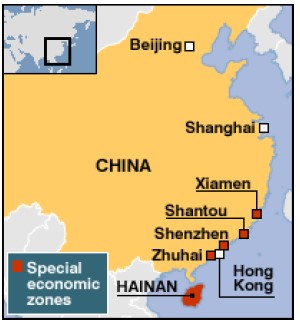
Chinas rasche wirtschaftliche Entwicklung war alles andere als gleichmäßig. Die Sonderwirtschaftszonen (SWZ) wurden allesamt an Chinas Ostküste errichtet, und alles, was die Produktionslinien hervorbringen, wird als Fracht auf Schiffe verladen und in die ganze Welt exportiert. Die Küstenregion ist dadurch mit der globalen Wirtschaft verflochten; sie hat den Großteil von Chinas rasanter Entwicklung erlebt und eine neue Generation von Kaufleuten reich gemacht, und das alles auf Kosten des übrigen Chinas. Der größte Teil Chinas ist heute nach wie vor weitgehend agrarisch geprägt, verfügt über wenig Infrastruktur und lebt in Armut. Daraus ist Chinas massives innergesellschaftliches Zusammenhaltsproblem erwachsen.
China’s rapid economic development has been anything but equal. The Special Economic Zone’s (SEZ) were all constructed on China’s Eastern coast and everything that comes of the production line is placed on ships as cargo and exported to the world. The coastal region as a result is interlinked with the global economy; it has seen most of China’s rapid development and enriched a new breed of merchants, all at the expense of the rest of China. Most of China today remains largely agrarian, has little infrastructure and lives in poverty. This has created China’s massive internal cohesion problem.