6.2 Maktab ta'limi bosqichlari
6.2 School education stages
Ta'limni bosqichlarga bo'lishda har bir bosqichda o'quvchining bola yoki balog'atga yetgan (baaligh) shaxs sifatidagi holatiga e'tibor berish lozim. Shuningdek, bunga bog'liq ravishda, ya'ni vali (waliyy al-amr) uni qanday tutishi va shunga ko'ra ustoz hamda tarbiyachi uning bilan qanday muomala qilishi bilan bog'liq Shariat dalillari va hukmlarga murojaat qilishimiz kerak, chunki Islomda Yaratuvchi, Tadbir qiluvchi (Al-Mudabir), olamlar Rabbi insonlarning bir-biri bilan qanday muomala qilishini tartibga soluvchi majburiy tizimni joriy etgan.
While dividing teaching into stages, we must pay attention to the student’s reality as a child or mature (baaligh) person at each stage. And we must refer to the Shari’ah evidences and rules they denote as related to the child or mature person with respect to how his guardian (waliyy al-amr), and consequently the teacher and educator deals with him, since in Islam, the Creator the Director (Al-Mudabir), the Lord of the World, has brought a binding system to regulate how humans deal with each other.
Mazkur masalaga oid dalillardan biri Alloh Taolonning shu so'zidir (An-Nur surasi, 58-oyat):
Among the evidences related to this subject is Allah Ta’ala’s saying (Surah An-Nur Ayah 58):
﴿يََ أَيُّ هَا الَّ ي ذينَ آمَنُوا لييَسْتَأْيذنكُمُ الَّ ي ذينَ مَلَكَتْ أَيَْْانُكُمْ وَالَّ ي ذينَ لََْ يَ بْ لُغُوا الُْْلُمَ يمنكُ مْ ثَلََثَ مَرَّا ت يمِّن قَ بْيل صَلََية الْفَجْير وَي حينَ تَضَعُونَ ثييَابَكُم يمِّنَ الظَّيهيرَية وَيمن بَ عْ ي د صَلََية الْيعشَايء ثَلََثُ عَوْرَا ت لَّكُمْ لَيْسَ عَلَيْكُمْ وَلَا عَلَيْيهمْ جُنَاحٌ بَ عْدَهُنَّ طَوَّافُونَ عَلَيْكُم بَ عْضُكُمْ عَلَىٰ بَ عْ ض كَذَٰليكَ ي بَُييِّنُ اللَّ هُ لَكُمُ الْآيََ ي ت وَاللَّ هُ عَلييمٌ حَ ي كيمٌ ﴾ “Ey iymon keltirganlar! Qo‘l ostingizdagi mulk qilgan (qullar) va sizlardan balog‘atga yetmaganlar (sizning huzuringizga kirishdan oldin) uch marta ijozat so‘rasinlar: bomdod namozidan oldin, tushlik paytida kiyimlaringizni yechib qo‘yganingizda va xufton namozidan keyin. Bu uchta vaqt sizlar uchun avratdir (yolg‘iz qolish vaqtidir). Bulardan keyin na sizlarga, na ularga gunoh yo‘q, chunki ular bir-laringizning oldida-keyinida aylanib yuradilar. Shunday qilib, Alloh sizlarga oyatlarni bayon qiladi. Alloh Bilguvchi, Hikmat egasidir.” Va Uning Ta’olo quyidagi oyatda aytdi:
﴿يََ أَيُّ هَا الَّ ي ذينَ آمَنُوا لييَسْتَأْيذنكُمُ الَّ ي ذينَ مَلَكَتْ أَيَْْانُكُمْ وَالَّ ي ذينَ لََْ يَ بْ لُغُوا الُْْلُمَ يمنكُ مْ ثَلََثَ مَرَّا ت يمِّن قَ بْيل صَلََية الْفَجْير وَي حينَ تَضَعُونَ ثييَابَكُم يمِّنَ الظَّيهيرَية وَيمن بَ عْ ي د صَلََية الْيعشَايء ثَلََثُ عَوْرَا ت لَّكُمْ لَيْسَ عَلَيْكُمْ وَلَا عَلَيْيهمْ جُنَاحٌ بَ عْدَهُنَّ طَوَّافُونَ عَلَيْكُم بَ عْضُكُمْ عَلَىٰ بَ عْ ض كَذَٰليكَ ي بَُييِّنُ اللَّ هُ لَكُمُ الْآيََ ي ت وَاللَّ هُ عَلييمٌ حَ ي كيمٌ ﴾ “O you who have believed, let those whom your right hands possess and those who have not [yet] reached puberty among you ask permission of you [before entering] at three times: before the dawn prayer and when you put aside your clothing [for rest] at noon and after the night prayer. [These are] three times of privacy for you. There is no blame upon you nor upon them beyond these [periods], for they continually circulate among you - some of you, among others. Thus does Allah make clear to you the verses; and Allah is Knowing and Wise.” And He Ta’ala said in the following Ayah:
﴿وَإِذَا بَلَغَ الْأَطْفَالُ مِنْكُمُ الْحُلُمَ فَلْيَسْتَأْذِنُوا كَمَا اسْتَأْذَنَ الَّذِينَ مِنْ قَبْلِهِمْ كَذَٰلِكَ يُبَيِّنُ اللَّهُ لَكُمْ آيَاتِهِ وَاللَّهُ عَلِيمٌ حَكِيمٌ﴾ “Va bolalaringizdan balog'at yoshiga yetganlar ruxsat so'rasinlar, xuddi ulardan oldingilar ruxsat so'raganlari kabi. Shunday qilib, Alloh sizlarga O'z oyatlarini bayon qiladi. Alloh – Bilguvchi, Hikmat egasidir.” [An-Nur: 59] Va Nabiy ﷺ aytdilar:
﴿وَإيذَا بَ لَغَ الْأَطْفَالُ يمنكُمُ الُْْلُمَ فَ لْيَسْتَأْيذنُوا كَمَا اسْتَأْذَنَ الَّ ي ذينَ يمن قَ بْيليهمْ كَذَٰليكَ ي بَُييِّنُ اللَّ هُ لَكُمْ آيََتييه وَاللَّ هُ عَلييمٌ حَ ي كيمٌ ﴾ “And when the children among you reach puberty, let them ask permission [at all times] as those before them have done. Thus does Allah make clear to you His verses; and Allah is Knowing and Wise.” [An-Nur: 59] And the Prophet (SAW) said:
"Qalam uch kishidan kaytarilgan: aqli buzilgan, aqli qoplangan majnundan to ayiq holatiga kelguncha, uxlab yotgan kishidan to uyg'onguncha va balog'atga yetmagan boladan to balog'atga yetguncha." (Abu Dovud o'zining "Sunan" kitobida rivoyat qilgan.) Va u (SAW) dedi: «Ey Asmo, ayol kishi hayz ko'rish yoshiga yetganda, undan bu va bu(dan) boshqasi ko'rinmasligi kerak», - deb yuzi va kaftlariga ishora qildi. (Abu Dovud o'zining "Sunan" kitobida rivoyat qilgan.) Va 'Atiya al-Qurazidan rivoyat qilinadi, u dedi:
رفع القلم عن ثلَثة، عن المجنون المغلوب على عقله حتى يفيق، وعن النائم حتى « » يستيقظ، وعن الصبي حتى يحتلم “The pen (i.e. accountability) is lifted from three persons: The insane whose mind is overcome until he recovers, the sleeper until he awakes and the child until he attains puberty.” (Narrated by Abu Dawud in his Sunan). And he (SAW) said: » يَ أسماء إن المرأة إذا بلغت المحيض لَ تصلح أن يرى منها إلا هذا وهذا « “‘O Asma, when the female reaches the age of menstruation, nothing should be seen of her except this and this’ and he indicated his face and palms.” (Narrated by Abu Dawud in his Sunan). And from ‘Atiya Al-Quradhi who said:
Bizni Quraycha kuni Nabiy ﷺ huzuriga olib kelindi. Kimning tuki o'sib chiqqan bo'lsa, o'ldirildi, o'smagan kishi esa qo'yib yuborildi. Men tuki o'smaganlar qatorida edim, shuning uchun meni qo'yib yuborishdi. (Termiziy o'z "Sunan" kitobida rivoyat qilgan.) U yana rivoyat qildi,
)عُيرضنا على النبي يوم قريظة فكان من أنبت قُتيل، ومن لَ ينبت خُلِّى سبيله، فكنت ممن لَ ينبت فخُلِّى سبيلي( “We (i.e. Bani Quraydha) were shown to the Prophet on the Day of Quradhya. Whoever had grown pubic hairs was killed while the one without growth was released. I was among those without growth so I was released.” (Narrated by Tirmidhi narrated in his Sunan). He also narrated,
Ushbu matn: "S'ad Quraydha haqida hukm chiqargandan keyin, Nabiy (ﷺ) ularning izorlarini (shaxsiy a'zolarini yopuvchi kiyimlarini) ochib ko'rishni buyurdi." Va Usmon (roziyallohu anhu) bolani olib kelinganda aytdi: «Uning izoriga qarang». Ular uning ostida tuk o'smaganini topdilar, shuning uchun uning qo'lini kesmadilar. Bunga hech bir sahoba inkor qilmadi. Nabiy (ﷺ) esa aytdilar: «Farzandlaringizni yetti yoshga kirganlarida namozga buyuring, o'n yoshga kirganlarida namoz uchun ularni urishingiz mumkin, va ularni yotoqlarida bir-biridan ajratib qo'ying». (Imom Ahmad o'zining "Musnad" kitobida rivoyat qilgan.) Bu dalillar shuni ko'rsatadiki, bolalik davri bolalar balog'atga, ya'ni voyaga yetish yoshiga yetganda tugaydi. Islom bolalikni voyaga yetishdan ajratuvchi aniq belgilarni belgilab qo'ydi: o'g'il bolalarda tush ko'rish (ihtilom) yoki qovoq tukining paydo bo'lishi, qiz bolalarda esa hayz ko'rish yoki homiladorlik. Shuningdek, voyaga yetganlarga qo'llaniladigan qoidalar bundan oldin ularga qo'llanilmasligini ko'rsatdi. Nabiy (ﷺ) aytdilar: «Farzandlaringizni yetti yoshga kirganlarida namozga buyuring, o'n yoshga kirganlarida namozni tark etgani uchun ularni urishingiz mumkin». (Imom Ahmad "Musnad"da rivoyat qilgan.) Hadis bolalarni tarbiyalashni ikki bosqichga bo'lganini ko'rsatadi: Birinchi bosqich — bola o'n yoshga to'lgunga qadar, bunda uni tarbiyalash uchun urish ishlatilmaydi, chunki hadis uni namozga faqat buyurish bilan cheklaydi va urishni ruxsat etmaydi. Demak, namozdan boshqa narsalarni o'rgatishda, a'lo darajada, uni urish yo'q. Uning tarbiyasi nasihat va ogohlantirish uslublari bilan, urishsiz cheklanadi. Ikkinchi bosqich — bola o'n yoshga to'lgandan balog'atgacha bo'lgan davr, bunda zarur bo'lganda uni urish ham tarbiyaning bir qismi hisoblanadi. Shu bilan birga, hudud va shariat jazolari (uqubot) balog'at yoshiga, ya'ni voyaga yetish bosqichiga yetmagunicha unga nisbatan qo'llanilmaydi, chunki Payg'ambar ﷺ shunday deganlar:
» أنَّ النبي لما حكَّم سعد اً فِ بني قريظة كان يكشف عن مؤتزرهم « “That after S’ad adjudicated regarding Quraydha, the Prophet commanded with exposing their wrappings (covering their private parts).” And Uthman said when a young boy was brought to him: » انظروا إلى مؤتزره، فوجدوه لَ ينبت فلم يقطع « “Look at his wrapper. They found him without pubic hair so they did not cut (his hand)” and no Sahabah denied this. And he (SAW) said: مروا صبيانكم بالصلَة إذا بلغوا سبعاً، واضربوهم عليها إذا بلغوا عش راً، وفرقوا بينهم « » فِ المضاجع “Command your children to pray when they attain seven years, and beat them over it (not praying) when they attain ten years. And separate between them in the beds.” (Narrated by Imam Ahmed in his Musnad). These evidences indicate that childhood ends when children attain puberty i.e. the age of maturity. Islam assigned distinctive tangible milestones separating childhood from maturity: when wet dreams occur or pubic hairs appear in males, and menstruation or pregnancy for females. It also indicated that the rules that are applied upon those attaining puberty do not apply upon them beforehand. And he (SAW) said: » مُ ر وا أبناءكم بالصلَة لسبع سنين واضربوهم عليها لعشر سنين « “Command your children to pray when they attain seven years, and beat them over it (for not praying) when they attain ten years” (Narrated by Imam Ahmed in his Musnad). The hadith shows that disciplining children is divided into two stages: The stage before the child attains ten years where beating is not used to discipline him because the hadith restricts one to command him with prayer without beating him. Thus, by greater reason, he is not beaten for being taught other than the prayer. His discipline is restricted to styles of exhortation and threats without beating. And the stage after he attains ten years until puberty his discipline includes beating him if necessary. However the hudood and Shari’ah punishments (‘uqoobaat) do not apply upon him until after attaining puberty i.e. the stage after maturity due to his (SAW) saying:
"Qalam ko'tarilgan" uch kishi bor: bolа balog'atga yetguncha, uxlayotgan kishi uyg'onguncha va aqli noqis (ma'toh) kishi tuzalguncha. (Abu Dovud o'zining "Sunan" kitobida rivoyat qilgan.) Bu yerda » رُفع القلم عن ثلَثة « — "qalam ko'tarilgan" iborasi javobgarlikdan ozod etilishni anglatadi. Bola balog'atga yetganda, Shariat uni javobgar deb hisoblaydi, shuning uchun u Shariat qoidalarini buzsa yoki harom ish qilsa, sud hukmi bilan jazolanadi. Bu esa maktablarda o'quvchilar balog'atga yetgan bosqichlarda va oliy ta'limda sud xodimlarining mavjudligini talab qiladi.
رُفع القلم عن ثلَثة، عن الصبيِّ حتى يبلغ، وعن النائم حتى يستيقظ، وعن المعتوه « » حتى يبرأ “The pen (i.e. accountability) is lifted from three persons: The child until he matures, the sleeper until he awakes and the imbecile until he recovers” (Narrated by Abu Dawud in his Sunan). The meaning of » رُفع القلم عن ثلَثة « “lifting the pen” here is non-accountability. When children attain puberty, the Shar’a deems them accountable so they are punished by judicial decree if they commit a violation (of the Shari’ah rules) or a haram. This requires the presence of judges in schools of mature students and higher level education.
Tarbiya (bolalarni tarbiyalash) va intizom ta'limning shartlari bo'lgani uchun, o'quv bosqichlarini tuzishda bola va balog'atga yetgan shaxsga oid bu qoidalarga rioya qilinishi lozim. Birinchi bosqich bola maktabga kirgan paytdan to o'n yoshga to'lguncha davom etadi. Ikkinchi bosqich uning o'n yoshga to'lganidan to balog'atga yetguncha davom etadi, balog'at odatda mo''tadil iqlimli mamlakatlarda o'n besh yoshda yuz beradi. Uchinchi bosqich esa o'n besh yoshdan to maktab ta'limini tugatguncha davom etadi.
These rules with respect to the child and mature person must be observed when devising teaching stages since tarbiyyah (raising of children) and discipline are prerequisites of education. The primary stage extends from the child’s entry into school until he reaches ten years. The second stage extends from his attaining ten years until puberty which normally occurs at fifteen years of age in countries of moderate climate. And the third stage extends from fifteen years until he completes school education.
Ushbu dalillar va qoidalarga ko‘ra, Xilofat davlatida maktab ta’lim bosqichlari o‘quvchilarning yoshiga asoslanib bo‘linadi, maktab o‘qitadigan fanlarga qarab emas. Maktablar quyidagicha uch turga bo‘linadi:
Based upon these evidences and rules, school teaching stages in the Khilafah State are divided upon the basis of student ages and not subjects offered by the school. Schools are divided into three types in the following manner:
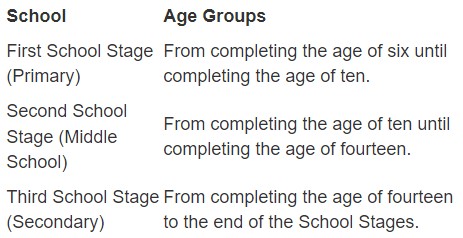
Talaba o'n yoshga to'lganidan so'ng, u o'quv natijalaridan qat'i nazar, ikkinchi maktab bosqichiga o'tkazilishi uchun g'amxo'rlik qilinadi. Va u balog'at yoshiga yetganida, akademik jihatdan bu bosqichga erishgan-erishmaganidan qat'i nazar, uchinchi maktab bosqichiga (balog'at yoshiga yetgan talabalar maktablariga) o'tkaziladi. Tez orada biz Ta'lim vazirligi davlat maktablarida joriy etadigan o'quv choraklari tizimi talabalarni yosh guruhlariga mos ravishda maktablarga joylashtirishni qanday ta'minlashini ko'rsatamiz.
Once the student completes ten years of age, care is taken to transfer him to the second stage of schooling irrespective of his academic achievement. And once he attains puberty, he is transferred to the third school stage (schools of students who reached puberty) whether or not he has attained that stage academically. We shall soon demonstrate how the system of school terms that will be implemented by the Education Department in State schools, guarantees the assigning of students to schools according to their age groups.
Oltі yoshgacha bo'lgan ta'lim (bolalar bog'chalari va maktabgacha ta'lim muassasalari) masalasiga kelsak, bu xalqning ixtiyoriga havola qilingan. Agar kimdir shu maqsadda xususiy maktab ochmoqchi bo'lsa, unga buni qilishga ruxsat beriladi, faqat davlat o'qitiladigan fanlar va ularning Xalifa tomonidan qabul qilingan ta'lim siyosatiga muvofiqligi bo'yicha bu ta'limni nazorat qilgan taqdirda.
As for education before six years, (Nurseries and Kindergarten), this is at the people’s discretion. If one wishes to establish a private school for this purpose, one is allowed to do so provided the State supervises this teaching with respect to study subjects and their conformity to the education policy adopted by the Khalifah.