14.2 The Development Of Fiqh
Fiqh is one of the most important Islamic disciplines having the greatest effect on society. It is one of the most important branches of the Islamic culture. That is because the Islamic culture is the Qur’ān and Sunnah and whatever is relied upon and laid down in order to understand the Qur’ān and Sunnah. Even though the Islamic culture includes the sciences of the Arabic language, hadīth and tafsīr, the most prominent thing that appears from it are the thoughts which relate to the viewpoint about life and the solutions which treat the problems of life. In other words, it appears in the beliefs (‘aqaid) and Sharī’ah rules because they are a practical culture adopted to face lifes problems which, in most cases, contains thoughts about beliefs and solutions i.e, the rules. Fiqh is nothing other than the knowledge of these rules.
The Islamic culture and the learning of Sharī’ah rules began from the time the Messenger was sent. The Messenger was the only reference point for the Sharī’ah rules because he was sent to teach people Allah’s deen. He said:
“O Messenger (saw)! Proclaim (the Message) which has been sent down to you from your Lord. And if you do not, then you have not conveyed His Message” [TMQ Mā’idah: 67]
He said:
“And We have also sent down unto you (O Muhammad(saw)) the reminder and the advice (the Qur’ān), that you may explain clearly to them” [TMQ Nahl: 44]
With the exception of the Messenger no Muslim has the right to independently put forward an opinion regarding any viewpoint or ruling. Due to the Messenger’s presence among them referring to him regarding anything they came across was easy, It was still not permitted for any of them to give his personal opinion regarding any event. That is why, when they came across an event or a dispute arose or one of them had an idea they would refer to the Messenger . And he would give an opinion, settle their disputes and answer their questions, sometimes with an ayah and sometimes with a hadīth. As for what has been reported that certain Sahabah exercised Ijtihād in the time of the Messenger and pronounced judgements according to their own Ijtihād in certain disputes or that they deduced the rule regarding certain events through their own Ijtihād. This does not make these Ijtihāds a source for Sharī’ah rules. Rather they constitute an understanding of the Sharī’ah in accordance with the order of the Messenger . They constitute the application of the Sharī’ah, relying on the Qur’ān and Sunnah as understood by those mujtahidin. This is demonstrated by the circumstance in which these Ijtihāds took place. It has been reported that the Prophet sent ‘Ali ibn Abi Talib to Yemen as a judge. He told him:
“May Allah guide your heart and affirm your tongue. When two disputants sit before you, do not pronounce judgment until you have listened to the latter just as you did with the former. It is more proper ( for you to does this) so that the judgment becomes manifest to you” [Reported by Abu Dawud on the authority of ‘Ali Ibn Abi Talib
It has been reported that the Prophet sent Mu’az ibn Jabal to Yemen and he said to him:
“With what will you judge when you come upon a judgement which you do not find in the Book of Allah or the Sunnah of His Messenger. What judgment will you give? Mu’az said: ‘I will exercise my own Ijtihād The Messenger said: ’‘Praise be to Allah who has made the messenger of the Messenger of Allah to accord with what Allah and His Messenger are pleased with” [Recorded by Abu Dawud]
It is reported that some people were disputing over a hut between themselves so Hudhayfa was sent to judge between them. Bukhari & Muslim report on the authority of ‘Amr bin al-‘Aas that he heard the prophet say:
“If the judge passes a judgment and makes ijtihaad and is right, he will have two rewards. If he passes a judgment and makes ijtihaad, and makes a mistake, he will have one reward”
All of these reports and other such examples indicate that the Ijtihādat that the Muslims performed during the days of the Messenger were in accordance with his order. Therefore, he was their source. Thus, the time of the Messenger was a time in which the source of the entire Islamic culture existed. That continued from the time he was sent until his death, in a period of time not exceeding twenty two years and a few months in which the whole Qur’ān was revealed and the sublime Sunnah was completed. These are the only texts considered as the source of thoughts, rules and culture in Islam.
With the death of the Messenger in the eleventh year of the Hijra began the age of the Sahabah. It is an age of tafsīr and the opening of the doors of deduction (istinbat) for issues that did not possess a (clear) text. The Sahabah saw that not all of the texts of the Qur’ān and the Sunnah were disseminated widely amongst the people such that they were accessible to each and every person because the texts of the Qur’ān were written down on special parchments preserved in the house of the Messenger and preserved in the houses of certain Sahabah and the Sunnah had not been written down yet. They found that the texts of the Qur’ān and Sunnah legislated rules for events and issues which took place at the time of legislation. Rules were not legislated for events and issues that only had a possibility of taking place. Needs, events and issues took place amidst the Muslims which did not take place during the time of the Messenger , there were no texts for the the problems arising later which would state their ruling. Likewise, they saw that not every Muslim was qualified to refer to the texts of the Qur’ān and Sunnah by himself and understand the ruling indicated by them, since the masses cannot understand the texts except by means of someone who will make them understand the rules of Islam. Therefore, they realised that it was incumbent on them to disseminate the Noble Qur’ān and the ahadīth of the Messenger among the Muslims. So they undertook the responsibility of compiling the Qur’ān and from this compilation they made many copies which they circulated amongst the Muslims and they took precautions ensuring the trustworthiness of the narration of the Sunnah and the trust in the scrutiny of the narrators. They also realised that it was incumbent on them to demonstrate to the Muslims the necessary clarification and explanation of the texts of the Qur’ān and Sunnah. So they began to teach people the deen, then they took the view that they should provide people with legal verdicts for the events and issues happening to them for which there was no (clear) text. Thus, they began to deduce rules which were necessary for the issues that took place. Due to this they undertook the obligation of the deen in the best manner possible.
The methodology according to which the Sahabah proceeded in the Sharī’ah rules is that when they found a text (nass) in the Qur’ān or Sunnah which indicated the ruling on an incident that has happened they stopped at the limit of this text and they confined their efforts to understanding the text and becoming acquainted with what is intended in it in order to attain its correct application on the reality. If they did not find a text in the Qur’ān and the Sunnah indicating the ruling on incidents that they are confronted with, they performed Ijtihād to deduce its ruling. In their Ijtihād they used to rely on their own understanding of the texts of the Sharī’ah and their knowledge of the Sharī’ah that they obtained by directly speaking to the Messenger and witnessing the revelation of the verses and their application on incidents. By studying the incidents for which they made Ijtihād one will notice that they used to make analogy between (an incident) which had a text with one that did not have a text and they did not consider the acquisition of a benefit (maslaha) and repulsion of a harm (mafsada) as an ‘illah (legal cause) for rulings rather they used to consider the benefit (maslaha) indicated by the Sharī’ah as the true benefit (maslaha). They used to make analogy between the benefit (maslaha) (for which no text was mentioned) with a benefit for which a text was mentioned. They did not hold their own opinion about a maslaha (benefit) because holding an opinion (which is from oneself) is forbidden. The historians, muhaddithin and fuqaha (jurists) transmitted many Ijtihādat of the Sahabah. By studying these Ijtihādat the extent of their adherence to the Sharī’ah and the extent of their advancement in understanding the Sharī’ah becomes clear. A story was brought to the attention of ‘Umar about a man who was killed by his stepmother and her lover.
‘Umar hesitated: are many people to be killed for the murder of one person? ‘Ali said to him: What do you think if a group participated in the theft of a slaughtered camel such that they distributed it amongst themselves. Would you cut their hands? He said: Yes. Ali said: well it is the same thing. So Umar acted upon Ali’s opinion and wrote to his ‘Amil: ‘kill them both for if the whole population of San’aa participated I would have had them killed.
Similarly when they disagreed about the question of joint share, when a woman died leaving a husband, mother, uterine brothers and full brothers. ‘Umar used to give the husband half, the mother a sixth, and the uterine brothers a third. So nothing remained for the full brothers. It was said to him: Suppose our father was a donkey. Are we not from one mother? So he changed his view and gave them a share. They used to acquaint themselves with the maslaha (benefit) for which the text came, if it was understood from the text. Another example is when Allah said:
“As-sadaqat (zakat) are only for the Fuqara (poor), and al-masakin (needy) and those employed to collect (the funds); and for to attract the hearts of those who have been inclined (towards Islam)” [TMQ Tawba: 60]
So Allah made those whose hearts have to be a reconciled (towards Islâm) an expenditure from the sources of zakat. It has been established that the Prophet used to give money to people whose hearts had been reconciled with Islam. After the death of the Messenger it is narrated about ‘Umar that he forbade the payment of those whose hearts had been reconciled (al-mu’allaftu qulubuhum). He told them:
‘Allah has made Islam strong and so Islam is in no need of you, either you stick to Islam or else between you and us is the sword.’
Umar was of the view that the reconcilings of hearts towards Islam was there because the state was weak because the expression, for the expression ‘reconciling hearts’ (ta’leeful al-qulub) indicates this. For when do you reconcile hearts except when you are in a state of need for them (the people) ? Umar took the opinion that the need to reconcile hearts ended when Islam became strong, without the need to reconcile hearts, the ‘illah (legal cause) does not apply and due to this the hukm also does not apply.
The Sahabah used to investigate and ask the people about the Sharī’ah texts regarding matters they did not know and they (may Allah be pleased with them) used to be all gathered together in the Hijaz, discussing the Qur’ān and Sunnah. If they did not find a hukm in the Qur’ān and Sunnah for the issue they were looking for they would ask Muslims if any of them knew what the Messenger of Allah passed as a judgement for the issue. That is why they used to refer to each other and get together to discuss the issues and give an opinion for it. Abu Bakr and ‘Umar used to deduce rules and refer to the people. Al-Baghawi has narrated in his Masabih al-Sunnah:
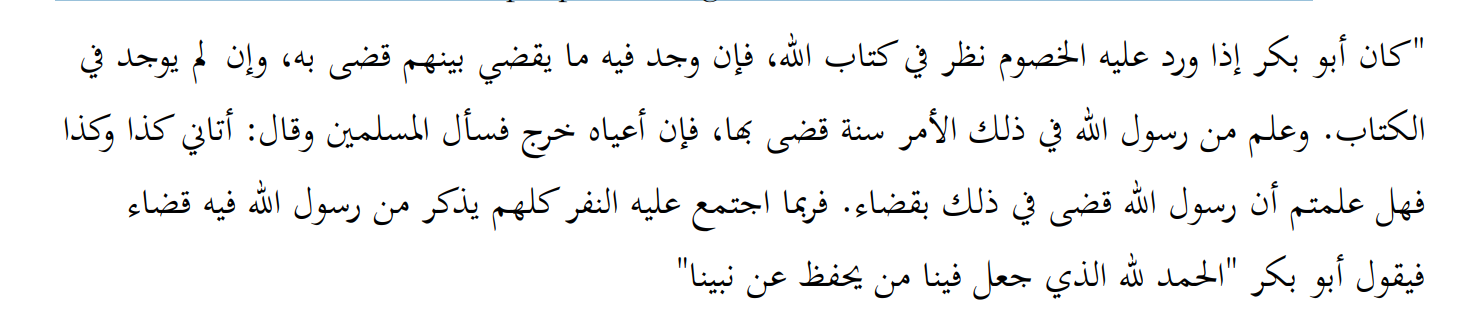
‘When a dispute was reported to Abu Bakr he used to look into the Book of Allah . If he found something to judge between them he gave that judgement and if it is not found in the Qur’ān and he knew a Sunnah from the Messenger of Allah regarding that matter he would give judgement by it. Failing that he would go out and ask the Muslims; such and such matter has come to me do you know of any judgement given by the Messenger of Allah pertaining to this?’ Probably the whole group would agree mentioning a judgment by the Messenger of Allah . Abu Bakr would say: ‘Praise be to Allah Who has made people amongst us memorise (issues) concerning our Prophet .
If he failed to find a Sunnah of the Messenger of Allah he gathered the heads of people and the best amongst them and consulted them. If they had a consensus on a matter he would judge with that. It has been reported that ‘Umar used to consult the Sahabah despite his knowledge of fiqh to the extent that when an incident would be refered to him he would say: Call ‘Ali for me, call Zayd. He used to consult them and settle the dispute with whatever they were agreed upon. Due to the Sahabah’s reference to each other differences of opinion between them were rare because each Sahābi expressed to another Sahābi his own perspective and the evidences he educed. Their view on the whole was true and correct and each one referred to the other. And even though their views differed in certain rules but their differences were rare and it was in their understanding and not in the method of understanding.
When the conquests expanded and the Sahabah became separated in various cities and it became difficult for these Sahabah to meet, every time an incident occurred which had no text, each Sahabah gave his own opinion without expressing it to others or referring to others due to the difficulty in meeting since the cities were distant from each other and also due to the need of giving an opinion on an incident occurring in the city in order pass judgement by it. In every Muslim city there was one or more Sahabah. They were the reference point for rulings. They used to deduce rules which had no text and assume the task of clarifying and explaining the text just as they took the responsibility of teaching the people the Qur’ān and Sunnah. The Sunnah had still not been written down, therefore the opinions of Sahabah differed about a single incident and each one had an evidence for the opinion he had educed and gave legal verdicts with. However, all of these opinions were Sharī’ah rules and were acceptable to all of them since their disagreement was only in their understanding. As for their method of Ijtihād it was one which is to consider the text of the Qur’ān and hadīth and examine the texts, and ensure that the accredited maslahas (benefit) are the ones only indicated by the Sharī’ah and make analogy to issues and maslahas. The unity of the methodology in Ijtihād did not allow the difference in understanding to have any effect. On the contrary it was one of the reasons for the growth and expansion of fiqh. Their legal verdicts (fatwas) were according to the incidents and issues that took place. The range of their disagreement did not widen and nor did it overstep the furu’ (branches of fiqh). The disagreement of the Sahabah in furu’ is attributable to two reasons:
First: That most of the texts of the Qur’ān and Sunnah are not definite in indicating what is meant rather they are of speculative meaning (zanniyya al-dalāla). Also they are liable to indicate this or that meaning due to the text sharing two or more linguistic meanings or the text being general such that it is open to specification. Each Mujtahid attempted to understand the text according to what was preponderant from the qara’in (indications).