Quran Course
All BooksDownloads
All BooksDownloadsSystem Of Islam
Also visitSystem Of Islam
Built with love by StudioToronto.ca
Quran Course
All BooksDownloads
All BooksDownloadsSystem Of Islam
0%
The Islamic Personality5 min readViewed 3 times

9. Science And Culture


In Arabic language it is said: the man has obtained (‘alima) knowledge (‘ilm). This means that he attained the true reality of knowledge (‘ilm). He gained knowledge of a thing means he became cognisant of it, which means that he became informed of a matter or acquainted with it. Also in the language it is said: He has gained comprehension (thaqifa), which means that he has become proficient, thus he is educated and cultured (thaqif). He has understood (thaqifa) a language (means) he has mastered and understood it swiftly. These linguistic meanings are the basis of the use of words, However if these words were used to indicate other meanings that relate to the linguistic meaning then that is permitted, like in the case of the adoption of the word fa’il (subject) in grammar for example. The linguistic meaning (of the words) was prevailing and this is why the ancients used to apply the word ‘ilm on all forms of knowledge without differentiating between the sciences and disciplines. Then people began to consider intellectual and natural disciplines as being general to all people whilst other traditional (textual) disciplines were considered specific to the nation from which it was transferred. Subsequently, each of science (‘ilm) and culture (thaqafa) began to be defined according to different specific disciplines, acquiring terminological meanings which were different to their linguistic meanings. According to this terminology they have the following meaning: Science (‘ilm) is the knowledge which is acquired through observation, experimentation and education like physics, chemistry and the rest of the empirical sciences and culture (thaqafa) is the knowledge which is acquired by way of transmission, learning and deduction as in (the study of) history, languages, jurisprudence (fiqh), philosophy and the rest of the non-empirical disciplines. And there are other non-empirical disciplines which are included as sciences (‘ilm) even though they come within culture such as arithmetic, engineering and industry; even though they come under culture (thaqafa) they are regarded as part of science because they are universal to all people and not specific to any one nation. In a similar way anything from the culture related to crafts which resemble industry such as trade and shipping; they are considered to be part of science and they are universal. As for the arts such as; painting, sculpture and music they are part of culture. They follow a particular viewpoint; which is a specific culture. The difference between culture (thaqafa) and science (‘ilm)

is that science is universal to all nations and not specific to any nation to the exclusion of another nation. As for culture (thaqafa) it might be specific, being ascribed to the nation from which it resulted or it may be part of the nation’s specific and particular characteristics such as literature and biographies of heroes, and their philosophy concerning life or they may be universal such as trade, shipping etc. Therefore, science is adopted universally from all nations because it is universal and not specific to any particular nation. As for culture (thaqafa) the nation should begin with its own culture, when she has studied it and is cognisant of it until it becomes focused in their minds then they can study other cultures. The Muslims used to differentiate between the sciences which a person used to attain by himself and the sciences he used to receive from others. Ibn Khaldun says in his book al-Muqaddima:
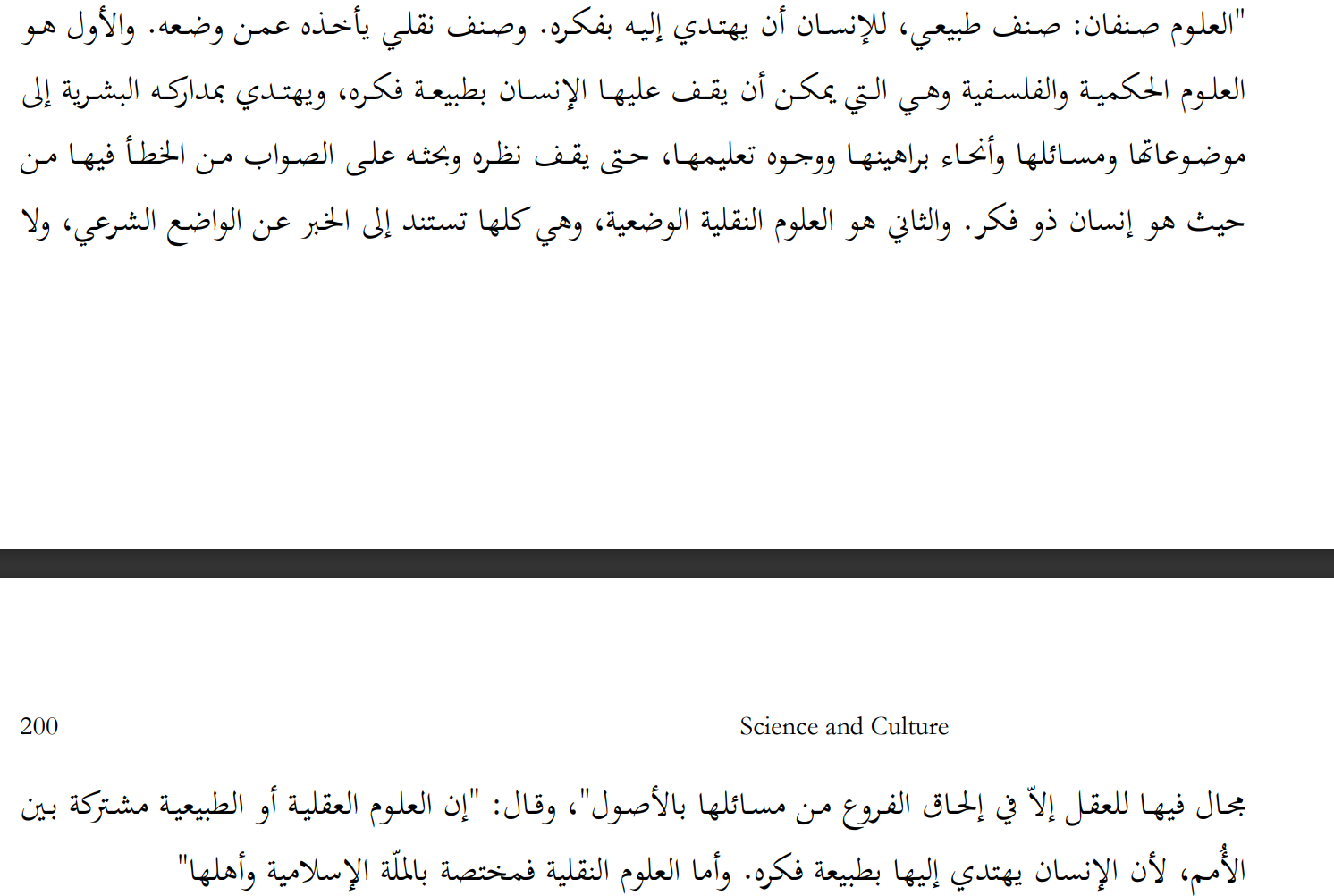
“The sciences are of two types: A natural type which is for man to arrive at through his thinking and a textual type which he takes from the one who authored it. The first are the philosophical and aphoristic sciences which he can seek by his thought and be guided through the human faculties to its subjects and issues and all its decisive proofs and aspects of its teachings. So as in his discernment and study he attains the correct (opinion) from the incorrect, in his capacity as a human being possessing the faculty of thought. The second are the textual and written sciences. They depend on the report coming from a shar’i source. The mind has no scope in this regard except to relate the branch issues to the usul (foundation)”.

He also said “The rational or natural sciences are common to all nations since man arrives at them naturally through his thought. As for the textual sciences they are specific to the Muslim religion and its adherents.” It appears that what Ibn Khaldun meant by specifying the textual sciences with the Islamic millah was only an example because nations other than the Islamic nation as well have textual sciences specific to them such as their legislation and language. Ibn Khaldun’s statement does not indicate that he distinguished between science and culture. It only indicates that he distinguished between textual and rational sciences. His comments are not an evidence to say that the Muslims used to differentiate between science and culture rather they are an evidence to prove that the Muslims used only to differentiate between disciplines. Thus, they divided them into two sections. However their division was in terms of their general acquisition and not in terms of the manner of acquisition. So they designated them as rational sciences i.e, acquired via the mind. And textual sciences acquired from the text. However, people today differentiate between disciplines in terms of the manner in which they were received. Thus, they apply the term ‘science’ (‘ilm) on anything that is acquired through the empirical method and they apply the term ‘culture’ (thaqafa) on anything acquired by means other than the empirical method

← Previous chapterNext chapter →
Chapters (185)
  1. 1Transliteration Guide
  2. 21. Personality
  3. 31.1 The Islamic Personality
  4. 41.2 The Formation Of Personality
  5. 51.3 Gaps In Conduct
  6. 62. The Islamic Aqidah
  7. 72.1 The Meaning Of Imān In The Day Of Resurrection
  8. 82.2 The Emergence Of The Mutakallimīn And Their Approach
  9. 92.3 The Error In The Methodology Of The Mutakallimīn
  10. 102.4 How The Issue Of Al-qadaa’ Wa‘l- Qadar Emerged
  11. 112.5 Al-qadr
  12. 122.6 Al-qadā’
  13. 132.7 Al-qadā’ Wa‘l-qadar
  14. 142.8 Guidance And Misguidance
  15. 152.9 The Termination Of The Life-span [ajāl ] Is The Sole Cause Of Death
  16. 162.10 Provision [rizq] Is In The Hands Of Allah Alone
  17. 172.11 The Attributes [sifāt] Of Allah
  18. 182.12 The Muslim Philosophers
  19. 192.13 The Prophets And Messengers
  20. 202.14 The Infallibility Of The Prophets
  21. 212.15 The Revelation
  22. 222.16 It Is Not Allowed On The Part Of The Messenger Pbuh That He Be A Mujtahid
  23. 233. The Noble Qur'ān
  24. 243.1 The Compilation Of The Qur’ān
  25. 253.2 The Qur’ānic Script
  26. 263.3 The Miracle Of The Qur’ān
  27. 274. The Sunnah
  28. 284.1 The Sunnah Is A Sharī’ah Evidence Like The Qur’ān
  29. 294.2 Inferring Evidences From The Sunnah
  30. 304.3 The Solitary Report (khabar Al-ahad) Is Not A Decisive Proof (hujjah) For Beliefs
  31. 314.4 The Difference Between The ‘aqīdah And The Sharī’ah Rule (hukm Shar’i)
  32. 325. Ijtihād And Taqlīd
  33. 335.1 Expert Research (ijtihād)
  34. 345.2 The Conditions Of Ijtihād
  35. 355.2 Taqlīd
  36. 365.3 The Reality Of Taqlīd
  37. 375.4 The States Of Muqallidin And Their Preponderant Qualifications
  38. 385.5 Migrating From One Mujtahid To Another
  39. 396. Learning The Sharī’ah Rule
  40. 407. The Strength Of The Evidence (quwwa Al-dalīl)
  41. 418. Consultation (shūrā) Or The Adoption Of An Opinion In Islam
  42. 429. Science And Culture
  43. 439.1 The Islamic Culture
  44. 449.2 The Method Of Study In Islam
  45. 459.3 Acquisition Of Culture (thaqafa) And Sciences
  46. 469.4 The Cultural Movement
  47. 479.5 The Position Of Muslims With Regards To Non- Muslim Cultures
  48. 4810. The Islamic Disciplines
  49. 4910.1 Tafsīr (qur’ānic Exegesis)
  50. 5010.2 The Exegetical Approaches Of Mufassirun
  51. 5111. Sources Of Tafsīr
  52. 5211.1 The Ummah's Need Today For Mufassirin
  53. 5312. The Science Of Ḥadīth (‘ilm Al-ḥadīth)
  54. 5412.1 The Hadīth
  55. 5512.2 The Transmitters Of Hadīth (ruwat Al Hadith)
  56. 5612.3 The One Whose Narration Is Accepted And The One Whose Narration Is Not Accepted And The Exposition Of (the Science Of) Invalidation And Attestation Of Reliability (al-jarh Wa Ta'dīl)
  57. 5712.4 Narrations Of The Muslim Sects
  58. 5812.5 Arration By Meaning (riwaya Bil Ma’na) And Abridgement Of The Hadīth
  59. 5912.6 Categories Of Hadīth
  60. 6012.7 Categories Of The Khabar Al-ahād
  61. 6112.8 The Accepted Hadīth (maqbul) And The Rejected Hadīth (mardud)
  62. 6212.9 The Mursal Hadīth
  63. 6312.10 The Ḥadīth Qudsi
  64. 6412.11 The Inability To Prove The Authenticity Of A Hadīth From Its Sanad Does Not Indicate That It Is A Weak Hadīth
  65. 6512.12 Consideration Of The Hadīth As An Evidence In The Sharī’ah Rules
  66. 6613. Prophetic Biography (sīrah) And History
  67. 6714. The Principles Of Islamic Jurisprudence (usūl Al-fiqh)
  68. 6814.1 Fiqh (jurisprudence)
  69. 6914.2 The Development Of Fiqh
  70. 7014.3 The Effect Of Disputes And Debates (munazarat) On Islamic Jurisprudence
  71. 7114.4 The Flourishing Of Islamic Jurisprudence
  72. 7214.5 The Decline Of Islamic Jurisprudence
  73. 7314.6 The Myth Of The Influence Of Roman Law On Islamic Jurisprudence
  74. 7415. Studying Fiqh
  75. 7516. Examples (namadhij) Of Fiqh
  76. 7617. The Khilafah
  77. 7717.1 The Time Limit Given For Muslims To Appoint A Khalifah
  78. 7817.2 Contracting (in’iqad) The Khilafah
  79. 7917.3 The Pledge (bay’ah)
  80. 8017.4 The Conditions Of Eligibility For The Khalifah
  81. 8117.5 Seeking The Khilafah Post
  82. 8217.6 The Unity Of The Khilafah
  83. 8317.7 Succession (istikhlaf) Or Reign (‘ahd)
  84. 8417.8 The Method To Appoint The Khalifah
  85. 8517.9 The Shar'a Did Not Designate A Specific Person For The Khilafah
  86. 8617.10 General Responsibilities/duties
  87. 8718 The Islamic State Is A Human State And Not A Theocratic State.
  88. 8818.1 Deposing Or Removal Of The Khalifah
  89. 8919. The Leadership (al-imarah)
  90. 9019.1 Obedience (at-ta’ah)
  91. 9119.2 The Khalifah's Adoption Of Rules And Styles I.e. Adopting Canons
  92. 9220. Jihad
  93. 9320.1 The Khalifah And Jihad
  94. 9420.2 The Meaning Of The Khalifah Supervising The Army's Leadership
  95. 9520.3 The Martyr
  96. 9620.4 Guarding The Frontiers (ar-ribat)
  97. 9720.5 The Islamic Army
  98. 9820.6 Seeking The Assistance Of Disbelievers In Fighting
  99. 9920.7 Preparing The Islamic Army
  100. 10020.8 Flags And Banners
  101. 10120.9 Captives
  102. 10221. The War Policy
  103. 10321.1 Lying In War
  104. 10421.2 Spying
  105. 10521.3 Truce (hudna)
  106. 10621.4 Military Alliances
  107. 10721.5 Permissible Treaties
  108. 10821.6 Emergency Treaties
  109. 10921.7 Annulling Treaties
  110. 11021.8the Belligerent Disbeliever (kafir Harbi)
  111. 11121.9 The Protected Person (al-m'ustamin)
  112. 11221.10 The Rules Of The Dhimmi
  113. 11322. Implementing Islam Is Obligatory Upon The Disbelievers
  114. 11423. The Jizyah
  115. 11524. The Lands Of Ushr, Kharaj And Sulh (truce)
  116. 11625. Dar Al-kufr And Dar Al-islam
  117. 11726. The Believer's Befriending The Disbelievers
  118. 11826.1 The Emigration (hijrah) From Dar Al-kufr To Dar Al-islam
  119. 11927. The Position Of Islam On Slaves And Slavery
  120. 12027.1 Treating Slaves
  121. 12127.2 Treating Slavery
  122. 12228. Relationships Between Individuals
  123. 12329. Trade (bai’)
  124. 12429.1 Everything Forbidden For Man, Trading It Is Also Forbidden
  125. 12529.2 It Is Not Allowed To Sell What You Do Not Have
  126. 12629.3 The Selling Of Advance Credit (as-salam)
  127. 12729.4 Buying Fruits While They Are Still On The Tree
  128. 12829.5 Sale On Credit And Instalments (taqseet)
  129. 12929.6 Brokerage (samsara)
  130. 13030. Hiring
  131. 13130.1 The Employee
  132. 13230.2 The Wage
  133. 13330.3 Estimating The Wage
  134. 13430.4 The Amount Of The Wage
  135. 13530.5 Paying The Wage
  136. 13630.6 Types Of Employees
  137. 13730.7 There Is No Labour Problem In Islam
  138. 13830.7 Hiring Assets
  139. 13930.8 Renting Houses For Residence
  140. 14031. All Bribery Is Forbidden
  141. 14132. Mortgage/ Pledging Security
  142. 14232.1 The Pledgee Benefiting From The Pledge
  143. 14333. The Bankrupt
  144. 14434. Transfer Of A Right (al-hawala)
  145. 14535. Drawing & Painting
  146. 14636. Usul Al-fiqh
  147. 14736.1 Al-hākim
  148. 14836.2 There is no hukm Prior to the coming of the revelation
  149. 14936.3 The legally responsible with respect to the shari’ah rulings
  150. 15037. The conditions of legal responsibility [shurūt al-taklīf]
  151. 15137.1 The legal ruling [al-hukm al-shar’i]
  152. 15237.2 The address of legal responsibility [khitab al-taklīf]
  153. 15337.3 The obligatory [al-wajib]
  154. 15437.4 That which is required to fulfill a wājib is itself wājib
  155. 15537.5 The prohibition [al-harām]
  156. 15637.6 The permissible [al-mubāh]
  157. 15737.7 The declaratory address [khitāb al-wad’]
  158. 15938. The Cause ( Al Sabab)
  159. 16039. The Condition ( Al Shart)
  160. 16140. The Prohibitive ( Al Manay)
  161. 16241. The Validity, The Invalidity, And The Corruption ( Al Sihhah, Wal Butlan, Wal Fasaad)
  162. 16342. The Determination And The Consession ( Al Azeema War Rukhsah)
  163. 16443. The Shari'ah Evidences ( Al Adilla-tul- Shariyah )
  164. 16544. The Shariah Evidences Must Be Decisives ( Al Adillah- Tu-shariah Yajebo An Takoona Qateyyah)
  165. 166What Is Considered As A Proof (hujjah) Of The Qur’aan
  166. 167Al-muhkam Wa Al-mutashabih The Precise And The Imprecise
  167. 168The Second Daleel Al–sunnah
  168. 16948. The Status Of The Sunnah In Relation To The Qur'aan
  169. 17049. Divisions Of The Sunnah (aqsaam Al Sunnah)
  170. 17150. The Mutawaatir
  171. 17251. The Number By Which The Certainty Occurs
  172. 17352. The Famous Hadeeth (al Mashhour)
  173. 17453. The Individuals Report (khabar Al Aahaad)
  174. 17554. The Narrators Of The Hadeeth (ruwaat Al Hadeeth)
  175. 17655. Types Of The Individuals Report
  176. 17756. Conditions For Accepting The Individuals Report
  177. 17857. The Actions Of The Messenger
  178. 17958. The Ways By Which The Direction (quality) Of The Action Of The Messenger Can Be Known
  179. 18059. The Silence Of The Prophet (saw)
  180. 18160. The Conflict Between The Actions Of The Messenger (saw)
  181. 18261. The Conflict Between The Action Of The Messenger (saw) And His Saying
  182. 18362. The Conflict Between The Sayings Of The Messenger (saw)
  183. 18463. The Inference (al Istidlaal) From The Kitaab And The Sunnah
  184. 18564. The Language Discussions
  185. 18665. The Way To Know The Arabic Language