2.7 Al-qadā’ Wa‘l-qadar
Al-qadā’ wa‘l-qadar, with this name, that is, by connecting two words together for one meaning, has a specific referent; that is, al-qadā’ linked to al-qadar, by making them two concomitant matters whereby one is not separable from the other, and they have a meaning that is exclusive to them. It is not correct to include in it other than this meaning which has not been used by the Sahabah or the Tabi’een. By studying the shar’i and linguistic texts and studying the sayings of the Sahabah, Tabi’een and those who came after them from the Ulama’, it is apparent that the terms al qadā’ wa‘l-qadar together, have not been used with a specific technical [istilāhī] meaning by any of the Sahabah or Tabi’een, nor have they come together with a specific technical meaning in the Qur’ān or the Hadīth; though they have come together in their linguistic meaning in what al Bazzār reported from the hadīth of Jabir with a hasan chain on the authority of the Prophet (PBUH) that he said:
“Most of my Ummah die after the qadā’ of Allaah and his qadar with the souls [anfūs].”
Therefore this terminological meaning which alludes to this name is not found except from the Mutakallimūn, after the first century had passed and after the translation of the Greek philosophy. It did not exist in the time of the Sahabah nor was there any dispute or discussion of those two terms as one name for a specific technical meaning. Throughout the era of the Sahabah the Muslims did not know of ‘al-qadā’ wa‘l-qadar’ though the word qadā’ had come on its own and the word qadar had come on its own in the ahadīth just as the two had come together in the aforementioned hadīth of Jabir, but in all of these cases they had come in the linguistic meaning. They have not come in the technical meaning. The word qadā’ has come in the hadīth of al-qunut. Al-Hasan said, the Messenger of Allah (PBUH) taught me words I say in the qunut of the witr, then he mentioned the du’a of qunut, of which is,
“...and save me from what You have decreed, for You are the one Who Decrees and you are not decreed upon,” [Reported by al-Darimi , Narrated by al-Hasan ibn Ali]
Its meaning is, protect me from the evil of what you have judged, for you judge what you wish and no one judges over you. The word qadar has come in the hadīth of Jibrīl in some of its narrations: He said,
“And to believe in al-qadar, the good and the bad thereof”, [Reported by Muslim, Narrated by Umar ibn al-Khattab]
And in his saying
“…If anything befalls you do not say, ‘had I done (this), it would have been such-and-such, but rather say, ‘Allah determined [qaddara] and He did what He willed,’”[Reported by Muslim, Narrated by Abu Hurairah]
The meaning of the word qadar in these two ahadīth is the Determination [taqdīr] and Knowledge of Allah , that is, that you should believe that the things have been written by Allah in the Lawh al-Mahfūdh and He knows of them before they come into existence, whether they be good or bad; and say Allah has written this in the Lawh al-Mahfūdh and he knew it before it came into being and he did what he wished. The word al-qadā’ in the meaning which it came in this hadīth or anywhere else it came was not disputed by the Muslims; they did not have discussions with regards to its wording or its import.
As for the word qadar in the meaning mentioned in those two ahadīth, the Muslims, before the presence of Greek philosophy, did not disagree about it or have discussions with regards to its wording or import. But after the presence of the Greek philosophy amongst the Muslims, a group from Kufa arose and said: there is no qadar, that is, there is no one who (pre)determines and everything occurs without any previous determination; they were called the Qadariyyah and they are the ones who deny the qadar and say that Allah created the fundamentals of things and then left them, so He does not have knowledge of their particulars [juz'iyāt]. This is contrary to what has come in the clear text of the Qur’ān which states that Allah is the Creator of all things, small or big, fundamental or branchial, and that He determined everything before its existence, that is, He wrote it in the Lawh al-Mahfūdh, that is, He knew it before it came to be. He said:
“He created all things and He is the All-Knower of everything” [TMQ-An’ām: 101]
And
“And He knows whatever there is in the Earth and in the sea: not a leaf falls, but He knows it. There is not a grain in the darkness of the Earth nor anything fresh or dry, but is written in a Clear Record.” [TMQ-An’ām: 59]
However, this disagreement and discussion is only with respect to the ‘qadar of Allah’ in terms of His Knowledge. So the Qadariyyah claimed that Allah knows the fundamentals of things but not their partial aspects, whilst Islam states that Allah knows the fundamentals of things as well as their partial aspects. Thus, the discussion with respect to the qadar of Allah , that is, His Knowledge, is about the subject of Allah's Knowledge. It is a subject different to that of al-qadā’ wa‘l-qadar. It is a different discussion, separate from the discussion of al-qadā’ wa‘l-qadar. Its reality that took place is the same, that is, it is a different subject to that of al-qadā’ wa‘l-qadar.
Thus, it is plainly apparent that the words al-qadā’ and al-qadar have each come on their own with each having a specific meaning. They do not have any relation with the study of al-qadā’ wa‘l qadar. In other words, the word al-qadā’ in all its linguistic and shar’i meanings that have come from the Legislator, and the word al-qadar in all its linguistic and shar’i meanings that have come from the Legislator, have no relation to any of these terms, whether mentioned alone or together, in the discussion of al-qadā’ wa‘l-qadar. They are confined with regards to their meaning, to that what they come with from the linguistic and shar'i meanings.
The ayāt which have come in demonstrating the Knowledge of Allah are the ones that indicate the all-encompassing nature of Allah's Knowledge with regards to all things, thus His saying:
“No calamity befalls on the Earth or in yourselves but is inscribed in a Book, before We bring it into existence. Indeed, that, upon Allah, is easy” [TMQ-Hadīd: 22]
And His saying,
“Say: ‘Nothing shall ever happen to us except what Allah has ordained for us. He is our Mawla.’ Then in Allah let the believers put their trust” [TMQ Tawba: 51]
And His saying,
“Escapes not from His Knowledge even the weight of an atom, in the Heavens or in the Earth, or less than that, or greater, but it is in a Clear Book” [TMQ Saba: 3]
And His saying,
“It is He, Who takes your souls by night, and (Who) has knowledge of all that you have done by day, then He raises (wakes) you up again that a term appointed be fulfilled, then unto Him will be your return. Then He will inform you what you used to do” [TMQ An’ām: 60]
These verses were revealed to the Messenger (PBUH) and they were memorised and understood by the Sahabah, it did not occur to them to discuss al-qadā’ wa‘l-qadar. Furthermore, the wording, understanding and indication of these verses states that they are a clarification about the Knowledge of Allah and have no relation to the study of al-qadā’ wa‘l-qadar. Similarly the ayah,
“And if some good reaches them, they say, ‘This is from Allah’, but if some evil befalls them, they say, ‘This is from you’. Say: ‘All things are from Allah’; so what is wrong with these people that they fail to understand any word?’ [TMQ-Nisā’: 78]
It has nothing to do with the discussion of al-qadā’ wa‘l-qadar because it is a refutation of the kuffār who differentiated between bad and good. Thus, they made bad to come from the Messenger and good from Allah . So Allah refuted them by declaring that everything is from Allah . The discussion is not about the good that a human being does and the evil that he pursues; rather the discussion is about fighting and death. The ayah itself and that what precedes it clarifies this:
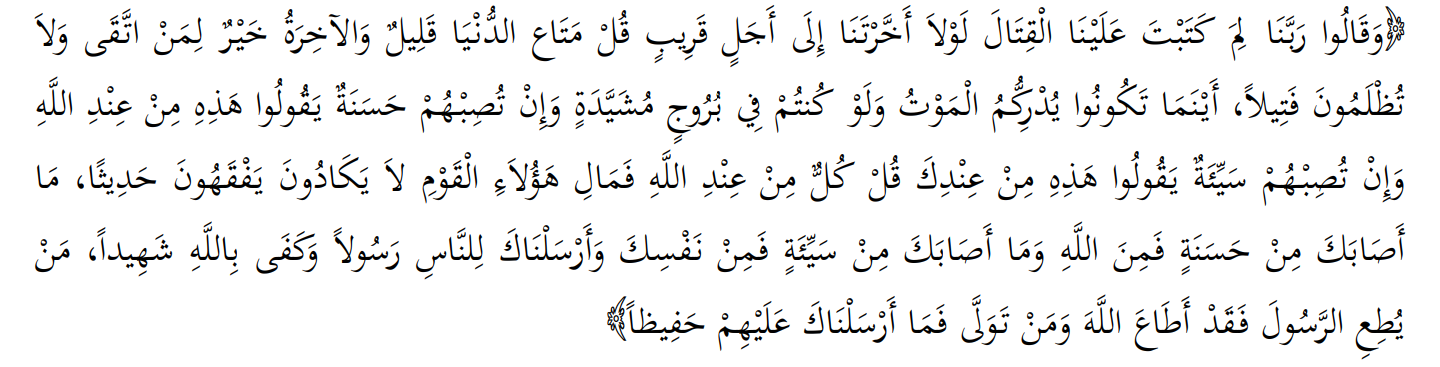
“They say: Our Lord! Why have you ordained for us fighting? Would that you have granted us respite for a short period?’ Say: ‘Short is the enjoyment of this world. The Hereafter is (far) better for him who fears Allah, and you shall not be dealt with unjustly in the least. Wheresoever you may be, death will overtake you even if you are in fortresses built up strong and high! And if some good reaches them, they say, ‘This is from Allah,’ but if some evil befalls them, they say, ’This is from you.’ Say: ‘All things are from Allah’, so what is wrong with these people that they fail to understand any word? Whatever of good reaches you, is from Allah, but whatever of evil befalls you, is from yourself. And We have sent you (O Muhammad) as a Messenger to mankind, and Allah is sufficient as Witness. He who obeys the Messenger, has indeed obeyed Allah, but he who turns away, then we have not sent you as a watcher over them.” [TMQ-Nisā’: 77-80]
So the subject is what befalls them and not what they are doing. Thus it has nothing to do with the study of al-qadā’ wa‘l-qadar.
Therefore, all that has been mentioned above has nothing to do with the study of al-qadā’ wa‘l qadar; they do not come under its meaning and have no relation whatsoever with what has been mentioned above. Rather, al-qadā’ wa‘l-qadar as a meaning has come from Greek philosophy which was transmitted by the Mu'tazilah who gave an opinion with regards to it. Ahl al-Sunnah and the Jabriyyah refuted them and Ahl al-Sunnah (also) made a refutation of the Jabriyyah. The discussion was confined to the same meaning and preceded upon the same premise. Thus the issue is a meaning/sense that came from Greek philosophy and it came to the fore in the debate which used to take place between the Muslims and the kuffar who used to be armed with the Greek philosophy. It is a meaning which has a relevance to the ‘aqīdah (creed), thus what is desired is to give Islam's opinion regarding this meaning. The Mu'tazilah gave an opinion and the Jabriyyah refuted them and gave another opinion. Ahl al-Sunnah refuted all of them and gave an opinion, and said about it that it is a third opinion which has come out from the two opinions and they described it as ‘the pure milk, sweet to drink, that comes out from between excrement and blood’.
Therefore, the subject of discussion, which came from the Greek philosophy, became known, and since it is related to the ‘aqīdah (creed), the Muslim must be clear as to what his belief is regarding this subject. The Muslims did actually state their opinion and three schools of thought arose. Thus it is not allowed to refer the issue of al-qadā’ wa‘l-qadar to what has come of the meaning of al-qadā’ or al-qadar, linguistically and in the Sharī’ah, nor is it allowed to imagine or conceive for al-qadā’ or ‘al-qadar any meaning from mere supposition, conception or imagination, and to say, for example, that al-qadā’ is the universal judgement on only the universals and al qadar is the universal judgement on the partial aspects and its details, or to say that al-qadar is the eternal plan for things and al-qadā’ is the execution and creation according to that predetermination and plan. Indeed, this is not allowed because this is mere imagination, assumption and a failed attempt of applying certain linguistic and shar’i expressions because they do not apply to it, they rather indicate general meanings; . It would then be an arbitrary action to restrict the two words to these specific meanings without evidence.
Similarly, it is not allowed to claim al-qadā’ wa‘l-qadar is a secret from amongst the secrets of Allah and that we have been forbidden to discuss it, because there is no shar’i text to say that it is one of the secrets of Allah , not to mention the fact that the subject matter is sensorially perceivable, for which an opinion must be given, so how can it be said that it cannot to be studied?! In addition to the fact that it is a rational inquiry and a subject which relates to matters that are studied by the intellect as a reality that is sensorially-perceivable; and since it relates to the imān in Allah . Thus, al-qadā’ wa‘l-qadar, in the meaning placed as the subject matter and which became part of the ‘aqīdah (creed) must be studied.
“Every soul is a pledge for what it earns,” [TMQ Muddathir: 38]