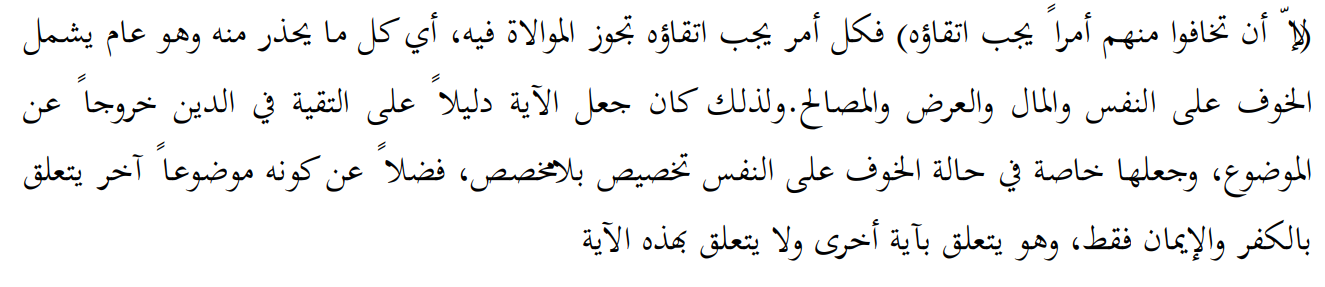
The subject is the subject of believers befriending disbelievers and the rest of the ayah is detailing the subject. This is because Allah (swt) prohibited the believers from taking the disbelievers as friends, and linked this prohibition with a definite decisiveness that the one who does that and takes the disbelievers as friends then Allah is absolved from him. The he excluded from this decisive prohibition one situation which is the believer fearing harm from the disbeliever, wherein it is allowed for him to befriend the disbelievers to prevent this harm. This is if the Muslim were under the disbelievers’ authority defeated in his affair i.e. the fear of the disbeliever permits his befriending. If the fear disappears then the befriending is forbidden. Accordingly the situation is not displaying befriending and hiding something else, but the issue is excluding the situation of the believer’s fear of the disbeliever when the Muslim is defeated in his affair from the generality of forbidding his befriending him. The meaning of the ayah is the decisive prohibition for the believers from taking the disbelievers as friends for them, and that they seek their assistance and depend upon them, and that they befriend them and there be love between them. So it forbade the believers from befriending disbelievers instead of believers then excluded one situation from this, which is in the situation where there exists fear from them when they are under their authority. Then it is allowed to display love for them and to befriend them to prevent their evil and harm. That is, it is allowed to take them as i.e. friends in the situation where there exists fear from them when they are under their rule. Apart from that, it is absolutely not allowed. This is for the disbelievers only in relation with the believers as the ayah was revealed in the affair of the believers who had relations friendship with the polytheists in Makkah. It prohibited those in Madinah from befriending the polytheists in Makkah and it prohibited all believers but excluded from that the believers who were in Makkah who were defeated in their affair. So it excluded them due to the existence of fear of the harm of the disbelievers near to them. This is the subject of the ayah and this is its meaning, and this is the Shari’ah rule deduced from it which is the forbidding of the believers befriending the disbelievers in all types of befriending, for support, friendship, assistance etc as the word (awliya) came general in the ayah covering all its meanings, and the permission of befriending them in the situation of fearing them i.e. fearing their violence and harm when the disbelievers are victorious over Muslims and the Muslims are defeated in their affair exactly like the situation of the Muslims in Makkah with the polytheists. There does not exist any other meaning in the ayah nor any rule other than this rule deducted from it. As for what some say that “taqiyyah” is that a Muslim displays opposite to what is hidden before any person from whom he fears harm or fears his knowing his reality and what is in his soul whether that person is a disbeliever or believer, this statement is pure error. The ayah does not indicate anything of this since the meaning of: “Except if you fear from them (tuqat)” i.e. except if you fear from them something to be frightened of as the meaning of “atqaytu” something “taqiyyah” is I feared it, and (tuqat) and (taqiyyah) are of one meaning. This is excluded from the prohibition of believers befriending disbelievers instead of believers so it is specific to what is excluded of it.
Accordingly displaying affection for the Muslim ruler due to fearing his harm when he is an oppressor, a transgressor, ruling by disbelief is haram. Similarly displaying affection for the Muslim contradicting you in the opinion while hiding hate for him is haram, and to show lack in restriction by Islam or not caring for it in front of the disbeliever or transgressor is not permitted. All of that and what is similar to that is hypocrisy which the Shar’a made haram upon Muslims since the subject of “Except if you fear from them something to fear (tuqat)” is restricted to the reality of Muslims who were in Makkah between polytheists i.e. restricted to the situation of the existence of Muslims under the authority of disbelievers and there is no capability for them to remove their authority i.e. defeated in their affair. Then it is allowed for them to befriend the disbelievers in fear over what is feared from them whether over their lives, wealth, honour or interests. In this situation alone it is allowed to take disbelievers as friends instead of believers. Everything that enters under this situation allows taking disbelievers as friends instead of believers. The issue is clarifying the situation wherein it is allowed for believers to befriend disbelievers which is where Muslims are defeated in their affair before disbelievers like where they are under their authority or rule; it is absolutely nothing else.
Muhammad bin Jareer At-Tabari said in his tafseer: “The view in interpreting His statement: ‘Let not the believers take the disbelievers as friends instead of believers’ until His statement ‘except if you fear from them something to be feared (tuqat).’ Abu Ja’far said: This is a prohibition from Allah (swt) for the believers not to take disbelievers as helpers and supporters and assisters. Accordingly He made (kasr) for “yatakhidhu” (to take) in the position of making the prohibition decisive but He made (kasr) for the “dhal” together with it due to the “sakina” which meets a “sakina”. The meaning of this is "Do no take, O you believers, the disbelievers as assisters and supporters befriending them, instead of Muslims, upon their religion and assist them against Muslims and direct them to their (Muslims’) weaknesses. For whoever does that then he is not from Allah (swt) in anything which means that he has been absolved from Allah (swt) and Allah (swt) is absolved from him by his apostasy from His deen and his entering into kufr ‘except if you fear from them something to be feared (tuqat)’ (i.e.) except if you are in their authority and fear them for your lives then show friendship by your tongues and hide your enmity from them but do not be partisans for what they are upon of kufr and do not help them against a Muslim by action" just as:
Al-Muthni narrated to me: Abdullah bin Sahr said: Mu’awiyya bin Salih informed me from Ali (ra) from ibn Abbas (ra) that His (swt) statement: “Let not the believers take disbelievers as friends instead of believers” except if the disbelievers become victorious so they shown them kindness but contradict them in their deen and that His (swt) statement: ‘except if you fear from them something to be feared (tuqat)’ until he said:
Al-Hasan bin Yahya narrated to me that Abdurraziq informed us that Mu’ammar informed us from His (swt) statement: ‘Let not the believers take the disbelievers as friends’ that Qatadah said: It is not allowed for a believer to take a disbeliever as a friend in his deen. And His (swt) statement: ‘Except if you fear from them something to be feared’: that there is between you and him kinship so you befriend him for that. Abu Ja’far said: That which was said by Qatadah in his interpretation is for him alone nor is it the direction which the clear apparent meaning of the ayah indicates except if you fear from the disbelievers something to be feared. The stronger of the meanings of these words is except if you fear from them something to be feared. The (taqiyyah) which Allah (swt) mentioned in this ayah is the (taqiyyah) from the disbelievers not others and Qatadah took it to mean except if you fear Allah (swt) because of the kinship between you and them something to be feared so you united its blood-relationship which is not stronger in relation to the meaning of the speech. The interpretation in the Qur’an is upon the stronger apparent (meaning) of the known speech of the Arabs as was used among them” (At-Tabari’s words ends).
And Abu Ali Al-Fadhl bin Al-Hasn At-Tabarsi said in his ‘Majmu Al-Bayan fi tafseer Al-Qur’an’ that Allah’s statement: ‘Let not the believers take the disbelievers as friends instead of believers, and whoever does that is not of Allah in anything except if you fear from them something to be feared (tuqat). And Allah warns you against Himself and to Allah is the return’ that Yaqub and Sahl recited it as (taqiyyah) which is the recitation of Al-Hasan and Mujahid with the rest as (tuqat)…When Allah clarifies that He is the King of the world and Hereafter, and All-Capable (Al-Qadir) to honour and humble, He prohibited believers from befriending those who have no honour nor humiliation from His enemies so that the eagerness becomes for what is with Him and His friends, the believers, not His enemies i.e the disbelievers. So He said: ‘Let not the believers take the disbelievers as friends/supporters (awliya)’ i.e. it does not suit the believers to take disbelievers as friends for themselves, seek assistance from them, seek refuge with them and show love for them like He (swt) said in numerous places of the Qur’an like His (swt) statement: