17.8 The Method To Appoint The Khalifah
When the Shari’ah made it obligatory upon the Ummah to appoint a Khalifah, it also defined the method by which the Khalifah is appointed. This method is proven by the Qur’an, the Sunnah and the Ijma’a of the Sahabah (ra), and this method is the bay’ah. So the appointment of the Khalifah is carried out by the bay’ah to him. The Proof that this method is the bay’ah is confirmed from the bay’ah of the Muslims to the Prophet (saw) and from the order of the Prophet (saw) for us to give bay’ah to the Imam. The bay’ah of the Muslims to the Prophet (saw) was not on his Prophethood; rather it was on ruling, since it was a bay’ah over action and not a bay’ah on belief. So the Prophet (saw) was given the bay’ah in his capacity as a ruler and not as a Prophet and a Messenger. Because the acknowledgement of the Prophethood and the Message is a matter of belief and not a bay’ah, so the bay’ah could only have been for him in his capacity as the head of the State. The bay’ah was mentioned in the Qur’an and the ahadith. Allah (swt) said:
"O Prophet, if the believing women come to give you a bay’ah that they will not associate anything as partners to Allah, not to steal, not to commit adultery, not to kill their children, not to produce any lie that they have devised between their hands and feet, nor disobey you in what is right then give them the bay’ah" [TMQ 60:12]
Allah (swt) also said:
"Lo! Those who give bay’ah to you (Muhammad) they give bay’ah only to Allah. The hand of Allah is above their hands"
Al-Bukhari reported: Ismail related to us that Malik related to me from Yahya bin Said who said: “Ubadah bin Waleed informed me that my father informed me from ‘Ubadah bin as-Samit (ra) who said:
“that we would listen to and obey him both at the time when we were active and at the time when we were tired and that we would not fight against the ruler or disobey him, and would stand firm for the truth or say the truth wherever we might be, and in the Way of Allah we would not be afraid of the blame of the blamers.
Al-Bukhari reported: Ali bin Abdullah related to us that Abdullah bin Yazeed related to us that Saeed (who is ibn al-Musayyib) who said: Abu ‘Aqeel Zahrah bin Ma’bad narrated to me from his grandfather ‘Abdullah bin Hisham who witnessed the Prophet (saw) that his mother Zaynab, daughter of Hameed, took him to the Messenger of Allah (saw) and said: “O Messenger of Allah, take his pledge. The Prophet (saw) said:
“He is a child, and rubbed (wiped) his head and said du‘a for him.”
Al-Bukhari said: ‘Abdan bin Abu Hamza related to us from Al-‘Amash from Abu Salih from Abu Hurairah (ra) who said: The Messenger of Allah (saw) said:

“(There will be three types of people whom Allah will neither speak to them on the Day of Resurrection nor will purify them from sins, and they will have a painful punishment: They are, (1) a man possessed superfluous water (more than he needs) on a way and he withholds it from the travelers. (2) a man who gives a pledge of allegiance to an Imam (ruler) and gives it only for worldly benefits, if the Imam gives him what he wants, he abides by his pledge, otherwise he does not fulfill his pledge; (3) and a man who sells something to another man after the `Asr prayer and swears by Allah (a false oath) that he has been offered so much for it whereupon the buyer believes him and buys it although in fact, the seller has not been offered such a price..”
From these three ahadith it is explicit that the bay’ah is the method of appointing the Khalifah. The hadith of ‘Ubadah states that he gave bay’ah to the Prophet (saw) to listen and obey and this is a bay’ah to a ruler. The hadith of ‘Abdullah bin Hisham states that the Prophet (saw) rejected his bay’ah because he was not mature which indicates that it is a bay’ah on ruling. From the hadith reported by Abu Hurairah (ra) it is evident that it is a bay’ah to the Imam. The word ‘Imam’ in the hadith is undefined i.e. any Imam. There are other ahadith which refer to giving bay’ah to the Imam. It is reported in Muslim via Abdullah bin ‘Amru that the Prophet (saw) said:
“Whoever gave bay’ah to an Imam giving him his handshake and the fruit of his heart should obey him as much as he can. If another person comes to dispute with him, strike the neck of the latter”.
Also Muslim narrates from Abu Said al-Khudri who said: The Prophet (saw) said:
“If a bay’ah is given to two Khalifahs kill the latter of them.”
And Muslim narrated that Abu Hazim who said: “I accompanied Abu Hurairah (ra) for five years and heard him narrate from the Prophet (saw) who said:
“The Prophets ruled over the children of Israel. Whenever a Prophet died another Prophet succeeded him, but there will be no Prophet after me. There will be Khulafaa and they will number many. They asked: What then do you order us? He said: Fulfill the bay’ah to them one after the other and give them their due. Surely Allah will ask them about what He entrusted them with.”
So the texts from the Qura'n and the Sunnah are clear that the method of appointing the Khalifah is the bay’ah. All the Sahabah understood this and followed it. So Abu Bakr (ra) was given a special bay’ah in the courtyard of Banu Sa‘ida, and a public bay’ah in the mosque, those who did not give him the bay’ah in the mosque and whose bay’ah is considered gave it later on like ‘Ali bin Abu Talib (ra). ‘Umar (ra) was given the bay’ah from the Muslims, ‘Uthman (ra) also was given the bay’ah by the Muslims and ‘Ali (ra) was given the bay’ah by the Muslims as well. So the bay’ah is the only method to appoint a Khalifah for the Muslims.
As for the practical details to conduct the bay’ah, they are evident in the appointment of the four Khulafaa who came directly after the death of the Prophet (saw), who are Abu Bakr (ra), ‘Umar (ra), ‘Uthman (ra) and ‘Ali (ra). And all of the Sahabah (ra) accepted this and confirmed it. If it was against the Shari’ah , they would definitely have denied it because it is related to the most important thing upon which the well being of Muslims and perseverance of the Islamic rule depends. Whoever follows what happened in the appointment of these Khulafaa will find that some Muslims had debated in the courtyard of Banu Sa‘ida; the nominees were Sa‘d (ra) , Abu ‘Ubaydah (ra), ‘Umar (ra) and Abu Bakr (ra) only, and as a result of the debate Abu Bakr (ra) was given the bay’ah. On the next day Muslims were called to the mosque and they gave him their bay’ah. As a result of this bay’ah, Abu Bakr (ra) became a Khalifah for the Muslims. When Abu Bakr (ra) felt that his illness carried with it death, he called upon the Muslims to consult them about who could become the next Khalifah. The opinion in these consultations focused on ‘Ali (ra) and ‘Umar (ra) only. He continued in these consultations for three months. When he completed them and knew the majority of the Muslims opinion he announced to them that ‘Umar (ra) would be the Khalifah after him. Immediately after his death Muslims came to the mosque and gave the bay’ah of Khilafah to ‘Umar (ra) so he became the Khalifah by this bay’ah from the Muslims not by the consultations or by the announcement by Abu Bakr (ra). When ‘Umar (ra) was stabbed, the Muslims asked him to appoint a successor for himself but he refused. They insisted, so he left it among six of the Sahabah (ra). Then after his death, the nominees appointed one of them, ‘Abdurrahman bin ‘Auf (ra), as a representative. He referred to the opinion of the Muslims and consulted them. Then he declared the bay’ah to ‘Uthman (ra). The Muslims stood up and gave their bay’ah to ‘Uthman (ra), and thereby he became the Khalifah by the pledge of the Muslims and not by the announcement of ‘Abdurrahman (ra). Later on ‘Uthman (ra) was killed and the majority of Muslims in Madinah and Kufa gave their bay’ah to ‘Ali bin Abu Talib (ra), so he too became the Khalifah by the bay’ah of Muslims.
From this it appears that the practical details to conduct the pledge of Khilafah is the debate among Muslims about who is suitable for the Khilafah. Once the opinion settles upon a list of people, their names will be publicised to the Muslims. For the one they choose from amongst them, they are asked to give him their bay’ah, and the rest of the nominees are also asked to give him their bay’ah as well. So in the courtyard of Banu Sa‘ida the debate was about Sa‘d (ra), Abu ‘Ubaydah (ra), ‘Umar (ra) and Abu Bakr (ra), then Abu Bakr (ra) was given the bay’ah which was equivalent to their selection. However, this selection was not binding for Muslims until his bay’ah was given by the Muslim populace. Abu Bakr (ra) discussed with the Muslims about ‘Ali (ra) and ‘Umar (ra) then he declared the name of ‘Umar (ra), who was then given the bay’ah. ‘Umar (ra) suggested the Khalifah to be from among the six people. After referring to the Muslims, ‘Abdurrahman bin ‘Auf (ra) declared the name of ‘Uthman (ra) who was then given the bay’ah. And ‘Ali (ra) was given the bay’ah immediately, as the situation was one of unrest, and it was known that no nominee was equivalent to him in the opinion of Muslims when ‘Uthman (ra) was killed. Thus the matter of bay’ah proceeds after the debate to nominate suitable candidates and from these, one is elected as the Khalifah, and then the bay’ah for him is taken from the people. Although this matter was evident in the consultations made for Abu Bakr (ra), it is very clear in the case of the bay’ah given to ‘Uthman (ra). Al-Bukhari narrated from Az-Zuhri that Hameed bin ‘Abdurrahman informed him that Al-Miswar bin Makhrama told him that the group appointed by ‘Umar (ra) met and consulted. Abdurrahman bin ‘Auf (ra) said to them:
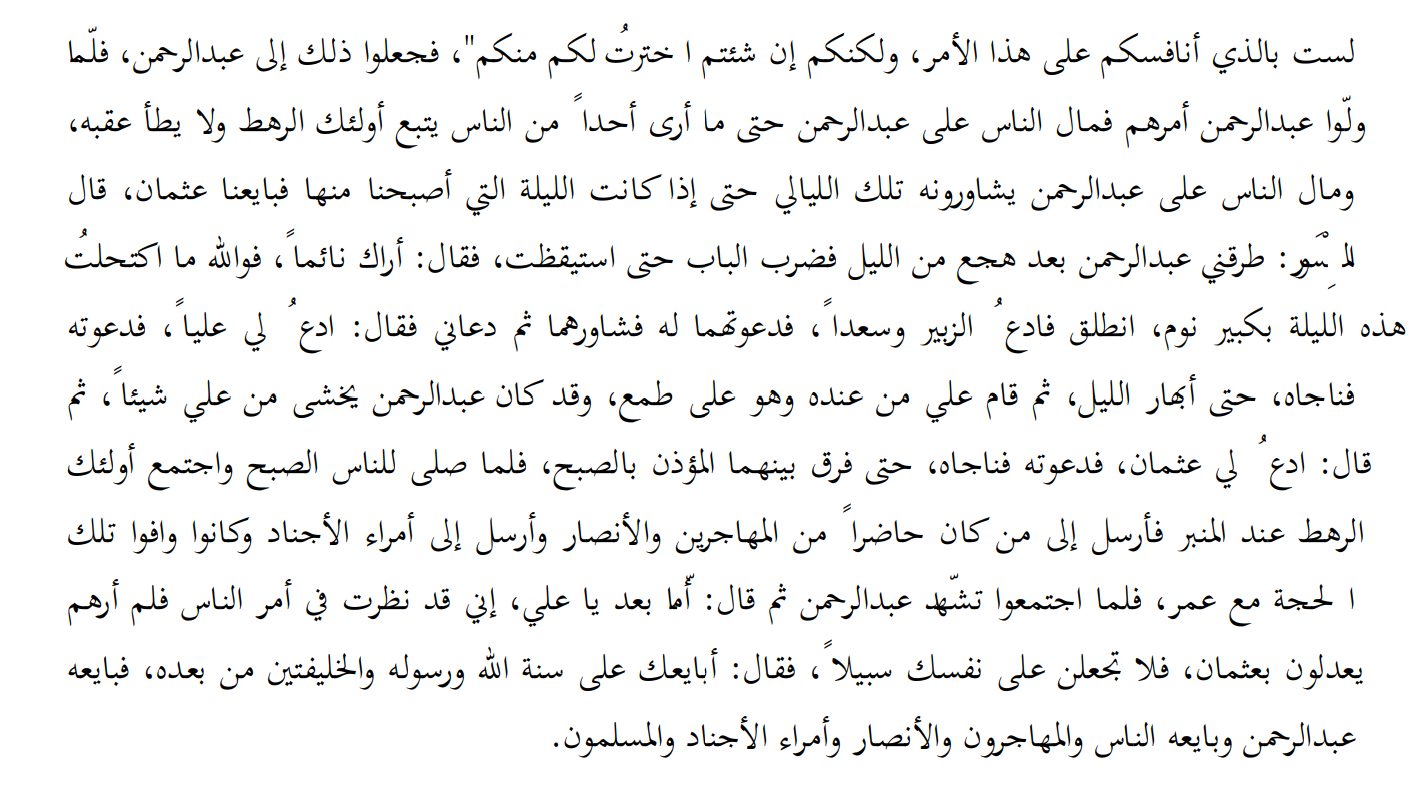
“I am not one who competes with you for this matter but if you wish I could choose for you one from among you. So they assigned this to ‘Abdurrahman . When they charged ‘Abdurrahman with this matter, people turned to him to the extent that I did not see any one who followed this group or stepped behind them. The people turned to ‘Abdurrahman consulting him in those nights until the night of which we woke up in the morning and gave our pledge to ‘Uthman. Al-Miswar said: ‘Abdurrahman knocked at my door, after a part of the night had passed, until I woke up. He said: I see you sleeping. By Allah, my eyes did not find much sleep tonight. Set forth and call Az-Zubair and Sa‘d. I invited them to him. He consulted with them. Then he called me and said: Call ‘Ali for me, so I called him. He carried on a whispered conversation with him until the night faded away. Then ‘Ali left him with some expectations, and ‘Abdurrahman was afraid about something from ‘Ali. Then he said call ‘Uthman for me, so I called him. He carried on whispered conversation with him until they departed as the muezzin called for fajr prayer. After he led the people in the fajr prayer, and the group of six persons met near the minbar (pulpit), he sent for all the Muhajirs and Ansar who were present (in Madinah) and sent for the leaders of the army who delivered the pilgrimage that year with ‘Umar. When they met, ‘Abdurrahman recited the two testimonies of faith (shahadahs) and said: O ‘Ali! I viewed the matter of the people and did not see them equalling anyone to ‘Uthman, so do not let anything disturb yourself. And he said (to ‘Uthman): I give you the bay’ah upon the way of Allah, His Messenger and the two Khulafaa who came after him. So ‘Abdurrahman, the Muhajirs, the Ansar, the leaders of the army and rest of the Muslims gave him the bay’ah.”
So the nominees for the Khilafah were limited to the group named by ‘Umar (ra) after the Muslims had asked him to do so. ‘Abdurrahman bin ‘Auf (ra), after he withdrew himself from the nomination to the Khilafah, took the opinion of the Muslims about who would be the Khalifah. He then announced the name of the person who the Muslims wanted after consulting with them. After he announced the name of the person who the people wanted, the bay’ah was given to him and he became the Khalifah by this bay’ah. Therefore the hukm shari’ concerning the appointment of the Khalifah is to limit the nominees for the Khilafah by those who represent the opinion of the majority of Muslims. Then their names are displayed to the Muslims and they are asked to select one of the nominees to be Khalifah for all. Then it is determined whom the majority of the Muslims have chosen, and the bay’ah from all the Muslims is taken for him, whether each person had specifically chosen him or not. This is the method because of the Ijma’a of the Sahabah about ‘Umar (ra) limiting the nominees for the Khilafah to six specific persons, and the consensus of the Sahabah that ‘Abdurrahman (ra) takes the opinion of all the Muslims about who will be the Khalifah for them, and the consensus to give the bay’ah to the one who ‘Abdurrahman (ra) announced as the person elected by Muslims as a Khalifah is clear when he said:
“I have looked at the people's tendencies and noticed that they do not consider anybody equal to `Uthman.”
All of these points clarify the hukm shari’ concerning the appointment of the Khalifah.
Two issues remain to be examined. One of them is who are the Muslims who appoint the Khalifah? Are they the influential people or a certain specific number of Muslims? Or do all of the Muslims appoint the Khalifah? The second issue concerns the actions occurring in this century in elections such as secret ballots, polling boxes and counting votes. Are these matters consistent with Islam and does Islam allows them or not?
As for the first issue, Allah (swt), has given the authority to the Ummah and he (swt) made the appointment of the Khalifah a right and duty for all Muslims; and He did not make it a right for one particular group excluding another, nor for a jama‘ah leaving another jama‘ah aside, since the bay’ah is a duty upon all the Muslims. The Prophet (saw) said:
“Whoever dies without having a pledge upon his neck would die the death of jahiliyyah”,
And this is general for every Muslim. Therefore, the influential people do not possess the exclusive right to appoint the Khalifah and cannot ignore the rest of the Muslims. Nor do specific persons have the exclusive right. Rather, this right is for all the Muslims with no exception, it even includes the fajirs (wicked people) and munafiqeen (hypocrites), provided they are mature Muslims because the Shari’ah text came in a general form in this instance and nothing came to limit it (make it specific to certain people) except the refusal of the pledge from the young who have not yet reached the age of puberty. So the text has to be taken generally.
However, it is not a condition that all Muslims practise this right. While it is a duty, because the bay’ah is fard, it is fard kifayah (obligation of sufficiency) and not fard ain (individual obligation). Thus, if some of the Muslims fulfill it, the duty drops from the rest of the Muslims. But all Muslims must be enabled to practice their right in electing the Khalifah, regardless of whether they use their right or not. In other words, every Muslim must be able to participate in selecting the Khalifah. So the issue is to enable the Muslims to carry out the duty of establishing the Khalifah which Allah (swt) prescribed upon them, in such a way that this duty falls (from their shoulders). The issue is not the actual participation of all the Muslims in conducting this duty. This is because the duty which Allah (swt) has prescribed is to establish the Khalifah for the Muslims by their consent, and it is not a requirement for all Muslims to perform it. Two matters result from this: One of them is that the consent of all the Muslims in the establishment of the Khalifah is achieved. Secondly, the consent of all the Muslims about the appointment is not achieved. The Muslims are however enabled (to participate in the appointment) in both cases.
With regards to the first matter, no condition is set concerning a specific number required to appoint the Khalifah. Rather any number of Muslims can give their bay’ah to the Khalifah and in this bay’ah the consent of the rest of the Muslims is attained by their silence, or by proceeding to obey him, or by anything which implies their consent, then the appointed Khalifah becomes a Khalifah for all the Muslims. He will legally be the Khalifah even if only three people appointed him, because collectivity is achieved by carrying out the appointment of the Khalifah. The consent is achieved by their silence and through obedience or anything similar, on condition that this is accomplished by unfettered choice and in every respect enabling the expression of opinions for all. However, if the consent of all the Muslims was not achieved, then the appointment of the Khalifah would not be accomplished unless it was performed by a group that represents the consent of the majority of the Muslims, regardless of the number in this group. From here some jurists stated that the appointment of the Khalifah is established by the pledge given to him by the people of influence (ahl al-hall wa al-‘aqd), because they consider the influential people as the group which achieves the consent of the Muslims through the pledge they give to any man who fulfils the contractual conditions of the Khilafah. Therefore, it is not the pledge of the influential people which establishes the Khalifah, nor is their pledge a condition for the legality of the appointment of the Khalifah. Rather the pledge of the influential people is evidence indicating that the consent of the Muslims to the pledge has been achieved, because the influential people are considered as representative of the Muslims. And every evidence which indicates that the consent of the Muslims with the pledge to a Khalifah is fulfilled completes the appointment of the Khalifah, and the appointment of the Khalifah by this bay’ah (pledge) would be legal.
“In Principle things are permitted unless there exists an evidence of prohibition.”
The difference between method (tareeqah) and style is that the method is an action which is considered by itself as an origin, or a branch to an action that does not have a general evidence for its origin; rather its evidence is specific to it. The style is an action which is a branch to an action—i.e. the origin—upon which there is no general evidence. Therefore, the method must depend upon a Shari’ah evidence because it is a Shari’ah rule, thus it must be adhered to and Muslims have no choice concerning it unless its rule is ibaha (of permissibility). This is different from the style which does not depend on a Shari’ah evidence; rather it is included in the rule of its origin. Therefore, it is not obligatory to follow a particular style even if the Messenger (saw)
did so. Rather a Muslim is allowed to use any style as long as it leads to the performance of the action, and thus it becomes a branch to the action. Thus it is said that the style is defined by the type of action.