6.7 学习的科目与阶段
6.7 Study subjects and stages
正如我们之前所说,学校教育分为36个学期,分布在3个阶段中,依据学生年龄划分,每个阶段都受相应的伊斯兰教法规则约束。就学习科目而言,每个阶段都有特定的科目,以及与留级和升级(从一个课程进入下一个课程)相关的特定规定。每个阶段的学习科目分为两类:基础科目和技能与活动科目。
As we have said before, the school education is divided into 36 school terms distributed between 3 stages according to student ages such that each stage is regulated by the relevant Shari’ah rules. With respect to study subjects, each stage has specific subjects together with specific rules related to failure and progress (transferring from one course to the next). Study subjects in each stage are divided into two: Basic subjects and Skills and Activities Subjects.

在第一学段,两位教师从第一学期开始教授学生。第一位教授他们伊斯兰文化和阿拉伯语,第二位教授他们科学和数学。两人共同承担技能与活动的教学。教师在本学段应当与其学生至少连续三个学期相伴。
In the 1st school stage, two teachers begin teaching students from the first term. The first teaches them Islamic culture and Arabic language, the second teaches them sciences and mathematics. Both share in teaching skills and activities. The teacher should remain with his students in this stage for at least three consecutive school terms.
在技能课上,老师会给孩子安排一些活动,以培养他的联系与思考能力,例如搭建和拆解物件。必须注意将这些活动和技能与本学期所采用的基础科目相联系。
In the skills subject, the teacher gives the child activities to develop his ability to link and think e.g. building and dismantling of things. Care must be taken to relate these activities and skills to the term’s basic adopted subjects.
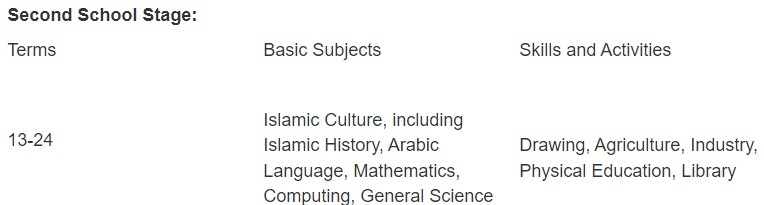
本阶段的“通识科学”课程包括化学、生物、物理和地理的基本原理。
The “General Sciences” subject in this stage includes principles of chemistry, biology, physics and geography.
第三学段:
Third School Stage:
本阶段涵盖第25至36学期。在本阶段中,所有学生仅在第25至30学期学习相同的课程。此后,在第31至36学期,学生可以加入其所选的选修方向(فروع)。这些选项包括:
This stage covers the terms 25 to 36. In this stage, all students participate in the same study subjects in terms 25 to 30 only. Thereafter, in terms 31 to 36 students join the optional branches (furoo’) they prefer. These options are:
- 文化类选项 - 科学类选项 - 工业或技术类选项(计算机、机械、电气、通信、制图等)
- Cultural Option - Scientific Option - Industrial or Technical Option (computing, mechanics, electrical, communications, cartography etc.)
- 农业选修 - 商业选修 - 家政选修(女生)
- Agricultural Option - Commerce Option - Domestic Option (for females)
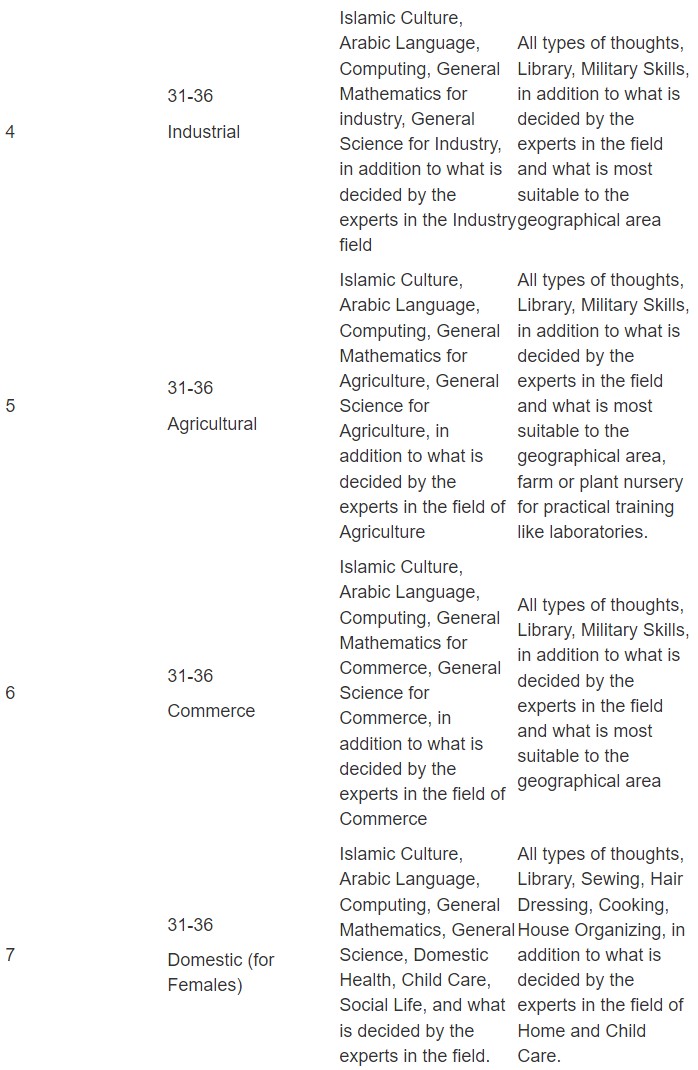
以下图表显示了这些选项中每一项所学习的科目:
The following chart shows the subjects studied in each of these options:
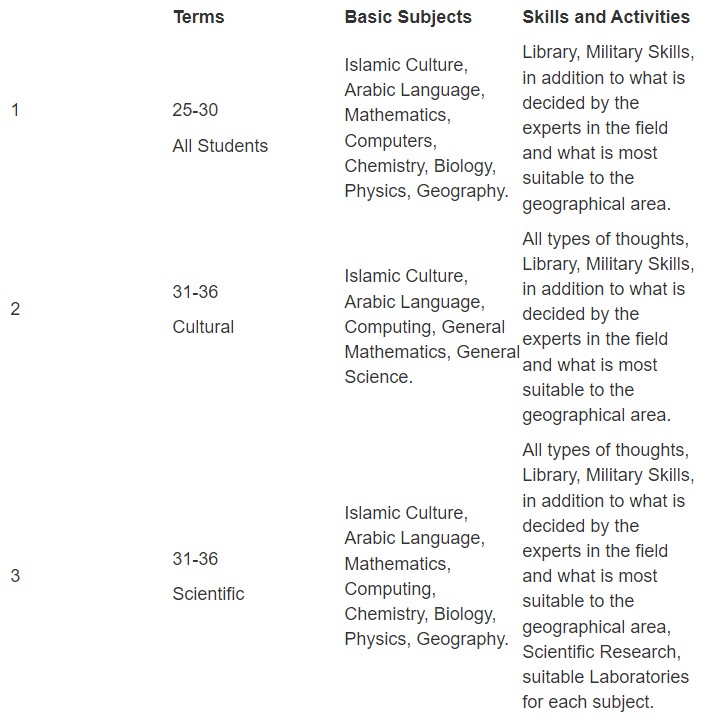
在第三学段的文化选修中,学生需要深入学习伊斯兰文化和阿拉伯语两方面的拓展课程。专家们确定了伊斯兰文化选修中的各门学科要求,包括教法学(Fiqh)、法理学(Usul)、古兰经注释学(Tafseer)、圣训学('Ulum Al-Hadith)、历史以及其他伊斯兰文化选修课程。同样,他们也为本学段所需的阿拉伯语选修课程制定了特定的课程(manaahij),例如修辞学(Balagha)、文学作品等。
In the cultural option of the third school stage, the student takes extended topics in both Islamic Culture and Arabic Language. Experts determine the requirements in the subjects of Fiqh, Usul, Tafseer, '‘Ulum Al-Hadith, History and other Islamic culture options. Likewise, they adopt specific courses (manaahij) in the Arabic language options required for this stage such as Eloquence (Balagha), Literature texts etc.
在非科学类选修方向中,学生以简明的形式学习数学和科学,且只侧重于其所选方向所需的课题。因此,商科方向的学生学习与商业相关的数学课题,例如会计、天课与遗产账目、损益账目,以及簿记和现金账目;同样,他/她也学习统计学方面的课题。而工业方向的学生则学习与工业相关的专门课题,例如几何制图、图形、面积与体积计算等。
In non-scientific options, the student takes Mathematics and Sciences in a concise form with focus paid only to the topics required for their option. Thus the Commerce option student takes Mathematics topics related to Commerce e.g. Accounting, Zakat and Inheritance Accounts, Profits and Loss Accounts together with Bookkeeping and Cashbook Accounts; likewise he/she takes topics in Statistics. Whereas the Industrial option student takes topics specific to Industry such as Geometrical Drawing, Shapes, Area and Volume Calculation etc.
非科学选修方向的普通科学学生,学习的课题侧重于人体研究、疾病、公共安全,以及与人和其环境相关的科学主题。在农业选修方向中,则增加了与农业和营养相关的课题,例如植物种植方法、植物病害及其防治、土壤类型、肥料、杀虫剂等。
The General Sciences student of the non-scientific option takes topics focusing upon studies of the Human Body, Diseases, Public Safety as well as scientific topics related to man and his environment. In the agricultural option, topics related to agriculture and nutrition are added such as methods of Plant Agriculture, their diseases and treatment, types of soil, fertilisers, insecticides etc.
工业类选修学生学习与材料科学及其属性相关的科目,例如密度和质量,同时学习机械动力学原理和公共安全。
The Industrial option student takes subjects related to the science of materials and their attributes such as Density and Mass, together with the principles of Mechanical Dynamics and Public Safety.
专家会根据每个学习阶段以及第三个学习阶段的每个选修方向,采纳学生所需要的内容。
Experts adopt what the student requires in each school stage and each option of the third school stage.