6.2 Matakan ilimin makaranta
6.2 School education stages
Yayin da ake raba koyarwa zuwa matakai, dole ne a kula da halin da yaro ko mutum mai balaga (baaligh) yake ciki a kowane mataki. Kuma dole ne a koma ga dalilan Shari'a da hukunce-hukuncen da suke nuna su, dangane da yaro ko mutum mai balaga, game da yadda waliyyin al-amr zai mu'amala da shi, da kuma yadda malami da mai koyarwa za su mu'amala da shi, domin a Musulunci, Mahaliccin Al-Mudabir, Ubangijin talikai, ya kafa wani tsari mai ɗaurewa da ke tsara yadda mutane za su mu'amala da juna.
While dividing teaching into stages, we must pay attention to the student’s reality as a child or mature (baaligh) person at each stage. And we must refer to the Shari’ah evidences and rules they denote as related to the child or mature person with respect to how his guardian (waliyy al-amr), and consequently the teacher and educator deals with him, since in Islam, the Creator the Director (Al-Mudabir), the Lord of the World, has brought a binding system to regulate how humans deal with each other.
Daga cikin hujjojin da suka shafi wannan magana akwai faɗin Allah Ta'ala (Suratun An-Nur, Aya ta 58):
Among the evidences related to this subject is Allah Ta’ala’s saying (Surah An-Nur Ayah 58):
﴿Ya ku waɗanda suka yi imani, bari waɗanda hannuwanku na dama suka mallaka da waɗanda ba su balaga ba daga cikinku su nemi izinin shiga wurinku a lokuta uku: kafin sallar alfijir, da lokacin da kuke cire tufafinku saboda hutawa da tsakar rana, da bayan sallar isha'i. Waɗannan lokuta uku ne na sirri a gare ku. Ba laifi a kanku ko a kansu bayan waɗannan lokuta, domin suna zagayawa a tsakaninku, wasu daga cikinku suna shiga wurin wasu. Kamar haka Allah yake bayyana muku ayoyi, kuma Allah Masani ne, Mai hikima.﴾ "Kuma Ya ce Ta'ala a cikin ayar da ke biye:"
﴿يََ أَيُّ هَا الَّ ي ذينَ آمَنُوا لييَسْتَأْيذنكُمُ الَّ ي ذينَ مَلَكَتْ أَيَْْانُكُمْ وَالَّ ي ذينَ لََْ يَ بْ لُغُوا الُْْلُمَ يمنكُ مْ ثَلََثَ مَرَّا ت يمِّن قَ بْيل صَلََية الْفَجْير وَي حينَ تَضَعُونَ ثييَابَكُم يمِّنَ الظَّيهيرَية وَيمن بَ عْ ي د صَلََية الْيعشَايء ثَلََثُ عَوْرَا ت لَّكُمْ لَيْسَ عَلَيْكُمْ وَلَا عَلَيْيهمْ جُنَاحٌ بَ عْدَهُنَّ طَوَّافُونَ عَلَيْكُم بَ عْضُكُمْ عَلَىٰ بَ عْ ض كَذَٰليكَ ي بَُييِّنُ اللَّ هُ لَكُمُ الْآيََ ي ت وَاللَّ هُ عَلييمٌ حَ ي كيمٌ ﴾ “O you who have believed, let those whom your right hands possess and those who have not [yet] reached puberty among you ask permission of you [before entering] at three times: before the dawn prayer and when you put aside your clothing [for rest] at noon and after the night prayer. [These are] three times of privacy for you. There is no blame upon you nor upon them beyond these [periods], for they continually circulate among you - some of you, among others. Thus does Allah make clear to you the verses; and Allah is Knowing and Wise.” And He Ta’ala said in the following Ayah:
﴿وَإِذَا بَلَغَ الْأَطْفَالُ مِنْكُمُ الْحُلُمَ فَلْيَسْتَأْذِنُوا كَمَا اسْتَأْذَنَ الَّذِينَ مِنْ قَبْلِهِمْ كَذَٰلِكَ يُبَيِّنُ اللَّهُ لَكُمْ آيَاتِهِ وَاللَّهُ عَلِيمٌ حَكِيمٌ ﴾ "Kuma idan yara daga cikinku suka kai balaga, to su nemi izini kamar yadda waɗanda suke gabaninsu suka nemi izini. Haka Allah ke bayyana muku ayoyinsa; kuma Allah Masani ne, Mai hikima." [An-Nur: 59] Kuma Annabi ﷺ ya ce:
﴿وَإيذَا بَ لَغَ الْأَطْفَالُ يمنكُمُ الُْْلُمَ فَ لْيَسْتَأْيذنُوا كَمَا اسْتَأْذَنَ الَّ ي ذينَ يمن قَ بْيليهمْ كَذَٰليكَ ي بَُييِّنُ اللَّ هُ لَكُمْ آيََتييه وَاللَّ هُ عَلييمٌ حَ ي كيمٌ ﴾ “And when the children among you reach puberty, let them ask permission [at all times] as those before them have done. Thus does Allah make clear to you His verses; and Allah is Knowing and Wise.” [An-Nur: 59] And the Prophet (SAW) said:
"An ɗauke alƙalami (wato hisabi) daga mutum uku: mahaukaci wanda hankalinsa ya rufe har sai ya warke, mai barci har sai ya farka, da yaro har sai ya balaga." (Abu Dawud ne ya rawaito shi a cikin Sunan dinsa). Kuma ya ce ﷺ: «Ya Asma'u, idan mace ta balaga da haila, bai kamata a ga wani abu daga jikinta ba sai wannan da wannan», sannan ya nuna fuskarsa da tafin hannayensa. (Abu Dawud ne ya rawaito shi a cikin Sunan dinsa). Kuma daga 'Atiyya Al-Quradhi, wanda ya ce:
رفع القلم عن ثلَثة، عن المجنون المغلوب على عقله حتى يفيق، وعن النائم حتى « » يستيقظ، وعن الصبي حتى يحتلم “The pen (i.e. accountability) is lifted from three persons: The insane whose mind is overcome until he recovers, the sleeper until he awakes and the child until he attains puberty.” (Narrated by Abu Dawud in his Sunan). And he (SAW) said: » يَ أسماء إن المرأة إذا بلغت المحيض لَ تصلح أن يرى منها إلا هذا وهذا « “‘O Asma, when the female reaches the age of menstruation, nothing should be seen of her except this and this’ and he indicated his face and palms.” (Narrated by Abu Dawud in his Sunan). And from ‘Atiya Al-Quradhi who said:
An aka gabatar da mu ga Annabi ranar Quraiza. Duk wanda ya riga ya tsiro da gashin al'aura ana kashe shi, wanda kuma bai tsiro ba an sake shi. Ni ina cikin wadanda ba su tsiro ba, don haka aka sake ni." (Tirmizi ya rawaito shi a cikin Sunansa). Ya kuma rawaito cewa,
)عُيرضنا على النبي يوم قريظة فكان من أنبت قُتيل، ومن لَ ينبت خُلِّى سبيله، فكنت ممن لَ ينبت فخُلِّى سبيلي( “We (i.e. Bani Quraydha) were shown to the Prophet on the Day of Quradhya. Whoever had grown pubic hairs was killed while the one without growth was released. I was among those without growth so I was released.” (Narrated by Tirmidhi narrated in his Sunan). He also narrated,
"Cewa lokacin da Annabi ya nada Sa'd ya yi hukunci game da Banu Quraiza, sai ya umarta a bayyana gindinsu (wato a cire wandon da suke sanye da shi)." Sai Uthman ya ce, lokacin da aka kawo masa wani yaro: "Ku duba wandonsa." Sai suka same shi bai fara tsiro gashin al'aura ba, don haka ba a yanke hannunsa ba. Babu wani sahabi da ya musanta wannan. Shi ma (SAW) ya ce: "Ku umarci yaranku su yi salla idan sun kai shekara bakwai, kuma ku doke su a kanta idan sun kai shekara goma, kuma ku raba tsakanin su a gadajensu." (Imam Ahmad ya ruwaito a cikin Musnadinsa). Wadannan hujjoji suna nuna cewa kuruciya tana karewa idan yara sun kai balaga, wato shekarun girma. Musulunci ya ayyana alamomi bayyanannu da ke raba kuruciya da girma: ga maza, mafarkin jima'i (ihtilam) ko fitowar gashin al'aura, ga mata kuwa, haila ko ciki. Haka kuma ya nuna cewa hukunce-hukuncen da ake yi wa masu balaga ba sa shafar yara kafin lokacin. Annabi (SAW) kuma ya ce: "Ku umarci yaranku su yi salla idan sun kai shekara bakwai, kuma ku doke su a kanta idan sun kai shekara goma." (Imam Ahmad ya ruwaito a cikin Musnadinsa). Wannan hadisi yana nuna cewa horon yara ya kasu kashi biyu: Mataki na farko, kafin yaro ya kai shekara goma, ba a amfani da duka wajen horon sa, domin hadisin ya takaita ga umartarsa da salla ba tare da duka ba. Saboda haka, tun da ba a doke shi saboda salla ba, to ba zai yiwu a doke shi saboda wani abu dabam ba. Horonsa a wannan mataki ya takaita ga nasiha da gargadi ba tare da duka ba. Mataki na biyu, daga lokacin da ya kai shekara goma har zuwa balaga, horonsa ya hada da duka idan bukata ta kama. Sai dai hukunce-hukuncen hudood da hukunce-hukuncen Shari'ah (‘uqoobaat) ba sa aiki a kansa sai bayan ya kai balaga, wato mataki bayan girma, saboda faɗarsa ﷺ:
» أنَّ النبي لما حكَّم سعد اً فِ بني قريظة كان يكشف عن مؤتزرهم « “That after S’ad adjudicated regarding Quraydha, the Prophet commanded with exposing their wrappings (covering their private parts).” And Uthman said when a young boy was brought to him: » انظروا إلى مؤتزره، فوجدوه لَ ينبت فلم يقطع « “Look at his wrapper. They found him without pubic hair so they did not cut (his hand)” and no Sahabah denied this. And he (SAW) said: مروا صبيانكم بالصلَة إذا بلغوا سبعاً، واضربوهم عليها إذا بلغوا عش راً، وفرقوا بينهم « » فِ المضاجع “Command your children to pray when they attain seven years, and beat them over it (not praying) when they attain ten years. And separate between them in the beds.” (Narrated by Imam Ahmed in his Musnad). These evidences indicate that childhood ends when children attain puberty i.e. the age of maturity. Islam assigned distinctive tangible milestones separating childhood from maturity: when wet dreams occur or pubic hairs appear in males, and menstruation or pregnancy for females. It also indicated that the rules that are applied upon those attaining puberty do not apply upon them beforehand. And he (SAW) said: » مُ ر وا أبناءكم بالصلَة لسبع سنين واضربوهم عليها لعشر سنين « “Command your children to pray when they attain seven years, and beat them over it (for not praying) when they attain ten years” (Narrated by Imam Ahmed in his Musnad). The hadith shows that disciplining children is divided into two stages: The stage before the child attains ten years where beating is not used to discipline him because the hadith restricts one to command him with prayer without beating him. Thus, by greater reason, he is not beaten for being taught other than the prayer. His discipline is restricted to styles of exhortation and threats without beating. And the stage after he attains ten years until puberty his discipline includes beating him if necessary. However the hudood and Shari’ah punishments (‘uqoobaat) do not apply upon him until after attaining puberty i.e. the stage after maturity due to his (SAW) saying:
"An ɗaga alƙalami daga mutum uku: daga yaro har sai ya balaga, daga mai barci har sai ya farka, da kuma daga mai tabin hankali har sai ya warke" (Abu Dawud ne ya ruwaito shi a cikin Sunan dinsa). Ma'anar "ɗaga alƙalami" a nan ita ce rashin hisabi. Idan yara suka balaga, Shari'a tana ɗaukar su a matsayin masu hisabi, don haka ana hukunta su ta hanyar hukuncin alƙali idan sun aikata take wata dokar Shari'a ko abin haramtacce. Wannan yana buƙatar kasancewar alƙalai a makarantu na ɗalibai masu balaga da kuma manyan makarantu.
رُفع القلم عن ثلَثة، عن الصبيِّ حتى يبلغ، وعن النائم حتى يستيقظ، وعن المعتوه « » حتى يبرأ “The pen (i.e. accountability) is lifted from three persons: The child until he matures, the sleeper until he awakes and the imbecile until he recovers” (Narrated by Abu Dawud in his Sunan). The meaning of » رُفع القلم عن ثلَثة « “lifting the pen” here is non-accountability. When children attain puberty, the Shar’a deems them accountable so they are punished by judicial decree if they commit a violation (of the Shari’ah rules) or a haram. This requires the presence of judges in schools of mature students and higher level education.
Waɗannan ƙa'idodin game da yaro da babba dole ne a kiyaye su yayin tsara matakan koyarwa, domin tarbiyya (renon yara) da ladabi sune abubuwan da ake buƙata kafin ilimi. Mataki na farko yana farawa daga lokacin da yaro ya shiga makaranta har zuwa lokacin da ya kai shekara goma. Mataki na biyu yana farawa daga lokacin da ya kai shekara goma har zuwa balaga, wanda yawanci yana faruwa a shekara goma sha biyar a ƙasashe masu yanayi mai matsakaici. Mataki na uku kuwa yana farawa daga shekara goma sha biyar har zuwa lokacin da ya kammala karatun makaranta.
These rules with respect to the child and mature person must be observed when devising teaching stages since tarbiyyah (raising of children) and discipline are prerequisites of education. The primary stage extends from the child’s entry into school until he reaches ten years. The second stage extends from his attaining ten years until puberty which normally occurs at fifteen years of age in countries of moderate climate. And the third stage extends from fifteen years until he completes school education.
Dangane da waɗannan hujjoji da ƙa'idoji, matakan koyarwa a makarantu a cikin Daular Khilafah an raba su ne bisa shekarun ɗalibai, ba bisa darussan da makaranta ke bayarwa ba. An raba makarantu zuwa nau'o'i uku kamar haka:
Based upon these evidences and rules, school teaching stages in the Khilafah State are divided upon the basis of student ages and not subjects offered by the school. Schools are divided into three types in the following manner:
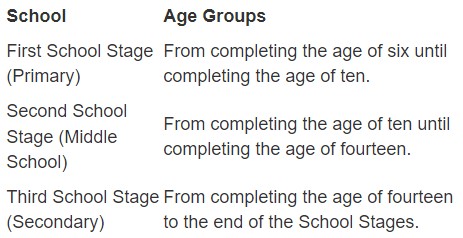
Da zarar ɗalibi ya cika shekara goma, ana kula da cewa an mayar da shi zuwa mataki na biyu na karatu, ba tare da la'akari da sakamakon karatunsa ba. Kuma da zarar ya balaga, ana mayar da shi zuwa mataki na uku na makaranta (makarantun ɗaliban da suka kai balaga), ko ya kai wannan matakin a karatunsa ko bai kai ba. Nan ba da jimawa ba za mu nuna yadda tsarin zangon karatu da Ma'aikatar Ilimi za ta aiwatar a makarantun gwamnati zai tabbatar da cewa an sanya ɗalibai a makarantu bisa ga shekarunsu.
Once the student completes ten years of age, care is taken to transfer him to the second stage of schooling irrespective of his academic achievement. And once he attains puberty, he is transferred to the third school stage (schools of students who reached puberty) whether or not he has attained that stage academically. We shall soon demonstrate how the system of school terms that will be implemented by the Education Department in State schools, guarantees the assigning of students to schools according to their age groups.
Game da ilimi kafin shekara shida (makarantun renon yara da kindergarten), wannan yana hannun al'umma ne. Idan wani yana so ya kafa makarantar masu zaman kansu don wannan manufa, an halatta masa hakan, matuƙar Dawla tana sa ido kan koyarwar dangane da darussan da ake koyarwa da kuma dacewarsu da manufofin ilimi da Khalifah ya ɗauka.
As for education before six years, (Nurseries and Kindergarten), this is at the people’s discretion. If one wishes to establish a private school for this purpose, one is allowed to do so provided the State supervises this teaching with respect to study subjects and their conformity to the education policy adopted by the Khalifah.