6.7 Darussan da matakai
6.7 Study subjects and stages
Kamar yadda muka faɗa a baya, ilimin makaranta an raba shi zuwa lokutan karatu guda 36, waɗanda aka rarraba su zuwa matakai 3 gwargwadon shekarun ɗalibai, ta yadda kowane mataki yana ƙarƙashin dokokin Shari'a da suka dace da shi. Dangane da darussan karatu, kowane mataki yana da takamaiman darussa tare da takamaiman ƙa'idojin da suka shafi faɗuwa da ci gaba (canjawa daga wannan aji zuwa na gaba). Ana raba darussan karatu a kowane mataki zuwa kashi biyu: Darussan asali da Darussan ƙwarewa da ayyuka.
As we have said before, the school education is divided into 36 school terms distributed between 3 stages according to student ages such that each stage is regulated by the relevant Shari’ah rules. With respect to study subjects, each stage has specific subjects together with specific rules related to failure and progress (transferring from one course to the next). Study subjects in each stage are divided into two: Basic subjects and Skills and Activities Subjects.

A matakin makaranta na farko, malamai biyu suna fara koyar da ɗalibai tun daga zangon farko. Na farko yana koya musu al'adun Musulunci da harshen Larabci, na biyu yana koya musu ilimin kimiyya da lissafi. Dukansu suna raba koyar da ƙwarewa da ayyuka. Malami ya kamata ya zauna tare da ɗalibansa a wannan matakin na akalla zangon makaranta uku a jere.
In the 1st school stage, two teachers begin teaching students from the first term. The first teaches them Islamic culture and Arabic language, the second teaches them sciences and mathematics. Both share in teaching skills and activities. The teacher should remain with his students in this stage for at least three consecutive school terms.
A cikin darasin ƙwarewa, malami yana ba yaro ayyuka don bunƙasa ikonsa na haɗa abubuwa da tunani, misali gina abubuwa da wargaza su. Ya zama dole a kula da danganta waɗannan ayyuka da ƙwarewa da darussan asali da aka ɗauka a wannan zangon karatu.
In the skills subject, the teacher gives the child activities to develop his ability to link and think e.g. building and dismantling of things. Care must be taken to relate these activities and skills to the term’s basic adopted subjects.
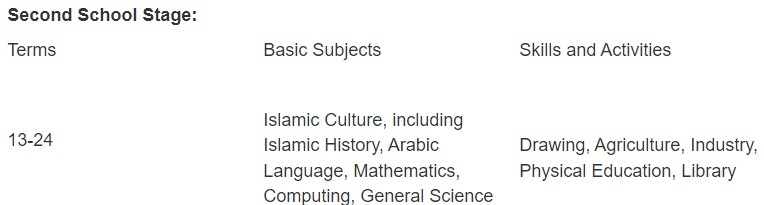
Wannan mataki ya ƙunshi darasin "Ilimin Gaba ɗaya" wanda ya haɗa da ka'idojin ilmin sinadarai (chemistry), ilmin halittu (biology), ilmin kimiyyar zahiri (physics) da ilmin ƙasa (geography).
The “General Sciences” subject in this stage includes principles of chemistry, biology, physics and geography.
Matakin Makaranta na Uku:
Third School Stage:
Wannan mataki ya ƙunshi zangwayoyi 25 zuwa 36. A wannan mataki, dukkan ɗalibai suna karatun darussa iri ɗaya a zangwayoyi 25 zuwa 30 kawai. Bayan haka, a zangwayoyi 31 zuwa 36, ɗalibai suna shiga rassan zaɓi (furoo’) da suka fi so. Waɗannan zaɓuɓɓuka sune:
This stage covers the terms 25 to 36. In this stage, all students participate in the same study subjects in terms 25 to 30 only. Thereafter, in terms 31 to 36 students join the optional branches (furoo’) they prefer. These options are:
- Zaɓin Al'adu - Zaɓin Kimiyya - Zaɓin Masana'antu ko Fasaha (kwamfuta, injiniyan inji, lantarki, sadarwa, taswirar ƙasa da sauransu)
- Cultural Option - Scientific Option - Industrial or Technical Option (computing, mechanics, electrical, communications, cartography etc.)
- Zaɓin Noma - Zaɓin Kasuwanci - Zaɓin Gida (ga mata)
- Agricultural Option - Commerce Option - Domestic Option (for females)
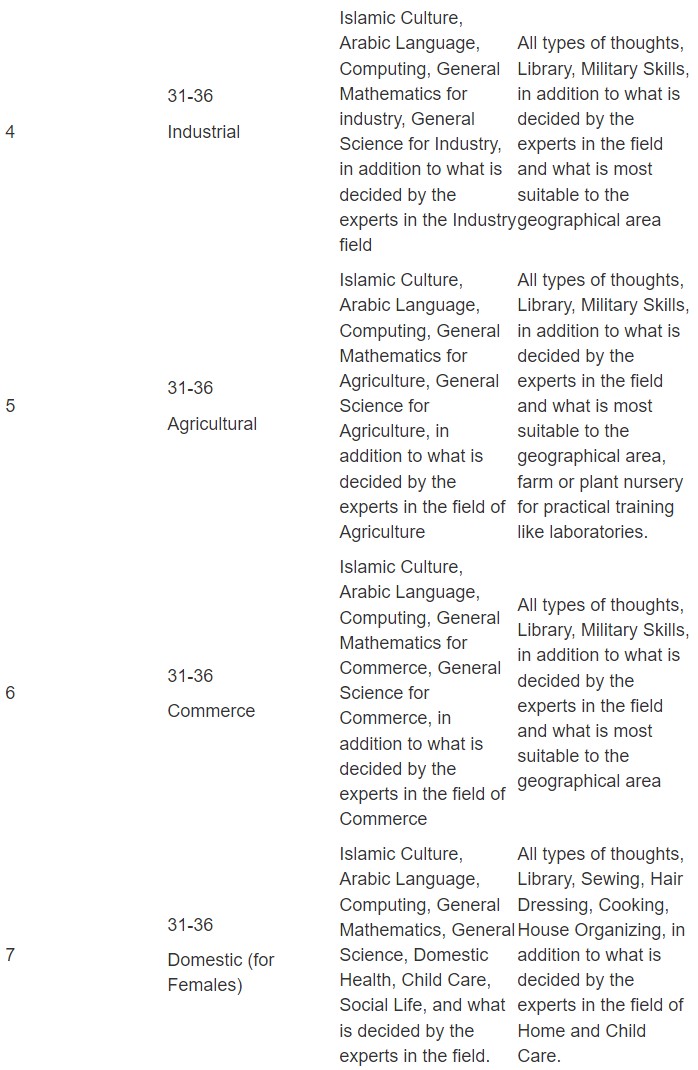
Ginshiƙin da ke ƙasa yana nuna darussan da ake karantawa a kowane ɗaya daga cikin waɗannan zaɓuɓɓuka:
The following chart shows the subjects studied in each of these options:
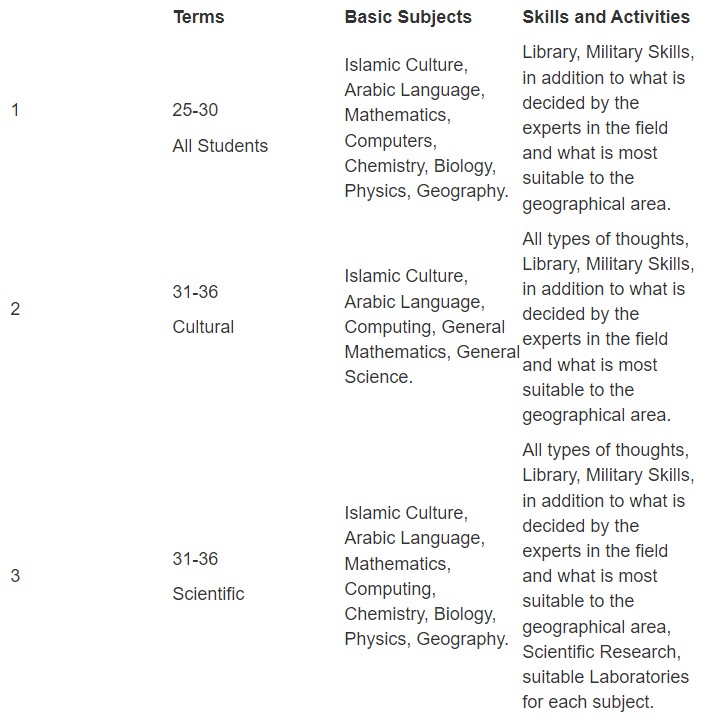
A cikin zaɓin al'adu na mataki na uku na karatu, ɗalibi yana ɗaukar darussa masu zurfi a fannonin Al'adun Musulunci da Harshen Larabci. Masana suna tantance abubuwan da ake buƙata a fannonin Fiqhu, Usulu, Tafsiri, 'Ulumul-Hadisi, Tarihi da sauran zaɓuɓɓukan al'adun Musulunci. Haka kuma, suna ɗaukar takamaiman darussa (manahij) a zaɓuɓɓukan harshen Larabci da ake buƙata a wannan mataki, kamar Balagha (fasahar magana mai kyau) da nassoshin adabi da sauransu.
In the cultural option of the third school stage, the student takes extended topics in both Islamic Culture and Arabic Language. Experts determine the requirements in the subjects of Fiqh, Usul, Tafseer, '‘Ulum Al-Hadith, History and other Islamic culture options. Likewise, they adopt specific courses (manaahij) in the Arabic language options required for this stage such as Eloquence (Balagha), Literature texts etc.
A cikin zaɓuka marasa na kimiyya, ɗalibi yana karatun Lissafi da Kimiyya a takaice, yana mai da hankali kawai ga darussan da zaɓinsa ke buƙata. Saboda haka ɗalibin zaɓin Kasuwanci yana karatun darussan Lissafi masu alaƙa da Kasuwanci, misali Lissafin Kuɗi, Lissafin Zakka da Gado, Asusun Riba da Asara, tare da Littafin Kuɗi da Asusun Akwatin Kuɗi; haka kuma yana karatun darussa a fannin Ƙididdiga. Shi kuwa ɗalibin zaɓin Masana'antu yana karatun darussan da suka shafi masana'antu, kamar Zanen Lissafi, Sifofi, da Lissafin Fili da Girma da sauransu.
In non-scientific options, the student takes Mathematics and Sciences in a concise form with focus paid only to the topics required for their option. Thus the Commerce option student takes Mathematics topics related to Commerce e.g. Accounting, Zakat and Inheritance Accounts, Profits and Loss Accounts together with Bookkeeping and Cashbook Accounts; likewise he/she takes topics in Statistics. Whereas the Industrial option student takes topics specific to Industry such as Geometrical Drawing, Shapes, Area and Volume Calculation etc.
Ɗalibin Janar Kimiyya na zaɓin rashin kimiyya yana karanta darussan da suka fi mayar da hankali kan nazarin jikin ɗan adam, cututtuka, tsaron al'umma, da kuma darussan kimiyya masu alaƙa da mutum da muhallinsa. A zaɓin noma kuwa, ana ƙara darussan da suka shafi noma da abinci mai gina jiki, kamar hanyoyin noman shuke-shure, cututtukansu da maganinsu, nau'ikan ƙasa, takin zamani, magungunan kashe kwari da sauransu.
The General Sciences student of the non-scientific option takes topics focusing upon studies of the Human Body, Diseases, Public Safety as well as scientific topics related to man and his environment. In the agricultural option, topics related to agriculture and nutrition are added such as methods of Plant Agriculture, their diseases and treatment, types of soil, fertilisers, insecticides etc.