1.1 危机的剖析
1.1 Anatomy Of A Crisis
不乏作家预言现行制度即将终结。事实上,此刻很可能有许多作者正把书稿寄给出版商,力求抢先拟定《资本主义的终结》这一书名,以媲美福山1989年那篇声名狼藉(如今已失去时效)的文章《历史的终结》。但这一事件真的会是资本主义的终结吗?不太可能。然而,它是否是资本主义终结的开端呢?很可能是。毋庸置疑,资本主义目前需要重症监护,正面临其最严重的危机。
There has been no shortage of writers predicting an end to the system as we know it. Indeed as we speak many authors are probably sending manuscripts to publishers trying to be first with the title “The End of Capitalism” to rival Fukuyama’s infamous (and now defunct) essay on the End of History in 1989. But will this event really be the end for Capitalism? Unlikely. But, is this the beginning of the end of capitalism? Quite probably, and it is without doubt that Capitalism currently needs intensive care and is facing its greatest crisis.
2008年9月的事件将作为资本主义历史上最黑暗的时期之一载入史册。美国联邦储备委员会前主席艾伦·格林斯潘表示,当前的事件十分罕见,大约每五十年或一百年才会出现一次。对美国而言,此次危机尤其相当于珍珠港事件与9·11事件的经济版本合二为一,是对整个体系的深刻冲击,其影响在未来数年乃至数十年内都将持续显现。我们不仅目睹了作为现代金融资本主义基石的独立投资银行模式的终结,还看到自由放任的自由市场经济教条被彻底摧毁,各国政府纷纷忙于救助下一家金融机构。
The events of September 2008 will go down in history as one of the darkest times in the history of Capitalism. Alan Greenspan former Chairman of the US Federal Reserve stated that the current events were rare, once every fifty or hundred years. For the US, in particular the current crisis constitutes the economic equivalent of Pearl Harbour and 9-11 combined a profound shock to the system which will be felt for years if not decades ahead. Not only have we witnessed the end of the stand alone investment banking model which was the cornerstone of modern financial capitalism, we have also seen the dogma of laissez faire free market economics trashed as Governments scramble around to bail out the next financial institution.
格林斯潘说这是百年一遇的事件,他错了。互联网泡沫破裂才过去八年,那次崩盘让股票市值蒸发了将近7万亿美元。那么我们究竟是怎么陷入这场困境的?美国是一个拥有14万亿美元经济规模的超级大国,怎么就沦为了笑柄?那些市值直到不久前还只有数百亿美元的投资银行,曾经熬过两次世界大战和大萧条,如今却会如此轻易地被摧毁。西方各国政府过去还自满地向发展中国家宣讲经济治理的艺术,如今的表现却不比那些典型的香蕉共和国好多少,这又是怎么回事?
Greenspan is wrong about a once a century occurrence, it has only been eight years since the dot com fiasco which wiped off almost 7 trillion dollars off stock market valuations. So how did we get into this mess, how could the United States, a superpower with a $14 trillion economy now become a laughing stock. How could investment banks valued only recently at tens of billions of dollars and who were able to survive two world wars and the great depression be wiped out so easily. How could western governments who used to smugly preach to the developing world the art of economic competence act no better than glorified banana republics?.
在过去一个月里发生的事件,根源在于次级贷款领域:经纪人受丰厚佣金的激励,成批地向数以百万计的借款人出售抵押贷款。历届政府都延续了鼓励普遍购房的政策,他们认为拥有自己的房子是美国梦的一部分。对许多被快速致富的念头驱动、又有宽松信贷托底的借款人来说,办理抵押贷款只是换取巨额利润的一点小代价,因为房价呈指数级上涨。经纪人收取佣金后,便决定将这些抵押贷款转手出售,不久它们就被打包,形成抵押支持证券(MBS),并在全球各地的银行之间反复买卖。在利率处于低位的时期,全球各地的银行受股东和分析师的鼓动(他们是企业资本主义的啦啦队),被迫追求越来越高的回报。因此,抵押支持证券犹如从天堂降下的涅槃,房价上涨时,市场对这类证券以及其他替代性金融工具的需求也始终居高不下。
The events of the past month were rooted in the sub prime sector when brokers incentivised by fat commissions sold mortgages in their truck loads to millions of borrowers. This policy of encouraging widespread home ownership had been followed by successive administrations who believed that owning one’s house was part of the American dream. For many borrowers motivated by a quick buck and cushioned by easy credit, getting a mortgage was a small price to pay in exchange for a huge profit as house prices rose exponentially. Brokers having banked their commissions decided to sell their mortgages on and soon these would be parcelled up and form mortgage backed securities (MBS) sold and resold by banks throughout the world. At a time of low interest rates, banks throughout the world egged on by shareholders and analysts, the cheerleaders of corporate capitalism, were challenged to seek to gain higher and higher returns. MBSs therefore were like nirvana from heaven and while house prices rose, demand for such instruments and other alternative instruments remained high.
当时,监管机构和评论人士都认为这种新型金融工具的销售模式十分巧妙,因为他们相信这些产品能够分散风险,确保没有任何单一机构承担过度的风险敞口。经过多年的房价上涨,所有人都很满意,直到不可避免的崩盘来临。 崩盘发生时,人们非但没有感受到风险分散带来的好处,反而陷入了深深的恐慌,因为银行发现它们其实并不清楚风险究竟在哪里。这导致信心严重丧失,银行间拆借随之冻结。各家银行彼此互不信任,都担心其他银行可能正持有大量因抵押贷款支持证券(MBS)价值下跌而产生的巨额损失,用专业术语来说,这些证券已经变成了“有毒资产”。 这种冻结使得一些银行陷入资不抵债的境地,另一些银行则因高杠杆衍生品投机失利导致流动性枯竭而倒闭。此外,信贷成本上升,民众对储蓄产生普遍的不安全感,大宗商品价格攀升,货币贬值,从而导致物价上涨。以下是自危机爆发以来对世界产生重大影响的主要事件。
At the time, this new model of selling on such instruments was considered ingenious by regulators and commentators alike as they believed these products diversified risk and ensured that no one entity would be disproportionately exposed. After years of house price growth, everyone was happy until the inevitable crash. At the time, far from the benefits of diversified risk, deep panic set in as banks discovered that they actually didn’t know where the risk was, thereby leading to a chronic loss of confidence and the freezing of inter bank lending. Banks simply didn’t trust each other believing that other banks could be potentially sitting on huge losses as these MBSs lost value or to use the technical term became “toxic”. This freeze would make certain banks insolvent and others would go to the wall due to a lack of liquidity following highly leveraged derivative bets. It would also make credit more expensive, lead to mass insecurity around savings, increase commodity prices and weaken currencies, so making prices higher. The following are the key events that have hit the world since the crisis began.
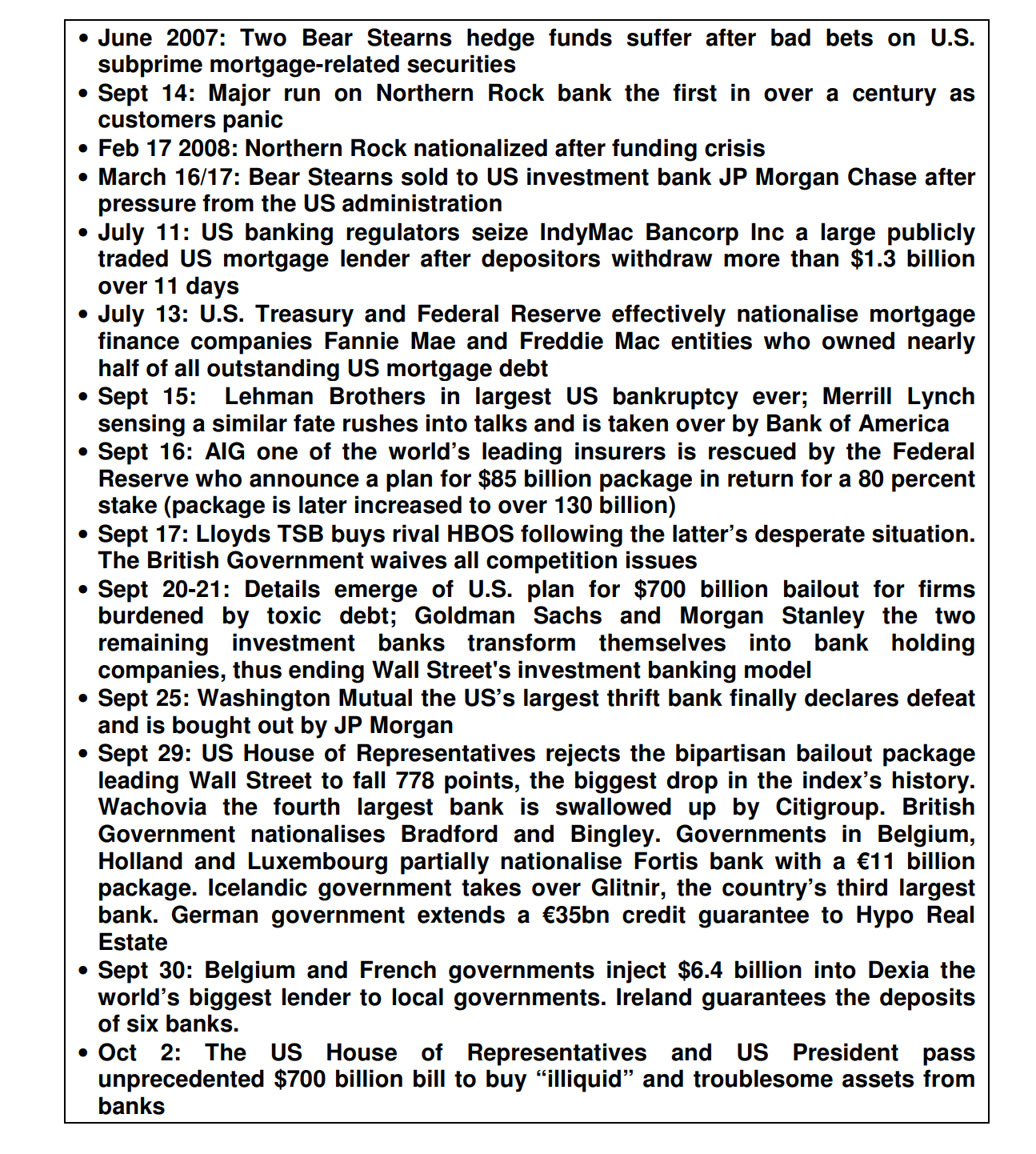

事件的剧烈波动前所未有。自大萧条以来,我们从未目睹过如此局面,金融体系也从未显得如此脆弱。美国政府提出以高达7000亿美元的价格从美国银行体系购买有毒资产,该提案最初在众议院以228比205被否决,许多人认为原因在于这一方案极不得民心。人们理所当然地指出,华尔街在形势好时乐于独享数十亿美元的利润,而在形势艰难时却想要将损失“国有化”,由美国纳税人埋单。与此同时,民众仍在承受食品、能源和医疗费用上涨的痛苦,而华尔街银行家的薪酬照常发放,雷曼兄弟的前员工们也有望在2009年从新雇主那里拿到数十亿美元的巨额奖金。难怪人们对华尔街及其在华盛顿的同伙如此失望。此外,也有人质疑,美国本已负债数万亿美元,如何承担如此庞大的救助计划,又如何继续向美国和全球市场提供数千亿美元的流动性。这时,现任美联储主席本·伯南克和他的“魔杖”登场了!六年前,伯南克在一次演讲中透露了他的秘密武器,他当时这样说道。
The events have been of unprecedented volatility. Not since the Great Depression have we witnessed such events and seen such fragility in the financial system. The US government’s proposal to buy toxic assets up to $700 billion from the US banking system was initially defeated by 228-205 in the House of Representatives, with many citing the sheer unpopularity of the package with the American people. People have rightly pointed to the fact that Wall Street was more than happy to keep their billion dollar profits private in the good times and yet want to ‘nationalise’ their losses, to be paid for by the American taxpayer when the going got tough. While people continue to suffer from higher food, energy and healthcare costs, Wall Street bankers’ compensation packages continue to be paid with ex Lehman’s staff on course for huge multi billion dollar bonuses from their new employers in 2009. No wonder people are so disillusioned with Wall Street and their cohorts in Washington. In addition some ask how the US, already trillions in debt can afford such huge bailouts and how they can continue to be able to provide hundreds of billions of dollars in liquidity to the US and world markets. Step forward Ben Bernanke the current Chairman of the Federal Reserve and his magic wand! In a speech given six years ago Bernanke revealed his secret weapons when he stated the following.
“与黄金一样,美元之所以有价值,是因为其供应量受到严格限制。但美国政府拥有一种技术——印刷机(如今则是其电子等价物)——使其能够以几乎零成本印制任意数量的美元。”
“Like gold, U.S. dollars have value only to the extent that they are strictly limited in supply. But the US government has a technology, called a printing press (or, today, its electronic equivalent), that allows it to produce as many U.S. dollars as it wishes at essentially no cost.".
在信心这一根本条件已然崩塌的情况下,资本主义政府手中唯一可用的,便只剩下印钞机及其电子等价物。为了救助贝尔斯登、美国国际集团(AIG)以及房地美和房利美,它们耗资数千亿美元,而这些资金要么来自印钞,要么来自发行更多国库券举债。政府一心只想在短期内不惜一切代价稳住体系,却完全无视由此带来的通货膨胀加剧和货币贬值的影响。
With the fundamental condition of confidence now shot, the only things capitalist governments have at their disposal is their printing presses and electronic equivalents. Having bailed out Bear Stearns, AIG as well as Freddie Mac and Fannie Mae at the cost of hundreds of billions of dollars, all financed by either printed money or borrowed by issuing more treasury bills. Intent on stabilising the system in the short term at all costs, the impact on higher inflation and a devalued currency are completely ignored.