6. Huesos
6. Bones
Y luego convertimos aquel trozo de carne en huesos,
and We made that lump into bones
Desde la etapa de la mudghah se crean los 'idhaam. Esta es la etapa siguiente. En la lengua árabe, la palabra 'idhaam significa hueso, y se aplica específicamente a los huesos de las manos y los pies, o de los brazos y las piernas de un animal, sobre los cuales se encuentra la carne.70
From the mudghah stage, `idhaam are created. This is the next stage. The word `idhaam in the Arabic language means bone, and is specifically applied to the bones of the hands and feet, or of the arms and legs of an animal, upon which is the flesh.70
INTERPRETACIÓN CIENTÍFICA
SCIENTIFIC INTERPRETATION
La etapa de *idhaam* se refiere al desarrollo del esqueleto axial y de las extremidades, y ocurre alrededor de la quinta semana. Barry Mitchell y Ram Sharma lo explican:
The `idhaam stage pertains to the development of the axial and limb skeleton, occuring at around the 5th week. Barry Mitchell and Ram Sharma explain:
El origen de las células mesenquimales que forman los tejidos esqueléticos varía en las distintas regiones del cuerpo. Las células mesenquimales que forman el esqueleto axial surgen de los somitas mesodérmicos, mientras que los huesos del esqueleto apendicular derivan del mesénquima somatopleural del mesodermo de la placa lateral. Tras llegar a su destino, las células mesenquimales se condensan y forman modelos de huesos. La posterior diferenciación de las células mesenquimales en condroblastos u osteoblastos está controlada genéticamente.71.
The origin of mesenchymal cells forming the skeletal tissues varies in different regions of the body. Mesenchymal cells forming the axial skeleton arise from the mesodermal somites, whereas the bones of the appendicular skeleton are derived from the somatopleuric mesenchyme of the lateral plate mesoderm. After reaching their destination the mesenchymal cells condense and form models of bones. The subsequent differentiation of mesenchymal cells into chondroblasts or osteoblasts is genetically controlled.71.
«Los huesos de las extremidades» es el significado específico de la palabra `idhaam, y por tanto puede referirse al desarrollo de los brotes de las extremidades, que dan lugar al desarrollo de las extremidades y del esqueleto apendicular. Barry Mitchell y Ram Sharma explican con detalle la formación de la extremidad y del esqueleto apendicular:
‘Limb bones’ is the specified meaning of the word `idhaam, and therefore can refer to the development of the limb buds which give rise to the development of the limbs and the appendicular skeleton. Barry Mitchell and Ram Sharma elaborate on the formation of the limb and appendicular skeleton:
El esqueleto apendicular está formado por las cinturas de las extremidades y los huesos de los miembros. Los huesos del esqueleto apendicular se desarrollan a partir de condensaciones mesenquimatosas que se convierten en modelos cartilaginosos.72 [See Figure 7]
The appendicular skeleton consists of limb girdles and the bones of the limbs. The bones of the appendicular skeleton develop from mesenchymal condensations which become cartilaginous models.72 [See Figure 7]
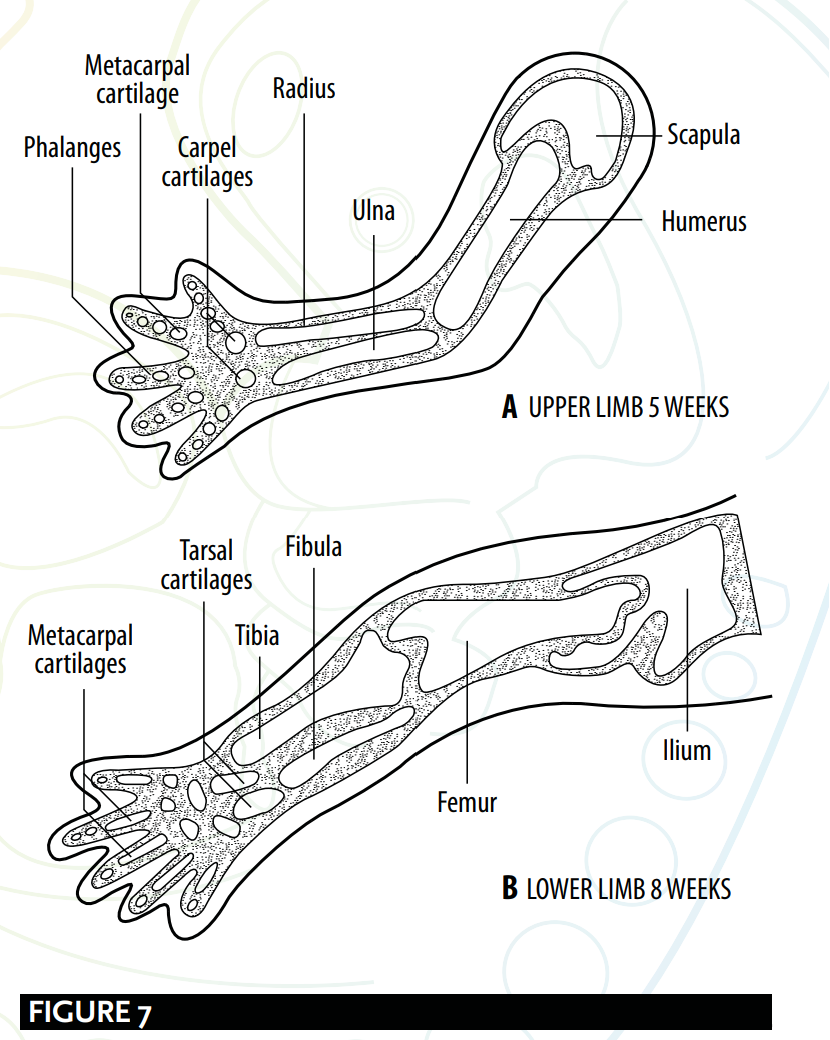
John Allen y Beverley Kramer también comentan sobre la formación de los huesos de las extremidades.
John Allen and Beverley Kramer also comment on limb bone formation.
El mesénquima del miembro es, al principio, una masa homogénea, pero pronto se producen condensaciones en él, que se condrifican para formar modelos cartilaginosos de los distintos huesos. Cada modelo de cartílago está rodeado por el pericondrio, que es una condensación del mesénquima. Se forma un centro de osificación (centro de osificación primario) sobre cada modelo de cartílago mediante el crecimiento hacia dentro de osteoblastos (células formadoras de hueso) procedentes del mesénquima circundante. El mesénquima circundante recibe ahora el nombre de periostio (que rodea el hueso). Los osteoblastos producen entonces hueso, que da lugar a los elementos esqueléticos de los miembros. 73.
The limb mesenchyme is at first a homogenous mass but soon condensations occur in it and these chondrify to form cartilaginous models of the various bones. Each cartilage model is surrounded by perichondrium which is a condensation of mesenchyme. An ossific centre (primary ossification centre) is formed upon each cartilage model by the ingrowth of osteobalsts (bone-forming cells) from the surrounding mesenchyme. The surrounding mesenchyme is now termed periosteum (surrounding the bone). Osteoblasts now produce bone which give rise to the skeletal elements of the limbs. 73.
Existen paralelismos claros entre la etapa coránica del "idhaam" (la cubierta de los huesos con carne) y la visión que la embriología moderna tiene del desarrollo del esqueleto axial, de las extremidades y del esqueleto apendicular.
There are clear parallels between the qur'anic `idhaam stage and the view modern embryology takes i.e. the development of the axial, limb and appendicular skeleton.
RESUMEN
SUMMARY
La etapa de ʿidhaam: la formación del esqueleto axial, de las extremidades y del esqueleto apendicular.
The `idhaam stage: The formation of the axial, limb and appendicular skeleton.
DE UN TROZO DE CARNE A HUESOS
FROM A LUMP TO BONES
Un malentendido común, generalmente cometido por quienes no son arabistas, es que este versículo puede traducirse literalmente como «y de aquel trozo de carne hicimos huesos». A partir de esto, concluyen que el versículo es anticientífico, porque un trozo de carne no puede convertirse en una masa de huesos. Sin embargo, esto se basa en una comprensión superficial de la gramática árabe y de la elocuencia del Corán. Desde una perspectiva gramatical, este versículo tiene los significados de: «y de/desde/a partir del trozo hicimos huesos».
A common misconception, usually made by non-Arabists, is that this verse can be literally translated as “and We made that lump into bones”. From this, they conclude that this verse is unscientific because a lump of flesh cannot turn into a mass of bones. However, this is based upon a crude understanding of Arabic grammar and the Qur’an's eloquence. This verse, from a grammatical perspective, has the meanings of: “and We made of/from/out of the lump bones”.
Por eso Yusuf Ali traduce este versículo como “luego hicimos de ese trozo huesos”74; Shakir lo traduce como “luego hicimos (en) el trozo de carne huesos”; y A. J. Arberry, en su traducción del Corán que todavía hoy utilizan los académicos, lo traduce como “luego creamos de los tejidos huesos”.75
This is why Yusuf Ali translates this verse as “then we made out of that lump bones”74; Shakir translates it as “then We made (in) the lump of flesh bones”; and A J Arberry, in his translation of the Qur’an which is still used by academics today, translates this verse as “then We created of the tissue bones”.75
HUESOS NO REALES
NOT REAL BONES
Otra propuesta de los comentaristas es que en esta etapa no existen huesos reales. Se argumenta que los supuestos huesos son meramente cartílago, ya que la osificación está incompleta y, por tanto, el Corán debe ser inexacto. Aunque es una objeción válida, está mal planteada. La palabra `idhaam` abarca la forma cartilaginosa de los huesos, en el momento en que se establece el armazón esquelético. Además, el proceso de osificación comienza hacia la octava semana,76 y continúa después del nacimiento, completándose finalmente alrededor de la pubertad. Barry Mitchell y Ram Sharma lo explican:
Another proposition from commentators is that at this stage there are no real bones. It is argued that the apparent bones are mere cartilage as ossification is incomplete and, as such, the Qur’an must therefore be inaccurate. Although a valid contention, it is misplaced. `idhaam encompasses the cartilaginous form of the bones as the skeletal framework is put in place. Additionally, the process of ossification begins by the 8th week,76 continuing on after birth, with the eventual completion of the ossification process at around puberty. Barry Mitchell and Ram Sharma explain:
Los centros de osificación aparecen por primera vez en los huesos de las extremidades durante la octava semana. Hacia la duodécima semana, las diáfisis de los huesos largos de las extremidades están osificadas, aunque los huesos del carpo de la muñeca permanecen cartilaginosos hasta después del nacimiento. La osificación de los tres tarsianos más grandes del tobillo comienza hacia la semana 16, pero algunos de los tarsianos más pequeños no se osifican hasta 3 años después del nacimiento.77.
The centres of ossification first appear in the limb bones during the eighth week. By the twelfth week, the shafts of the limb bones are ossified, though the carpal bones of the wrist remain cartilaginous until after birth. The ossification of the three largest tarsal bones of the ankle begins about 16 weeks, but some of the smaller tarsal bones do not ossify until 3 years after birth.77.
Desde esta perspectiva, sería un absurdo médico suponer que los recién nacidos o los adolescentes jóvenes no tienen huesos por el simple hecho de que necesitan osificarse, sobre todo porque la osificación se completa al final del estirón de la pubertad. Sin embargo, si este fuera el caso, y consideramos que esta etapa es de "ausencia de huesos", por así decirlo, las derivaciones de la palabra `idhaam permiten una interpretación que lo abarca todo, pues los "modelos cartilaginosos de los distintos huesos"78 quedan incluidos en su significado.
From this perspective, it would be a medical absurdity to assume newborns or young teenagers do not have bones simply because they require ossification, especially since ossification completes at the end of the growth-spurt of puberty. Nevertheless if this were the case, and we are to take this stage as being ‘boneless’, as it were, the derisions of the word `idhaam allow for an all encompassing interpretation because the “cartilaginous models of the various bones”78 is included in its meaning.