La 'aqīdah y lo que emana de ella en cuanto a los aḥkām y lo que se construye sobre ella en cuanto a pensamientos, es el fundamento del At-Taghyīr (el cambio).
The Aqeedah and what emanates from it in terms of Ahkaam and what is built upon it in terms of thoughts, is the basis of At-Taghyeer (change).
La conducta del ser humano está ligada a lo que porta en términos de conceptos. Los conceptos (Mafaaheem) son convicciones (Qanaa'aat) resultantes de una comprensión de las cosas y de sus atributos, además de lo que se construye sobre esta comprensión o emana de ella en términos de otras convicciones.
The conduct of the human is tied to what he carries in terms of concepts. The concepts (Mafaaheem) are convictions (Qanaa’aat) resulting from a comprehension of things and their attributes in addition to what is built upon this comprehension or emanates from it in terms of other convictions.
Los conceptos son de dos tipos:
Concepts are of two types:
The first
The first:
Conceptos sobre las cosas. Son convicciones o ahkaam (juicios) cuya fuente son las propias cosas. Esto incluiría afirmaciones como: "El fuego quema", "El veneno mata", "El alcohol embriaga", "La carne se come mientras que la tierra no se come", "La acumulación creciente de presión genera una explosión (de cierto tipo)", "La sociedad está compuesta por un conjunto de individuos unidos por relaciones permanentes" y "El renacimiento no ocurriría sino por medio del pensamiento esclarecido".
: Concepts about things. These are convictions or Ahkaam (rulings) whose source is the things themselves. This would include statements like: ‘Fire burns’, ‘Poison kills’, ‘Alcohol intoxicates’, ‘Meat is eaten whilst soil is not eaten’, ‘The increased build-up of pressure generates an explosion (of sorts)’, ‘The society is composed of a collection of individuals bound by permanent relationships’ and ‘Revival would not occur except by way of the enlightened thought’.
Todos estos pensamientos son descripciones o ahkam cuya fuente es su objeto. Pueden ser correctos o incorrectos según su conformidad con la realidad o su contradicción con ella. En todos estos casos se consideran conceptos con respecto a quien ha creído en ellos. La conducta y el comportamiento humano están ligados a sus conceptos sobre las cosas, de modo que quien está convencido de que su comida ha sido envenenada nunca comería de ella, aunque tuviera hambre. Asimismo, quien tiene sed buscará agua y no otra cosa, mientras que quien quiere embriagarse buscará alcohol y nada más.
All of these thoughts are descriptions or Ahkaam whose source is its subject. They could be correct or incorrect depending on their conformity to the reality or their contradiction to it. In all of these cases they are considered to be concepts in respect to the one who has believed in them. The human behaviour and conduct is tied to his concepts about things and so whoever is convinced that his food has been poisoned would never eat from it and even if he was hungry. Similarly the one who was thirsty would seek water and not something else whilst the one who wanted to be intoxicated would seek alcohol and nothing else.
El segundo tipo:
The second type:
Conceptos (Mafaaheem) sobre la vida. Son convicciones o ahkaam cuya fuente es externa a su objeto. Por ejemplo, afirmaciones como: "La Salah es Fard", "El fraude es Haram" y "Matar a una persona es Haram", etc. La fuente de este hukm no es la cosa en sí ni la acción; estas solo representan el ámbito del tema o la realidad sobre la que se juzga, mientras que la fuente del juicio es otra y se encuentra en otro lugar.
Concepts (Mafaaheem) about life. These are convictions or Ahkaam whose source is external to its subject. This is like the statements: ‘The Salaah is Fard’, ‘Fraud is Haraam’ and ‘Killing someone is Haraam’ etc... The source of this Hukm is not the thing itself or the action and these only represent the subject area or the reality that is being judged upon whilst the source of the judgement is something else and lies elsewhere.
Nuestra afirmación «El alcohol embriaga» refleja una descripción o un atributo interno asociado al alcohol. Es un juicio emitido sobre una cosa por lo que contiene o por lo que produce. Sin embargo, la afirmación «El alcohol es haram» no es un juicio emitido sobre una cosa en función de lo que contiene, sino que representa un hukm de Allah (SWT).
So our statement: ‘Alcohol intoxicates’ reflects a description or an internal attribute associated to alcohol. It is a judgement made upon a thing due to what it contains or results in. The statement however ‘Alcohol is Haraam’ is not a judgement passed upon a thing on the basis of what is in it but rather it represents a Hukm from Allah (swt)
¿Quién decide qué es haram y qué es mubaah (permitido)?
who decides what to make Haraam and what to make Mubaah (permissible).
La conducta de una persona también está ligada a sus concepciones sobre la vida. Si una persona tuviera el concepto o la comprensión de que la carne de cerdo es comestible y saciaría el hambre, esto representaría un concepto sobre una cosa. Sin embargo, el concepto sobre la vida es que el cerdo es Haram, lo que significa que es obligatorio para él evitarlo y mantenerse alejado de él. Esto se convertiría en un concepto para quien ha comprendido este Hukm, lo ha creído, y tendría un efecto en su conducta, impidiéndole saciar su hambre con carne de cerdo.
The behaviour of the person is also tied to his concepts about life. If he held the concept or understanding about the flesh of pig that it was edible and would satisfy hunger, then this would represent a concept about a thing. The concept about life however is that the pig is Haraam meaning that is obligatory for him to avoid and keep away from it. It would become a concept for the one who has comprehended this Hukm and believed in it and it would have an effect upon his behaviour and prevent him from satisfying his hunger from pig.
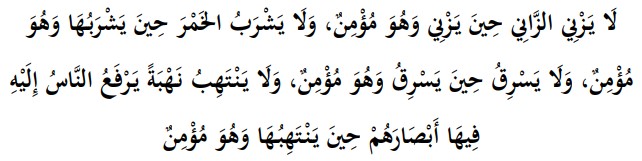
Cuando el fornicador comete zina no es creyente, cuando el bebedor de alcohol bebe alcohol no es creyente, cuando el ladrón roba no es creyente, y ningún saqueador que saquea un bien valioso que atrae la atención de la gente es creyente mientras comete este acto (Al-Bujari).
When the fornicator is committing Zinaa he is not a believer, when the alcohol drinker is drinking alcohol he is not a believer, when the thief steals he is not a believer and no plunderer who plunders a valuable thing that attracts the attention of people is a believer whilst he commits this act (AlBukhaari).
Por tanto, es obligatorio devolver las verdades (Haqaa’iq) a las mentes para corregir la conducta y enderezarla. Entre ellas se encuentran: las Haqaa’iq (verdades) de las cosas y las verdades de la Shar’iyah en cuanto a creencias y Ahkaam. Deben recordarse con ellas para que se vuelvan frescas, firmemente arraigadas y presentes, y de este modo tengan efecto sobre la conducta.
It is therefore obligatory to restore the truths (Haqaa’iq) to the minds to correct the behaviour and to rectify it. These include: The Haqaa’iq (truths) of things and the Shar’iyah truths in terms of beliefs and Ahkaam. They must be reminded with them so that they become fresh, firmly embodied and present, and as such have an effect upon the behaviour.
Allah (SWT) dijo:
Allah (swt) said:

Y recuerda, pues el recuerdo ciertamente beneficia a los creyentes (Adh-Dhaariyaat 55).
And remind for verily the reminder benefits the believers (Adh-Dhaariyaat 55).
Lo contrario ocurre con los incrédulos, pues recordarles las verdades y los conceptos de la Shari'ah no les aporta ningún beneficio. Los escuchan como simples pensamientos, pero para ellos no representan verdades ni conceptos, y por tanto no tienen ningún efecto sobre su conducta.
The opposite is the case in respect to the disbelievers because reminding them of the truths and Shar’iyah concepts does not benefit them. They hear them as thoughts but they do not represent truths for them nor do they represent concepts for them and as such they have no effect upon their behaviour.
Por lo tanto, los conceptos sobre la vida son los que definen la manera en que vive el ser humano. Su principal preocupación no es solo vivir, sino cómo debe vivir, y su principal preocupación no es satisfacer sus necesidades, sino el modo en que las satisfará. Por esta razón, sus conceptos sobre la vida le configuran una manera y un estilo de vida específicos.
Therefore the concepts about life are what define the manner by which the human lives. His main concern is not just living but rather how he should live and his main concern is not about satisfying his needs but rather it concerns the manner by which he will satisfy them. For this reason his concepts about life fashion for him a specific manner and style of living.
En el caso en que la fuente de los conceptos sobre la vida es externa a las cosas y a las acciones mismas, no es posible adoptarlos sino después de convencerse de que la fuente es verdadera o de que tiene el poder o la autoridad para juzgar sobre ellos, y de que sus Ahkaam son válidos y correctos.
In the case where the source of the concepts in life are external to the things and actions themselves, it is not possible to adopt them except after being convinced that the source is true or has the power or authority to make a judgment upon them, and that its Ahkaam are valid and correct.
El Islam ha establecido que el Hākim (Juez) es Allah (SWT) y que la fuente de los Aḥkām (dictámenes) es la Wahi (revelación divina).
Islaam has established that the Haakim (Judge) is Allah (swt) and that the source of the Ahkaam (rulings) is the Wahi (divine revelation)
revelado sobre nuestro señor Muhammad ﷺ.
revealed upon Sayyidunaa Muhammad (saw).
Allah (SWT) dijo:
Allah (swt) said:

Ciertamente, el juicio (ḥukm) no pertenece sino a Allah. Él ha ordenado que no adoréis a nadie más que a Él (Yusuf 40).
Verily the Hukm (rule) is not but for Allah. He commanded that you do not worship other than him (Yousuf 40).
Y Él (swt) dijo:
And He (swt) said:

Y quien no juzga conforme a lo que Allah ha revelado, entonces esos son los incrédulos (Al-Ma'idah 44).
And whosoever does not judge by what Allah has revealed then it those who are the disbelievers (Al-Maa’idah 44).
Todo fallo o juicio distinto del Hukm de Allah es Taaghoot:
Every ruling or judgement other than the Hukm of Allah is Taaghoot:
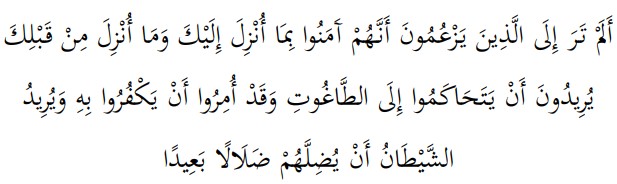
¿No has visto a aquellos que pretenden haber creído en lo que te fue revelado a ti ﷺ, y en lo que fue revelado antes de ti? Desean someter sus disputas al Tágut, cuando se les ordenó rechazarlo; y Satanás quiere desviarlos profundamente (An-Nisa 60).
Have you not seen those who claim to have believed in what was revealed to you, [O Muhammad], and what was revealed before you? They wish to refer legislation to Taghoot, while they were commanded to reject it; and Satan wishes to lead them far astray (An-Nisaa 60).
Por tanto, no queda ningún juicio en manos de la mente ni del ser humano. Esto no significa que se haya anulado el papel de la mente ni que se le haya impuesto una limitación a sus capacidades. Más bien, se debe a que la mente y el ser humano no poseen las herramientas necesarias para emitir un juicio o dictar un fallo. Esto se debe a que la fuente del fallo no es la cosa en sí ni el sujeto sobre el que recaerá el fallo.
As such there is no judgement left to the mind or the human and this does not mean that the role of the mind has been taken away or that a limitation has been placed upon its capabilities. It is rather because the mind and the human do not possess the necessary tools to make judgement or pass a ruling. This is because the source of the ruling is not the thing itself or the subject that the ruling will be made upon.
Así, quienes han atribuido al pueblo la potestad de legislar, por ejemplo, no se han basado en evidencia alguna, sino que se han extraviado y descarriado. Han sostenido un concepto que no es veraz y que carece de realidad, y al mismo tiempo han rechazado la verdad al separar la religión (ad-Deen) de la vida, lo que significa que no existe hukm alguno que pertenezca a Allah.
So those who have allocated the provision of the ruling to the people, for example, have not based this upon evidence and have rather wandered and gone astray. They have carried a concept which is not truthful and has no reality to it, whilst at the same time they have denied the truth by separating the Deen from life which means that there is no Hukm belonging to Allah.
Si se le hubiera concedido al ser humano el derecho y la potestad de dictar juicios y sentencias, sin que poseyera las herramientas necesarias para ello, entonces nada prevalecería salvo sus deseos, inclinaciones e intereses según su propio punto de vista. Estos cambiarían y fluctuarían, y podría ver algo dañino como beneficioso, y podría ver una enfermedad como una medicina y una cura.
If the right and power of issuing judgements and rulings was given to the human whilst he does not possess the necessary tools to do that, then nothing would prevail apart from his desires, inclinations and interests according to his viewpoint. These would be changing and fluctuate and he could see something that is damaging as being beneficial and he could see a disease as a medicine and cure.
En este contexto, cobra protagonismo la importancia de la fe (Imaan) en Allah, en la profecía y en el Corán. Esta fe es la 'Aqeedah, que influye en la conducta, pues proporciona al ser humano los conceptos sobre la vida que definen cómo debe vivir, cuál es su propósito en la vida y cuál es el propósito detrás de su comportamiento y su conducta, que es alcanzar el agrado de Allah ‘Azza Wa Yalla.

Di: ¿Quieres que te informemos de quiénes son los mayores perdedores en cuanto a sus obras? Son aquellos cuyo esfuerzo se pierde en la vida mundanal, mientras ellos creen que están haciendo el bien (Al-Kahf 103-104).
Say: Shall We inform you of the greatest losers in respect to (their) deeds? [They are] those whose effort is lost in worldly life, whilst they were thinking that they are doing good (Al-Kahf 103-104).
Sí, los individuos se extravían y los pueblos se extravían, igual que un pez en el océano cuando muerde el cebo, o el ratón que se precipita hacia la comida colocada en una trampa para ratones.
Yes the individuals are led astray and the peoples are led astray just like a fish in the ocean when it takes the bait or the mouse that rushes to the food placed in a mouse trap.
El ser humano divaga y no alcanza su meta cuando avanza por un camino que está convencido de que lo llevará a ella, cuando en realidad se dirige en la dirección exactamente opuesta.
The human wanders around and does not arrive at his aim when he proceeds along a path that he is convinced will lead to it whilst in reality he is actually going in the exact opposite direction.
Está también extraviado cuando sostiene conceptos erróneos sobre la vida, por ignorancia o por distorsión, como quien ve o se le hace ver que el Ribaa es Halal, que la democracia procede del Islam y que el estudio de la Sharee'ah es para ganarse la vida, igual que cualquier otra especialidad o profesión. Cuando las Haqaa'iq (verdades/hechos) del Islam se ausentan y las mentes se llenan de pensamientos falsos, como las ideas de las libertades generales, o que es imposible cambiar la realidad decadente en nuestra generación o en cien años, o que este cambio es un don de Allah y que no nos queda nada por hacer salvo esperar o aguardar al Mahdi, todo esto convierte a los individuos, a los pueblos o a la Ummah en un conjunto de gente perezosa, arrastrada lentamente hacia la dirección que quienes les han dado estos conceptos quieren, y los lleva a convertirse en herramientas de sus enemigos, mientras creen que en realidad luchan contra ellos.
He is also led astray when he carries incorrect concepts about life as a result of ignorance or distortion like the one who sees or is made to see that Ribaa is Halaal, that democracy is from Islaam and that learning the Sharee’ah is for the sake of earning a living just like any other area of specialisation or profession. When the Haqaa’iq (truths/facts) of Islaam become absent and the minds are filled with false thoughts like the thoughts of general freedoms or that changing the declined reality is impossible in our current generation or one hundred years, or that this change is a gift from Allah and that there is nothing for us to do apart from wait or to wait for the Mahdi. All of this transforms the individuals, peoples or the Ummah into a collection of lazy people sluggishly being driven in whatever direction those who have given them these concepts want them to and it leads them into becoming tools for their enemies whilst they believe that they are actually struggling against them.

Como quien extiende sus manos hacia el agua para que llegue a su boca, pero esta no llega a ella (Ar-Ra'd 14).
Like the one who stretches his hands toward water [from afar, calling it] to reach his mouth, but it does not reach it (Ar-Ra’d 14).

Su ejemplo es el de quien encendió un fuego, pero cuando iluminó lo que le rodeaba, Allah les quitó la luz y los dejó en tinieblas [de modo que] no podían ver (Al-Baqarah 17).
Their example is that of one who kindled a fire, but when it illuminated what was around him, Allah took away their light and left them in darkness [so] they could not see (Al-Baqarah 17).
Por lo tanto, repetimos que, para cambiar la conducta, rectificarla y convertirla en una conducta correcta y elevada que alcance su propósito, es esencial generar conceptos correctos sobre las cosas y sobre la vida. En ese momento, la persona estará en buena disposición para dominar y utilizar con éxito las cosas y sus atributos, y estará en buena disposición para adoptar la conducta que lo lleve a su propósito y al mayor de todos los objetivos, que es la obtención del agrado de Allah ‘Azza Wa Jall:
Therefore, we repeat, that in order to change the conduct, rectify it and make it a correct elevated conduct that arrives at its purpose, it is essential to generate correct concepts about things and life. At that time the person will be in a good position to subjugate and utilise the things and their attributes successfully and will be in a good position to adopt the conduct that arrives to his purpose and the greatest of all objectives which is the attainment of the pleasure of Allah ‘Azza Wa Jall:

Pero busca, a través de lo que Allah te ha concedido, la morada de la Otra Vida; y, sin embargo, no olvides tu parte del mundo. Y haz el bien como Allah te ha hecho bien a ti (Al-Qasas 77).
But seek, through that which Allah has given you, the home of the Hereafter; and [yet], do not forget your share of the world. And do good as Allah has done good to you (Al-Qasas 77).
La primera de las Haqaa'iq (verdades) y, sin duda, la más importante es la 'Aqeedah, que define los conceptos del ser humano sobre la vida. La 'Aqeedah consiste en que todas las cosas han sido creadas por un Creador, que es Allah (swt), en que Allah envió un Mensajero, que es Muhammad ﷺ, con la Risaalah (mensaje) del Islam, que explica todo lo relacionado con el ser humano, y en que Él (swt) lo juzgará según su fe (Imaan) o su incredulidad (Kufr), y según su acatamiento de lo que trajo el Nabi ﷺ o su desacatamiento del mismo.
The first of the Haqaa’iq (truths) and absolutely its most important is the Aqeedah that defines the human’s concepts about life. The Aqeedah is that all things have been created by a creator who is Allah (swt), that Allah sent a Messenger who is Muhammad (saw) with the Risaalah (message) of Al-Islaam which explains everything that relates to the human being and that He (swt) will account him upon the basis of Imaan or Kufr and upon the basis of his abiding by what the Nabi (saw) came with or by his non-abidance to it.
El propósito del musulmán en la vida:
The Muslim’s purpose in life:
Entre las verdades más importantes después de la fe (Imaan) está que el ser humano comprenda el propósito de su creación, es decir, aquello que debe esforzarse por alcanzar.
From amongst the most important Haqaa’iq (truths) after Imaan is that the human understands the purpose of his creation i.e. that which he must strive to accomplish.
Allah (SWT) dijo:
Allah (swt) said:
«Y no he creado a los genios ni a los humanos sino para que Me adoren» (Adh-Dhariyat 56).
And I have not created the Jinn or humankind except to worship me (AdDhaariyaat 56).
La adoración (‘Ibaadah) a Allah consiste en tener Imaan en Él y obedecerle. La obediencia a Él, Ta’Aalaa, significa compromiso y adhesión (Al-Iltizaam) a todos Sus Ahkaam. Esto no se limita a los actos de ‘Ibaadah, Akhlaaq (moral) y Mu’aamalaat (transacciones sociales), sino que incluye todo aquello que Allah (SWT)
The worship (‘Ibaadah) to Allah means having Imaan in Him and obedience to Him. Obedience to Him Ta’Aalaa means commitment and abidance (Al-Iltizaam) to all of His Ahkaam. This is not restricted to the acts of ‘Ibaadah, Akhlaaq (morals) and Mu’aamalaat (societal transactions) but rather includes everything that Allah (swt)
...ha ordenado o prohibido. Incluye que nada tiene derecho a ser adorado sino Allah, y que ningún mandato o prohibición puede provenir de nadie fuera de Él (SWT).
has commanded or forbidden. It includes that nothing has a right to be worshipped other than Allah and that no command or forbiddance can come from anyone besides Him (swt).
Ahmad y At-Tirmidhi relataron que ‘Adiy Bin Haatim (ra) acudió al Mensajero de Allah ﷺ mientras él recitaba el aleya:
Ahmad and At-Tirmidhi related that ‘Adiy Bin Haatim (ra) came to the Messenger of Allah (saw) whilst he was reciting the Aayah:
Tomaron a sus rabinos y monjes como señores en lugar de Allah, y también al Mesías, hijo de María. Y no se les ordenó sino que adoraran a un solo Dios; no hay más dios que Él. ¡Glorificado sea por encima de lo que Le asocian! (At-Tawba 31).
They have taken their Rabbis and monks as lords besides Allah, and [also] the Maseeh, the son of Mary. And they were not commanded except to worship one God; there is no deity except Him. Exalted is He above whatever they associate with Him (At-Taubah 31).
«Adiy dijo: "No los adoraban". Entonces el Mensajero de Allah ﷺ dijo:
‘Adiy then said: ‘They did not worship them’. So the Messenger of Allah (saw) said:
Por el contrario, ellos hicieron haram lo que Allah había hecho halal para ellos y hicieron halal lo que Allah había hecho haram, y ellos los siguieron en esto. Por tanto, esto fue su adoración hacia ellos.
On the contrary, they made the Halaal Haraam upon them and made the Haraam Halaal for them, then they followed them (in this). Therefore this was their worship to them.
Así, conceder a cualquiera el derecho (haqq) de decidir qué es halal y qué es haram, o el derecho de legislar, y el derecho a ser obedecido, constituye adoración (‘ibaadah) hacia esa persona.
As such giving the Haqq (right) to anyone to decide the Halaal and decide the Haraam or the right to make legislation and the right of obedience represents ‘Ibaadah to that person.
Allah (SWT) dijo:
Allah (swt) said:
No adoráis nada aparte de Él, sino meros nombres que vosotros y vuestros padres les habéis puesto, sin que Allah haya hecho descender autoridad alguna sobre ello.
You worship nothing besides Him except [mere] names you have named them with, you and your fathers, for which Allah has sent down no authority.
La legislación no es sino de Allah. Él ha ordenado que no adoréis sino a Él. Esa es la religión correcta, pero la mayoría de la gente no lo sabe (Yusuf 40).
Legislation is not but for Allah. He has commanded that you worship not except Him. That is the correct Deen, but most of the people do not know (Yusuf 40).
En cuanto al derecho de obediencia que corresponde al Hakim (gobernante), al Ameer o a los padres, esto se debe al Haqq (derecho) que Allah (SWT)
As for the right of obedience that belongs to the Hakim (ruler), Ameer or parents then this is due to the Haqq (right) that Allah (swt)
...provisto para ellos.
has provided to them.
La ‘ibaadah a Allah (SWT) incluye la obediencia en lo que respecta a hacer que la humanidad lo adore a Él (SWT), es decir, someterlos a la Shari’a de Allah y luchar contra la existencia de cualquier Haakimiyah (derecho a legislar) a otro que no sea Allah o a otra cosa que no sea la Shari’ah del Islam, además de luchar contra la salida (Juruuj) de la Hukm (autoridad) de Allah (SWT). Esto es lo que indican los textos y el significado con el que han venido; aquellos que han venido ordenando el ‘Amr Bil Ma’rouf’ (ordenar lo bueno) y el ‘Nahi ‘An il-Munkar’ (prohibir lo malo). Ordenan emprender discusiones, explicaciones, convencer a la gente e invitarla por medio de la Da’wah. Además, ordenan los azotes, las amputaciones, la muerte (como castigos y disuasión) y el combate y el Yihad para extender la ley de Allah sobre la Tierra y enaltecer Su palabra por encima de todo.
‘Ibaadah to Allah (swt) includes the obedience in respect to making mankind worship Him (swt) i.e. to make them submit to the Shar’a of Allah and to fight against the existence of any Haakimiyah (right to make rules) to other than Allah or to other than the Sharee’ah of Islaam in addition to fighting against the exiting (Khurooj) from the Hukm (rule) of Allah (swt). This is what the texts have indicated and the meaning that they have come with; those which have come commanding the ‘Amr Bil Ma’rouf’ (Commanding the good) and the ‘Nahi ‘An il-Munkar’ (Forbidding the evil). They have commanded the undertaking of discussions, explanations, convincing people and inviting them by way of Da’wah. Additionally they have commanded lashing, cutting, killing (as punishments and deterrents) and fighting and Al-Jihaad to spread the rule of Allah upon the Earth and to raise His word the highest.
Así, vimos que, después de que el Mensajero de Allah (saw) estableció el Estado Islámico en Al-Madinah Al-Munawaarah y afianzó firmemente sus pilares, envió mensajeros a los reyes y gobernantes invitándolos al Islam. Luego vimos a los Julafa’ (rah) que vinieron después de él ﷺ enviando portadores de la Da’wah, muyahidines y ejércitos para invitar a las gentes a la Fe (Imaan) y sacarlas de la oscuridad para conducirlas a la luz. Combatieron con el propósito de que las tierras y los siervos se sometieran a la autoridad del Islam.
As such we saw that after the Messenger of Allah (saw) established the Islamic State in Al-Madinah Al-Munawaarah and established its pillars firmly, he (saw) sent the messengers to the Kings and rulers inviting them to Islaam. We then saw the Khulafaa’ (rah) who came after him (saw) sending out carriers of the Da’wah, Mujaahideen and armies to invite the people to Imaan and to take them out of the darkness and bring them into the light. They fought for the purpose of making the lands and servants submit to the authority of Islaam.
Allah Azza wa Jall nos ha enviado para liberaros de la adoración de los siervos (de las personas) y llevaros a la adoración del Señor de los siervos (de las personas), para liberaros de la opresión de otras religiones (Deen) y llevaros a la justicia del Islam, y de la estrechez de este mundo y llevaros a la amplitud de este mundo y de la otra vida.
Allah Azza wa Jall has sent us to deliver you from the worship of the servants (people) to bring you to the worship of the Lord of the servants (people) and to deliver you from the oppression of other Deens and bring you to the justice of Islaam and from the narrowness of this world and bring you to the vastness of this world and the hereafter.
Este punto ha quedado muy claro en el Corán, en la Sunnah y en las acciones del Mensajero de Allah ﷺ, en textos tan numerosos que no es posible ponerles un límite. Sin embargo, mencionaremos algunos de ellos.
This thought has been made very clear in the Qur’aan, the Sunnah and the actions of the Messenger (saw) within texts that are too numerous for a limit to be placed upon them. We will however make a mention of some of them:
Allah (SWT) dijo:
Allah (swt) said:
Di: ¡Oh gente! Ciertamente yo soy el Mensajero de Allah ﷺ para todos ustedes (Al-A'raf 158).
Say: O people! Verily I am the Messenger of Allah to you all (Al-Aa’raaf 158).
Él (swt) dijo:
He (swt) said:
Y no te hemos enviado sino como portador de buenas nuevas y como amonestador para toda la humanidad (Saba' 28).
And we have not sent you except to the entirety of mankind as a bringer of glad tidings and as a warner (Saba’ 28).
Y Él (swt) dijo:
And He (swt) said:
Él es Quien envió a Su Mensajero con la guía y la religión de la verdad, para que prevalezca sobre todas las demás religiones, aunque a los politeístas les disguste (At-Tawba 33, As-Saff 9). Note: The Qur'an verse text in braces is not present here, so no ﷺ applies within it. The Prophet is referenced as "Su Mensajero" (His Messenger), so ﷺ is written once after it. Él es Quien envió a Su Mensajero ﷺ con la guía y la religión de la verdad, para que prevalezca sobre todas las demás religiones, aunque a los politeístas les disguste (At-Tawba 33, As-Saff 9).
He its is who has sent His Messenger with the guidance and the Deen of truth so that it prevails over all other Deens and even if the Mushrikeen hate it (AtTaubah 33, As-Saff 9).
Y:
And:
¡Oh, los que habéis creído! Combatid a los incrédulos que están cerca de vosotros, y que encuentren en vosotros dureza. Y sabed que Allah está con los piadosos (At-Tawba 123).
O you who have believed, fight those adjacent to you of the disbelievers and let them find in you harshness. And know that Allah is with the righteous (AtTaubah 123).
El objetivo y propósito es que no exista ninguna ley que se obedezca ni ninguna legislación que se adopte, salvo aquella que proviene de Allah (SWT).
So the objective and purpose is that no law that is obeyed or no legislation that is adopted can exist except for that which Allah (swt)
…ha ordenado, y que no hay Haakim (legislador) aparte de Allah. En cuanto a dejar a los incrédulos en sus creencias y cultos, quedan en ellos en conformidad y en cumplimiento con el mandato de Allah (SWT).
has commanded and that there is no Haakim (law maker) other than Allah. As far as leaving the disbelievers upon their beliefs and worships then they are left upon these matters in accordance to and in compliance to the command of Allah (swt).
Allah (SWT) ha dejado claro y explicado este objetivo y propósito respecto a Su creación de los seres humanos cuando dijo (SWT):
Allah (swt) has made clear and explained this objective and purpose in respect to His creation of the people when He (swt) said:
Y así os hemos hecho una comunidad justa/la mejor comunidad para que seáis testigos sobre la humanidad y el Mensajero sea testigo sobre vosotros (Al-Baqarah 143).
And thus we have made you a just/best Ummah so that you will be witnesses over mankind and the Messenger will be a witness over you (Al-Baqarah 143).
Esta alocución se dirige a la Umma islámica y le encomienda la responsabilidad legal (Takleef) de transmitir el Mensaje, después del Mensajero de Allah ﷺ, a toda la humanidad. Y, en efecto, el Nabi ﷺ lo transmitió, cumplió su Amaanah y, tras haber hecho Al-Jihaad por la causa de Allah con todas las fuerzas, esfuerzo y capacidad que poseía, se puso de pie en la última peregrinación de despedida, dirigió la palabra a su Umma y dijo:
This address is to the Islamic Ummah and it entrusts her with the legal responsibility (Takleef) to carry the Message, after the Messenger of Allah (saw), to the whole of mankind. And indeed the Nabi (saw) carried it and after conveying the message, fulfilling his Amaanah and after having performed Al-Jihaad for Allah’s sake with all that he possessed of strength, effort and capability. He (saw) stood in the final farewell Hajj, addressed his Ummah and said:
Reference: Taghyeer (cambio) - Mahmoud Abdul-Kareem Hasan
"Y en verdad he dejado entre vosotros aquello que, si os aferráis a ello firmemente, nunca os extraviaréis: el Kitaab (libro) de Allah, y sois responsables ante mí (es decir, después de mí). Entonces, ¿qué decís todos?". Ellos dijeron: "Damos testimonio de que has transmitido, cumplido y aconsejado". Luego, levantando el dedo índice hacia el cielo y después hacia la gente, dijo: "¡Oh Allah, sé testigo! ¡Oh Allah, sé testigo! ¡Oh Allah, sé testigo!" (Abu Daawood).
‘And indeed I have left amongst you that which if you hold on firmly to you will never go astray: The Kitaab (book) of Allah, and you are responsible from me (i.e. after me). So what do you all say?’. They said: ‘We bear witness that you have conveyed, fulfilled and advised’. He then said whist raising his index finger to the sky and then towards the people: ‘O Allah bear witness, O Allah bear witness, O Allah bear witness’ (Abu Daawood).
Así, el Nabi ﷺ dio testimonio sobre nosotros con la responsabilidad de transmitir y cargar con la Amanah (confianza), y pidió a Allah Su testimonio sobre nosotros en cuanto a ello. Por tanto, después de eso, nos es obligatorio ser testigos sobre las personas conforme a exactamente la misma metodología que emprendió el Noble Mensajero ﷺ. En verdad, Allah (swt) dejó claro que este es el propósito y el objetivo de la creación antes de Su creación de Adán (as).
So in this way the Nabi (saw) bore witness over us with the responsibility of conveying and carrying the Amaanah (trust) and sought Allah’s witness upon us in regards to that. Therefore, after that it is obligatory upon us to be witnesses over the people in accordance to exactly the same methodology that the Noble Messenger (saw) undertook. Indeed Allah (swt) made clear that this is the purpose and objective of the creation before His creation of Aadam (as).
Allah (SWT) dijo:
Allah (swt) said:
Y [recuerda] cuando tu Señor dijo a los ángeles: "Ciertamente, pondré en la tierra un sucesor." Dijeron: "¿Pondrás en ella a quien cause corrupción en ella y derrame sangre, mientras nosotros glorificamos Tu alabanza y Te santificamos?" Dijo Allah: "Ciertamente, Yo sé lo que vosotros no sabéis." (Al-Baqara 30).
And [remember] when your Lord said to the angels, "Verily, I will make upon the earth a successive authority." They said, "Will You place upon it one who causes corruption therein and sheds blood, while we declare Your praise and sanctify You?" Allah said, "Indeed, I know that which you do not know." (AlBaqarah 30).
Los Malā'ikah (ángeles) son siervos de Allah (SWT) y no le desobedecen:
The Malaa’ikah (Angels) are the servants of Allah (swt) and do not disobey Him:
Sobre los cuales hay ángeles designados, severos y duros; no desobedecen a Allah en lo que Él les ordena, sino que hacen lo que se les manda (At-Tahrim 6).
Over which are [appointed] angels, harsh and severe; they do not disobey Allah in what He commands them but do what they are commanded (At-Tahreem 6).
Cuando Allah (SWT) les dijo:
When Allah (swt) said to them:
Verdaderamente, pondré en la tierra un poder sucesorio (Jalifah)
Verily, I will make upon the earth a successive authority (Khalifah)
Comprendieron y entendieron que Él (swt) pondrá sobre la tierra a quienes serán desobedientes. Esto se deduce de la expresión «Jalifah», pues en este contexto significa aquel a quien Allah concederá la sucesión y delegará la tarea de corregir y velar por los asuntos, así como otras labores que asume quien ha sido encomendado. Este papel de rectificar y atender los asuntos implica que existirán quienes necesiten ser rectificados y que requieran Ri'aayah (cuidado). Esto significa que habrá quienes salgan fuera del mandato de Allah, y que ello conducirá a la desgracia, la angustia y el desorden. Por eso dijeron:
They realised and comprehended that He (swt) will make upon the earth those who will be disobedient. This is understood from the wording ‘Khalifah’ because here in this context it means the one who Allah will give succession and delegate to undertake the acts of correcting and caretaking amongst other matters that the one who is entrusted would undertake. This role or rectifying and taking care of affairs means that their will exist those who need to be rectified and who are need of Ri’aayah (caretaking). This means that there will be those who go outside of the command of Allah and that this will lead to misery, anguish and disorder. This is why they said:
Dijeron: ¿Pondrás en ella a quien hará corrupción en ella y derramará sangre? (Al-Baqarah 30).
They said: Will you make those who will make corruption in it (the earth) and spill blood (Al-Baqarah 30).
En otras palabras, si la creación no incluyera algo que fuera desobediente, todo procedería de acuerdo con el mandato de Allah (SWT). Por lo tanto, cuando Allah (SWT) quiso crear a alguien que emprendiera las acciones de rectificación y guía, esto significa que existirían quienes elegirían el extravío y la desobediencia a Allah.
In other words, if the creation did not include something that would be disobedient then everything would proceed in accordance to the command of Allah (swt). So when Allah (swt) wanted to create someone who will undertake the actions of rectifying and guidance then this means that there will exist those who will choose misguidance and disobedience to Allah.
Por lo tanto, el propósito de la vida que Allah (swt) ha dejado claro y explicado antes de la creación de Adán (as) es que habrá un ser humano que sea siervo ('Abd) de Allah y que emprenderá la labor de hacer que otros adoren a Allah (swt), de entre quienes se han apartado de Su adoración o la han rechazado.
Therefore the purpose in life which Allah (swt) has made clear and explained before the creation of Aadam (as) is that there will be a human being who is a slave (‘Abd) to Allah and that he will undertake the work of making others worship Allah (swt) from those who have gone astray from His worship or have rejected it.
La vida, por tanto, es una confrontación y lucha intelectual, basada en la creencia y política entre el Imaan y el Kufr. Es de base creencial en cuanto a que se lleva a cabo por la exaltación de la palabra de Allah, para que la Din de las personas sea totalmente y únicamente para Allah. De modo que no exista ningún Hukm sino que sea para Allah, que Él (swt) no tiene Shareek (asociado), que no se adora a nada ni a nadie aparte de Allah y que la sumisión es únicamente a la Shar'a de Allah. De esta manera representa una lucha política en la que se ha hecho obligatorio que el cuidado de los asuntos de los seres humanos no sea confiado a ninguna forma de legislación distinta de la Sharí'ah de Al-Islam.
The life is therefore an intellectual, belief based and political clash and struggle between Imaan and Kufr. It is belief based in terms of it being for the sake of raising the word of Allah the highest and so that the Deen of the people is all and only for Allah. So that no Hukm exists except that it is for Allah, that He (swt) has no Shareek (partner), that nothing or no one is worshiped aside from Allah and that submission is only to the Shar’a of Allah. In this way it represents a political struggle where the caretaking of the affairs of human beings has been made obligatory to not be entrusted to any form of legislation other than the Sharee’ah of Al-Islaam.