1.4 Yaushe aka kulla “Mu’akhaah” (yarjejeniyar 'yan'uwantaka) da kuma yaushe aka rubuta Sahifah (ta Madina)?
1.4 When was the “Mu’akhaah” (brotherhood pact) concluded and when was the Sahifah (of Al-Madinah) written?
Rubutun da aka gabatar ya isa, kuma daga cikinsu muna fahimtar haka:
The texts that have already been presented should be sufficient and from them we deduce the following:
1) Ra'ayin da ya fi dacewa shi ne cewa wannan 'yan'uwantakar tsakanin Muhajirai da Ansar ba zai yiwu ba ta faru kafin mutuwar As'ad bin Zurarah (Allah ya yarda da shi), a lokacin ginin Masallaci, kimanin watanni bakwai bayan isowar Annabi ﷺ. Ba zai yiwu ba ta faru a lokacin rayuwarsa ba tare da an ambace shi a cikinta ba, domin shi ne shugaban Ansar kuma ɗaya daga cikin Naqeebs (shugabannin da aka zaɓa daga cikin Ansar a alkawarin 'Aqabah na biyu). Saboda haka, maganar Abu 'Umar ibn Abd AlBarr:
1) The correct view is that this brotherhood between the Muhajirin and the Ansar could not possibly have taken place prior to the death of As’ad bin Zurarah (May Allah be pleased with him), during the building of the Masjid, about seven months following the arrival of the Prophet (peace be upon him). It is not conceivable that it took place in his lifetime without him having been mentioned in it, as he was chief of the Ansar and one of the Naqeebs (selected leaders of the Ansar at the second pledge of ‘Aqabah). Therefore, the statement of Abu ‘Umar ibn Abd AlBarr:
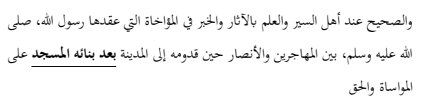
"Ra'ayin da ya dace bisa ga malaman Sira da riwayoyin da suka shafi "Mu'akhaah" (’yan’uwantaka) wadda Manzon Allah ﷺ ya kulla tsakanin Muhajirai (masu hijira) da Ansarawa (mataimaka), a lokacin da ya zo Madina, shi ne cewa ya faru ne bayan ginin Masallaci da ya yi, kuma bisa tushen taimako/goyon baya da kuma Haqq (gaskiya) …"
“The correct view as held by the scholars of Seera and reports in respect to the “Mu’akhaah” (brotherhood) which the Messenger of Allah (peace be upon him) concluded between the Muhajirin (emigrants) and the Ansar (helpers), when he came to Al-Madinah, was that it took place after his building of the Masjid and it was upon the basis of the provision of assistance/support and the Haqq (truth) …” .
Yana da matukar yiwuwa, musamman ma yayin da aka kammala ginin Masallaci da bikin buɗe shi, wanda ya kasance dama mai kyau don daukar irin wannan mataki. Bugu da ƙari, dole ne a yi shi kafin yakin Badar, saboda an ambaci Ubaida bin Al-Harith (bin Al-Muttalib bin Abd Manaf bin Qusayy Al-Qurashi Al-Muttalibi) a cikinsa tare da ɗan’uwansa 'Umair bin Al-Humam (bin Al-Jamuh bin Zaid bin Haram bin Ka’b), dukkansu biyu kuma sun yi shahada a yakin Badar, Allah ya yarda da su. Sun kasance ’yan’uwa a rayuwa da kuma a mutuwa, kuma muna fatan daga Allah cewa su kasance haka ma a Ranar Kiyama. 2) Ra’ayin da ya dace shi ne cewa wannan ’yan’uwantaka tsakanin Muhajirai da Ansar ba a rubuta ta a asali ba, domin yanayinta bai dace da hakan ba. Wannan saboda dukkan rahotannin, ba tare da togiya ba, ba su ambaci wata takarda da aka rubuta ba kwata-kwata. Bincike a littattafan Sira, tarihi da Hadisi ya nuna cewa babu ambaton wata yarjejeniya, takarda da aka rubuta ko doka kafin Sahifar Madina. Banda abin da ya haɗa da:
is very conceivable, and particularly as the completion of the building of the Masjid and the celebration for its opening, represented a good occasion for such a step to be undertaken. I addition, it must have been undertaken prior to the battle of Badr because Ubaida bin Al- Harith (bin Al-Muttalib bin Abd Manaf bin Qusayy Al-Qurashi Al-Muttalibi) is mentioned in it along with his brother ‘Umair bin Al- Humam (bin Al-Jamuh bin Zaid bin Haram bin Ka’b) and they were both martyred at the battle of Badr, may Allah be pleased with them. They were brothers in life and at death, and we hope from Allah that they be like that also, on the Day of Judgement. 2) The correct view is that this brotherhood between the Muhajirin and the Ansar was not written in origin as its nature was incompatible with that. That is because all of the narrations, without exception, do not mention a written document at all. An examination of the books of Seera, history and Hadith reveal the absence of the mention of any charter, written document or code prior to the Sahifah of Al-Madinah. The exception to that included:
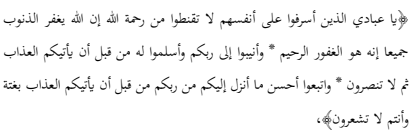
"Ka ce, "Ya bayina waɗanda suka zalunci kansu [ta hanyar aikata zunubi], kada ku yanke ƙauna daga rahamar Allah. Lalle ne, Allah yana gafarta dukan zunubai. Lalle ne, shi ne Mai yawan gafara, Mai yawan jin ƙai". Kuma ku koma [cikin tuba] zuwa ga Ubangijinku, ku miƙa wuya gare Shi kafin azaba ta zo muku; sa'an nan ba za a taimake ku ba. Kuma ku bi mafi kyau daga abin da aka saukar muku daga Ubangijinku kafin azaba ta zo muku ba zato ba tsammani alhali ba ku sani ba" [TMQ 39:53-55]."
“Say, “O My servants who have transgressed against themselves [by sinning], do not despair of the mercy of Allah. Indeed, Allah forgives all sins. Indeed, it is He who is the Forgiving, the Merciful”. And return [in repentance] to your Lord and submit to Him before the punishment comes upon you; then you will not be helped. And follow the best of what was revealed to you from your Lord before the punishment comes upon you suddenly while you do not perceive” [TMQ 39:53-55].
b) Majallatul Luqman: Al-Majallah da haka kuma As-Sijli shafi ne (takarda da aka rubuta a kai) wanda ake juya shi ko (shafukansa) ana juya su. Wannan kamar abin da ya zo a cikin "Dala'il An-Nubuwwah" na Al-Baihaqi (2/419). (Bayan ambaton cikakken sarkar watsa labari) 'Asim bin 'Umar bin Qatadah Al-Ansaariy ya ruwaito daga Shuyukh (dattawan) mutanensa, cewa sun ce:
b) The Majallah of Luqman: Al-Majallah and likewise As-Sijli are a Sahifah (written document) that is turned or (its pages) turned over. That is like what came mentioned in “Dala’il An-Nubuwwah” of Al- Baihaqi (2/419). (After mentioning the full line of transmission) ‘Asim bin ‘Umar bin Qatadah Al-Ansaariy related from the Shuyukh (elders) of his people, that they said:
"Suwaidu ɗan As-Samit, ɗan'uwan Bani 'Amr ɗan 'Awf, ya zo Makkah domin aikin Hajji ko 'Umrah. Mutanensa sun siffanta Suwaid da cewa shi ne abin koyi a cikinsu, saboda shekarunsa, launin fatarsa da gashin kansa. Ya ce (mai ruwaitowa):"
“Suwaid bin As-Samit, the brother of Bani ‘Amr bin ‘Awf, came to Makkah as a pilgrim for Hajj of ‘Umrah. Suwaid was described by his people as being the model of perfection among them, due to his age, skin and hair. He (the narrator) said:
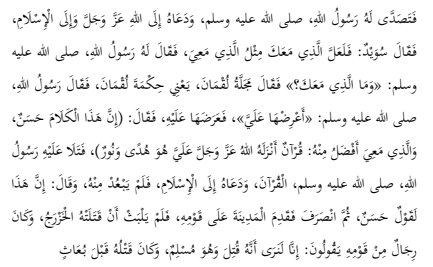
Sa'an nan Manzon Allah (ﷺ) ya zo wurinsa, ya gayyace shi zuwa ga Allah ‘Azza Wa Jalla da zuwa Musulunci. Suwaid ya ce: “Watakila abin da kake da shi yana kama da wanda nake da shi”. Sai Manzon Allah (ﷺ) ya tambaye shi: “Ko me kake da shi?” Ya amsa da cewa yana da Majallar Luqman, wato Hikimar Luqman. Sai Manzon Allah (ﷺ) ya ce: “Ka nuna mini ita”, sai ya nuna masa. Ya (ﷺ) ya ce: “Wannan magana tana da kyau, amma abin da nake da shi ya fi ta. Alkur’ani ne da Allah ‘Azza Wa Jalla ya saukar, shiriya ne kuma haske ne”. Sai Manzon Allah (ﷺ) ya karanta masa Alkur’ani ya kuma gayyace shi zuwa Musulunci. Bai nisanta kansa daga gare shi ba, ya ce: “Lallai wannan magana ce mai kyau”. Sannan ya tafi, daga baya ya isa Al-Madinah wurin mutanensa. Ba da daɗewa ba aka kashe shi a hannun Khazraj. Akwai mutane daga cikin mutanensa da suke cewa: “Muna ganin cewa an kashe shi yana Musulmi”, kuma kisansa ya faru kafin yakin Bu’ath. [Karshen magana] c) Takardar (rubutacciyar) Kauracewa azzalumar la’ananniyar da Quraishawa suka rataya a cikin Ka’aba tare da labarinta, labarin kwari da suka cinye ta, da kuma sanannen labarinta na Mutawatir game da soke ta. d) Shafukan (Suhuf) da Manzon Allah (ﷺ) ya ba shugabannin yaƙe-yaƙen soji, waɗanda ke ɗauke da umarni, kuma an rufe su ko an haɗa su tare. Misali na haka shi ne abin da ya zo a cikin “Kitab ul-Maghazi” na Al-Waqidi (1/13):
Then, the Messenger of Allah (peace be upon him) approached him and invited him to Allah ‘Azza Wa Jalla and to Islam. Suwaid said: “It may be that what you have is like that which I have”. So, the Messenger of Allah (peace be upon him) asked: “And what do you have?” He responded by saying that he had the Majallah of Luqman, meaning the Hikmah (wisdom) of Luqman. The Messenger of Allah (peace be upon him) then said: “Show it to me” and so he did. He (peace be upon him) said: “This speech is good but what I have is better than it. It is a Qur’an that Allah ‘Azza Wa Jalla has revealed and it is guidance and light”. The Messenger of Allah (peace be upon him) then recited the Qur’an to him and invited him to Islam. He didn’t distance himself from it and said: “Verily, this is a good speech”. He then left and later arrived to Al-Madinah to his people. It was not long thereafter that he was killed by the Khazraj. There were men from his people who would say: “We view that he was killed whilst he was a Muslim” and his killing occurred before the war of Bu’ath” [End of Quote]. c) The Sahifah (written document) of the (oppressive and accursed) Boycott which the Quraish hung inside the Ka’ba along; its story, the story of the termites eating it and then its well-known Mutawatir story concerning its nullification. d) The pages (Suhuf) which the Messenger of Allah (peace be upon him) gave to the commanders of the military expeditions, containing instructions, and they were sealed or patched together. And example of that is what came stated in Al-Waqidi’s “Kitab ul-Maghazi” (1/13):
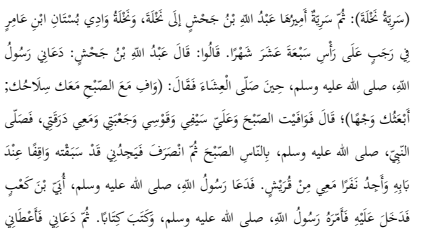
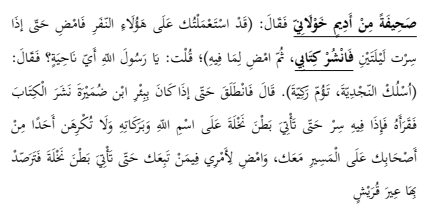
Yaƙin Nakhla wanda Abdullahi ɗan Jahshi ya jagoranta (Nakhla kwari ne a cikin Lambun Ibn ‘Amir) ya faru a watan Rajab, wata na goma sha bakwai bayan Hijira.
“The expedition to Nakhla commanded by Abdullah bin Jahsh (Nakhla is a valley in the Bustan (Orchard) of Ibn ‘Amir) took place in the month of Rajab, the seventeenth month AH.
Sun ce: Abdullahi bin Jahsh ya ce: Manzon Allah ﷺ ya kira ni a lokacin da ya yi sallar Isha'i, ya ce: "Ka zo wurina da asuba da makamanka, domin zan aike ka a wata manufa." Ya ce: Sai na zo a asuba da takobina, da bakanina, da kwari na kibau, da garkuwata. Manzon Allah ﷺ ya yi sallar Subh (watau Fajr) tare da mutane, sannan ya fita ya same ni. Ya same ni na riga shi zuwa, ina tsaye a bakin kofarsa, sannan na sami wata tawaga ta Kuraishawa (watau Muhajirai) tare da ni a wurin. Manzon Allah ﷺ ya kira Ubayyu bin Ka'b, ya umarce shi ya rubuta wata takarda. Sannan ya kira ni, ya ba ni wata fatar takarda daga Khawlan, yana cewa: "Na nada ka shugaban wannan tawaga. Ci gaba har sai ka yi tafiyar dare biyu. Sannan ka buɗe wasiƙata, ka aikata abin da ke cikinta." Na ce: "Ya Manzon Allah, wace hanya?" Ya amsa: "Ku nufi Najdiyya har sai kun isa wata ƙaramar rijiya." Mai ruwaitowa ya ce: Abdullahi bin Jahsh ya hanzarta, har ya isa rijiyar Ibn Dumaira. Sannan ya buɗe wasiƙar ya karanta ta. Ta ce: "Ku tafi, da sunan Allah da albarkarsa, har sai kun zo kwarin Nakhla, amma kada ku tilasta wa kowane daga cikin abokan tafiyarku ya tafi tare da ku. Ku ci gaba bisa umarnina tare da duk wanda ya bi ku, har sai kun isa kwarin Nakhla, sannan ku yi wa tawagar Kuraishawa kwanton bauna a can." [Ƙarshen zance]
They said: Abdullah bin Jahsh said: The Messenger of Allah (peace be upon him) called for me when he prayed Ishaa’, and said: “Come to me at dawn with your weapons, as I will send you on a mission”. He said: So, I approached at dawn with my sword, my bow, my quiver and my shield. The Prophet prayed Subh (i.e. Fajr) with the people, and then he left and found me. He found me having preceded him already standing at his door whilst I found a group of the Quraysh (i.e. Muhajirun) with me there. The Messenger of Allah (peace be upon him) called for Ubayy bin Ka’b and commanded him to write a document. Then he called me and gave me the sheet of leather from Khawlan, saying: “I have appointed you over this group. Proceed until you have travelled for two nights. Then open my letter and do as it says”. I said: “O Messenger of God, in which direction?” He replied, “Go towards Najdiyya until you reach a small well”. The narrator said: Abdullah bin Jahsh hastened, until he reached the well of Ibn Dumayra. He then opened the letter and read it. It said: “Go, in the name of Allah and with His blessings, until you come to the valley of Nakhla, but do not force any one of your companions to go with you. Proceed according to my commands with whoever follows you, until you reach the valley of Nakhla and lie in wait for the caravan of Quraysh from there” [End of Quote].
Taƙaitaccen Kammalawa
Summary Conclusion
Duk inda aka sami labari game da wata Sahifah ko takardar yarjejeniya tsakanin Muhajirai da Ansar, ko wadda ta shafi diyyar jini, yaki ko zaman lafiya, mun sani, bisa larura, cewa ba ta da alaka da wannan "Mu'akhaah" (kulla 'yan'uwantaka). Ko dai za ta shafi Sahifar Madina ne, ko kuma wani abu ne da ya zo ko aka rubuta shi daga baya sosai. Haka kuma babu inganci a abin da aka ruwaito a cikin "As-Seera An-Nabawiyah" na Ahmad Abu Zaid (shafi na 71), karkashin taken "Ranar rubuta yarjejeniyar (Mu'ahadah) da Yahudawa": "Wani masanin zamani ya ga cewa rinjayen ra'ayi shi ne takardar ta kasance asali takardu biyu ne, sai malaman tarihi suka hada su guda daya. Daya daga cikinsu ta yi magana ne a kan yarjejeniyar Manzon Allah ﷺ da Yahudawa, kuma an rubuta ta kafin babban yakin Badr. Shi kuwa na biyun ya yi bayani ne a kan nauyin da ke kan Musulmi daga Muhajirai da Ansar, da hakkokinsu da wajibansu." Ya ce: "A ganina, ra'ayi mafi rinjaye shi ne an rubuta takardar zaman lafiya (Muwada'ah) da Yahudawa kafin babban yakin Badr. Amma takarda ta biyu, an rubuta ta ne bayan yakin." Maganganun malaman farko sun goyi bayan wannan ra'ayi. Abu 'Ubaid Al-Qasim bin Salam ya ce: "An rubuta Wathiqa (takardar) a lokuta biyu: lokacin da Annabi ﷺ ya isa Madina, kafin Musulunci ya yi karfi kuma ya tabbata, kuma kafin a umarce shi da karbar Jizyah daga Ahl ul-Kitab (mutanen littafi)." Al-Baladhari kuwa ya ce: "Lokacin da Manzon Allah ﷺ ya isa Madina, ya kulla yarjejeniyar zaman lafiya (Muwada'ah) da Yahudawa, ya rubuta takarda tsakaninsa da su. Ya sharadanta a kansu cewa kada su taimaka ko su goyi bayan abokan gabansa, su taimake shi a kan wadanda suka kai masa hari, kuma shi ba zai yaki don kare Ahl udh-Dhimmah ba." Bai yi yaƙi da kowa ba, kuma ba a zage shi ba, kuma bai aika da wata runduna ta yaƙi ba, har sai da Allah ‘Azza Wa Jalla ya saukar da: “An yi izni ga waɗanda ake yaƙa, saboda an zalunce su. Kuma lalle Allah Mai iko ne a kan taimakon su. [Su ne] waɗanda aka kora daga gidajensu ba da gaskiya ba” (TMQ 22:39-40)”.
Wherever we find a narration about a Sahifah or a written document between the Muhajirin and the Ansar, or concerning blood money rights, war or peace, we know, by necessity, that it bears no relation to this “Mu’akhaah” (formation of brotherhood). It would either be related to the Sahifah of Al-Madinah or something that came or was written (much) later than it. There is also no validity in what came related in “As-Seera An- Nabawiyah” by Ahmad Abu Zaid (p. 71) under the heading “The date of the writing of the treaty (Mu’ahadah) with the Jews”: “One of the contemporary researchers found preponderant that the document was actually two documents in origin and then the historians combined them into one. One of them dealt with the treaty of the Messenger of Allah (peace be upon him) with the Jews and was written prior to the great battle of Badr. That is whilst the second clarified the commitments (duties) of the Muslims from the Muhajirin and the Ansar, their rights and obligations. He said: “It is preponderant in my view that the peace agreement (Muwada’ah) document with the Jews was written before the great battle of Badr. As for the second document, then it was written after it”. The classical sources have expressed that which supports this preponderance. Abu ‘Ubaid Al-Qasim bin Salam said: “The Wathiqa (document) was written on two occurrences, when the Prophet (peace be upon him) arrived in Al-Madinah, prior to the dominance of Islam and its becoming strong and before he was commanded to take the Jizyah from Ahl ul-Kitab (the people of the book)”. Al-Baladhari said: “When the Messenger of Allah (peace be upon him) arrived in Al-Madinah he made a treaty (Muwada’ah) with the Jews and wrote between himself and them a document. He stipulated upon them that they should not support or side with his enemies, to support him against those who attack him and that he would not fight in defence of the Ahl udh-Dhimmah. He did not then wage war against anyone, they did not defame him and he did not dispatch a military expedition, until Allah ‘Azza Wa Jalla revealed: “Permission [to fight] has been given to those who are being fought, because they were wronged. And indeed, Allah is capable of providing them victory. [They are] those who have been evicted from their homes without right” (TMQ 22:39- 40)”.

An aka ba izini (yaƙi) ga waɗanda ake yi wa yaƙi, saboda an zalunce su. Kuma lallai Allah Yana da ikon ba su nasara.
“Permission [to fight] has been given to those who are being fought, because they were wronged. And indeed, Allah is capable of providing them victory.
"[Su ne] waɗanda aka kora daga gidajensu ba da gaskiya ba" [TMQ 22:39-40]
[They are] those who have been evicted from their homes without right” [TMQ 22:39-40]
Wannan ya faru ne saboda "Muwada'ah" (zaman lafiya da sulhu) ita ce yanayin halitta da ta asali, kuma ba ta buƙatar a kira taro don kafa ta. Sannan, idan yaƙi ya faru, "Muwada'ah" za ta ƙare, kuma ba za ta dawo ba sai yaƙin ya ƙare ta hanyar yarjejeniyar sulhu, yarjejeniya, ko yarjejeniyar zaman lafiya.
That is because the “Muwada’ah” (peace and truce) is the natural and original situation and is not in need of being convened in order to establish it. Then, if war was to take place, the “Muwada’ah” would cease and it would not return until the war ends by way of a truce, treaty or peace agreement.
Saboda haka, "Muwada'ah" yana wakiltar wani matsayi wanda zai iya kasancewa ko kuma ya ɓace. Don haka, maganar Manzon Allah ﷺ: "Ku bar Habashawa su kadai muddin su ma suka bar ku," na nufin tilas: Tabbatar da ci gaba da matsayin yanzu na Muwada'ah (zaman lafiya da sulhu) muddin Habasha ta yi haka. Saboda haka, dangane da maganar da malaman Seera suke amfani da ita, da rahotannin game da Annabi ﷺ kamar: "Lokacin da ya isa Madina ya yi zaman lafiya da dukan Yahudawan da suke zaune a can," ba a halatta a fahimce shi da cewa ya kafa Muwada'ah ta hukuma ko ya ƙulla yarjejeniya (yarjejeniyar hukuma). Maimakon haka, yana nufin ya tabbatar tare da ci gaba da matsayin asali na sulhu da zaman lafiyar da ke tsakaninsu.
Consequently, the “Muwada’ah” represents a status that could be present or absent. Therefore, the statement of the Messenger of Allah (peace be upon him): “Leave the Abyssinians be as long as they leave you be” means by necessity: Affirm and continue upon the status quo of the Muwada’ah (peace and truce) as long as Abyssinia does so. As such, in respect to the statement used by the scholars of Seera and reports concerning the Prophet (peace be upon him) like: “When he arrived in Al-Madinah he made peace with all of the Jews who were residing there”, it is not permissible to be understood to mean that he established an official “Muwada’ah” or contracted a covenant (official treaty). Rather, it means that he affirmed and continued upon the original status quo of the truce and peace existing between them.
In tafsirin wannan hadisi da aka ruwaito daga gare shi (ﷺ) cewa: "Da ya kasance ya tsaya ga abin da wanda ba shi ba, wanda ya raba ra'ayinsa, ya tsaya a kai, da ba a kashe shi ba. Amma ya zage mu, ya kuma yi mana izgili ta hanyar waka, kuma babu wanda daga cikinku da zai yi haka sai dai idan yana da takobi," idan mun lura da shi, za mu ga cewa yana tabbatar da wannan ra'ayinmu sosai. Hakan ya faru ne domin babu wani abu da aka ambata a cikinsa game da alkawari ko yarjejeniya da Ka'b bin Al-Ashraf ya karya. Maimakon haka, bai ci gaba da tsayawa a kan zaman lafiya ba (Muwada'ah) kamar yadda sauran mutane suka tsaya a kai ba. Imam Ibn ul-Qayyim (Allah ya yi masa rahama) ya san wani ɓangare na wannan. Ya ce a cikin littafinsa "Ahkam Ahu dh-Dhimmah" (3/1404):
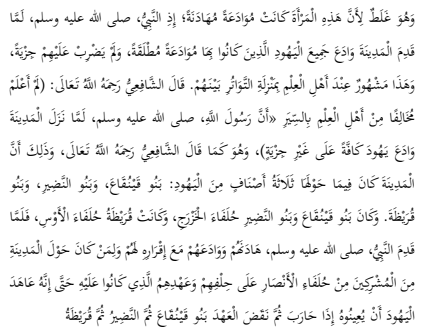
“Kuma wannan kuskure ne, domin wannan mace tana cikin zaman lafiya da yarjejeniyar sulhu (Muhadanah). Wannan saboda lokacin da Annabi ﷺ ya zo Al-Madinah, ya yi sulhu da dukkan Yahudawan da ke zaune a can ba tare da wani sharadi ba, kuma bai sanya musu Jizyah ba. Wannan sananne ne ga malaman ilimi har zuwa matakin Tawatur (ingantaccen yaɗuwar labari daga jama'a masu yawa) a tsakaninsu. Ash-Shafi'iy (rahamar Allah ta tabbata a gare shi) ya ce: “Ban san wani daga cikin malaman Seera da ya saɓa a kan wannan batu ba: cewa lokacin da Manzon Allah ﷺ ya zauna a Al-Madinah, ya yi sulhu da dukkan Yahudawa ba tare da sanya Jizyah ba.” Abin yake kamar yadda Ash-Shafi'iy (rahamar Allah ta tabbata a gare shi) ya faɗa. Wannan saboda Al-Madinah tana kewaye da ƙabilu uku na Yahudawa: Banu Qainuqaa', Banu An-Nadir da Banu Quraizha. Banu Qainuqaa' da Banu An-Nadir abokan ƙawance ne na Khazraj, yayin da Banu Quraizha kuma abokan ƙawance ne na Aws. Sa'annan lokacin da Manzon Allah ﷺ ya zo Al-Madinah, ya yi sulhu da zaman lafiya da su, yana mai amincewa da su, tare da waɗanda ke kewaye da Al-Madinah daga cikin masu bautar gumaka waɗanda abokan ƙawancen Ansar ne, bisa tushen ƙawancensu da alkawarin da suka kasance a kansa a baya. Ya ma karɓi alkawari daga Yahudawa cewa za su taimake shi idan aka yaƙe shi. Sa'an nan Banu Qainuqaa' suka karya alkawari, sai An-Nadir, sannan Quraizha.” [Ƙarshen nakalto].
“And it is a mistake because this woman was at peace and under a truce (Muhadanah). That is because when the Prophet (peace be upon him) came to Al-Madinah he made peace with all of the Jews residing there an unrestricted manner and he did not impose Jizyah upon them. This is well-known by the people of knowledge to the level of Tawatur (decisive concurrent transmission) among them. Ash- Shafi’iy (may Allah’s mercy be upon him) said: “I do not of any from the people of knowledge of Seera who disagree upon the point “That when the Messenger of Allah (peace be upon him) settled in Al- Madinah, he made peace with all of the Jews without the imposition of the Jizyah”. It is as Ash-Shafi’iy (May Allah’s mercy be upon him) stated. That is because Al-Madinah had three groups of Jews surrounding it: Banu Qainuqaa’, Banu An-Nadir and Banu Quraizha. Banu Qainuqaa’ and Banu An-Nadir were allies of the Khazraj, while Banu Quraizha were allies of the Aws. Then when the Messenger of Allah (peace be upon him) came to Al-Madinah, he made a truce and peace with them with his approval of them, alongside those who were around Al-Madinah from the polytheists who were allies of the Ansar, upon the basis of their alliance and covenant that they had previously been upon. He even took a covenant from the Jews that they would support him if he was fought against. Then, Banu Qainuqaa’ broke the covenant, followed by An-Nadir and then Quraizha” [End of Quote].
Ko da yake wasu daga cikin kalmomin da aka yi amfani da su a nan ƙila ba su kasance mafi daidaito ba, kamar faɗinsa cewa matar Bayahudiya tana ƙarƙashin "sulhu" (Muhadanah), tun da ba a yi wani yaƙi ba tukuna da za a ce sulhu ya biyo baya. Yana yiwuwa wannan kawai kuskuren furuci ne.

An Wathiqa (takardar yarjejeniya) an rubuta ta sau biyu (Hadathani), lokacin da Annabi ﷺ ya isa Al-Madina, kafin Musulunci ya yi ƙarfi da mamaye, kuma kafin a umarce shi ya karɓi Jizyah daga Ahl ul-Kitab (mutanen littafi).
“The Wathiqa (document) was written on two occurrences (Hadathani), when the Prophet (peace be upon him) arrived in Al- Madinah, prior to the dominance of Islam and its becoming strong and before he was commanded to take the Jizyah from Ahl ul-Kitab (the people of the book)” .
Kalmar "Hadathani" ba ta kafa mana wani ƙayyadadden lokaci da za a iya la'akari da shi ba. Musulunci bai bayyana sosai ba kuma bai zama mai ƙarfi sosai ba sai bayan an ci ƙungiyoyin haɗin gwiwar (Al-Ahzab, watau yakin Khandaq). Wannan saboda Manzon Allah ﷺ ya fara kai hari ga mutane, su kuma ba su ƙara kai masa hari ba. Haka kuma, ba mu san lokacin da aka umarce shi ya karɓi Jizya daga mutane ba. Bayan haka, maganarsa "ku karɓi Jizya daga Ahlul-Kitab (mutanen littafi)" maimaita kuskure ne sananne, domin gaskiya ita ce an karɓi Jizya har daga masu bautar gumaka, ciki har da Majusawa, kamar yadda ya zo a cikin hadisin An-Nu'uman bin Muqarrin, wanda Sahihu Muslim da sauran littattafai suka ruwaito. 2) Game da maganar Al-Baladhari kuma,
is vague because the word “Hadathani” does not establish for us a determined time frame that can be taken into consideration. Islam only manifested in a prevalent manner and truly became powerful following the defeat of the confederates (Ahzab i.e. battle of the trench). That is because the Prophet (peace be upon him) began to go on the offensive against the people and they were no longer on the offensive against him. In addition, we do not know when he was commanded to take the Jizyah from the people. That is whilst his statement “take the Jizyah from Ahl ul-Kitab (the people of the book)” is a repetition of a well-known error, as the truth is that the Jizyah was taken even from the polytheists, including the Majus, as has come stated in the Hadith of An-Nu’man bin Muqarrin, recorded in Sahih Muslim and other collections. 2) As for the statement of Al-Baladhari
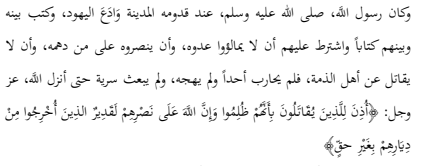
Lokacin da Manzon Allah ﷺ ya isa Al-Madinah, ya yi yarjejeniya (Muwada’ah) da Yahudawa, ya rubuta takarda a tsakaninsa da su. Ya sanya musu sharadi cewa kada su goyi bayan ko su taimaki abokan gābansa, su taimake shi a kan waɗanda suke kai masa hari, kuma cewa ba zai yi yaƙi don kare Ahl udh-Dhimmah ba. Bai kuma yi yaƙi da kowa ba a lokacin, ba su zagi shi ba, kuma bai aika da wata rundunar soja ba, har sai da Allah ‘Azza Wa Jalla ya saukar da: “An yi izini ga waɗanda ake yaƙi da su, saboda an zalunce su. Kuma lallai Allah Mai iko ne a kan ya taimake su. [Su ne] waɗanda aka kora daga gidajensu ba da wani haƙƙi ba” (TMQ 22:39-40).
“When the Messenger of Allah (peace be upon him) arrived in Al- Madinah he made a treaty (Muwada’ah) with the Jews and wrote between himself and them a document. He stipulated upon them that they should not support or side with his enemies, to support him against those who attack him and that he would not fight in defence of the Ahl udh-Dhimmah. He did not then wage war against anyone, they did not defame him and he did not dispatch a military expedition, until Allah ‘Azza Wa Jalla revealed: “Permission [to fight] has been given to those who are being fought, because they were wronged. And indeed, Allah is capable of providing them victory. [They are] those who have been evicted from their homes without right” (TMQ 22:39-40)”.
Wannan jawabin yana cin karo da kansa, domin shi (ﷺ) ba a ba shi izinin yin yaƙi ba tun kafin saukar Aayar, kuma bai kasance cikin yanayin yaƙi da kowa ba. Haka kuma babu wani tsammani cewa za a kai wa Al-Madinah hari. Saboda haka, jumlar da ke cikin jawabinsa: “Ya sharadanta a kansu cewa kada su taimaka wa maƙiyansa ko su shiga sahunsu, su taimake shi a kan waɗanda suke kai masa hari”, wadda ta taƙaita wasu abubuwan da aka faɗa a cikin “Sahifah”, ba za a iya tunaninta ba kuma babu hujja a zahirinta a wannan lokacin. Abin da ya fi muni shi ne jumlar: “Kuma cewa ba zai yi yaƙi don kare Ahl udh-Dhimmah ba”, idan dai babu kuskure a bugun littafin. Da farko, babu “Ahl udh-Dhimmah” a wurin tun asali. Na biyu, ta yaya za a ce suna da wajibi su taimake shi a kan waɗanda suke kai masa hari, alhali shi kuma ba shi da wajibi ya taimake su a kan waɗanda suke kai musu hari?! 3) Maganar Al-Baladhariy game da Banu Qainuqaa’:
This speech is contradictory because he (peace be upon him) had not been permitted in origin to engage in fighting prior to the revelation of the Aayah and was not in a state of war with anyone. There was also no expectation for Al-Madinah to be attacked. Therefore, the sentence from his speech: “He stipulated upon them that they should not support or side with his enemies, to support him against those who attack him”, which summarized some of what came stated in the “Sahifah”, is inconceivable and has no reality to it during that time period. Even more atrocious is the statement: “And that he would not fight in defence of the Ahl udh-Dhimmah”, assuming there was no error in the printing. Firstly, there were no “Ahl udh-Dhimmah” there in origin. Secondly, how could it be that they are obliged to support him against those who attack him, whilst he is not obliged to support them against those who attack them?! 3) The statement of Al-Baladhariy concerning Banu Qainuqaa’:
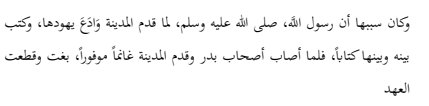
“Dalilin hakan shi ne cewa Manzon Allah (tsira da amincin Allah su tabbata a gare shi) lokacin da ya isa Al-Madina, ya yi yarjejeniyar zaman lafiya da Yahudawan garin, ya kuma rubuta takarda tsakanin shi da su. Sannan, lokacin da Musulmi suka yi nasara a Badr suka dawo Al-Madina da ganima mai yawa, Yahudawa suka tayar da kai suka karya alkawari”, to wannan ma ba shi da ma'ana. Hakan ne saboda “Muwada’ah” (zaman lafiya) ita ce asali kuma ba ta bukatar a yi ta bisa tsari na hukuma ko a rubuta ta. Alhali kuwa Ka’b bin Al-Ashraf ne farko ya keta, ya yi yaki kuma ya yanke “Muwada’ah” (zaman lafiya ko sulhu) wadda, kamar yadda aka ambata a baya, an kafa ta ta hanyar riwayoyi Mutawatir (masu yanke hukunci na sahihanci), sannan ya rubuta “Sahifah” wadda manufarta ba kafa “Muwada’ah” ba ce, face kafa “Hadaddiyar Kungiya ta Tarayya (Ittihad Confedarali)”. Bayan haka, Banu Qainuqaa’ suka fice daga “kungiyar” suka yi yaki, sai Banu An-Nadir, sannan Quraizah suka ci amana. 4) Game da maganar At-Tabari:
“The reason for it was that the Messenger of Allah (peace be upon him), when he arrived in Al-Madinah, made a peace agreement with its Jews and wrote a document between himself and them. Then, when the Muslims were victorious at Badr and came back to Al- Madinah with abundant booty, the Jews rebelled and broke the covenant”, then this also has no meaning to it. That is because the “Muwada’ah” (state of peace) is the origin and does not need to be officially mutually contracted or write. That is while Ka’b bin Al-Ashraf was the first to transgress, war and cut the “Muwada’ah” (state of peace or truce) which, as previously mentioned, has been established via Mutawatir (decisive concurrent) transmissions and he then wrote the “Sahifah” which was not the purpose of establishing a “Muwada’ah” but rather to establish a “Confederal Union (Ittihad Confedarali)”. Thereafter, Bani Qainuqaa’ exited from the “union” and waged war, followed by Banu An-Nadir and then Quraizhah betrayed it. 4) Concerning the statement of At-Tabari:
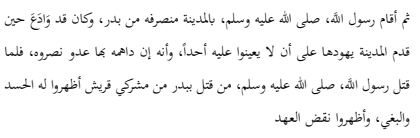
Sa'an nan Manzon Allah ﷺ ya zauna a Al-Madina bayan ya dawo daga Badar. Lokacin da ya isa Al-Madina, ya yi yarjejeniyar zaman lafiya da Yahudawan garin, bisa sharadin cewa ba za su taimaka wa kowa a kansa ba, kuma idan wani maƙiyi ya kai masa hari a Al-Madina, za su tallafa masa. Sai kuma, lokacin da Manzon Allah ﷺ ya kashe waɗanda ya kashe daga cikin mushrikai (masu bautar gumaka) na Quraish, sai suka nuna hassada da tawaye a gare shi, kuma suka nuna karya alkawari.
“Then the Messenger of Allah (peace be upon him) remained in Al- Madinah after his return from Badr. When he had arrived in Al- Madinah he had made a peace agreement with its Jews upon the stipulation that they do not assist anyone against him and that if he was attacked in Al-Madinah by an enemy, they would support him. Then when the Messenger of Allah (peace be upon him) killed those whom he had killed from the Mushrikin (polytheists) of Quraish, they demonstrated envy and rebelliousness towards him and demonstrated the breaching of the covenant”,
Saboda haka yana daidai da maganar Al-Baladhariy da ke sama, kuma amsar da aka yi mata daya ce, duk da cewa ta fi wannan kyau. Wannan saboda shi (Ibn Ishaq / mai maganar) bai tabbatar da cewa tsohuwar "Muwada'ah" (yarjejeniyar zaman lafiya/sulhu), kafin Badr, takarda ce da aka rubuta ba, kamar yadda Al-Baladhariy ya yi kuskure a cikinsa, haka kuma rubutunsa ba shi da wani abu daidai da jumlar mummuna "Kuma cewa ba zai yi yaki don kare Ahl udh-Dhimmah ba". Duk da haka, maganar At-Tabari "karya alkawari (Naqdh Al-'Ahd)" ba abu ne da ya dace da gaskiya ba. Wannan saboda babu wani "Ahd" (alkawari) a asali kafin hakan, sai dai "Muwada'ah" bisa asalin yanayinta. Sai dai idan za mu dauki karbarta da bin ta a matsayin "Ahd" (Alkawari/yarjejeniya) a fakaice?! Kamar maganar Ahmad Abu Zaid:
then it is in line with the speech of Al-Baladhariy above and the refutation to it is the same, although it is much better. That is because he did not assert that the old “Muwada’ah” (agreement of peace/truce), prior to Badr, was a written document, as Al-Baladhariy slipped up in, just as his text does not include something equal to the atrocious sentence “And that he would not fight in defence of the Ahl udh-Dhimmah”. Despite that, the statement of At-Tabari “breaching of the covenant (Naqdh Al‘Ahd)” is not something that fits with reality. That is because there was no prior “Ahd” (covenant) in origin but rather a “Muwada’ah” upon its original state. That is unless we were to consider its acceptance and adherence to it as being an “Ahd” (Covenant/treaty) implicitly?! As the statement of Ahmad Abu Zaid:

A cikin waɗannan shaidu na Mutawatir (tabbatattun watsawa masu tabbatar da hujja), akwai isasshen dalili da zai kai ga tabbatar da cewa takardar yarjejeniyar zaman lafiya da Yahudawa an rubuta ta ne a shekara ta farko ta Hijira. Bugu da ƙari, nazarin ƙa'idodinta da rubutunta ya nuna cewa ba su nuna wani rikici tsakanin Annabi ﷺ da Yahudawa ba. Saboda haka, bisa duk waɗannan dalilai, da'awar littafin encyclopaedia na Musulunci ta faɗi, kuma shakkunsu sun kasance ba su da tushe.
“In these Mutawatir (concurrent transmissions indicating decisiveness) testimonies, there is enough to establish preponderance to conclude that the peace agreement document with the Jews was written in the first year of the Hijrah. In addition, an analysis of its articles and texts indicate that they are not indicative of any tension between the Prophet (peace be upon him) and the Jews. As such, due to all of this, the claims of the Islamic encyclopaedia fall down and their doubts are refuted”, then there are significant, indeed fatal errors in it.
1) Bayanai ko ra'ayoyin masana tarihi ba a kiransu shaida (shahada) sai dai idan sun fito daga shaida ta zahiri (ta farko) wanda ya gani da idonsa a lokacin. In ba haka ba, irin wannan ra'ayi kawai hasashe ne bisa bayanai ko tushe da suka dace ko kuma ba daidai ba. Yawan ra'ayoyi masu dacewa ko kama da juna ba a kiransu Tawatur (wato tabbatar da abu gaba ɗaya ta hanyar riwaya mai yawa da ke tabbatarwa), kuma ba su da daraja irin ta shaidun Tawatur masu tabbatarwa karara.
1) The statements or views of the historians are not called testimonies (shahada) unless it is from a contemporary (first-hand) witness. Otherwise, such a view is merely an opinion based upon correct or incorrect information or premises. A large number of conforming or similar opinions is not called Tawatur (i.e. established definitely by concurrent transmission) and they do not hold the value of Tawatur (decisive) testimonies of affirmation.
2) Wasu kundin tsarin mulki na iya kasancewa an rubuta su bayan yaƙin basasa, duk da haka rubutun nasu ba sa nuna wani rikici tsakanin ɓangarorin da abin ya shafa. Hakan ya faru ne saboda manufar kundin tsarin mulki ita ce kafa dokoki da tsarin gudanar da ƙasa (watau ko tsarin ƙasa ɗaya ne ko na haɗin gwiwa, da sauransu). Saboda haka, ranar rikici ko faɗan da ya faru kafin a rubuta kundin, ba a rubuta ta ko ambace ta a cikinsa ba. Dangane da maganar “Su (watau rubutun) ba sa nuna wani rikici tsakanin Annabi (ﷺ) da Yahudawa”, to, akasin hakan ma gaskiya ne. Hakan ya faru ne domin rubuta kundin tsarin mulki na tarayya ko yarjejeniyar ƙasashe a kanta ba hujja ba ce cewa an sami wani rikici, faɗa ko yaƙi a gabansa. Ana iya samun hakan, kuma ana iya rashin samunsa. Hakan zai zama sananne ne kawai ta hanyar wasu alamomin tarihi waɗanda ake dubawa daban da takardar da ake bincika, ko kuma daga cikin rubutun takardar kanta wanda ke nuna ƙarshen wani rikici ko tsayawar faɗa ko warware matsalolin diyya da kuɗin jini, da sauransu. Ustaz Ahmad Abu Zaid yana so ya ƙaryata iƙirarin “Encyclopaedia na Musulunci” wanda ya ƙirƙira shi jim kaɗan kafin haka a cikin “As-Seera An-Nabawiyah” na Ahmad Abu Zaid (shafi na: 70) kamar haka:
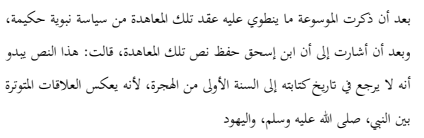
Bayan da ensaiklofidiyar ta bayyana abin da yarjejeniyar (Mu'ahadah) ɗin ta ƙunsa ta fuskar hikimar manufofin Annabi ﷺ, kuma bayan ta nuna cewa Ibn Ishaq ne ya adana rubutun wannan yarjejeniya, sai ta ce: Da alama wannan rubutu ba ya komawa, dangane da lokacin rubuta shi, zuwa shekara ta farko ta Hijira, saboda yana nuna tsaiko da tsamin dangantaka tsakanin Annabi ﷺ da Yahudawa.
“After the encyclopaedia mentioned what the contracting of that treaty (Mu’ahadah) contained in terms of wise prophetic policy making and after it indicated to Ibn Ishaq having preserved the text of that treaty, it stated: It appears that this text does not go back, in respect to the date of its writing, to the first year of the Hijrah, because it reflects the tense relations between the Prophet (peace be upon him) and the Jews”.
Gaskiya ita ce cewa an rubuta Sahifar Madina a farkon shekara ta uku bayan Hijra, bisa shaidar rubuce-rubucen tarihi da aka watsa da muka gabatar a baya. Saboda haka, littafin ensaiklopediya ya yi daidai a wannan batu. Amma game da hasashen masu nazarin Gabas (orientalists), waɗanda su ne marubutan ensaiklopediyar, cewa rubutun (watau Sahifar)
The truth is that the Sahifah of Al-Madinah was written at the beginning of the third year of Hijrah based upon the evidence of the historical transmitted texts that we have presented earlier. As such, the encyclopaedia was correct regarding this matter. As for the deduction of the orientalists, who are the authors of the encyclopaedia, that the text (i.e. Sahifah)

Ya nuna alaƙar tashin hankali tsakanin Annabi ﷺ da Yahudawa.
“reflected tense relations between the Prophet (peace be upon him) and the Jews”, .
Haka kuma ba ta gamsar ba, kuma ba ta dace ba. Mutane sun bar tunaninsu ya yi yawo a nan. Tarihi kuwa abubuwa ne da suka wuce, kuma rahotonsa dole ne a karɓe su daga shaidun gani da ido da kuma rubuce-rubucen mutanen da suke raye a lokacin, ba daga tunanin rai ko ma daga hasashe na hankali ba. Gaskiya ne cewa yanayin rubuta Sahifah ya nuna cewa an rubuta ta ne saboda tashin hankali da ya faru a alaƙar da ke tsakanin wasu Yahudawa (musamman Ka'b bn Al-Ashraf). Sai dai, matnin nata bai ƙunshi wani abu da ke nuna wata tashin hankali ko rikici a baya ba, ko kaɗan ma!
then this is not convincing and out of place. People have given free reign to their imaginations here. That is whilst history is merely events and realities that have passed by and its reports must be taken from first-hand witnesses and records of those living at the time, not from imaginations or even logical deductions. Yes, it is true that the circumstances surrounding the writing of the Sahifah reveal that it was written due to the occurrence of a tension in the relations with some of the Jews (Ka’b in Al-Ashraf specifically). However, its text does not include anything indicating to any prior tension or conflict and not even remotely!