4. Bentuk yang Melekat
4. A Clinging Form
Kemudian Kami jadikan tetesan air mani itu segumpal darah yang melekat.
Then We made that drop of fluid into a clinging form
Al-Qur'an menggambarkan tahap perkembangan embrio manusia berikutnya dengan kata `alaqah. Kata ini memiliki berbagai makna, antara lain: menggantung, tergantung, dijuntaikan, menempel, melekat, berpegang, dan melekat erat. Kata ini juga dapat berarti tertangkap, terperangkap, terpasang, atau dilampirkan.48
The Qur’an describes the next stage of the developing human embryo with the word `alaqah. This word carries various meanings including: to hang, to be suspended, to be dangled, to stick, to cling, to cleave and to adhere. It can also mean to catch, to get caught, to be affixed or subjoined.48
Makna lain dari kata 'alaqah mencakup zat yang menyerupai lintah, menyerupai cacing; atau yang berwatak merayap dan cenderung menghisap darah. Terakhir, maknanya juga mencakup tanah liat yang melekat di tangan, dan darah yang mengental dan membeku, karena sifatnya yang saling melekat. 49
Other connotations of the word `alaqah include a leech-like substance, having the resemblance of a worm; or being of a ‘creeping’ disposition inclined to the sucking of blood. Finally, its meaning includes clay that clings to the hand and thick, clotted blood - because of its clinging together. 49
TAFSIR ILMIAH
SCIENTIFIC INTERPRETATION
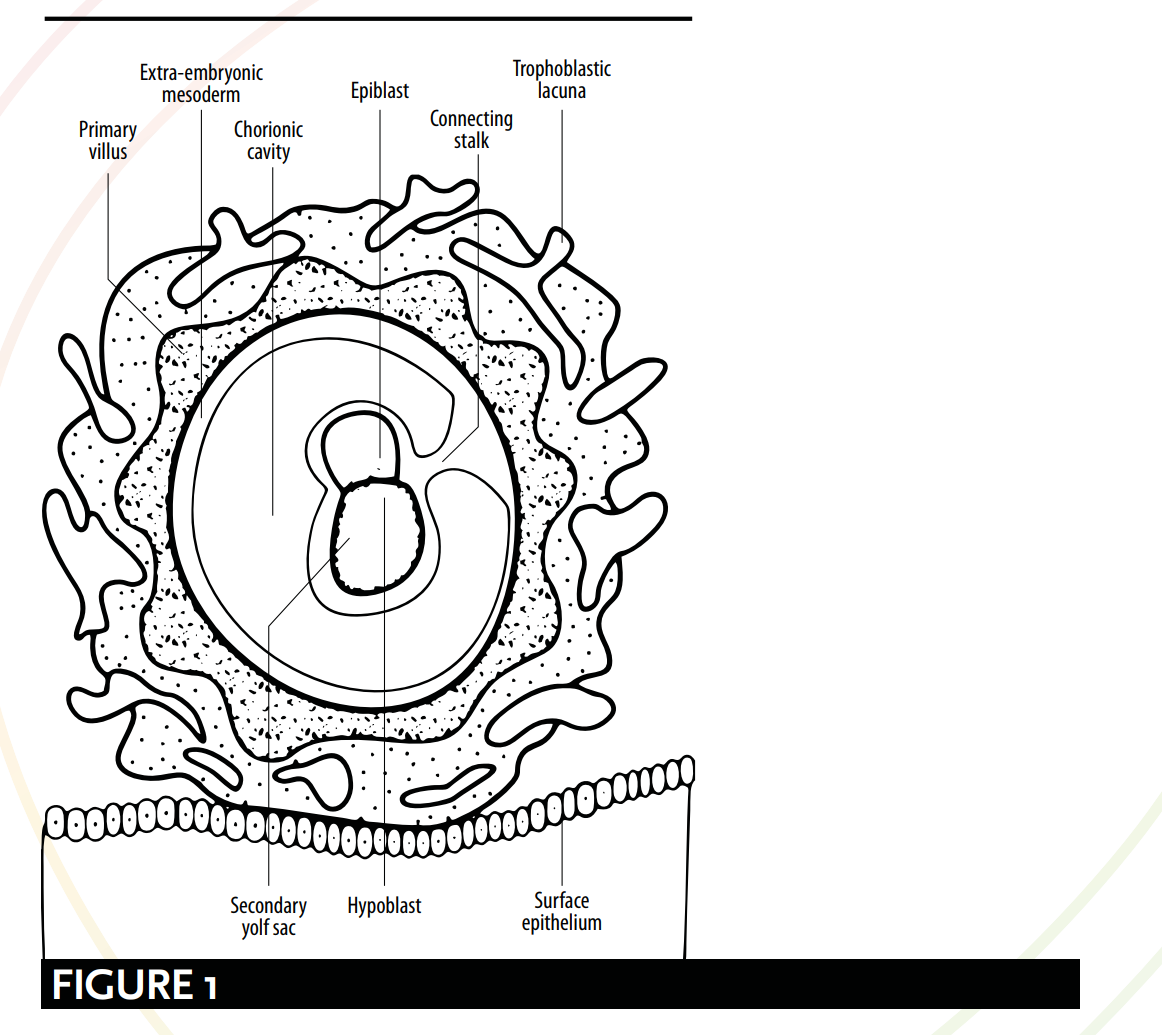
Sebagaimana didefinisikan oleh embriologi modern, berbagai makna dari kata `alaqah berhubungan dengan berbagai tahap perkembangan embrio. Perbandingan dapat dibuat antara gambaran Al-Qur'an dan ilmiah tentang penampakan embrio dan hubungannya dengan rahim. Menurut embriologi modern, sejak hari ke-15 embrio tergantung atau tergantung melalui 'tangkai penghubung' [lihat Gambar 1] dan memperoleh nutrisi melalui kontak dengan pembuluh darah ibu. Deskripsi ini sangat mirip dengan gambaran yang dilukiskan oleh kata `alaqah – suatu zat yang 'tergantung' atau 'melekat', yang memperoleh nutrisi dari darah inangnya.
As defined by modern embryology, the myriad of meanings for the word `alaqah correspond to various stages of the embryo’s development. Comparisons can be drawn between qu’ranic and scientific depictions of the embryo's appearance and its relationship with the womb. According to modern embryology, from day 15 the embryo is hanging or suspended via the ‘connecting stalk’ [see Figure 1] and it obtains nutrients through contact with the maternal blood vessels. This description bears a striking resemblance to the picture painted by the word `alaqah – a ‘hanging’ or ‘suspended’ substance, obtaining nutrients from its host’s blood.
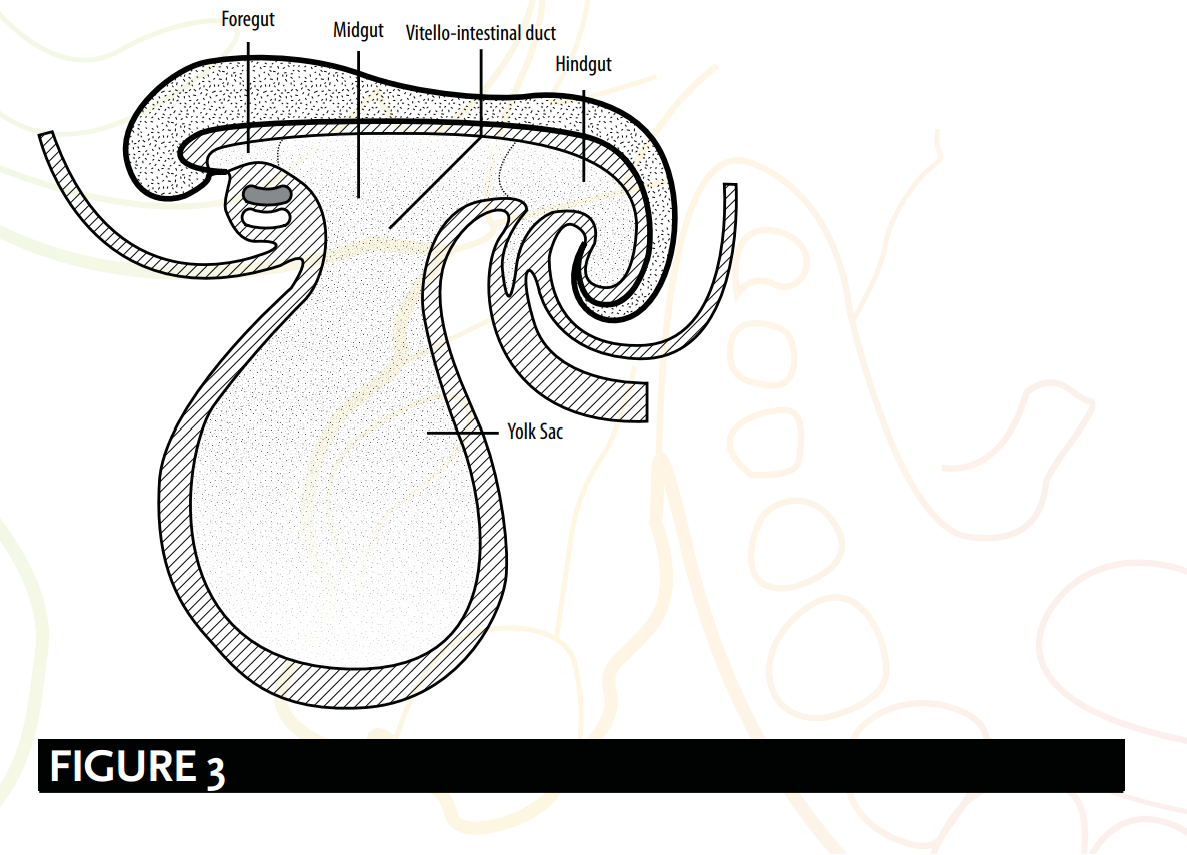
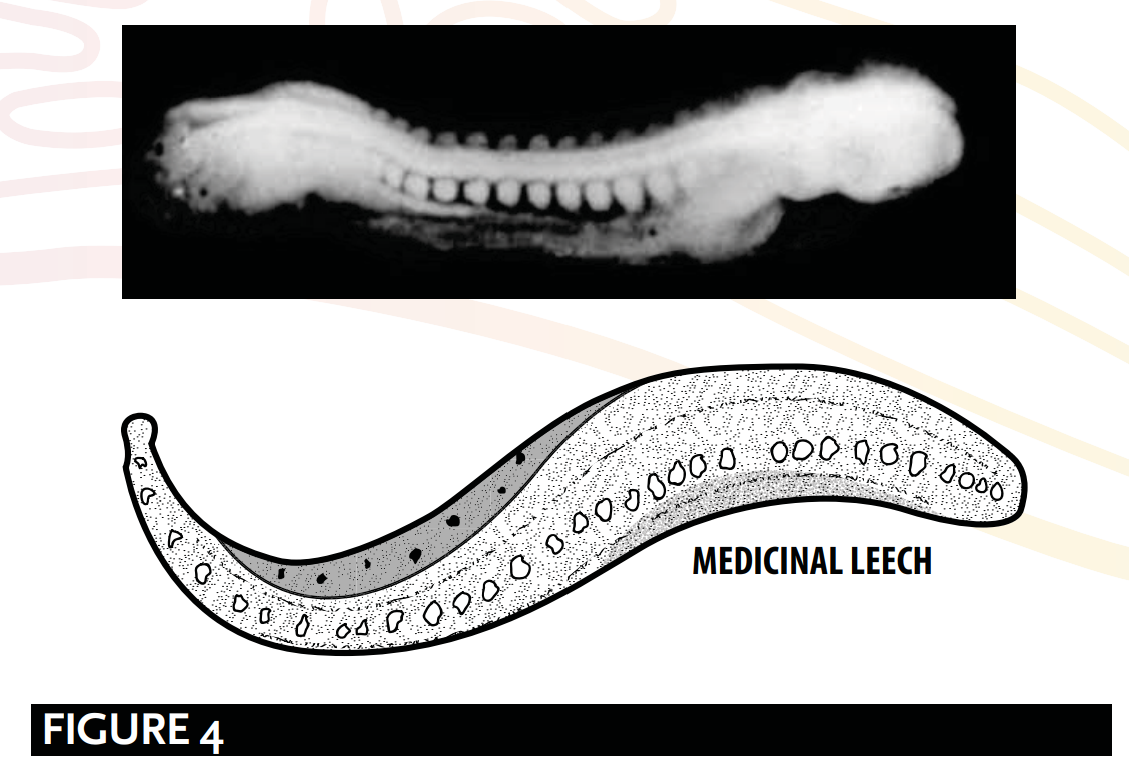
Setelah itu, pada minggu ke-4, dua proses terjadi: pembentukan otak dan sumsum tulang belakang, yang dikenal sebagai neurulasi; dan tahap awal pelipatan embrio. Dengan selesainya kedua proses ini, embrio menyerupai bentuk seperti lintah yang diisyaratkan oleh kata `alaqah – zat yang merayap, menyerupai lintah atau cacing [lihat Gambar 2, 3 dan 4].
Following this, during the 4th week, two processes occur: the formation of the brain and the spinal cord, known as neurulation; and the initial stages of the folding of the embryo. It is upon the culmination of these two processes that the embryo resembles a leech-like form suggested by the word `alaqah – a creeping, leech or worm-like substance [see Figure 2, 3 and 4].
GANTUNG/DIGANTUNG
HANGING/SUSPENDED
Para embriolog Barry Mitchell dan Ram Sharma menjelaskan aspek "menggantung" atau "tergantung" pada tahap ʿalaqah. Mereka menggambarkan embrio sebagai "terhubung dengan sitotrofoblas melalui tangkai penghubung dari mesoderm ekstra-embrionik (jaringan ikat primitif). Tangkai ini adalah cikal bakal tali pusat." 50 Gambar 1 menunjukkan embrio yang terhubung dengan sitotrofoblas melalui tangkai penghubung, seolah-olah sedang menggantung.
Embryologists Barry Mitchell and Ram Sharma explain the ‘hanging’ or ‘suspended’ aspects of the `alaqah stage. They describe the embryo as being, “connected to the cytotrophoblast by a connecting stalk of extra-embryonic mesoderm (primitive connective tissue). The stalk is the forerunner of the umbilical cord.” 50 Figure 1 shows the embryo connected to the cytotrophoblast via a connecting stalk, as if it were hanging or suspended.
MEMPEROLEH NUTRISI MELALUI PEMBULUH DARAH
OBTAINING NUTRIENTS VIA BLOOD VESSELS
Mengenai cara embrio memperoleh nutrisinya melalui kontak dengan pembuluh darah ibu, Barry Mitchell dan Ram Sharma menulis: Karena pertumbuhan embrio yang pesat pada minggu kedua, diperlukan sarana yang lebih efisien untuk pertukaran nutrisi dan gas. Hal ini tercapai ketika pembuluh darah embrio pada korion bersentuhan dengan pembuluh darah ibu pada desidua.51.
With regard to the way the embryo obtains its nutrients through contact with the maternal blood vessels, Barry Mitchell and Ram Sharma write: Due to the rapid growth of the embryo during the second week, there is a need for a more efficient means of nutritional and gaseous exchange. This is achieved when the embryonic blood vessels of the chorion come into contact with the maternal blood vessels of the decidua.51.
... [pada minggu ketiga]... Pertukaran nutrisi, gas pernapasan, dan produk limbah antara darah ibu dan darah janin berlangsung melintasi membran plasenta di dalam ruang intervili. Darah ibu masuk ke ruang-ruang ini dari arteri spiralis, cabang dari arteri uterina, yang membawa nutrisi dan oksigen untuk embrio dan janin.52
... [by the third week]... The exchange of nutrients, respiratory gases and waste products between the maternal and fetal blood takes place across the placental membrane within intervillous spaces. Maternal blood enters these spaces from the spiral arteries, branches of the uterine artery, bringing nutrients and oxygen for the embryo and fetus.52
Hal ini memperkuat keabsahan makna kata ʿalaqah, serta membangkitkan gambaran tentang sebuah makhluk yang memperoleh nutrisinya melalui darah.
This reinforces the validity of the meanings of `alaqah, and its evoking images of an entity obtaining its nutrients via blood.
NEURULASI & PELIPATAN EMBRIO
NEURULATION & THE FOLDING OF THE EMBRYO
Tahap ʿalaqah menunjukkan proses neurulasi dan tahap awal pelipatan embrio. Neurulasi meliputi pembentukan otak dan sumsum tulang belakang pada hari ke-19 hingga ke-25 (kurang lebih); sedangkan pelipatan embrio melibatkan kepala dan ekor yang saling mendekat. Kombinasi kedua perubahan fisiologis ini menyebabkan embrio menyerupai zat seperti lintah.
The `alaqah stage suggests the process of neurulation and the initial stages of the folding of the embryo. Neurulation comprises of the formation of the brain and the spinal cord from days 19 to 25 (approx.); and the folding of the embryo involves the head and the tail being brought closer together. The combination of these two physiological changes causes the embryo to resemble a leech-like substance.
NEURULASI
NEURULATION
Pada akhir neurulasi, ujung kranial dan kaudal tabung saraf menutup. Pada titik ini, embrio tampak seperti lintah 53 [lihat Gambar 2].
At the end of neurulation the cranial and caudal ends of the neural tube close. The embryo, at this point, becomes leech-like in appearance 53 [see Figure 2].
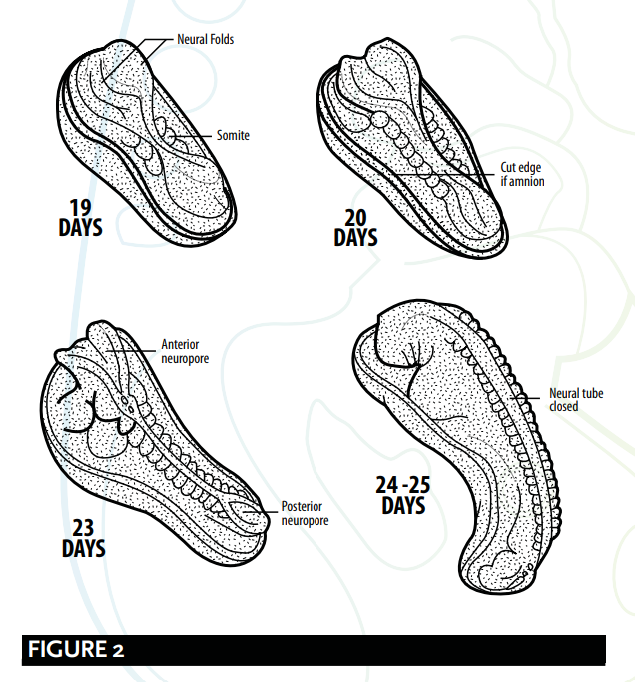
Barry Micthell dan Ram Sharma menjelaskan proses neurulasi.
Barry Micthell and Ram Sharma explain the process of neurulation.
Pada sekitar hari ke-19, di ujung kranial garis primitif (primitive streak), mesoderm dan notokorda yang berada di bawahnya merangsang ektoderm untuk membentuk lempeng saraf (neural plate), yang kemudian melengkung membentuk lipatan saraf (neural folds). Lempeng saraf pada awalnya membesar di ujung kranial. Pada hari ke-20, lempeng saraf di daerah tengah embrio tetap menyempit, tetapi membesar di ujung kaudal. Lempeng ini semakin dalam hingga membentuk alur saraf (neural groove), dari mana tabung saraf (neural tube) terbentuk. Ujung kranial dan kaudal tabung ini terbuka dan dikenal sebagai neuropori anterior dan posterior; keduanya pada akhirnya akan menutup.
At about 19 days, at the cranial end of the primitive streak, the underlying mesoderm and notochord induce the ectoderm to form the neural plate, which rounds up to form the neural folds. The neural plate enlarges initially at the cranial end. At 20 days, the neural plate in the mid-region of the embryo remains narrowed, but it expands at the caudal end. The plate deepens to form the neural groove from which the neural tube forms. The cranial and caudal ends of the tube are open and are known as the anterior and posterior neuropores; these eventually close. 54
PENCANTUMAN JANIN
FOLDING OF THE EMBRYO
Pelipatan embrio juga bertanggung jawab atas terbentuknya bentuk menyerupai lintah [lihat Gambar 3], atau sebagaimana para embriolog menggambarkannya; struktur silindris atau menyerupai tabung. Para embriolog Keith Moore dan T. V. N. Persaud menyatakan bahwa:
The folding of the embryo is also responsible for forming a leech-like shape [see Figure 3], or as embryologists have described; a cylindric or tube-like structure. Embryologists Keith Moore and T. V. N. Persaud suggest that:
Peristiwa penting dalam pembentukan bentuk tubuh adalah terlipatnya cakram embrio trilaminar yang datar menjadi embrio yang agak silindris. Pelipatan ini terjadi akibat pertumbuhan embrio yang cepat, terutama otak dan sumsum tulang belakang. 55
A significant event in the establishment of body form is the folding of the flat trilaminar embryonic disc into a somewhat cylindric embryo. Folding results from the rapid growth of the embryo, particularly the brain and the spinal cord. 55
Struktur menyerupai tabung atau lintah [lihat Gambar 4], sebagaimana dijelaskan oleh Barry Mitchell dan Ram Sharma, disebabkan oleh:
The tube-like or leech-like structure [see Figure 4], as explained by Barry Mitchell and Ram Sharma, is due to:
Lipatan longitudinal, yang terjadi antara hari ke-21 dan ke-24, menghasilkan … embrio menekuk sehingga kepala dan ekornya saling mendekat ... [untuk] membentuk struktur menyerupai tabung. 56
longitudinal folding, which occurs between days 21 and 24, result[ing] in … the embryo [bending] so that the head and tail are brought closer together...[to] form a tube-like structure. 56
RINGKASAN
SUMMARY
Tahap ʿAlaqah:
The `alaqah stage:
Embrio terhubung dengan sitotrofoblas melalui tangkai penghubung, seolah-olah ia tergantung atau terayun.
The embryo is connected to the cytotrophoblast via a connecting stalk, as if it were hanging or suspended.
Pembentukan otak dan sumsum tulang belakang, yang dikenal sebagai neurulasi; dan selama tahap awal pelipatan embrio. Setelah proses-proses ini mencapai puncaknya, embrio tampak menyerupai lintah.
The formation of the brain and the spinal cord, known as neurulation; and during the initial stages of the folding of the embryo. It is upon the culmination of these processes that the embryo appears leech-like.
Embrio memperoleh nutrisinya melalui kontak dengan pembuluh darah ibu. Hal ini serupa dengan cara zat seperti lintah memperoleh nutrisinya dari darah.
The embryo obtains its nutrients via contact with the maternal blood vessels. This mirrors the action of a leech-like substance obtaining its nutrients via blood.
GALEN & `ALAQAH
GALEN & `ALAQAH
Para kritikus menyatakan bahwa penggunaan kata ʿalaqah merupakan deskripsi tentang tahap kedua embrio manusia menurut Galen. Terjemahan mereka atas kata ʿalaqah sebagai "gumpalan darah" menimbulkan kesan bahwa itu adalah deskripsi Galen tentang tahap ini.
Critics declare that the use of the word `alaqah is a description of Galen’s second stage of the human embryo. Their translation of the word `alaqah to ‘blood clot’ creates an impression of Galen's description of this stage:
Namun ketika segumpal darah itu telah terisi darah, dan jantung, otak serta hati masih belum terbentuk dan belum berbentuk jelas, tetapi kini telah memiliki kepadatan tertentu dan ukuran yang cukup besar, inilah periode kedua; substansi janin kini berbentuk daging dan tidak lagi berbentuk air mani. 57
But when it [the clot] has been filled with blood, and heart, brain and liver are still unarticulated and unshaped yet have by now certain solidarity and considerable size, this is the second period; the substance of the foetus has the form of flesh and no longer the form of semen. 57
Ada sejumlah kelemahan dalam implikasi dari para kritikus ini:
There are a number of weaknesses with the implications of these critics:
Pertama, Al-Qur’an tidak menyebutkan "hati, otak dan hati..."
1. Firstly, the Qur’an does not make a mention of the “heart, brain and liver...
"belum terartikulasi dan belum berbentuk, namun memiliki semacam solidaritas tertentu dan berukuran cukup besar".
[being] unarticulated and unshaped yet [with] a certain solidarity and [of a] considerable size”.
Kedua, kata ʿalaqah tidak berarti darah; makna utamanya adalah ‘bentuk yang melekat’ dan ‘zat yang menyerupai lintah’. Sebagian ahli bahasa Arab menisbatkan makna ‘gumpalan darah’ kepada kata ʿalaqah, bukan karena ia berisi darah, melainkan karena sifatnya yang ‘melekat’. Penafsiran ini sesuai dengan makna utama kata tersebut.
2. Secondly, the word `alaqah does not mean blood; rather, its primary meanings are ‘a clinging form’ and ‘a leech-like substance’. Some Arab linguists would attribute the meaning of a ‘blood clot’ to the word `alaqah, not because of it being filled with blood, but instead due to it ‘clinging’ by nature. This interpretation matches the primary meaning of the word.
3. Ketiga, Galen bersikeras bahwa "janin sudah memiliki bentuk daging" pada tahap kedua, sedangkan Al-Qur'an menegaskan bahwa tahap mudghah (sepotong daging yang telah dikunyah atau segumpal daging) datang setelah tahap 'alaqah.
3. Thirdly, Galen insists “the foetus has the form of flesh” during the second stage, whereas the Qur’an affirms the mudghah (a chewed piece of meat or lump of flesh) stage comes after the `alaqah stage.
4. Keempat, dalam bukunya On the Natural Faculties, Galen menulis: demikian pula dengan mani: daya-dayanya telah dimilikinya sejak awal.58 Implikasi keliru Galen bahwa mani sepenuhnya bertanggung jawab atas materi genetik bertentangan dengan, dan berlawanan secara langsung dengan, Al-Qur'an dan hadits Nabi ﷺ. Sebagaimana telah dibahas sebelumnya (lihat Aristoteles, Galen & Nutfah), sumber-sumber rujukan Islam memandang nutfah sebagai tetesan atau cairan campuran dari laki-laki dan perempuan, dan menegaskan bahwa baik laki-laki maupun perempuan bertanggung jawab atas genetik anak.59 Oleh karena itu, jika Nabi ﷺ menyalin pandangan Galen tentang perkembangan manusia, bagaimana mungkin beliau menolak ilmu yang keliru dan hanya menggunakan yang benar, padahal di Arab abad ke-7 tidak ada cara untuk mengetahui pandangan mana yang akurat?
4. Fourthly, in his book On the Natural Faculties, Galen writes: so it is with the semen: its faculties it possessed from the beginning.58 Galen’s incorrect implication of the semen’s sole responsibility for the genetic material is incompatible, and in direct opposition, to the Qur’an and Prophetic traditions. As previously explored (see Aristotle, Galen & Nutfah) the Islamic source texts considers the nutfah as a mingled drop or fluid from both the male and the female, and confirm both the male and female as responsible for the genetics of the child.59 Therefore, if the Prophet ﷺ copied Galen’s views on human development, how is it that he rejected the incorrect science and only used what was correct, even though there was no way in 7th century Arabia of knowing which views were accurate?
MENGGAMBARKAN SECARA KELIRU BENTUK EMBRIO
MISREPRESENTING THE EMBRYO’S APPEARANCE
Para komentator kontemporer berpendapat bahwa embrio hanya tampak seperti lintah apabila kantung kuning telur (yolk sac) dibuang, dan oleh karena itu deskripsi tentang 'alaqah merupakan penggambaran yang keliru mengenai penampakan embrio pada tahap ini. Namun, para embriolog menjelaskan bahwa kantung kuning telur dipisahkan dari embrio oleh suatu struktur ekstra-embrionik yang disebut rongga ekstra-embrionik (extra-embryonic coelom). Fakta ini membantah tuduhan adanya penggambaran yang keliru, karena kantung kuning telur bukan bagian dari struktur embrio itu sendiri.60
Contemporary commentators argue the embryo only looks leech-like when the yolk sac is removed, and that the `alaqah's description is therefore a misrepresentation of the embryo’s appearance at this stage. However, embryologists explain that the yolk sac is separated from the embryo by an extra-embryonic feature, called the extra-embryonic coelom. This fact disproves claims of misrepresentation as the yolk sac is not part of the structure of the embryo.60