5. Un morceau de chair
5. A Lump Of Flesh
puis Nous avons transformé cette forme en un morceau de chair
and then We made that form into a lump of flesh
L'étape suivante du développement humain définie dans le Qur'an est la *mudghah*. Ce terme signifie mâcher, mastication, le fait de mâcher, être mâché, et un petit morceau de viande.⁶¹ ⁶² Il décrit également l'embryon après qu'il est passé à une autre étape et est devenu de la chair.⁶³ D'autres significations incluent quelque chose que les dents ont mâché et sur lequel elles ont laissé des marques visibles ; et des marques qui changent lors du processus de mastication en raison de l'acte répétitif.⁶⁴ L'étape de la *mudghah* est développée plus en détail, ailleurs dans le Qur'an :
The next stage of human development defined in the Qur’an is mudghah. This term means to chew, mastication, chewing, to be chewed, and a small piece of meat.61 62 It also describes the embryo after it passes to another stage and becomes flesh.63 Other meanings include something that teeth have chewed and left visible marks on; and marks that change in the process of chewing due to the repetitive act.64 The mudghah stage is elaborated on further, elsewhere in the Qur'an:
puis à partir d'une masse de chair (mudghah), formée et non formée. 65
then from a fleshy lump (mudghah), formed and unformed. 65
Le mot arabe utilisé ici pour « formée » est mukhallqah, ce qui peut également signifier « façonnée » ou « moulée ».66
The Arabic word used here for ‘formed’ is mukhallqah which can also mean ‘shaped’ or ‘moulded’.66
INTERPRÉTATION SCIENTIFIQUE
SCIENTIFIC INTERPRETATION
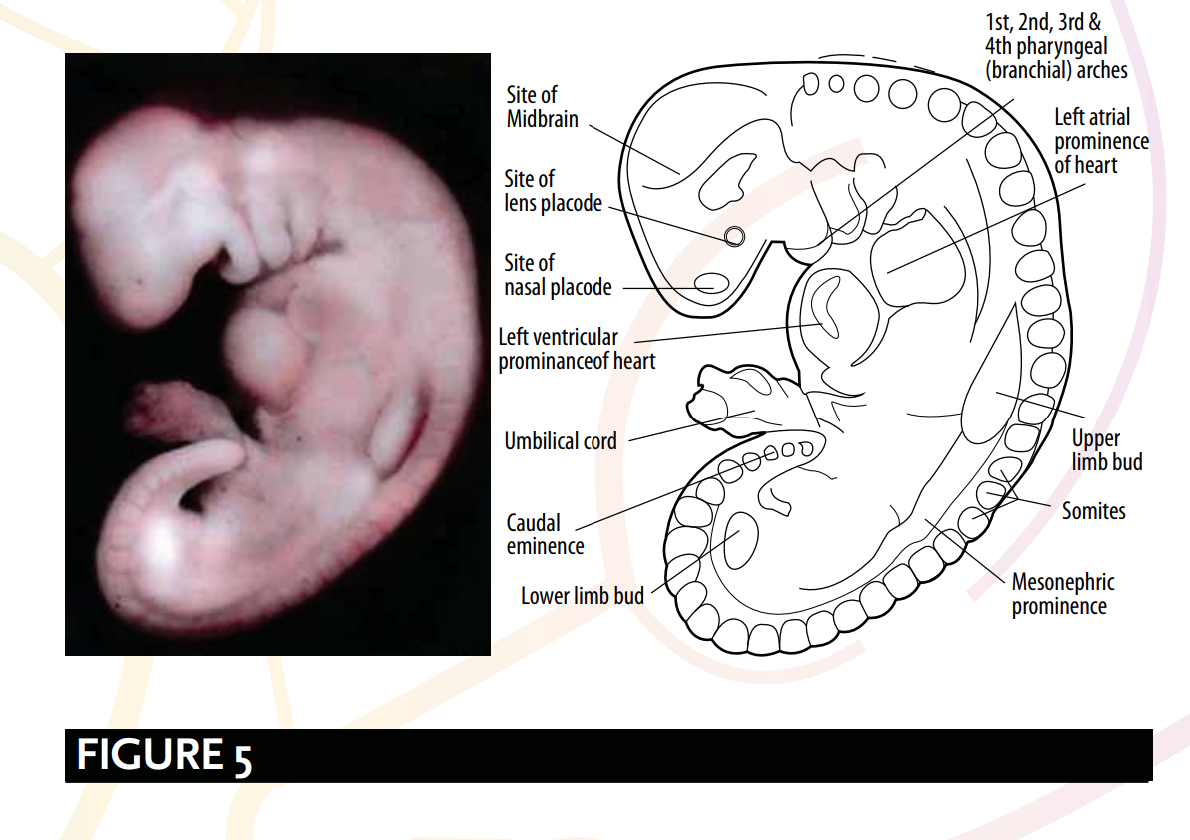
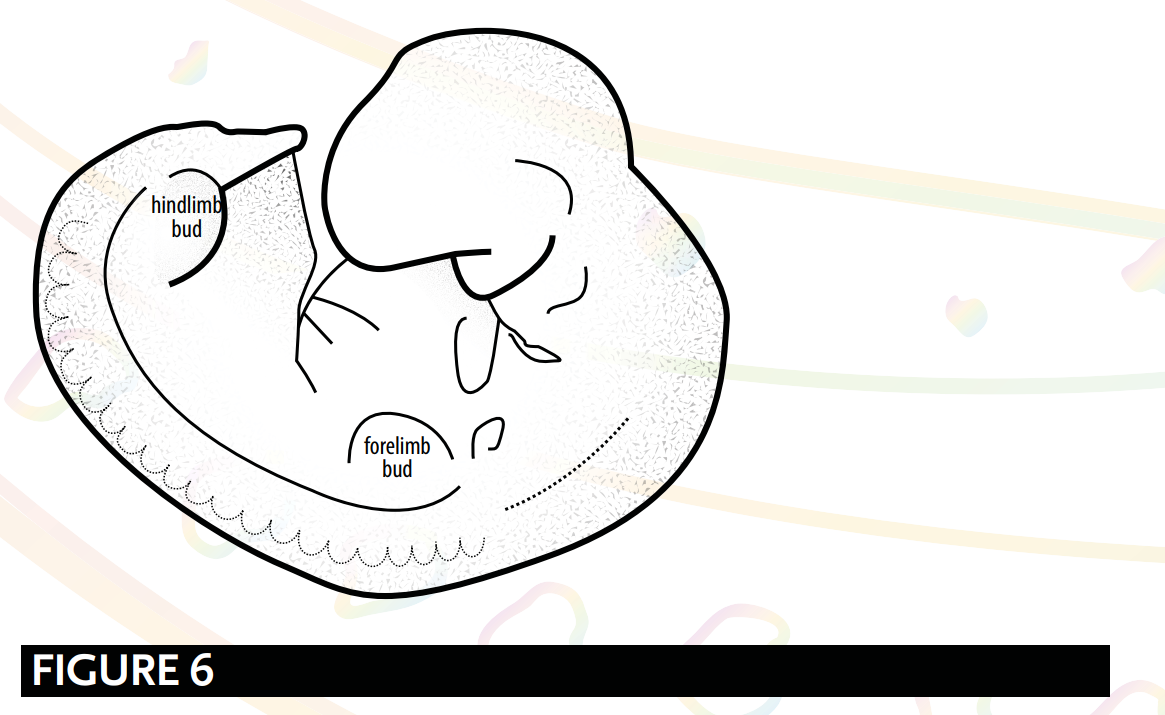
Adoptant une approche lexicale pour l'interprétation du mot, cette étape concerne la 4ème semaine, lorsque les somites, qui ressemblent à des traces de dents [voir Figures 5 et 6], commencent à se développer. L'apparence de l'embryon à ce stade, due au développement des somites, correspond aux significations : « être mâché » et « quelque chose que les dents ont mâché et sur lequel elles ont laissé des marques visibles ». Concernant le développement des somites, Barry Mitchell et Ram Sharma écrivent :
Taking a lexical approach to the interpretation of the word, this stage deals with the 4th week, when somites, which resemble tooth-marks [see Figures 5 and 6], begin to develop. The appearance of the embryo at this stage, due to somite development, corresponds with the meanings: ‘to be chewed’ and ‘something that teeth have chewed and left visible marks on’. Concerning somite development, Barry Mitchell and Ram Sharma write:
Au cours de la quatrième semaine, les cellules mésenchymateuses placées médialement des somites migrent vers la chorde pour former des sclérotomes [le mésenchyme est le tissu conjonctif embryonnaire lâchement organisé dans l'embryon].67
In the fourth week, the medially placed mesenchymal cells of the somites migrate towards the notochord to form scelerotomes [mesenchyme is the loosely arranged embryonic connective tissue in the embryo].67
Un autre sens du mot mudghah inclut quelque chose ressemblant à une bouchée de chair. Ceci est également une description précise de l'apparence de l'embryon à ce stade. Curieusement, l'explication coranique de mudghah comme étant « formé et non formé » peut se référer à la période d'organogenèse, durant laquelle tous les organes principaux ont commencé à se développer, mais ne sont pas encore pleinement formés.⁶⁸ Cette période survient également autour de la 4ème semaine.
Another meaning for the word mudghah includes something looking like a morsel of flesh. This too is an accurate description of the embryo's appearance at this stage. Interestingly, the qur’anic explanation of mudghah as being “formed and unformed”, can refer to the organogenetic period, during which all the main organs have begun to develop, but are not yet fully formed.68 This period also occurs at around the 4th week
UNE SUBSTANCE MASTIQUÉE
A CHEWED SUBSTANCE
Un argument soulevé par les critiques concernant le stade de la *mudghah* est qu'un morceau de viande mâché ou une masse de chair ne ressemble à l'embryon à aucun stade décrit par l'embryologie moderne. Pour répondre à cela, il est nécessaire de clarifier ce qui constitue un « morceau de chair mâché ». Cela inclut, non seulement la mastication, mais aussi le fait qu'une chose soit mâchée une seule fois. Cela maintient le sens du mot *mudghah* car les marques de morsures ressemblent effectivement à un morceau de viande mâché une fois. Cela est mis en évidence par son autre signification : « quelque chose que les dents ont mâché et sur lequel elles ont laissé des marques visibles ».
An argument raised by critics concerning the mudghah stage is that a chewed piece of meat or a lump of flesh does not resemble the embryo at any stage described by modern embryology. In responding to this, it is necessary to clarify what constitutes a ‘chewed piece of flesh’. It includes, not just mastication, but also something being chewed just the once. This maintains the meaning of the word mudghah as the bite marks do resemble a piece of meat chewed once. This is highlighted by its other meaning: ‘something that teeth have chewed and left visible marks on’.
RÉSUMÉ
SUMMARY
L'étape de la `mudghah :
The `mudghah stage:
Le développement des somites donnant à l'embryon l'apparence d'une substance mâchée. Ce qui ressemble à un morceau de chair — une description précise de l'apparence de l'embryon à ce stade.
The development of somites giving the embryo the appearance of a chewed substance. What looks like a morsel of flesh - an accurate description of embryo's appearance at this stage.
Il décrit également la période organogénétique (le développement des organes, qui ne sont pas encore pleinement formés).
It also describes the organogenetic period (the development of organs, not yet fully formed).
Comme toujours, des tentatives ont été faites pour comparer le terme coranique *mudghah* aux travaux de Galien afin de soutenir l'idée que le Prophète Muhammad ﷺ aurait plagié des écrits grecs sur le développement humain. Cependant, en analysant les écrits de Galien et en les mettant en contraste avec les significations diverses et étendues du mot *mudghah*, une différence marquée apparaît. Galien déclare :
As ever, there have been attempts to compare the qur’anic term mudghah with Galen’s work to substantiate the view that the Prophet Muhammad ﷺ plagiarised from Greek writings on human development. However, upon analysing Galen’s writings, bringing it in contrast to the various and extensive meanings of the word mudghah, a pointed difference is made distinct. Galen states:
La troisième période suit celle-ci, moment où, comme il a été dit, il est possible de voir clairement les trois parties dominantes et une sorte de contour, une silhouette, pour ainsi dire, de toutes les autres parties. Vous verrez la conformation des trois parties dominantes plus nettement, celle des parties de l'estomac plus faiblement, et de manière encore plus ténue, celle des membres. Plus tard, ils forment des « brindilles », comme l'a exprimé Hippocrate, indiquant par ce terme leur similitude avec des branches.69
The third period follows on this, when, as was said, it is possible to see the three ruling parts clearly and a kind of outline, a silhouette, as it were, of all the other parts. You will see the conformation of the three ruling parts more clearly, that of the parts of the stomach more dimly, and much more still, that of the limbs. Later on they form ‘twigs’, as Hippocrates expressed it, indicating by the term their similarity to branches.69
Comme cela a été exploré, le Coran mentionne la *mudghah* comme une substance semblable à quelque chose de mâché et un petit morceau de chair. En revanche, Galien discute de la « conformation » des « trois parties régissantes », des « silhouettes » et des « brindilles », ce qui fait très probablement référence à la formation des os des membres. Il détaille ces trois parties régissantes comme étant plus visibles que l'estomac et les membres. Cependant, le Coran n'en fait aucune mention, et sa mention de la formation des os des membres intervient à l'étape suivante. Il est donc à la fois improbable et peu pratique de suggérer que le Prophète Muhammad ﷺ a copié les œuvres de Galien, car le Coran n'inclut aucune des descriptions fournies par Galien à ce stade.
As explored, the Qur’an mentions mudghah as a chewed-like substance and a small piece of flesh. In contrast, Galen discusses the “conformation” of “the three ruling parts”, “silhouettes” and “twigs”, which is most likely in reference to limb bone formation. He details these three ruling parts as being more visible than the stomach and the limbs. However, the Qur’an makes no mention of this, and its mention of the limb bone formation comes at the next stage. It is both implausible and impractical, therefore, to suggest the Prophet Muhammad ﷺ copied the works of Galen as the Qur’an does not include any of the descriptions provided by Galen at this stage