2.1 Tsarin Daleel
2.1 Structure of Daleel
Kamar yadda aka ambata a baya, Daleel hujja ce ga wata ra'ayi, ƙa'ida, hukunci, ko tunani daga Musulunci. Akwai bangarori biyu da suka shafi kowane Daleel: Riwayah (ruwaitowa) da Dalalah (ma'ana).
As mentioned earlier, a Daleel is an evidence for an opinion, concept, ruling, or a thought from Islam. There are two aspects related to any Daleel, Riwayah (reportage) and Dalalah (meaning).
Riwayah ta ƙunshi batutuwan da suka shafi yadda aka isar mana da bayanin, wanda ya haɗa da adadin masu ruwaito shi da kuma amincinsu.
The Riwayah covers issues related to how the information was relayed to us, which includes the number and the integrity of its reporters.
Dalalah yana da alaƙa da ma'anar nassi a cikin Daleel. Akwai kuma kalmomi guda biyu da ake amfani da su dangane da Riwayah da Dalalah: Qata'i da Dhanni.
The Dalalah is related to the meaning of the text in the Daleel. There are also two terms used in connection with Riwayah and Dalalah; Qata‟i and Dhanni.
Ana bayyana Qat'i a matsayin wanda yake tabbatacce ko mai yanke hukunci, yayin da Zanni kuwa shi ne akasin Qat'i, ma'ana wanda ba tabbatacce ba ne, mai hasashe ko mai rashin yanke hukunci.
Qata‟i is defined as being conclusive or decisive, while Dhanni is the opposite of Qata‟i and means non-definite, speculative or indecisive.
Riwayah
Riwayah
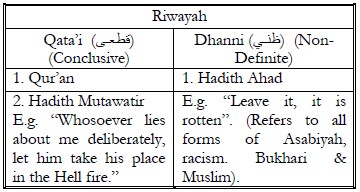
Duk wata Aya daga Alƙur'ani ko Hadisi Mutawatir ana ɗaukarta Qat'i (tabbatacciya) a cikin Riwayarta (ruwayarta).
Any Ayah from the Qur‟an or Hadith Mutawatir is considered Qata‟i (conclusive) in its Riwayah (report).
Ma'anar "Qata'i" a cikin Riwayah tana nuna cewa hujjar ingantacciya ce ba tare da wani shakka ba. Wannan ingancin an tabbatar da shi ne bisa ga hanyar watsawa (isnad).
The Qata‟i in Riwayah implies that the evidence is authentic without any shadow of doubt. This authenticity is established based on the methodology of transmission.
Hanyar da aka isar da Alkur'ani zuwa gare mu ta hana duk wani yunkurin ƙirƙira shi. An isar da rahoton tsara bayan tsara ta hanya guda daidai. Ba zai yiwu ba ga dukkan tsara ta yi ƙirƙira, goge, ko ƙara abubuwa a cikin Alkur'ani. Abin da ba zai yiwu a yarda da shi ba shi ne cewa kowane mutum a cikin wannan tsara ya taru tare ya yarda ya ƙara ko ya cire sassan Alkur'ani. Kowa a cikin wannan tsara yana karanta abubuwan Alkur'ani iri ɗaya, don haka yana tabbatar da ingancin abubuwan da ke cikinsa.
The methodology by which the Qur‟an was transmitted to us precludes any possibility of fabrication. The report was transmitted generation by generation in exactly the same manner. It is impossible for an entire generation to fabricate, erase, or add contents to the Qur‟an. It is inconceivable to believe that every single individual in that generation assembled together and agreed to add or delete parts of the Qur‟an. Everyone in that generation was reciting the same contents of the Qur‟an, thus authentifying its contents.
Hadith Mutawatir ba a isar da shi daga tsara zuwa tsara kawai ba, a'a ta hannun mutane masu yawa. Saboda yawan mutanen da suka ruwaito Daleel din, da bambancin wuraren zamansu, da amincinsu da yakinin da aka tabbatar game da su, ba zai yiwu a yi tunanin cewa wannan Daleel din zai iya zama kuskure ba. Duk wani rahoto na bayani ta wata hanya banda Alkur'ani ko Hadith Mutawatir, kamar Hadith Ahad, ana ɗaukarsa Dhanni (wanda ba tabbatacce ba), ma'ana akwai dan karamin yiwuwar Daleel din ya ƙunshi kuskure. A takaice:
Hadith Mutawatir was not transmitted generation-by-generation, but rather by a large number of people. Due to the large number of people reporting the Daleel, and their diversity of residence, their established reliability and conviction, it is inconceivable that this Daleel could be wrong. Any report of information other than through the Qur‟an or Hadith Mutawatir, such as Hadith Ahad, is considered Dhanni (non-definite), meaning that there is a minute possibility that the Daleel could contain error. To summarise:
Dalalah
Dalalah
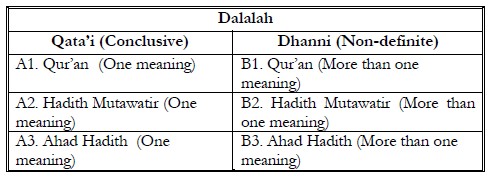
Rukuni na biyu na Daleel shi ne Dalalah (ma'ana). Idan nassin Alkur'ani, ko Hadisi Mutawatir, ko Hadisi Ahad, a bayyane yake, takamaimai ne, kuma yana da ma'ana guda ɗaya kacal, to ana ɗaukarsa Qat'i. Nassin Daleel Qat'i dole ne ya zama yana da ma'ana guda ɗaya kacal, kuma ba zai yiwu a fassara shi ta wata hanya daban ba. Idan kuwa nassin yana iya ɗaukar fiye da fassara ɗaya, to ana ɗaukarsa Zanni. Tun da fassarori suna samuwa ne saboda harshen Larabci, duk wata fassara dole ne a tabbatar da ita ta hanyar harshen Larabci. Taƙaitawa kenan.
The second aspect of the Daleel is the Dalalah (meaning). If the text of Qur‟an, Hadith Mutawatir or Hadith Ahad is clear, specific, and has only one meaning, then it is considered Qata‟i. The text of a Qata‟i Daleel has to have only one meaning and cannot be open to any other interpretation. If the text is open to more than one interpretation, then it is considered Dhanni. Since interpretations are due to the Arabic language, any interpretation has to be justified through the Arabic language. To summarise:
A1. Misalin Alkur'ani mai ma'ana ta ƙwarai (qat'i):
A1. Example of Qur‟an with a Qata‟i (conclusive) meaning:
"Abin da matayenku suka bari, rabonku rabi ne, idan ba su bar ɗa ba." (Suratun An-Nisā'i: 12)
“What your wives leave, your share is a half, if they leave no child”. (TMQ An-Nisa: 12)
"Waɗanda suke zargin mata masu tsarki da zina, sa'an nan ba su kawo shaidu huɗu ba, to ku yi musu bulala tamanin."
“Those who accuse chaste woman of zina (adultery) and fail to bring four witnesses (to prove it) flog them eighty stripes.” (TMQ An-Nur: 4)
Ɓangaren ƙididdiga na waɗannan hukunce-hukuncen, wato rabi da tamanin, a bayyane suke, don haka ba zai yiwu a karkata su zuwa wata fassara ta daban ba.
The quantitative aspect of these rulings, namely one half and eighty are clear and therefore cannot be open to any other interpretations.
A2. Misalin Hadisin Mutawatir mai Ma'ana ta Qat'i (tabbatacciya):
A2. Example of Hadith Mutawatir with Qata‟i (conclusive) meaning:
"Duk wanda ya yi ƙarya a kaina da gangan, to ya shirya wurinsa a wuta." (Bukhari & Muslim)
“Whosoever lies about me (Prophet Muhammad saw) deliberately let him take his place in the hell-fire.” (Bukhari & Muslim)
Wannan Hadith Mutawatir yana da bayyanannen maudu'i; don haka babu wata fahimta daga nassin face guda ɗaya, cewa duk wanda ya yi ƙarya game da abin da Annabi ﷺ ya faɗa, da gangan, zai shiga wutar Jahannama.
This Mutawatir Hadith is very clear in its subject; thus there is only one understanding from the text that whoever lies about what Prophet (saw) said, intentionally, he will go to hell-fire.
A3. Misali na Hadith Ahad mai ma'ana Qata'i (tabbatacce):
A3. Example of Hadith Ahad with Qata‟i (conclusive) meaning:
An rahoto daga wani hadisi wanda ba mutawatir ba cewa Annabi ﷺ ya yi azumin kwana shida a watan Shawwal. Ma'anoni masu ƙarfi da ake fahimta daga wannan hadisi su ne kamar haka:
It is reported from a non-Mutawatir Hadith that the Prophet (saw) fasted 6 days in Shawwal. The conclusive meanings from this Hadith are the following:
a) Halaccin azumtar kwanaki 6 a watan Shawwal.
a) Permissibility of fasting 6 days in Shawwal.
b) Sai dai ranar farko ta watan Shawwal, domin ita ce ranar Idi, kuma haramun ne a yi azumi a ranar Idi.
b) Except on the first day of Shawwal, since it is the day of Eid, and it is Haram to fast on Eid.
B1. Misalin Aya ta Alqur'ani mai ma'anar Dhanniy (ba ta tabbata ba):
B1. Example of Quranic Ayah with a Dhanniy (non-definite) meaning:
Allah (SWT) ya ce:
Allah (swt) says:
"Ya ku waɗanda suka yi imani! Idan kun tashi zuwa Salla, to ku wanke fuskokinku da hannuwanku har zuwa gwiwar hannu, kuma ku shafi kawunanku, kuma ku wanke ƙafafunku har zuwa idon sawu. Idan kuma kun kasance cikin janaba, to ku tsarkake kanku (ku yi wanka duka jikinku). Amma idan kun kasance marasa lafiya, ko kuna kan tafiya, ko ɗayanku ya zo daga bayan gida, ko kuka taɓa mata, sannan ba ku sami ruwa ba, to ku yi Tayammum da ƙasa mai tsarki, ku shafa da ita fuskokinku da hannuwanku."
“O you who believe! When you intend to offer As-Salat (the prayer), wash your faces and your hands (forearms) up to the elbows, rub (by passing wet hands over) your heads, and (wash) your feet up to ankles. If you are in a state of Janaba (i.e. had a sexual discharge), purify yourself (bathe your whole body). But if you are ill or on a journey or any of you comes from answering the call of nature, or you have been in contact with women and you find no water, then perform Tayammum with clean earth and rub therewith your faces and hands.” (TMQ Al-Maida: 6)
Ayar ya ce idan kun „lamastum" mata, wannan yana karya Wudhu. An fassara kalmar „lamastum" da ma'anoni biyu:
The verse says if you „lamastum‟ the women, it breaks the Wudhu. The word „lamastum‟ has been interpreted as having two meanings:
a) Taɓawa (taɓa mace) b) Jima'i (saduwa ta jima'i) Don haka ayar tana da Dalalah Zanniyya, watau tana iya nufin cewa taɓa mata yana karya alwala, ko kuma saduwa ta jima'i da mace tana karya alwala.
a) Touching b) Sexual intercourse Thus the Ayah has a Dhanni Dalalah, i.e. it could mean touching women breaks the Wudhu, or sexual intercourse with a woman breaks the Wudhu.
B2. Misalin Hadith Mutawatir mai ma'ana Dhanniy (ba ta tabbata ba):
B2. Example of Hadith Mutawatir with a Dhanniy (non-definite) meaning:
An an ruwaito cewa Annabi (saw) yana cire ihrāminsa ta wata hanya ta musamman. Sai dai a lokacin da Sahabbai (ra) suka gaya wa Annabi (saw) cewa sun cire nasu ta hanya daban da yadda shi (saw) ya cire tasa, Annabi (saw) ya amince da abin da suka yi. Ko da yake wannan lamari mutawātir ne, hukunce-hukuncen cire ihrām suna da yawa.
It was reported that the Prophet (saw) used to take off his Ihram in a specific manner. However, when the Sahabah (ra) told the Prophet (saw) that they took it off in a manner different from the way he (saw) took it off, the Prophet (saw) approved of their actions. Though this incident is Mutawatir, the rules to take off one‟s Ihram are many.
B3. Misalin Hadith Ahad mai ma'anar Dhanniy (ba ta tabbata ba):
B3. Example of a Hadith Ahad with a Dhanniy (non-definite) meaning:
An hadisi wanda ba mutawatir ba ya ruwaito cewa Annabi ﷺ ya yi azumin kwana shida a watan Shawwal. Ma'anoni marasa tabbas na wannan hadisi sune:
It is reported from a non-Mutawatir Hadith that the Prophet (saw) fasted 6 days in Shawwal. The non-definite meanings of this Hadith are:
a) Shin azumin kwana shida ya zama a jere ne ko kuwa a'a?
a) Whether the six days of fasting are consecutive or not?
b) Azumi a wane sashe na watan Shawwal?
b) Fasting in which part of Shawwal?
Har yanzu mun tattauna bangarorin Qat'i da Dhanni na Riwayah da Dalalah daban-daban. Sai dai hanyar tantance ko Daleel (a cikin Riwayah da Dalalah duka) Qat'i ne (tabbatacce) ko Dhanni (ba tabbatacce ba) ita ce kamar haka:
So far we have discussed the Qata‟i and Dhanni aspects of both Riwayah and Dalalah separately. However, the method to determine whether the Daleel (both in Riwayah and Dalalah) is Qata‟i (conclusive) or Dhanni (non-definite) is the following:
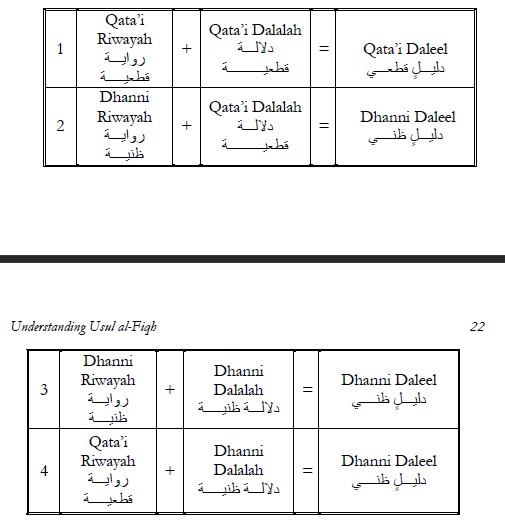
Duk wani ra'yi, tunani ko ra'ayi da ya shafi al-'Aqeedah dole ne ya dogara ne akan Dalili Qat'i. Misali, ra'ayin cewa Mala'iku suna wanzuwa yana dogara ne akan Dalili Qat'i, ba akan Dhanni ba. Haka kuma, a cikin Usulul Fiqh, domin kafa wata madogara ta fitar da hukunce-hukunce bisa ra'ayin da ya fi karfi, dole ne madogarar ta dogara akan Dalili Qat'i ita ma.
Any idea, thought, or concept related to the „Aqeedah has to be based upon a Qata‟i Daleel. As an example, the concept that Angels exists is based upon a Qata‟i Daleel not Dhanni. Also, in Usul al-Fiqh, to establish a source for extracting rulings according to the strongest view, the source must base upon a Qata‟i Daleel as well.
Misali, domin a ɗauki Ijma‟ as-Sahabah (yarjejeniyar Sahabbai) a matsayin tushen hukunce-hukunce, dole ne hujjar da ke tabbatar da ikon Ijma‟ as-Sahabah ta kasance Qat‟i a ɓangaren Riwayah da kuma Dalalah, ko da yake ana iya samun hukunci daga hujja ta Qat‟i ko ta Dhanni.
As an example, to consider Ijma‟ as-Sahabah (consensus of the Companions) as a source of rulings, the Daleel to prove the authority of Ijma‟ as-Sahabah has to be Qata‟i both in Riwayah and Dalalah, though a ruling can be derived from either Qata‟i or Dhanni Daleel.
Mutum zai iya tambaya: me ya sa fahimtar nassin Alkur'ani da Sunnah yake da wuya haka?
One might wonder why understanding the text of Qur‟an and Sunnah is so complicated?
Ta hanyar duba nassin Alkur'ani da Sunnah, mutum zai ga cewa yawan rubutunsu yana da iyaka. Da wannan iyakantaccen rubutu, ana iya samar da hukunce-hukunce ga duk wata matsala da ta shafe mu a ko'ina kuma a kowane lokaci har zuwa Ranar Alkiyama.
By examining the text of Qur‟an and Sunnah one can see that it is limited in its volume. With its limited text one can generate rulings to any problems affecting us anywhere and anytime until the Day of Judgment.
Daga cikin mu'ujizar Allah (SWT) ita ce cewa nassosin Alkur'ani da Sunnah suna da ikon bayyana hukunce-hukunce masu yawa daga ayar guda ɗaya da hadisi guda ɗaya; alhali kuwa ikon fahimtar ma'anoni da yawa daga nassi guda ɗaya ba a samun sa a kowane littafin shari'a a duniya! Kalubale ga Musulmi a kowane zamani shi ne ƙoƙarin fahimtar nassi da kuma danganta shi da rayuwarsu, domin Alkur'ani da Sunnah suna dacewa da kowane lokaci da kowane wuri.
It is a miracle from Allah (swt) that the texts of the Qur‟an and Sunnah have the ability to express numerous rulings from a single Ayah and Hadith; whereas, the ability to understand many meanings from a single text cannot be found in any other legal text in the world! The challenge is for Muslims in each generation to try to understand the text and relate it to their lives since the Qur‟an and Sunnah are relevant to all times and places.
Tushen Hukunci Shari'i
Sources of Hukm Shar‟i
Kamar yadda aka bayyana a baya, Hukm Shar‟i hukunce-hukuncen Allah (SWT) ne da suke shafar ayyukanmu. Ana samun wadannan hukunce-hukuncen daga wasu tushe. Tushen da ake amfani da su wajen fitar da hukunce-hukunce dole ne su kasance bisa Adilla Qata‟iya (hujjoji tabbatattu).
As defined earlier, Hukm Shar‟i are the rulings of Allah (swt) addressing our actions. These rulings are derived from certain sources. The sources, which are used to extract rulings, have to be based on Adilla Qata‟iya (Decisive evidences).
Majiyoyin hukuncin shari'a guda huɗu da ba su da tababa su ne: Alƙur'ani, Sunna, Ijma'in sahabbai da Ƙiyas. Za a tattauna su a cikin babuka masu zuwa. Bayan haka za a kawo taƙaitaccen bayani game da majiyoyin da ake sabani a kansu, waɗanda malamai ba su yarda da juna a kansu ba.
The four definitive sources of Hukm Shar‟i are; the Qur‟an, Sunnah, Ijma‟ as-Sahabah and Qiyas. These will be discussed in the following chapters. This will be followed by a brief summary of the disputed sources which the scholars disagree on.