6. 骨
6. Bones
そして、その塊を骨へと変えました。
and We made that lump into bones
ムドガ(肉塊)の段階から、イダーム(骨)が造られます。これが次の段階です。アラビア語における「イダーム」という語は骨を意味し、特に手足の骨、あるいは動物の腕や脚の骨で、その上に肉がついているものを指して用いられます。70
From the mudghah stage, `idhaam are created. This is the next stage. The word `idhaam in the Arabic language means bone, and is specifically applied to the bones of the hands and feet, or of the arms and legs of an animal, upon which is the flesh.70
科学的解釈
SCIENTIFIC INTERPRETATION
「イダーム」段階は、5週目頃に起こる体軸骨格と四肢骨格の発達に関わるものです。バリー・ミッチェルとラム・シャルマは次のように説明しています。
The `idhaam stage pertains to the development of the axial and limb skeleton, occuring at around the 5th week. Barry Mitchell and Ram Sharma explain:
間葉細胞が骨格組織を形成する起源は、体の部位によって異なります。体軸骨格を形成する間葉細胞は体節の中胚葉に由来するのに対し、付属肢骨格の骨は側板中胚葉の体壁中胚葉の間葉から生じます。目的の場所に到達すると、間葉細胞は凝集して骨の原型を形成します。その後、間葉細胞が軟骨芽細胞または骨芽細胞へ分化することは、遺伝的に制御されています。71.
The origin of mesenchymal cells forming the skeletal tissues varies in different regions of the body. Mesenchymal cells forming the axial skeleton arise from the mesodermal somites, whereas the bones of the appendicular skeleton are derived from the somatopleuric mesenchyme of the lateral plate mesoderm. After reaching their destination the mesenchymal cells condense and form models of bones. The subsequent differentiation of mesenchymal cells into chondroblasts or osteoblasts is genetically controlled.71.
「イドハーム」という語の特定の意味は「四肢の骨」であり、したがって四肢および付属骨格を生じさせる四肢芽の発達を指すことができる。バリー・ミッチェルとラム・シャーマは、四肢と付属骨格の形成について詳しく述べている。
‘Limb bones’ is the specified meaning of the word `idhaam, and therefore can refer to the development of the limb buds which give rise to the development of the limbs and the appendicular skeleton. Barry Mitchell and Ram Sharma elaborate on the formation of the limb and appendicular skeleton:
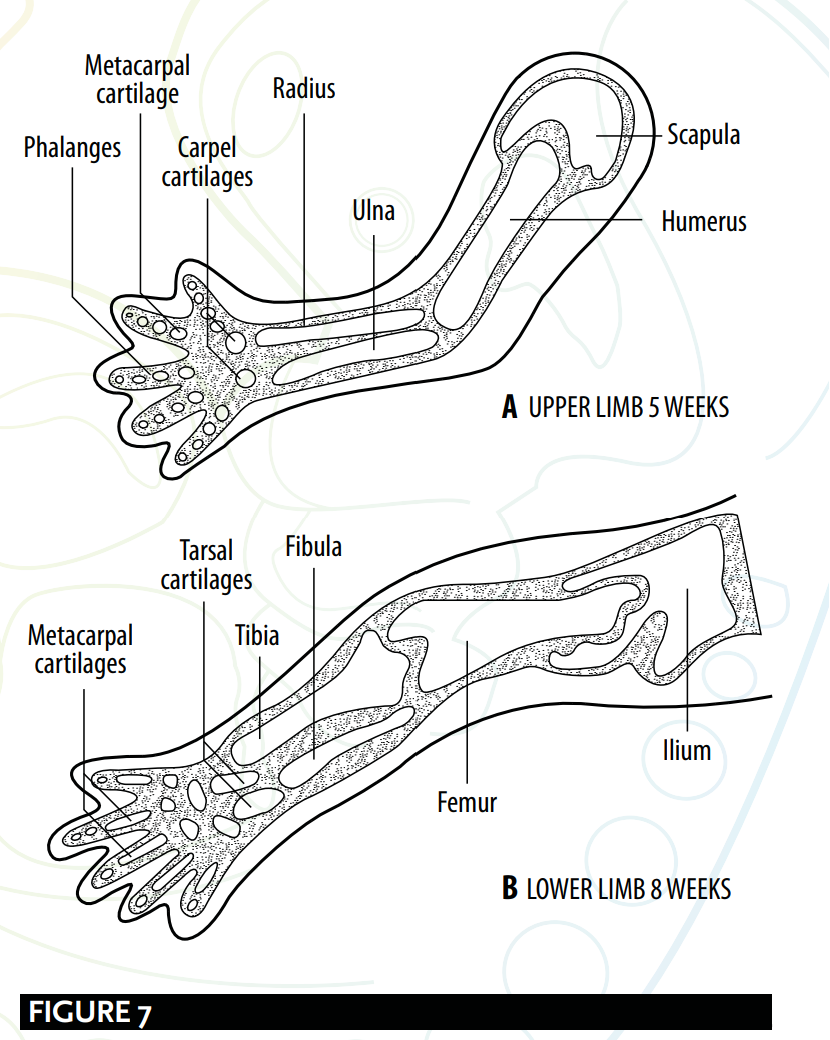
付属骨格は、四肢帯と四肢の骨から構成される。付属骨格の骨は、軟骨性の原基となる間葉系の凝集から発生する。72 [See Figure 7]
The appendicular skeleton consists of limb girdles and the bones of the limbs. The bones of the appendicular skeleton develop from mesenchymal condensations which become cartilaginous models.72 [See Figure 7]
ジョン・アレンとベバリー・クレイマーもまた、四肢の骨の形成について論じている。
John Allen and Beverley Kramer also comment on limb bone formation.
肢の間葉は当初は均質な塊ですが、やがてその中に凝集が起こり、これが軟骨化して各骨の軟骨原基を形成します。各軟骨原基は間葉の凝集である軟骨膜に囲まれています。各軟骨原基には、周囲の間葉から骨芽細胞(骨を作る細胞)が内方に侵入することによって骨化中心(一次骨化中心)が形成されます。周囲の間葉は今や骨膜(骨の周囲)と呼ばれます。骨芽細胞は今や骨を産生し、これが四肢の骨格要素を生み出します。73.
The limb mesenchyme is at first a homogenous mass but soon condensations occur in it and these chondrify to form cartilaginous models of the various bones. Each cartilage model is surrounded by perichondrium which is a condensation of mesenchyme. An ossific centre (primary ossification centre) is formed upon each cartilage model by the ingrowth of osteobalsts (bone-forming cells) from the surrounding mesenchyme. The surrounding mesenchyme is now termed periosteum (surrounding the bone). Osteoblasts now produce bone which give rise to the skeletal elements of the limbs. 73.
クルアーンのイドラーム(idhaam)の段階と、現代の胎生学が描く発生過程、すなわち体軸骨格、四肢および付属骨格の発達との間には、明確な類似点が見られます。
There are clear parallels between the qur'anic `idhaam stage and the view modern embryology takes i.e. the development of the axial, limb and appendicular skeleton.
要約
SUMMARY
「イドガーム」段階:体軸骨格、四肢骨格および付属骨格の形成。
The `idhaam stage: The formation of the axial, limb and appendicular skeleton.
骨へと変わる肉の塊
FROM A LUMP TO BONES
よくある誤解として、アラビア語に通じていない人々がこの節を「そして我々はその塊を骨に変えた」と文字通りに訳し、そこから、肉の塊が骨の塊に変わることはありえないのだから、この節は非科学的だと結論づけるものがあります。しかし、これはアラビア語の文法とクルアーンの雄弁さを粗雑に理解したものに基づいています。文法の観点から見ると、この節は「そして我々は塊から骨を作った」という意味を持ちます。
A common misconception, usually made by non-Arabists, is that this verse can be literally translated as “and We made that lump into bones”. From this, they conclude that this verse is unscientific because a lump of flesh cannot turn into a mass of bones. However, this is based upon a crude understanding of Arabic grammar and the Qur’an's eloquence. This verse, from a grammatical perspective, has the meanings of: “and We made of/from/out of the lump bones”.
このため、ユースフ・アリーはこの節を「それから私たちはその塊から骨を作った」と訳し、シャーキルは「それから私たちは肉の塊の中に骨を作った」と訳し、今日でも学者に用いられているA・J・アーベリーの訳『クルアーン』では、この節は「それから私たちは組織から骨を創った」と訳されています。75
This is why Yusuf Ali translates this verse as “then we made out of that lump bones”74; Shakir translates it as “then We made (in) the lump of flesh bones”; and A J Arberry, in his translation of the Qur’an which is still used by academics today, translates this verse as “then We created of the tissue bones”.75
本物の骨ではない
NOT REAL BONES
別の論点として、注釈者の中には、この段階ではまだ本当の骨は存在しないという主張がある。見かけ上の骨は単なる軟骨にすぎず、骨化が未完了であるため、クルアーンは不正確であるに違いない、という議論である。これは一見もっともらしい主張ではあるものの、的外れである。ʿidhāmは、骨格が組み立てられていく段階における骨の軟骨状の形態をも包含している。さらに、骨化の過程は妊娠8週目までに始まり、出生後も続き、骨化の過程が最終的に完了するのは思春期頃である。バリー・ミッチェルとラーム・シャルマは次のように説明している。
Another proposition from commentators is that at this stage there are no real bones. It is argued that the apparent bones are mere cartilage as ossification is incomplete and, as such, the Qur’an must therefore be inaccurate. Although a valid contention, it is misplaced. `idhaam encompasses the cartilaginous form of the bones as the skeletal framework is put in place. Additionally, the process of ossification begins by the 8th week,76 continuing on after birth, with the eventual completion of the ossification process at around puberty. Barry Mitchell and Ram Sharma explain:
四肢の骨には、妊娠8週目に骨化の中心が初めて現れます。12週目までに四肢骨の骨幹は骨化しますが、手首の手根骨は出生後まで軟骨のままです。足首の大きな距骨・踵骨・舟状骨などの3つの最大の足根骨の骨化は約16週から始まりますが、小さな足根骨の一部は出生後3歳まで骨化しません。77。
The centres of ossification first appear in the limb bones during the eighth week. By the twelfth week, the shafts of the limb bones are ossified, though the carpal bones of the wrist remain cartilaginous until after birth. The ossification of the three largest tarsal bones of the ankle begins about 16 weeks, but some of the smaller tarsal bones do not ossify until 3 years after birth.77.
この観点からすると、新生児や思春期前の若者が、骨化を必要とするという理由だけで骨を持たないと想定するのは、医学的にばかげたことになるだろう。特に骨化は思春期の成長spurtの終わりに完了するのだから。とはいえ、仮にそうだとして、この段階を、いわば「骨のない」状態とみなすとしても、「idhaam」という語の解釈は、「様々な骨の軟骨性のモデル」78もその意味に含まれるため、あらゆるものを包含する解釈を許すことになる。
From this perspective, it would be a medical absurdity to assume newborns or young teenagers do not have bones simply because they require ossification, especially since ossification completes at the end of the growth-spurt of puberty. Nevertheless if this were the case, and we are to take this stage as being ‘boneless’, as it were, the derisions of the word `idhaam allow for an all encompassing interpretation because the “cartilaginous models of the various bones”78 is included in its meaning.