6. Botten
6. Bones
en Wij maakten die klomp tot botten
and We made that lump into bones
Vanaf het stadium van de mudghah worden de `idhaam gecreëerd. Dit is het volgende stadium. Het woord `idhaam betekent bot in de Arabische taal, en wordt specifiek toegepast op de botten van de handen en voeten, of van de armen en benen van een dier, waarop het vlees zit.70
From the mudghah stage, `idhaam are created. This is the next stage. The word `idhaam in the Arabic language means bone, and is specifically applied to the bones of the hands and feet, or of the arms and legs of an animal, upon which is the flesh.70
WETENSCHAPPELIJKE INTERPRETATIE
SCIENTIFIC INTERPRETATION
De `idhaam-fase heeft betrekking op de ontwikkeling van het axiale skelet en het ledematen-skelet, wat rond de 5e week plaatsvindt. Barry Mitchell en Ram Sharma leggen uit:
The `idhaam stage pertains to the development of the axial and limb skeleton, occuring at around the 5th week. Barry Mitchell and Ram Sharma explain:
De oorsprong van de mesenchymale cellen die het skeletweefsel vormen, varieert in verschillende regio's van het lichaam. Mesenchymale cellen die het axiale skelet vormen, ontstaan uit de mesodermale somieten, terwijl de botten van het appendiculaire skelet afkomstig zijn van het somatopleurische mesenchym van het laterale plaatmesoderm. Nadat ze hun bestemming hebben bereikt, condenseren de mesenchymale cellen en vormen ze modellen van botten. De daaropvolgende differentiatie van mesenchymale cellen in chondroblasten of osteoblasten wordt genetisch gecontroleerd.71.
The origin of mesenchymal cells forming the skeletal tissues varies in different regions of the body. Mesenchymal cells forming the axial skeleton arise from the mesodermal somites, whereas the bones of the appendicular skeleton are derived from the somatopleuric mesenchyme of the lateral plate mesoderm. After reaching their destination the mesenchymal cells condense and form models of bones. The subsequent differentiation of mesenchymal cells into chondroblasts or osteoblasts is genetically controlled.71.
‘Limb bones’ is de gespecificeerde betekenis van het woord `idhaam, en kan daarom verwijzen naar de ontwikkeling van de ledemaatknoppen die leiden tot de ontwikkeling van de ledematen en het appendiculaire skelet. Barry Mitchell en Ram Sharma lichten de vorming van de ledemaat en het appendiculaire skelet toe:
‘Limb bones’ is the specified meaning of the word `idhaam, and therefore can refer to the development of the limb buds which give rise to the development of the limbs and the appendicular skeleton. Barry Mitchell and Ram Sharma elaborate on the formation of the limb and appendicular skeleton:
Het appendiculaire skelet bestaat uit de ledematengordels en de botten van de ledematen. De botten van het appendiculaire skelet ontwikkelen zich vanuit mesenchymale condensaties die kraakbeenmodellen worden.72 [See Figure 7]
The appendicular skeleton consists of limb girdles and the bones of the limbs. The bones of the appendicular skeleton develop from mesenchymal condensations which become cartilaginous models.72 [See Figure 7]
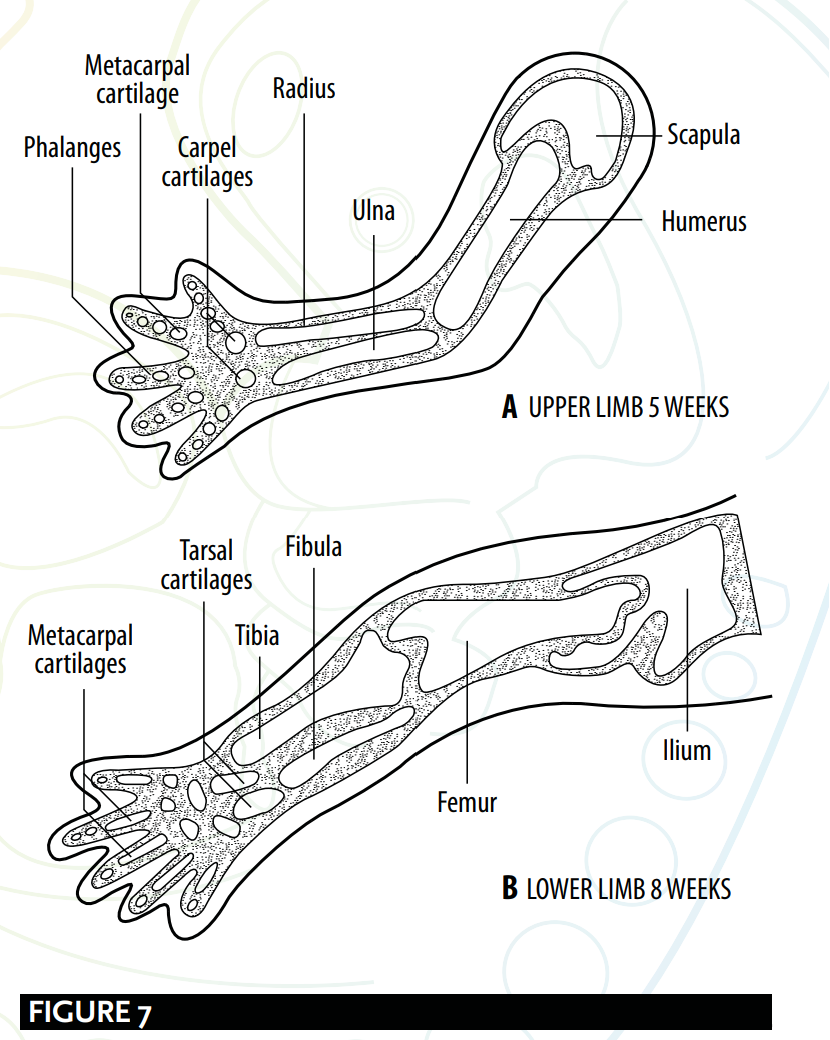
John Allen en Beverley Kramer geven ook commentaar op de vorming van ledematen.
John Allen and Beverley Kramer also comment on limb bone formation.
Het mesenchym van de ledematen is aanvankelijk een homogene massa, maar al snel treden er condensaties op die verchondren om kraakbeenmodellen van de verschillende botten te vormen. Elk kraakbeenmodel wordt omgeven door perichondrium, wat een condensatie van mesenchym is. Een ossificatiecentrum (primair ossificatiecentrum) wordt op elk kraakbeenmodel gevormd door de ingroei van osteoblasten (botvormende cellen) vanuit het omringende mesenchym. Het omringende mesenchym wordt nu periosteum (het bot omringend) genoemd. Osteoblasten produceren nu bot, wat de skeletelementen van de ledematen vormt. 73.
The limb mesenchyme is at first a homogenous mass but soon condensations occur in it and these chondrify to form cartilaginous models of the various bones. Each cartilage model is surrounded by perichondrium which is a condensation of mesenchyme. An ossific centre (primary ossification centre) is formed upon each cartilage model by the ingrowth of osteobalsts (bone-forming cells) from the surrounding mesenchyme. The surrounding mesenchyme is now termed periosteum (surrounding the bone). Osteoblasts now produce bone which give rise to the skeletal elements of the limbs. 73.
Er zijn duidelijke parallellen tussen de koranische `idhaam-fase en het standpunt dat de moderne embryologie inneemt, namelijk de ontwikkeling van het axiale, het ledematen- en het appendiculaire skelet.
There are clear parallels between the qur'anic `idhaam stage and the view modern embryology takes i.e. the development of the axial, limb and appendicular skeleton.
SAMENVATTING
SUMMARY
De `idhaam-fase: De vorming van het axiale, het ledematen- en het appendiculaire skelet.
The `idhaam stage: The formation of the axial, limb and appendicular skeleton.
VAN EEN KLONT TOT BOTTEN
FROM A LUMP TO BONES
Een veelvoorkomend misverstand, meestal gemaakt door niet-Arabisten, is dat dit vers letterlijk vertaald kan worden als “en Wij maakten die klomp tot botten”. Hieruit concluderen zij dat dit vers onwetenschappelijk is, omdat een klomp vlees niet kan veranderen in een massa botten. Dit is echter gebaseerd op een gebrekkig begrip van de Arabische grammatica en de welsprekendheid van de Qur'an. Dit vers heeft, vanuit een grammaticaal perspectief, de betekenis van: “en Wij maakten van/uit de klomp botten”.
A common misconception, usually made by non-Arabists, is that this verse can be literally translated as “and We made that lump into bones”. From this, they conclude that this verse is unscientific because a lump of flesh cannot turn into a mass of bones. However, this is based upon a crude understanding of Arabic grammar and the Qur’an's eloquence. This verse, from a grammatical perspective, has the meanings of: “and We made of/from/out of the lump bones”.
Dit is de reden waarom Yusuf Ali deze vers vertaalt als “dan maakten Wij uit die klomp botten”74; Shakir vertaalt het als “dan maakten Wij (in) de klomp vlees botten”; en A J Arberry, in zijn vertaling van de Qur’an die vandaag de dag nog steeds door academici wordt gebruikt, vertaalt deze vers als “dan schiepen Wij uit het weefsel botten”.75
This is why Yusuf Ali translates this verse as “then we made out of that lump bones”74; Shakir translates it as “then We made (in) the lump of flesh bones”; and A J Arberry, in his translation of the Qur’an which is still used by academics today, translates this verse as “then We created of the tissue bones”.75
GEEN ECHTE BOTTEN
NOT REAL BONES
Een andere stelling van commentatoren is dat er in deze fase nog geen echte botten zijn. Er wordt betoogd dat de schijnbare botten slechts kraakbeen zijn, aangezien de verbening onvolledig is, en dat de Koran daarom onnauwkeurig moet zijn. Hoewel dit een geldige argumentatie is, is deze misplaatst. `idhaam omvat de kraakbeenachtige vorm van de botten terwijl het skelet wordt gevormd. Bovendien begint het proces van verbening in de 8e week,76 en gaat dit na de geboorte door, waarbij het proces van verbening uiteindelijk rond de puberteit wordt voltooid. Barry Mitchell en Ram Sharma leggen uit:
Another proposition from commentators is that at this stage there are no real bones. It is argued that the apparent bones are mere cartilage as ossification is incomplete and, as such, the Qur’an must therefore be inaccurate. Although a valid contention, it is misplaced. `idhaam encompasses the cartilaginous form of the bones as the skeletal framework is put in place. Additionally, the process of ossification begins by the 8th week,76 continuing on after birth, with the eventual completion of the ossification process at around puberty. Barry Mitchell and Ram Sharma explain:
De ossificatiecentra verschijnen voor het eerst in de ledematen tijdens de achtste week. Tegen de twaalfde week zijn de schachten van de ledematen vergroeid, hoewel de carpale botten van de pols kraakbeenachtig blijven tot na de geboorte. De ossificatie van de drie grootste tarsale botten van de enkel begint rond de 16 weken, maar sommige van de kleinere tarsale botten vergroeien pas 3 jaar na de geboorte.77.
The centres of ossification first appear in the limb bones during the eighth week. By the twelfth week, the shafts of the limb bones are ossified, though the carpal bones of the wrist remain cartilaginous until after birth. The ossification of the three largest tarsal bones of the ankle begins about 16 weeks, but some of the smaller tarsal bones do not ossify until 3 years after birth.77.
Vanuit dit perspectief zou het een medische absurditeit zijn om aan te nemen dat pasgeborenen of jonge tieners geen botten hebben, simpelweg omdat zij verbening (ossificatie) vereisen, vooral aangezien verbening voltooid wordt aan het einde van de groeispurt van de puberteit. Desalniettemin, indien dit het geval zou zijn, en we deze fase als het ware als 'botloos' zouden beschouwen, laten de verschillende interpretaties van het woord `idhaam een allesomvattende interpretatie toe, omdat de "kraakbeenmodellen van de diverse botten"⁷⁸ in de beteken ervan is inbegrepen.
From this perspective, it would be a medical absurdity to assume newborns or young teenagers do not have bones simply because they require ossification, especially since ossification completes at the end of the growth-spurt of puberty. Nevertheless if this were the case, and we are to take this stage as being ‘boneless’, as it were, the derisions of the word `idhaam allow for an all encompassing interpretation because the “cartilaginous models of the various bones”78 is included in its meaning.